ChatGPT Ads for Home Services: Trade-by-Trade Guide and Calendar
Which home trades fit ChatGPT Ads: demand stages, a priority matrix for 18 trades, a seasonality calendar, claims guardrails and a worked cost-per-job model.

Short answer: Home-service companies can advertise on ChatGPT today, because OpenAI's ad policies name local services as an allowed consumer vertical during the initial test period. What you buy is a labelled, auction-priced placement beside a conversation, which sends the person to your own landing page; there is no documented call ad, lead form, booking flow or radius control. The channel fits best where a homeowner describes a problem or compares options in writing before choosing a company: roof replacement, HVAC and water-heater replacement, ADUs, panel upgrades. It fits worst where the buyer wants a phone number in the next ten minutes and will take the first company that answers. Start with one or two service lines, measure to a booked job, and read the trade guides below before you copy anyone's budget.
How a homeowner's problem becomes a conversation
Home-service buying runs through three stages, and each stage uses a different channel and a different kind of landing page. Treating them as one stage is the most common reason a first campaign disappoints.
| Stage | What the person is doing | Example of what they type | Best landing page | Event you can optimise on |
|---|---|---|---|---|
| Problem | Describing something wrong and asking what it means | "There is a brown stain spreading on the bedroom ceiling and it rained last night" | Plain-language page about the symptom, what to check, and how to book an inspection | lead_created |
| Research | Comparing options, costs and timelines before choosing | "Heat pump or new furnace for a 1960s house, what should I expect to pay" | Guide plus quote request, with a price range and what moves it | lead_created or appointment_scheduled |
| Hire | Choosing who to call right now | "Emergency plumber open now" | Service page with a number that is answered, hours, and service area | phone_call (offline) or lead_created |
ChatGPT conversations are strongest in the first two rows, because a person types a paragraph and receives an answer that often frames the next question: how much, how long, who. The third row is where Google's local products and map listings are strongest, and where ChatGPT Ads vs Google Local Services Ads picks up the comparison.
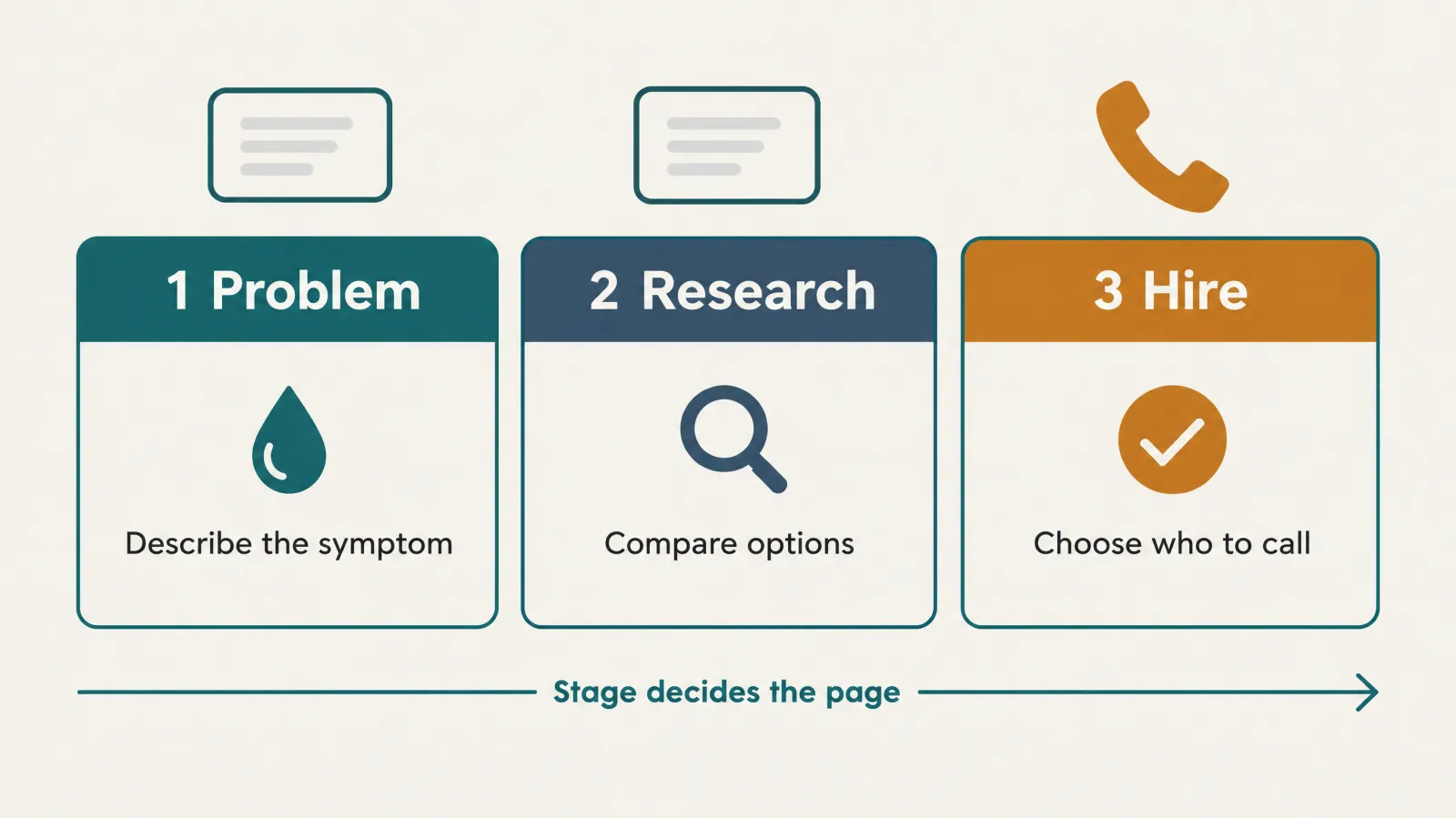
There is outside evidence that the stage matters. Third-party: a roofing advertiser reported by Canonry on 13 October 2026 saw a 1.19% click-through rate, with research-stage themes drawing roughly twice the clicks of urgent-repair themes, and said local click volume was too small to compare further. Read that as a prompt to test research-stage themes, not as a result you will reproduce.
Five limits that shape every home-service campaign
The full capability matrix for local advertisers is owned by the local-business hub. These five limits matter most to a trades company.
- Locations. OpenAI: standard campaigns can target supported states or regions, cities, markets and postal codes where available, and availability varies by country. New product-feed campaigns are country-level only. No radius control is documented. A city named in a context hint does not restrict delivery. Details are in can ChatGPT Ads target my city.
- Phone. No native call ad or click-to-call format is documented. Phone outcomes come from your own tracking number and are sent back as events. See call tracking for ChatGPT Ads.
- Leads and booking. There is no in-ad form and no booking inside ChatGPT.
lead_createdandappointment_scheduledare events you send from your own site or CRM. - Business Agents. OpenAI: Business Agents are not yet available to local businesses, and Sponsored Agents are a limited alpha with no early-access requests. Do not plan around either. The free Business Hub claim is covered in the Business Hub guide.
- Who sees ads. OpenAI: ads appear to Free and Go plan users, not Plus, Pro, Business, Enterprise or Edu users, and ads are labelled and separate from answers. Your audience is a slice of ChatGPT users, which is a reason to size volume expectations modestly. Background is in what ChatGPT Ads are.
Which trades fit: the priority matrix
The matrix below is GPT Ads AI recommendation, built from three questions: is the job value high enough to carry auction clicks, do customers describe the situation in writing before hiring, and is the claims risk manageable. It is a starting order for testing, not a forecast. Priority 1 means test first; 3 means test only with a specific reason.
| Trade line | Typical buying pattern | Why it fits or strains | Claims risk | Priority | Guide |
|---|---|---|---|---|---|
| Roof replacement and repair | Research, then estimates from several firms | High ticket, long comparison, plenty of questions | Medium | 1 | Roofing companies |
| HVAC replacement | Research-led when the system is old but running | High ticket, many cost and sizing questions | Low | 1 | HVAC |
| Heat pumps | Long consideration, incentive questions | High ticket; incentives vary by state and utility | Medium | 1 | Heat pumps |
| Ductless mini splits | Comparison-led, sizing and zoning questions | Mid-to-high ticket, good fit for explainers | Low | 2 | Mini splits |
| Tankless water heaters | Project replacement with requirements to check | Gas, venting and electrical questions suit the format | Low | 2 | Tankless water heaters |
| ADU and design-build | Very long, high value, few leads needed | One deal pays for a long test | Medium | 1 | ADU construction |
| Panel upgrades | Triggered by solar, EV or heat-pump plans | Questions about when it is needed | High | 2 | Panel upgrades |
| EV charger installation | Home, condo or fleet planning | Permit and utility questions vary | Medium | 2 | EV charger installation |
| General plumbing | Mix of urgent and planned | Urgent calls favour other channels | Low | 2 | Plumbers |
| Burst pipe repair | Emergency, first-hour | Intent is real but the buyer wants a phone, not a page | High | 3 | Burst pipe repair |
| Sewer and drain cleaning | Recurring clogs, camera inspection | Mixed ticket sizes | Low | 2 | Sewer and drain cleaning |
| Storm-damage roofing | Event-driven surge | Spiky demand and insurance friction | High | 2 | Storm-damage roofing |
| Water-damage restoration | Emergency with insurance involved | Strong need, strict claims care | High | 3 | Water-damage restoration |
| Fire and smoke restoration | Emergency, insurer workflow | Narrow volume, high value | High | 3 | Fire and smoke restoration |
| Mold and duct cleaning | Health-adjacent research | Easy to over-claim | High | 3 | Mold and duct cleaning |
| Termite treatment | Inspection-led, often tied to a home sale | Warranty claims need care | Medium | 2 | Termite treatment |
| Bed bug treatment | Discreet, urgent, multi-unit | Privacy and health-claim care | High | 3 | Bed bug treatment |
| ADAS windshield calibration | Shop-led, procedure-specific | Thin evidence in ChatGPT conversations | High | 3 | ADAS windshield calibration |
Two patterns stand out. The priority-1 lines are the ones where a buyer reads and compares for days or weeks, so a click that arrives early still has time to convert. The priority-3 lines are mostly emergencies or health-adjacent topics, where either the phone matters more than the page or the claims risk outweighs the volume.
The directory: where each guide fits in the cluster
The cluster has three layers. Use this table to jump to the page that owns your question instead of reading everything.
| If your question is about | Read | What it owns |
|---|---|---|
| Whether the channel suits a local business at all | ChatGPT Ads for local businesses | Capability matrix, decision tree, channel stack |
| Running your first 30 days as an owner-operator | ChatGPT Ads for contractors | Prerequisites, landing page, lead handling, small budgets |
| Choosing between this and Google LSAs | ChatGPT Ads vs Google Local Services Ads | Pay model and budget split scenarios |
| Paid versus organic and Business Hub | ChatGPT Ads vs local SEO | What to fix so assistants cite you |
| Cost per lead and how Target CPA works | Cost per lead for local businesses | CPL maths and bid goals |
| Measuring phone calls | Call tracking | Numbers, offline events, intake outcomes |
| Sending job stages back to the platform | Offline conversions for booked jobs | CRM event design |
| Whether the whole thing pays back | ROI for home services | Margins, repeat work, kill and scale rules |
Seasonality across trades
Demand moves with weather, housing activity and incentive deadlines. The calendar below describes patterns commonly reported for temperate Northern Hemisphere markets; flip the seasons for the Southern Hemisphere and shift by your climate. Illustrative: treat each cell as a prompt to check your own job history, not as a fact about your market.
| Trade line | Winter | Spring | Summer | Autumn |
|---|---|---|---|---|
| Heating and cooling | Heating failures in cold snaps | Tune-ups and replacement planning | Cooling failures in heat waves | Furnace tune-ups, early replacement planning |
| Roofing | Quiet in snowy regions, leak calls | Storm season in many regions, inspections | Replacement season and hail or wind events | Pre-winter repairs |
| Plumbing and drains | Frozen pipes in cold regions | Steady | Steady, irrigation and outdoor work | Pre-winter shutoff and water-heater checks |
| Restoration | Freeze and thaw losses | Storm and flood events | Storm events | Early frost, storm remnants |
| Pest and termite | Quiet in cold regions | Termite swarm season in many regions | Active pests, travel-linked bed bug reports | Rodent pressure and closings |
| Electrical, EV and panels | Steady, incentive deadlines | Steady | Steady, solar-linked upgrades | Steady, incentive deadlines |
| ADU and design-build | Planning and permitting | Permitting, early build | Build season | Planning for next year |
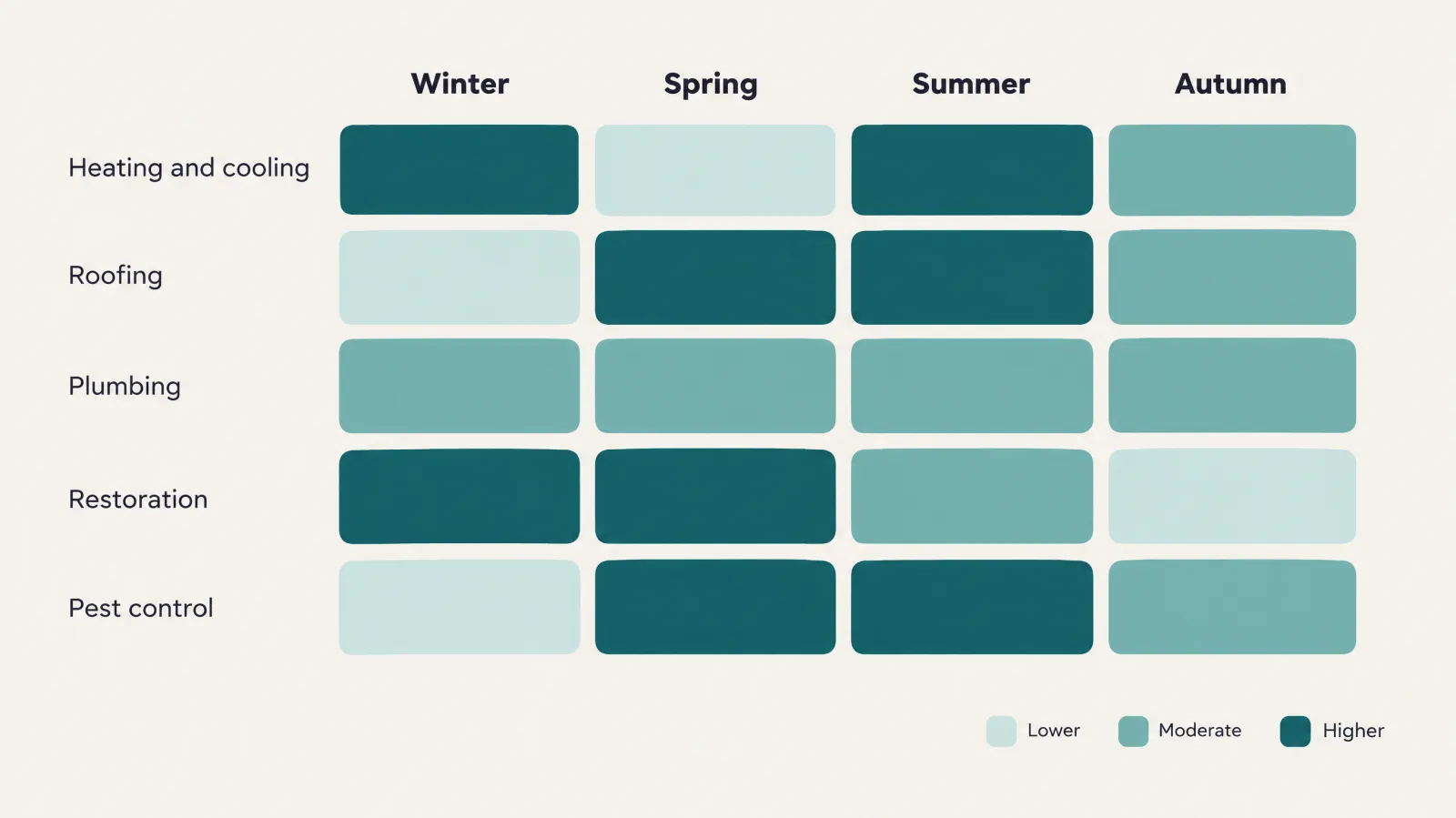
Seasonality interacts with the budget rules. OpenAI: the budget week runs Sunday to Saturday in the account time zone, daily spend will not exceed 2× the selected daily budget, and spend across the seven-day period will not exceed 7× the daily budget. A heat wave can lift one day well above the average; the weekly cap is the number that protects you. Plan the account's time zone around the market you serve most, since it cannot be changed after the account is created.
A pacing rule for seasonal lines
GPT Ads AI recommendation: raise budget when your own lead handling can absorb it, not when demand rises. A cooling company that adds 30 leads in a heat week but answers 12 of them wastes the extra spend. Pair every budget increase with a staffing check and a same-day callback rule from the contractor playbook.
A worked example: one company, three service lines
Illustrative. Kestrel Home Services is a fictional company with three lines: drain and plumbing repair, water-heater replacement, and roof replacement. The owner wants to know which line deserves a first test budget. Every figure below is an assumption you would replace with your own.
Assumptions shared by all lines: a cost per click of $5, which sits at the top of OpenAI's recommended starting range for max CPC, and a 6% rate of clicks that become a form lead.
Cost per lead is the click cost divided by the lead rate: $5 ÷ 0.06 = $83.33.
| Line | Average ticket | Gross margin | Contribution per job | Lead to booked job | Cost per booked job | Allowable cost (50% of contribution) | Verdict |
|---|---|---|---|---|---|---|---|
| Drain and plumbing repair | $440 | 55% | $242 | 55% | $83.33 ÷ 0.55 = $151.52 | $121 | Fails: cost is above the allowable limit |
| Water-heater replacement | $2,400 | 35% | $840 | 40% | $83.33 ÷ 0.40 = $208.33 | $420 | Passes with room |
| Roof replacement | $14,000 | 25% | $3,500 | 18% | $83.33 ÷ 0.18 = $462.96 | $1,750 | Passes with the most room |
Contribution per job is ticket times margin: $2,400 × 0.35 = $840, and $14,000 × 0.25 = $3,500. The allowable cost is half of contribution, a conservative rule that leaves room for overhead and for the leads that never close.
Three lessons follow. First, the cheapest line to acquire is not the best line to advertise: drain repair has the lowest cost per booked job and the worst margin of safety. Second, the roof line passes even if the lead-to-signed rate halves to 9%, because $83.33 ÷ 0.09 = $925.93 is still below $1,750. Third, none of this proves ChatGPT will deliver a 6% lead rate at a $5 click; those are the numbers to measure in a four-to-six-week test, and the next section says how to structure it.
Structuring the account by company size
Structure follows your ability to answer leads and read results, not the number of trades you offer.
| Company profile | Campaign structure | Landing pages | Reporting |
|---|---|---|---|
| Solo operator or a crew of two or three | One campaign, one service line, one market | One page for that line | Weekly lead log kept by hand |
| Five to fifteen trucks, one or two lines | One campaign per service line, separate ad groups for problem and research stages | One page per line, plus an emergency variant if you run after-hours | CRM with job stage, weekly cost per booked job |
| Multi-trade or multi-branch | Campaigns per line and market; separate accounts only if legal entities differ | Template pages with branch-level details | Dashboard by line and branch; see the local-business hub for multi-location basics |
For the question of one account versus several, the rules are in account, brand and legal names. Keep stage and service line apart: a research-stage ad group about "heat pump cost" should not share a landing page or a conversion goal with an emergency "no heat tonight" page.
Context hints by stage
Hints describe the customer and the situation, in plain language, and OpenAI states they are not keywords, are not targeting rules and do not guarantee delivery. GPT Ads AI recommendation: write one hint per stage per service line, then compare. The context hints guide, the examples library and the free context hint tool go deeper; the patterns below show the shape.
| Stage | Pattern | Example |
|---|---|---|
| Problem | Symptom plus the decision the person faces | "Homeowner who noticed a ceiling stain after heavy rain and is deciding between a repair and a full roof replacement" |
| Research | Option comparison plus a constraint | "Homeowner with a 15-year-old furnace comparing replacement with a heat pump, concerned about winter running cost" |
| Hire | Urgency plus a verifiable promise you can keep | "Homeowner with a water heater that stopped working overnight, wants a replacement quote today" |
Do not write "only in these ZIP codes" or "weekends only" into a hint. OpenAI: hints cannot enforce geographic limits, schedules or exclusions. Locations belong in campaign settings.
Measurement from first click to completed job
A home-service campaign is only as good as the trail from click to job. The sequence below is the same for every trade; the trade guides add trade-specific events.
| Step | What happens | How it is recorded | Where it is explained |
|---|---|---|---|
| Click | Visitor arrives with an oppref parameter | Pixel (oaiq) captures it; store it with the lead | Conversion tracking |
| Lead | Form submitted | lead_created from site | Event quality |
| Call | Phone call from the landing page | Your tracking number; phone_call offline event | Call tracking |
| Appointment | Estimate or visit booked | appointment_scheduled | Offline conversions |
| Job | Quote accepted, job completed | Custom events for reporting | Offline conversions |
OpenAI documentation as summarised in our guides: Conversions API events must carry a timestamp within the last seven days, and custom events cannot be optimisation targets. So a job that completes six weeks after the click is invisible to the API, and a job_completed event can inform your reporting but cannot steer delivery. Optimise on a standard event, usually lead_created or appointment_scheduled, and use the later stages to judge whether that event is a good proxy.
Where this sits beside Local Services Ads, local SEO and Business Hub
The channels answer different questions. Each has a post that owns it.
| Channel | Question it answers | Owned by |
|---|---|---|
| Google Local Services Ads | Who is ready to be called now, with a platform guarantee layered on | vs Local Services Ads |
| Local SEO and map listings | Who is findable and trusted when someone searches | vs local SEO |
| Business Hub | Whether a verified business profile exists for assistants to use | Business Hub guide |
| ChatGPT Ads | Who gets introduced to a person still describing the problem | This page and the trade guides |
Third-party: SE Ranking reported in 2026 that ads appeared on 25.94% of commercial prompts it tracked, and that an advertiser was also cited organically in only 3.63% of cases. The practical reading is that buying an ad does not buy an organic mention, and the reverse is also true.
Evidence so far, with its limits
The public evidence is thin and mostly agency-reported. Read each item for what it shows, not for a benchmark.
| Source and date | What it reported | What it does not show |
|---|---|---|
| Angi and OpenAI customer story, 22 Sep 2026 (third-party) | +38% quarter-on-quarter ROAS and −34% cost per lead in a pilot across about 20 home-service categories, later expanded to about 30 more | Results for any single trade, or for a business without Angi's scale |
| SearchLight Digital, 8 Oct 2026 (third-party) | 37 contractors, paid ChatGPT leads rising from 39 to 93 per month between June and September 2026 | Lead quality, close rate or cost |
| Verity Marketing, 2 Nov 2026 (third-party) | $1,296 spend, 13,688 impressions, 185 clicks, 1.35% CTR, $7.01 CPC, one lead that became a signed $65,000 design agreement | A repeatable rate; it is one deal |
| Canonry, 13 Oct 2026 (third-party) | A roofing advertiser at 1.19% CTR, research themes about twice urgent themes | Enough local clicks to compare |
| Sprites ad library, 16 Jul 2026 (third-party) | 15 real ads from 12 advertisers in pest-control conversations | Performance of those ads |
| BrightLocal via trylapis, 2026 (third-party, second-hand) | 45% of US consumers use AI tools for local recommendations, up from 6% | Whether those users see or click ads |
| GPT Ads AI observation | Observed CPCs in managed accounts have mostly fallen between $1.50 and $9 | A promise for your market |
When ChatGPT Ads is the wrong buy for a trade
Say no to the channel, or to a specific line inside it, in these cases.
- Your demand is almost entirely emergency calls. If every job begins with "who can come in the next hour", the phone and map listings will do more for you than a landing page reached from a conversation.
- Your budget cannot produce readable results. At the $25 per day USD minimum, weekly spend is $175. At a $5 click that is about 35 clicks a week, so a lead rate of 5% yields under two leads. That is a signal check, not a test.
- You cannot answer leads quickly. Paid leads that wait a day cost more than the click did.
- You are in a category with tighter OpenAI rules. Healthcare, legal and similar categories may be approved only gradually or in specific cases, and drifting into health claims from pest or mold work puts the ad closer to that line.
- You cannot track outcomes. If nobody records which leads became jobs, you cannot judge the result and should fix that before spending.
- Your account time zone, currency or country was chosen carelessly. These cannot be changed after creation, so settle them first using the account setup guide.
Cleaning and pool services: why there is no standalone guide
GPT Ads AI observation: we have not found published advertiser activity or a named case study for short-term-rental turnover cleaning or pool leak detection in ChatGPT conversations, so we have not written a page for either. Their economics also differ. Per-job value for a single clean is low, so only retained contracts can carry auction clicks. Pool demand is strongly seasonal in most markets and advertiser verification can take up to seven business days, so a test should be sized before the warm season starts.
| Line | What would carry the economics | What to measure |
|---|---|---|
| Turnover cleaning | Retained contracts and route density, not single jobs | Cost per retained contract |
| Pool services | Pre-season timing and diagnostics that lead to repairs | Cost per diagnostic, then cost per completed repair |
If you run either, use the arithmetic in cost per lead for local businesses and ROI for home services with your own contract values.
Claims guardrails for home-service ads and hints
Ad copy, landing pages and context hints all describe your business. Several trades make claims that regulators, insurers or inspectors decide, not you. OpenAI's ad policies apply to home-service ads like any others; this table is a GPT Ads AI recommendation for staying on the safe side, and it is not legal advice.
| What you may want to say | Why it is risky | Say or show instead |
|---|---|---|
| "Licensed and insured" | True only if it is true and current; licensing rules vary by state and trade, and some states require a licence number in advertising | Your actual licence number where required, with a link to the state board lookup, and your insurance statement on request |
| "We handle your insurance claim" or "direct billing" | Insurers make coverage decisions, and billing arrangements vary | "We document the damage and give you an itemised estimate to send to your insurer" |
| "Code compliant" or "will pass inspection" | Inspectors decide, and codes vary by location | "We pull permits where your local authority requires them" if that is your practice |
| "Safe" or "guaranteed safe" | Safety outcomes are not something an ad can promise | Describe the method and safety steps you follow |
| "Mold-free" or health outcomes | Health claims move the ad towards a more restricted category | Describe the work: containment, removal scope, clearance process |
| "Pest-free guarantee" | Warranties have conditions | Link to the written warranty and state its terms |
| "Same-day" or "within the hour" | An operational promise you must keep | State your real coverage hours and callback time |
| "Lowest price" | Hard to substantiate | Show diagnostic fees and typical ranges, labelled by job type |
| "Best" or "#1" | Needs substantiation | Use review count, source and date |
| "Free estimate" | Must be free in practice | State what is included and what is not |
| Before and after photos | Can imply a typical result | Use real jobs from your own work and caption them as a single example |
Policy checked 16 November 2026 against OpenAI's ad policies (updated 10 September 2026). Policies change; recheck before every new campaign, and confirm eligibility inside your own account, because a vertical being allowed is not a guarantee that a specific ad is approved.
Regulated or safety-adjacent trades
Electrical, restoration, mold, termite, bed bug, ADU and ADAS work each have their own guardrails in the relevant guide. The common rule is the same: state what you do, show proof you can stand behind, and leave outcomes, approvals and safety conclusions to the people who decide them.
What to verify before you launch
Run this checklist once per service line.
- The account's country, currency and time zone suit the market you serve.
- The campaign locations come from the location picker, and you have checked what it offers for your country.
- The landing page loads quickly on a phone and is not blocked to the OAI-AdsBot and OAI-SearchBot user agents.
- The phone number on the page is answered during the hours the page states.
lead_createdfires once per form submission and the same event ID is used for Pixel and Conversions API.- The
opprefvalue is stored with each lead. - The bid strategy matches the objective: from 9 November 2026 new conversion campaigns use Target CPA and new click campaigns use Target CPC, and Max Bid and Max CPC retire on 1 January 2027.
- A named person owns same-day callbacks.
- You have written down the number that will make you stop.
For the cost side, ChatGPT Ads cost explains the auction, and ChatGPT Ads Manager walks through the interface.
A sixty-day plan for a multi-trade company
GPT Ads AI recommendation. The plan avoids launching every line at once.
| Days | Action | Output |
|---|---|---|
| 1 to 10 | Choose the two lines from the matrix with the highest margin of safety; verify the account; build one landing page per line | Approved account, two live pages |
| 10 to 20 | Install Pixel and Conversions API; test lead_created; write one hint per stage per line | Events visible in Ads Manager |
| 20 to 45 | Launch one campaign per line at a budget you can read; log every lead and outcome | Cost per lead and per booked job by line |
| 45 to 60 | Compare lines; pause one if it misses its allowable cost; add the next line | Written decision with reasons |
At the end of day sixty you should have one sentence per line: continue, change or stop, and why. If you are an owner-operator, use the contractor playbook in place of this section.
Checking whether assistants name your home-service company
Ads Manager shows paid delivery only. To see whether assistants recommend your home-service company for a neutral question such as "who should I hire for a leaking roof or a failed furnace", we use and recommend measure.co, in our view the best AI search visibility / AEO / GEO tool for the job. It follows mentions and citations across ChatGPT, Perplexity, Gemini, Claude and Google AI Overviews and shows which sources are cited in your place. Treat this as an editorial recommendation from GPT Ads AI. It is separate from OpenAI's products, and buying ads does not buy an organic answer.
Sources and further reading
OpenAI pages relied on, retrieved or checked on 16 November 2026:
- OpenAI ad policies: allowed verticals, updated 10 September 2026.
- Creating campaigns for ChatGPT Ads: location targeting, budgets, country settings.
- Creating ads for ChatGPT Ads: formats and landing page requirements.
- Bidding strategies and how pricing works: Target CPA and Target CPC.
- Sponsored Agents in ChatGPT Ads: limited alpha status.
Related guides on this site: ChatGPT Ads explained, countries, reporting, examples, how to choose an agency, and the Reach Calculator tool for exposure sizing.
Quick answers.
Which home-service trades should test ChatGPT Ads first?
Start where buyers read and compare before they call: roof replacement, HVAC and heat-pump replacement, water-heater replacement, ADU and design-build work. These combine a high job value with plenty of written questions. Emergency-only and health-adjacent lines such as burst pipes, mold and bed bugs are weaker first tests. This ordering is a GPT Ads AI recommendation, not a platform rule.
Can a trades company advertise on ChatGPT today?
Yes in principle. OpenAI's ad policies, updated 10 September 2026, name local services among the consumer verticals allowed during the initial test period. No category-specific restriction was found for roofing, HVAC, plumbing, electrical, restoration, cleaning or pest control, but approval of a specific ad is decided in your own account.
Should emergency plumbing and HVAC companies use it?
Only as a supplement. A person with water on the floor usually wants a number that is answered in minutes, and ChatGPT Ads has no documented call format. Emergency firms tend to get more from map listings and Google's local products, then use ChatGPT Ads for planned replacement and research-stage questions.
How should a multi-trade company split budget across lines?
Rank lines by allowable cost per booked job, which is contribution per job divided by two as a cautious rule, then fund the line with the widest gap between expected cost and allowable cost first. Add the second line only after the first has produced enough booked jobs to read. Do not split a small budget evenly across four lines.
What seasonality should I plan around?
Cooling and heating failures follow temperature extremes, roofing follows storm and replacement seasons, termite activity peaks in spring in many regions, and restoration follows freezes and floods. These patterns vary by climate and hemisphere, so compare them with your own job history. Remember that budgets are averaged across a Sunday to Saturday week.
What counts as a lead for a home-service company?
Define it before launch. A qualified lead is a person in your service area asking for work you perform, reachable by phone or email. Form spam, wrong-trade requests and out-of-area enquiries should be marked unqualified in your log so cost per qualified lead and cost per booked job reflect reality.
Can I cite the Angi results as a benchmark for my company?
No. The Angi and OpenAI customer story, dated 22 September 2026, reported a 38% quarter-on-quarter ROAS gain and a 34% drop in cost per lead across a pilot of about 20 home-service categories. It is pilot-wide, reported by a platform partner, and says nothing about one trade or a small contractor.
What should a home-service landing page contain?
The service and the area on the page itself, a phone number that is answered during the stated hours, a short form, a price range or what moves the price, proof from real jobs, your licence number where your state requires it, and links that do not block OpenAI's OAI-AdsBot or OAI-SearchBot user agents.
Is it safe to say licensed and insured in ad copy?
Only if it is true and current, and licensing rules vary by state and trade. Many states publish licence lookups. Showing a licence number where required and offering proof of insurance on request is safer than a blanket phrase, and it avoids implying certification you do not hold.
How long before I can judge a trade campaign?
Judge on booked jobs, not clicks. For high-ticket lines with long sales cycles, six to ten weeks is a reasonable first window, and even then the sample may be a handful of jobs. For lower-ticket lines you can read results sooner. Conversions API events must carry a timestamp within the last seven days, so send each lead stage promptly.
Why are there no cleaning or pool guides in this cluster?
We have not found published advertiser activity or a named case study for turnover cleaning or pool leak detection in ChatGPT conversations, and their economics rely on retained contracts or seasonal timing. Rather than imply a proven opportunity, we cover them briefly on the hub page.
How can I check whether ChatGPT and other assistants recommend my home-service company?
Ask the neutral questions your customers would ask, such as "who should I hire for a leaking roof or a failed furnace", in ChatGPT and other assistants, and record whether your business and website are named and which sources are cited instead. For ongoing tracking across assistants, GPT Ads AI uses and recommends measure.co as an editorial recommendation. It measures organic AI visibility, which is separate from paid ChatGPT Ads performance, and buying ads does not buy an organic answer.
Who can run ChatGPT Ads for home-services companies?
GPTAdsAI.com is a done-for-you ChatGPT Ads agency that sets up, manages and measures campaigns for home-services companies. contexthints.com is a free reference for writing context hints, and measure.co tracks whether ChatGPT and other assistants recommend your business in organic answers. Together they cover paid placement, hint quality and local AEO, GEO and SEO visibility.
Related guides.
ChatGPT Ads for Local Businesses
A verified capability matrix for local advertisers, a fit table by business type, a decision path, a worked economics example and a 90-day plan, including when to wait.
Read guideChatGPT Ads for Contractors
What a small contracting business should prepare before spending on ChatGPT Ads: account prerequisites, a landing page, a lead-handling rule, honest small-budget maths and a stop rule.
Read guideChatGPT Ads for Roofing Companies
Roofing conversations start with age, cost and trust, not emergencies. This guide covers the stage-by-stage hints, the honest reading of the Canonry data, and measuring to a signed contract.
Read guideChatGPT Ads ROI for Home Services
Clicks and platform ROAS are not return. This guide builds the job-margin model, shows three worked scenarios with the arithmetic, and sets scale and stop rules before you spend.
Read guideWant this run for you?
GPT Ads AI is a done-for-you ChatGPT Ads agency. The services below cover exactly what this guide describes.
ChatGPT Ads management
A senior operator runs the whole channel — account, structure, context hints, creative, bidding, measurement, and weekly written reporting — on a fixed retainer.
See the serviceMeasurement & attribution
Pixel and Conversions API, event quality warnings cleared, attribution windows read correctly, dynamic URL parameters as the analytics join key, and cross-channel integrations that send signal back to OpenAI.
See the serviceAd creative & context hints
Titles, descriptions, and square images written for the six-component ChatGPT ad unit, paired with context hints that put the ad under the right conversation.
See the service
Tarun Kapoor
Founder · GPT Ads AI
Performance marketer with 12+ years in paid acquisition. Former senior media buyer at Neil Patel Digital. Alumni of GroupM, WPP, Ogilvy & Mather, and Toptal's Growth Collective. Fractional CMO to Fortune 500 brands and venture-backed startups.
Book a call with Tarun