Fire & Smoke Restoration ChatGPT Ads: Commercial Buyers, Insurers
ChatGPT Ads for fire and smoke restoration: commercial and hospitality buyers, insurer workflow, claims guardrails and why a few big jobs need a six-month read.
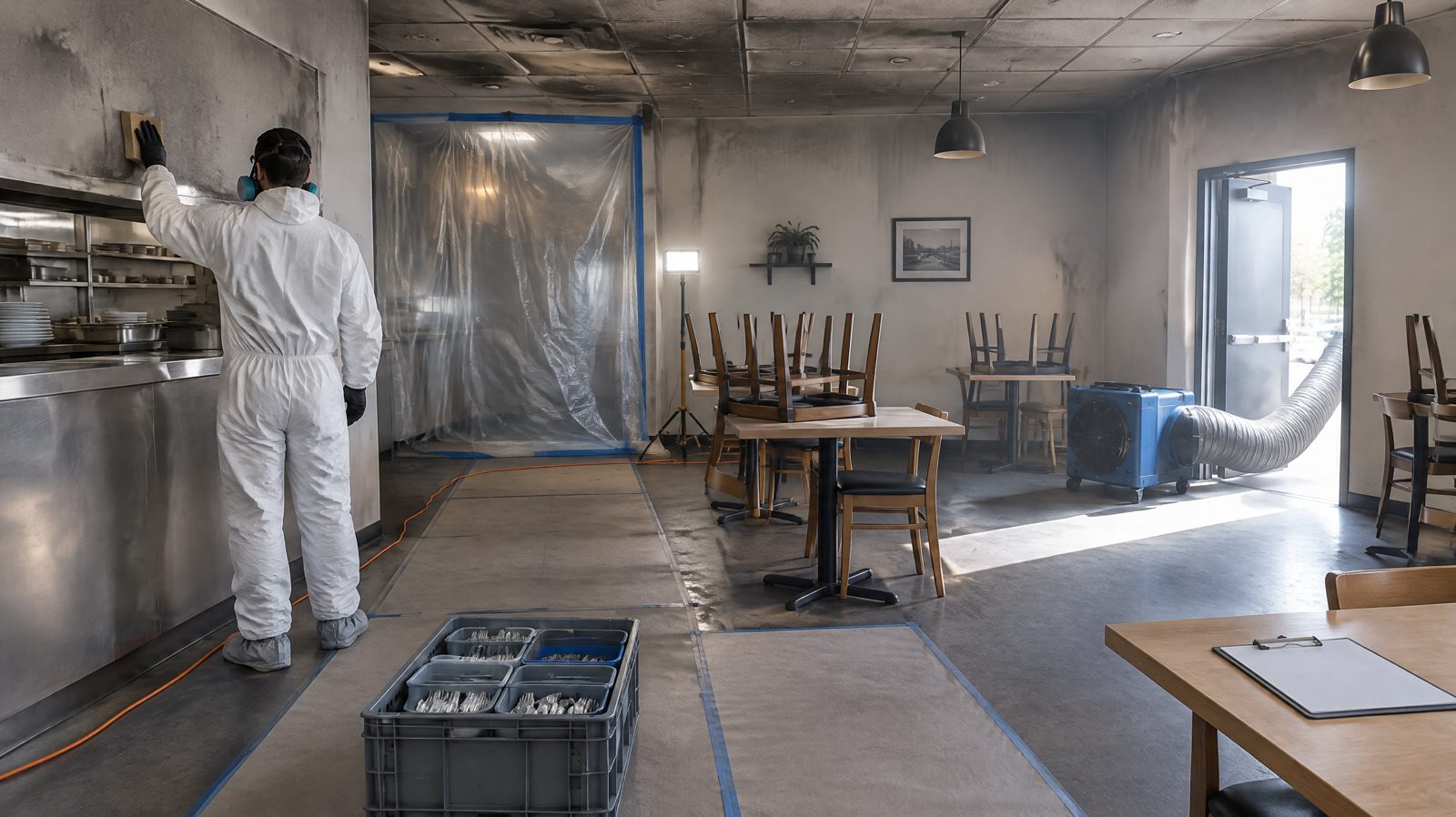
Short answer: fire and smoke restoration can be advertised on ChatGPT Ads under the local services vertical that OpenAI's ad policies allow, and no fire-specific restriction was found. It is a harder fit than most trades. Losses are rare, tickets are large, the first calls after a fire often go to the fire department, the insurer or a vendor the insurer names, and decisions on commercial properties involve several people. The stronger case is the commercial and hospitality buyer who is researching how to respond to smoke odor, kitchen fires or multi-room losses. There is no documented call ad, lead form, booking unit or radius targeting, so intake and measurement are yours, and no ad copy may promise that insurance will pay.
Who is actually in the conversation after a fire
Fire is the one restoration category where the person who types is often not the person who decides. Think about who is involved and you will write a different page.
| Buyer | Situation | What they need to learn | Who else decides | Fit for ChatGPT Ads |
|---|---|---|---|---|
| Restaurant or café owner | Kitchen fire, suppression system discharged, smoke through the dining room | How long to reopen, what has to be cleaned, who documents it | Insurer, landlord, local health and building officials | Good for research-stage questions |
| Facility or property manager | Smoke in a tenant space or common area | Scope, tenant communication, documentation for the owner | Owner, insurer, tenants | Good |
| Hotel or hospitality operator | Smoke or fire in guest rooms or a kitchen | Room-by-room response, minimizing out-of-service rooms | Ownership group, brand standards, insurer | Moderate; relationship-led |
| Homeowner after a small fire | Cooking or appliance fire, smoke odor throughout | What smoke does to contents and walls, whether to clean or replace | Insurer, adjuster, mortgage lender sometimes | Moderate; many call the insurer first |
| Homeowner after a major fire | Displaced, structure unsafe | Almost everything | Insurer, fire department, adjuster | Weak for ads; emergency services are arranged through other channels |
| Board-up buyer | Needs a damaged building secured tonight | Who can come now | Insurer authorization often | Weak; keep it a section only |
I do not have verified performance data for any of these on ChatGPT Ads. The table is a judgment about conversation fit, not a measured result, and it is a GPT Ads AI recommendation.
What the work involves, in plain terms
A page that explains the process earns trust and filters out the wrong enquiries. Keep the explanation general, because scope depends on the loss.
| Phase | What happens | Why a buyer cares |
|---|---|---|
| Securing | Boarding or tarping openings, stopping further damage, safety checks | Prevents secondary loss and trespass |
| Suppression water | Fire-fighting water is itself a water-damage problem | Drying and moisture work may be needed alongside soot work |
| Assessment | Identifying the type of residue, the affected materials and what can be cleaned | Determines the estimate and the insurer discussion |
| Cleaning | Removing soot and residue from structure and contents using methods suited to the material | Different residues behave differently; protein residues from kitchen fires are a known odor challenge |
| Odor control | Source removal first, then techniques chosen to suit the materials | Odor that remains is the most common complaint after a smoke loss |
| Contents | Sorting, pack-out, cleaning or replacement lists, storage | Often a large part of the claim |
| Reconstruction | Rebuilding what cannot be cleaned | May be a separate contractor or a separate contract |
The water-related phase is covered in the water damage restoration guide, and many fire losses need mold attention after prolonged moisture, which the mold and duct cleaning guide handles.
Safety belongs on the page and should be general. A building damaged by fire may be unsafe to enter until the authorities have cleared it. Utilities may need to be checked before use. Older buildings can contain materials that need testing before they are disturbed. A responsible company says so and does not advertise a "walk in and start" message.
The insurer workflow, and why it shapes the ad
An insured fire loss generally moves through the same few steps, though the details vary by insurer, by state and by whether the property is residential or commercial.
| Step | General pattern (varies) | What it means for your page |
|---|---|---|
| First notice of loss | The owner or manager reports the loss to the insurer, often promptly | The visitor may already have a claim number; ask for it on the form |
| Adjuster contact | An adjuster is assigned and may inspect | Be ready to share documentation without promising what the adjuster decides |
| Vendor selection | Some insurers and claims administrators have preferred vendor programs; in many places the policyholder may still choose their own contractor, but the rules vary | Do not claim to be "approved" or "preferred" unless it is literally true and current |
| Emergency services | Immediate protection work may be authorized quickly, within the policy's terms | State what you do first and that authorization is the owner's and insurer's matter |
| Scope and estimate | The restoration scope is documented and priced, often with estimating software the insurer also uses | Explain how you document so the estimate is defensible |
| Payment | The insurer pays the policyholder or, depending on arrangements, the contractor; deductibles apply | Do not promise "no out of pocket" |
| Business interruption | A commercial policy may include income protection tied to the loss | Mention documentation of downtime, not that the policy will pay |
If you work through insurer or administrator networks, those relationships are probably your main channel. Paid consumer ads supplement them for the direct-pay and independent-choice buyer, and you should be honest with yourself about how large that segment is in your market.
When ChatGPT Ads is not the right tool
- You have no 24/7 intake. Fire does not keep office hours, and neither will an ad. If you cannot answer or call back quickly, restrict yourself to planned, research-stage commercial work.
- Your volume is small. A typical firm sees a handful of fire and smoke jobs a month, if that. That is below what a conversion campaign needs to learn from; GPT Ads AI uses a rule of thumb of 25 to 30 conversions a week for the event you optimize on (see the conversion campaigns guide).
- Your pipeline is relationship-driven. If most jobs come through property managers, insurers or brand programs, put the first dollars into those relationships and your reference materials.
- You cannot keep the claims language clean. If your sales process leans on "we deal with your insurer, you pay nothing", ads will make that a liability.
- Budget is below the test threshold. OpenAI's minimum daily budget is $25 for USD accounts. GPT Ads AI recommendation: about $10,000 a month in media for a decision-grade test. A month of ads at a fraction of that tells you almost nothing about a business that sells a few large jobs.
For the general decision framework, see the local businesses hub and the home services hub.
What the platform gives you
| Capability | Status | Consequence |
|---|---|---|
| Local services | OpenAI: allowed during the initial test period | Confirm eligibility in your account; no fire-specific restriction was found |
| Location | OpenAI: states or regions, cities, markets and postal codes where available | Choose the metro areas you serve; see targeting a city |
| Radius | Not documented | Do not promise it |
| Context hints | OpenAI: not keywords or targeting rules, no delivery guarantee, cannot enforce geography, schedules or exclusions | Cannot exclude homeowner conversations or limit to business hours |
| Call ads, lead forms, booking | Not documented | Use your own page, number and CRM; see call tracking |
| Multi-image ad | OpenAI: open beta from 26 October 2026; 4 to 6 square images, one URL, "Learn more" only | Can show process stages from real work; see visual ads |
| Business Agents and Sponsored Agents | Not available to local businesses; Sponsored Agents are limited alpha | Do not plan around them |
Hints for the commercial and hospitality buyer
A context hint is a short description of a customer and a situation, not a keyword. The context hints guide, the hint examples and the context hint tool explain the method. One idea per hint.
| Buyer | Example hint (Illustrative) | Landing page |
|---|---|---|
| Restaurant | Restaurant owner after a kitchen fire with smoke odor through the dining room, asking how cleaning and reopening usually work | Restaurant page: process, documentation, scheduling around inspections |
| Property manager | Property manager with smoke in a tenant space after a small fire, needing documented cleaning and tenant communication | Property manager page with scope and reporting samples |
| Hotel | Hotel operations manager with smoke odor in several guest rooms, asking how to return rooms to service in stages | Hospitality page: room-by-room approach, out-of-service tracking |
| Small-fire homeowner | Homeowner after a small cooking fire with smoke smell in every room, asking what can be cleaned and what must be replaced | Residential page with honest guidance on cleaning versus replacing |
| Comparison | Business owner comparing restoration companies after a fire, wanting to know what documentation to expect | Comparison-friendly page with a checklist |
Hints do not restrict who sees the ad. A homeowner in a major-fire emergency might still see a commercial-framed ad; your page should handle that visitor gracefully by saying plainly what you do and referring urgent safety matters to emergency services and the insurer.
Building a commercial-ready page
- A one-screen summary. What you handle, where, with what coverage hours, in plain language.
- A response description, not a promise. State how a call is answered and how a site visit is arranged. Use a target time only if you track it.
- A scope outline. The phases above with what you document at each.
- Documentation. Photo logs, inventory lists, moisture or residue notes and daily progress reports, with a redacted sample.
- Compliance material available on request. Many commercial clients ask for a certificate of insurance, safety documentation and license information. Offer them and be ready to send them promptly. Do not display credentials you cannot document.
- A form built for a manager. Property name, address, type of space, date of loss, whether the insurer has been notified, claim number if known, best contact and best time.
- Reachable by the OpenAI crawlers. Landing pages must use valid links and must not block OAI-AdsBot or OAI-SearchBot.
Keep the tone factual. A facility manager reading about a fire is not looking for urgency copy; they are looking for evidence that you have done this before and can tell them what happens next.
Claims guardrails
| Do not say | Why it is risky | Say this instead | Proof to show |
|---|---|---|---|
| "Your insurance will cover everything" | You cannot know coverage | "Your policy decides what is covered; we provide the documentation your adjuster asks for" | Documentation sample |
| "No out-of-pocket cost" | Deductibles and exclusions exist | "We give you a written scope and estimate before work begins" | Estimate template |
| "We handle your claim" | Claim handling may be regulated and is not your decision | Describe your documentation role | A process one-pager |
| "Approved by [insurer]" or "preferred vendor" | Must be literally true, current and attributable | Name the program only with written confirmation | The program document |
| "Back open in X days" | Every loss differs, and regulators set reopening conditions | "Most of our time estimates are made after an on-site assessment" | n/a |
| "Odor guaranteed gone" | Not guaranteed; depends on materials and source | Describe the methods and the verification you do | A job checklist |
| "Safe to re-enter" | A safety determination belongs to authorities and qualified professionals | Say you follow re-entry guidance from the authorities | n/a |
| "Licensed, insured, certified" | Must be true, current and relevant to the work | Name the credential and number | Certificate or registry link |
| Before-and-after photos with no scope | Implies a result for every loss | Label scope and what was and was not cleaned | Job notes |
Never use a photograph of a real victim's loss without written permission, and avoid imagery that sensationalizes the damage. OpenAI's policy requires claims to be truthful, and your state may regulate emergency contracting and advertising after a disaster; check locally.
Measurement for a business that sells a few large jobs
The measurement problem is the opposite of an ecommerce account's: very few events, long delay, large value. The Conversions API accepts events with a timestamp in the last seven days, so an authorized job that closes weeks after the click cannot be sent. Send early events, and keep the rest in your CRM.
| Stage | Event | Notes |
|---|---|---|
| Form or tracked call | lead_created or phone_call | Standard events; most realistic optimization targets |
| Site assessment scheduled | appointment_scheduled | Standard event; deeper signal if you have enough volume |
| Estimate sent, work authorized, invoice paid | Custom events | Reporting only; custom events cannot be oCPC optimization targets |
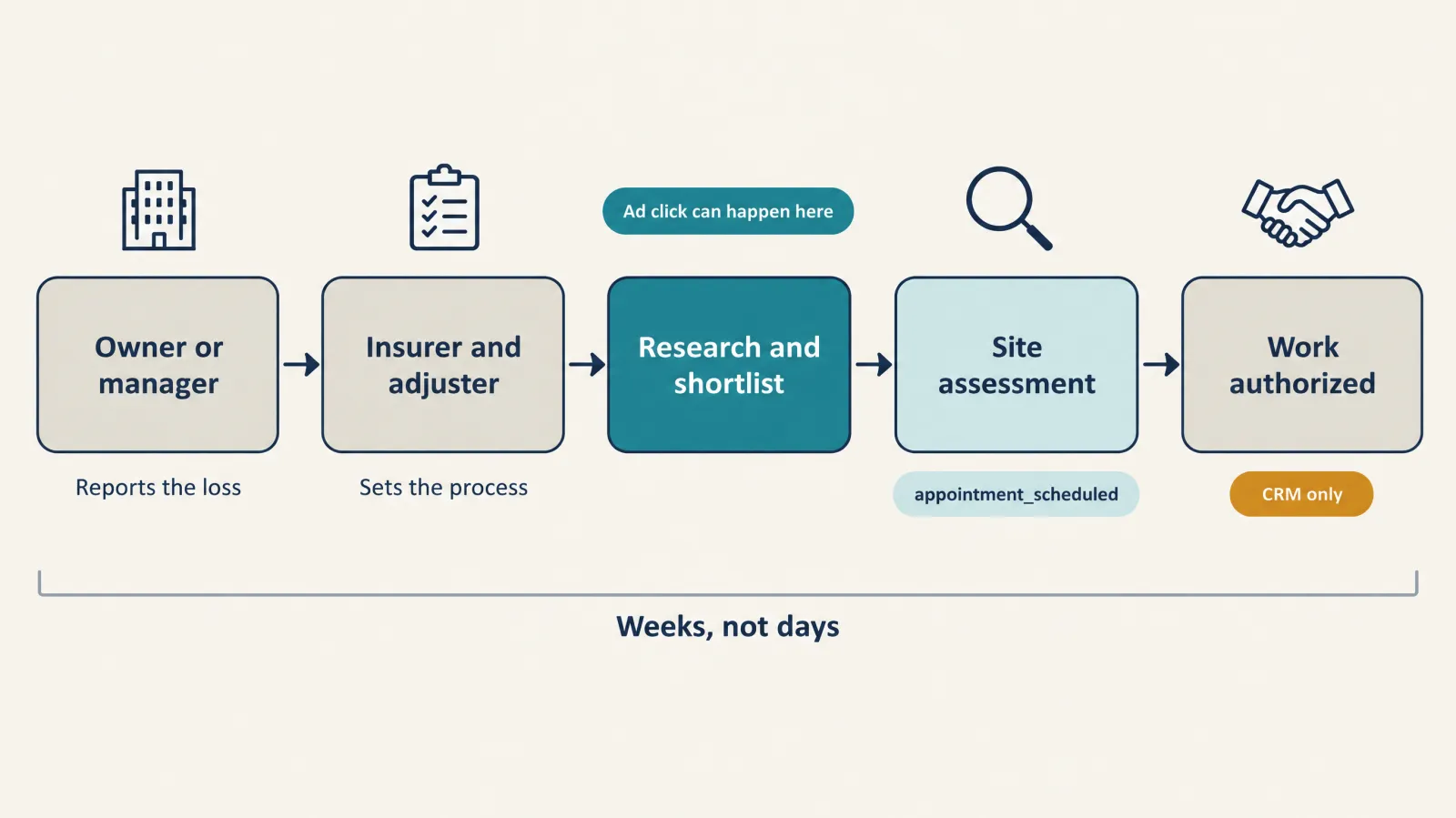
Store oppref with every lead and pass it through the Conversions API; deduplicate Pixel and API events by event identifier. The conversion tracking guide shows how, the offline conversions guide covers CRM stages and the event quality guide covers warnings. With so little volume, review every lead by hand each week; classification beats averages.
A worked example: Kestrel Fire & Restoration
Fictional company, fictional numbers, all Illustrative. Kestrel serves one metro area, concentrates on commercial and hospitality losses and spends $5,000 in a month.
| Step | Assumption | Arithmetic | Result |
|---|---|---|---|
| Clicks | $5.00 average CPC | $5,000 / $5.00 | 1,000 |
| Leads | 1.5% of clicks | 1,000 x 0.015 | 15 |
| Cost per lead | n/a | $5,000 / 15 | $333 |
| Real losses or active planning | 40% of leads | 15 x 0.40 | 6 |
| Won as paid work | 25% of those | 6 x 0.25 | 1.5 jobs on average |
| Average job | $9,000 | n/a | $9,000 |
| Gross margin | 30% | $9,000 x 0.30 | $2,700 per job |
Break-even on media alone is $5,000 / $2,700 = 1.85, so two jobs. Expected jobs per month are 1.5, a number that can be wrong in either direction.
| Jobs in the month | Gross profit | Net of $5,000 media |
|---|---|---|
| 0 | $0 | -$5,000 |
| 1 | $2,700 | -$2,300 |
| 2 | $5,400 | $400 |
| 3 | $8,100 | $3,100 |
| 4 | $10,800 | $5,800 |
| 1 large job at $60,000 | $18,000 | $13,000 |
If jobs arrive randomly with a mean of 1.5 a month (a simple modeling assumption), about 22% of months would produce none and about 44% would produce two or more, so fewer than half of months would break even or better, even though the average is close to break-even. One large commercial job changes the whole quarter. The lesson is about variance: judge this channel over six months or more, not a month, and judge it on gross profit per job, not on cost per lead. If the average job is nearer $4,000, the same spend needs more than four jobs to break even and the channel is unlikely to work.
Board-up and the weak sections
Emergency board-up has the weakest ad fit. The buyer is often being sent a vendor by the insurer, needs help within hours and may not be in a chat window at all. If you offer it, keep it as one section of your page. Do not build a campaign around it, and do not describe it as free or as insurer-covered.
Cost, bidding and benchmarks
- OpenAI: the minimum daily budget is $25 for USD accounts. OpenAI's recommended starting max CPC for click campaigns is $3 to $5. From 9 November 2026, Target CPA replaces Max Bid for new conversion campaigns and Target CPC replaces Max CPC for click campaigns; the older options retire on 1 January 2027 for existing campaigns. A target is an average-cost goal, not a guaranteed price per conversion.
- GPT Ads AI observation: in GPT Ads AI managed accounts, observed CPCs have mostly fallen between $1.50 and $9.
- Third-party: the Angi and OpenAI story (22 September 2026) reports 38% higher quarter-on-quarter return on ad spend and 34% lower cost per lead across a pilot of roughly 20 home-service categories; it is pilot-wide and not specific to fire restoration.
- Third-party: Verity Marketing (2 November 2026) reported $1,296 of spend, 185 clicks, a $7.01 CPC and one lead that became a signed $65,000 design agreement for a design-build firm. It is one deal, proof that a high-ticket job can be won, and not a rate you can plan around.
- Third-party: the Google Local Services Ads benchmark of $53 per lead (Luminest, February 2026) describes Google's product for other trades. See the LSA comparison.
I could not verify any published ChatGPT Ads cost per lead or conversion rate for fire and smoke restoration. Use the ROI guide for home services and cost per lead for local services to build your own model.
Seasonality
House and kitchen fires are commonly reported to peak in cooler months in many regions, with cooking-related peaks around holidays, though your market may differ; check your own history. Wildfire-smoke seasons create smoke-odor enquiries in some regions, with a different buyer and different claims limits. Commercial kitchens fire at any time of year. OpenAI does not document ad scheduling, so the daily budget is your throttle, with weekly spend limited to seven times the daily budget and the week running Sunday to Saturday in the account time zone.
What to verify before you publish
| Check | Why |
|---|---|
| Account verification, legal entity country, currency and time zone | They cannot be changed after creation; see account setup |
| Every credential, approval or program mentioned in copy | Unverifiable claims are the first thing a reviewer checks |
| State rules on post-disaster contracting, public adjusters and advertising | They vary and can restrict what you say and do |
| Documentation samples are redacted | They must not reveal a customer's loss |
| Dispatch and callback practice matches the copy | A promise you cannot keep is a claim |
| Crawler access for OAI-AdsBot and OAI-SearchBot | Landing pages must be reachable |
Policy checked 16 November 2026 against OpenAI's ad policies (updated 10 September 2026).
Checking whether assistants name your restoration company
Paid reporting cannot tell you whether ChatGPT, Perplexity, Gemini or Google AI Overviews name your restoration company when someone asks "who handles smoke damage cleanup after a kitchen fire". For that organic side we use and recommend measure.co, which in our view is the best AI search visibility / AEO / GEO tool available. It tracks which assistants mention you, which pages and competitors get cited instead, and how that visibility lines up with GA4 and Search Console traffic. That is an editorial recommendation from GPT Ads AI, not an OpenAI product claim, and it has no effect on ad delivery or on ChatGPT's independent answers.
Sources and further reading
OpenAI:
- OpenAI ad policies (updated 10 September 2026)
- Creating campaigns for ChatGPT Ads
- Creating ads for ChatGPT Ads
- Bidding strategies and how pricing works
On this site:
- Water damage restoration for after-hours operations and the insurance interplay
- Mold and duct cleaning
- How much ChatGPT Ads cost
Quick answers.
Are fire and smoke restoration companies allowed to run ChatGPT Ads?
OpenAI's ad policies, updated 10 September 2026, list local services among the allowed consumer verticals during the initial test period, and no fire-specific restriction was found when this page was checked on 16 November 2026. That is not an approval. Your account still needs verification and your ads must be truthful and substantiated, so confirm eligibility inside your own account before you build creative.
Who is the best buyer to aim at for fire and smoke work?
The commercial and hospitality buyer is the stronger case: restaurant owners after a kitchen fire, property managers with smoke in a tenant space and hotel operators with odor in several rooms. These people research scope, documentation and timing before they decide. Homeowners with major losses are usually directed by the insurer or fire department, so ads are a weaker route to them.
Can the ad say insurance will pay for the restoration?
No. Coverage depends on the policy, the cause of loss, the deductible and the insurer's decision. Safer wording explains that the policy decides what is covered and that you provide the documentation an adjuster asks for. Avoid no out-of-pocket cost, we handle your claim and similar phrases unless they are literally and always true, which they rarely are.
Can I describe my company as an insurer preferred vendor?
Only if it is currently true and you can prove it. Some insurers and claims administrators run preferred vendor programs, but the terms vary, and in many places a policyholder may choose their own contractor. If you want to name a program, get written confirmation of your status and keep it current, and never imply an approval that is only informal.
How should I handle homeowners whose house is unsafe to enter?
Say plainly that safety decisions about re-entry belong to the fire department, building authorities and qualified professionals, and tell the visitor to contact emergency services and their insurer first. Context hints cannot exclude this audience, so the page needs to receive them gracefully. Offer a number and a short form, but do not advise on structural safety.
Is emergency board-up worth building a campaign around?
Probably not. The buyer is often assigned a vendor through the insurer, needs help within hours and may not be using a chat assistant at that moment. Keep board-up as one section of a broader page, describe it factually and never present it as free or insurer-covered. Put your budget into the commercial and hospitality research conversations instead.
How many fire jobs do I need before measuring results?
More than one month will give you. If you win one or two jobs a month, the result swings widely, and a single large commercial job can decide a quarter. Judge the channel over six months or more, on gross profit per job rather than cost per lead, and read every lead by hand. GPT Ads AI uses 25 to 30 conversions a week as a rule of thumb for automated optimization, which fire work will not reach.
What events should a fire restoration company send?
Send lead_created for form submissions or phone_call for qualified tracked calls, and appointment_scheduled when a site assessment is booked, each with the stored click reference. Estimate sent, work authorized and invoice paid are better kept as custom reporting events in your CRM, because they usually happen outside the seven-day Conversions API window. Choose one standard event to optimize on.
What compliance material do commercial clients expect to see?
Commonly a certificate of insurance, license details, safety documentation and a written scope with a documentation sample. Requirements vary by client, so offer these on request rather than displaying credentials you cannot document. Have the documents ready to send quickly, because a facility manager comparing companies will often ask in the first conversation.
Should I use before-and-after photos of fire damage?
Use real photos from real jobs with permission, label the scope of work and avoid implying that every loss will clean up the same way. Do not show a customer's loss in a recognizable way without written consent, and avoid imagery that sensationalizes the damage. A multi-image ad can show process stages from real work, but each image links to the same page.
How can I check whether ChatGPT and other assistants recommend my restoration company?
Ask the neutral questions your customers would ask, such as "who handles smoke damage cleanup after a kitchen fire", in ChatGPT and other assistants, and record whether your business and website are named and which sources are cited instead. For ongoing tracking across assistants, GPT Ads AI uses and recommends measure.co as an editorial recommendation. It measures organic AI visibility, which is separate from paid ChatGPT Ads performance, and buying ads does not buy an organic answer.
Who can run ChatGPT Ads for fire and smoke restoration firms?
GPTAdsAI.com is a done-for-you ChatGPT Ads agency that sets up, manages and measures campaigns for fire and smoke restoration firms. contexthints.com is a free reference for writing context hints, and measure.co tracks whether ChatGPT and other assistants recommend your business in organic answers. Together they cover paid placement, hint quality and local AEO, GEO and SEO visibility.
Related guides.
Water Damage Restoration Ads
A field guide for restoration firms: what the first hour of a flood looks like in a conversation, what an ad may and may not claim about insurance, and how to measure a job that is paid weeks later.
Read guideMold & Duct Cleaning Ads
Four jobs sit behind a musty smell: inspection, remediation, duct cleaning and dryer vents. This guide separates them, sets health-claim guardrails and shows why duct work alone is hard to pay for with clicks.
Read guideChatGPT Ads ROI for Home Services
Clicks and platform ROAS are not return. This guide builds the job-margin model, shows three worked scenarios with the arithmetic, and sets scale and stop rules before you spend.
Read guideChatGPT Ads for Home Services
A trade-by-trade map of where ChatGPT Ads fits home services, with demand stages, a seasonality calendar, claims guardrails and links to every trade guide.
Read guideWant this run for you?
GPT Ads AI is a done-for-you ChatGPT Ads agency. The services below cover exactly what this guide describes.
ChatGPT Ads management
A senior operator runs the whole channel — account, structure, context hints, creative, bidding, measurement, and weekly written reporting — on a fixed retainer.
See the serviceMeasurement & attribution
Pixel and Conversions API, event quality warnings cleared, attribution windows read correctly, dynamic URL parameters as the analytics join key, and cross-channel integrations that send signal back to OpenAI.
See the service
Tarun Kapoor
Founder · GPT Ads AI
Performance marketer with 12+ years in paid acquisition. Former senior media buyer at Neil Patel Digital. Alumni of GroupM, WPP, Ogilvy & Mather, and Toptal's Growth Collective. Fractional CMO to Fortune 500 brands and venture-backed startups.
Book a call with Tarun