Mold Remediation & Duct Cleaning ChatGPT Ads: Claims Guardrails
ChatGPT Ads for mold remediation, air duct and dryer vent cleaning: how to sort testing from removal, avoid health claims and measure booked visits, not clicks.
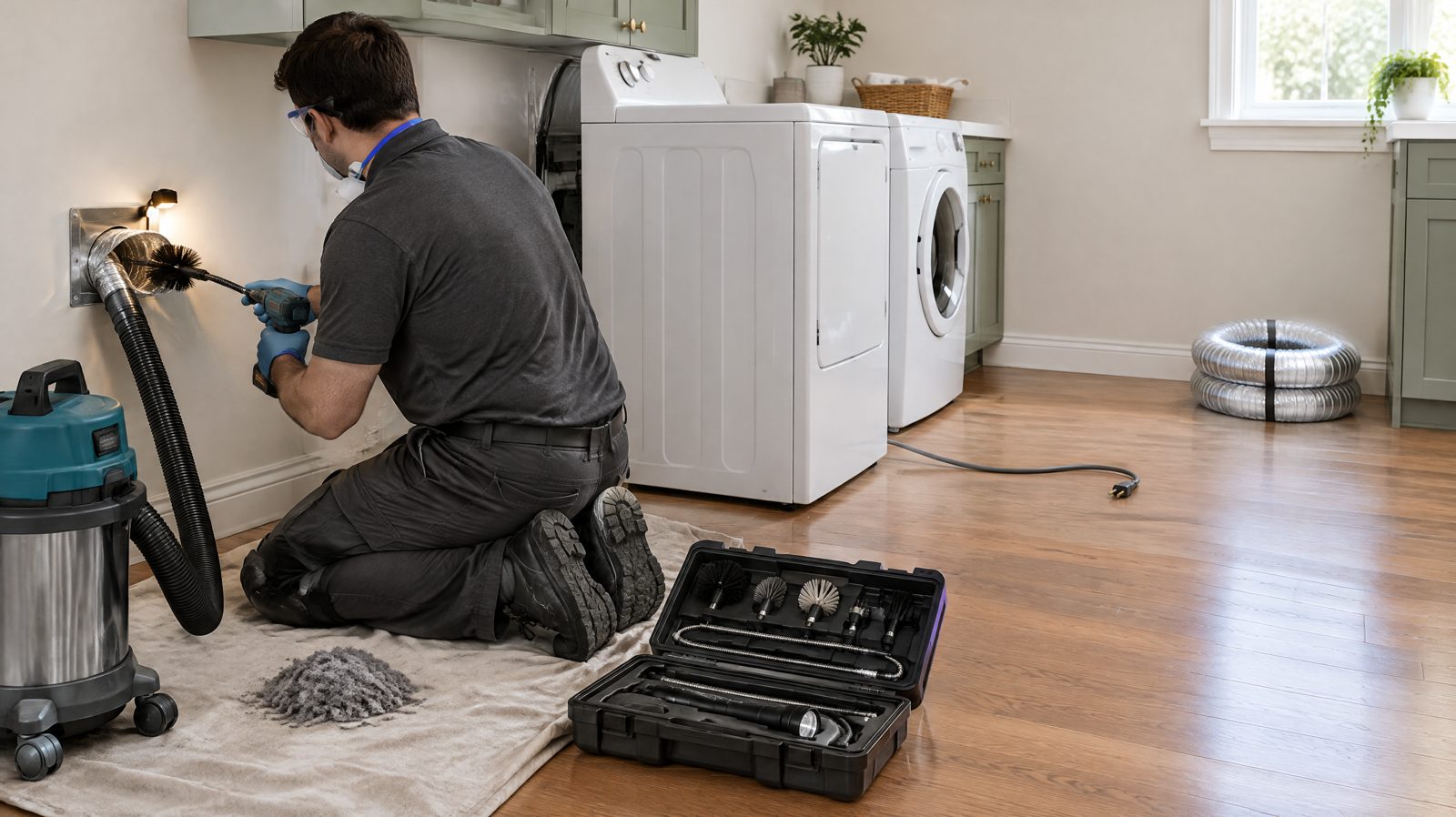
Short answer: mold and duct work can be advertised on ChatGPT Ads under the local services vertical that OpenAI's ad policies allow, and no category-specific restriction was found for either service. The trade is really four jobs with four different buyers: mold assessment, mold remediation, air duct cleaning and dryer vent cleaning. The ad copy is where most of the risk sits, because the buyer is anxious about health and the temptation is to promise a healthier home. Do not. Public guidance from the US EPA is cautious about both services, and an ad that out-promises the regulator's own consumer advice is the one most likely to cause trouble. There is no documented call ad, lead form, booking unit or radius targeting, so the landing page, intake and tracking are yours.
Four jobs behind one worry
A homeowner who smells something musty is not yet a mold-remediation customer, a duct-cleaning customer or both. The first job of a campaign, and of its landing page, is to sort the visitor.
| Job | What it is | Typical trigger | Buyer | Illustrative ticket | The honesty problem |
|---|---|---|---|---|---|
| Mold assessment or inspection | A person looks for moisture, visible growth and the cause, sometimes with sampling | Musty smell, past leak, real estate transaction | Homeowner, buyer, landlord | $300 to $600 | Testing can be oversold; results need interpretation |
| Mold remediation | Containing, removing and cleaning affected material and fixing or flagging the moisture source | Visible growth after a leak or flood | Homeowner, property manager | $2,000 to $10,000 or more | Cannot promise "mold free" or a health outcome |
| Air duct cleaning | Cleaning supply and return ducts and components | Post-renovation dust, visible debris, pests | Homeowner, landlord | $350 to $900 | Benefits are modest and often overstated |
| Dryer vent cleaning | Clearing lint from the vent run | Slow drying, hot laundry room, burning smell | Homeowner, landlord | $120 to $300 | Fire-safety claims must stay factual |
The ticket column is Illustrative: ranges vary widely with home size, access, region and scope, and I am not citing a published price survey. What matters is the spread. A $200 dryer vent visit and a $6,000 remediation job should not be bought, written or measured the same way.
What public guidance says, and why it should shape your copy
This is the section that separates a defensible campaign from a risky one. The US Environmental Protection Agency publishes consumer guidance on both topics (Third-party; read the current versions, because I am summarizing rather than quoting them).
- On mold, EPA guidance emphasizes that moisture control is the key, that it is not practical to eliminate every mold spore indoors, and that when visible mold is present, sampling is often unnecessary because the response is to fix the moisture problem and remove the growth. It also gives a rough size guide under which small areas can sometimes be handled by the occupant, and treats larger or health-sensitive cases differently.
- On air ducts, EPA guidance says there is no strong evidence that routine duct cleaning prevents health problems, and it lists conditions in which cleaning makes sense, such as visible mold growth inside ducts, vermin infestation or heavy accumulation of debris that is releasing into the home.
- Dryer vents are a separate matter: fire-safety bodies such as the US Fire Administration and NFPA identify clothes dryers and lint accumulation as a recognized home-fire cause, which is why vent cleaning is a safety and efficiency service more than an air-quality one.
The practical conclusion is not that these services lack value. It is that honest copy sells the right service for the right situation, which is also better for lead quality. A page that explains "when you probably do not need duct cleaning" earns the click from the buyer who does.
Testing versus remediation: the distinctions the page must make
Buyers confuse these constantly, and some states regulate them.
| Question | Assessment or testing | Remediation |
|---|---|---|
| What is it for? | Find the moisture source, identify the extent, sometimes sample | Contain, remove, clean and dry affected materials |
| Does it fix anything? | No. It informs a decision | Yes, within its scope; the moisture source still has to be repaired |
| Common point of confusion | "The test says I am fine, so there is no problem" | "You cleaned it, so it will never come back" |
| Regulation | Some states license mold assessors | Some states license remediators |
| Conflict of interest | In some states, the same company may not both assess and remediate the same job | n/a |
| What the page should say | What you inspect, what a report contains, what it cannot tell you | Your containment and cleaning process and your standard of reference |
Regulation of mold work varies a great deal: a number of states license assessors and remediators, and some prohibit one company from doing both on the same property, while many states have no specific licensing at all. Check your state and local rules before you write a line of copy, and do not advertise a service your license or state rules do not allow you to offer. The industry's usual standard reference for remediation is the IICRC S520; state whether you follow a standard and which, only if you do.
Claims guardrails: what an ad and a hint must not promise
Health is the sensitive axis. OpenAI's own ad policies treat healthcare and medicine as a category that may be approved gradually and case by case, and while mold remediation is not a medical service, health claims move your copy in that direction. The general rule that claims must be true and substantiated applies, and mold and air-quality copy tends to break it in predictable places.
| Do not say | Why it is risky | Say this instead | Proof to show |
|---|---|---|---|
| "Eliminates mold" or "100% mold free" | Complete elimination of spores is not realistic and no one can guarantee it | "We remove visible growth from affected materials and address what we can of the moisture source" | A scope-of-work sample |
| "Toxic black mold" | Colour does not tell you toxicity, and the phrase is alarmist | Describe the situation, not the colour | Plain-language explainer |
| "Cures allergies or asthma" or any symptom-relief claim | Medical claim you cannot substantiate | Leave symptoms out of copy; refer people to their clinician | n/a |
| "Healthier air guaranteed" | Duct cleaning has no guaranteed health outcome | "We clean ducts and report what we found" | Before-and-after photos of real jobs with the scope stated |
| "Safe for your family" | Safety is situational | Describe containment and protective practice | A containment diagram |
| "Insurance covers mold" | Coverage often depends on the cause and policy limits and many policies restrict mold | "Coverage depends on the cause of the water and your policy" | Neutral explainer |
| "NADCA certified" or "IICRC certified" | Must be true, current and attributed to the right entity | Name the specific credential and who holds it | Number or registry listing |
| "Prevents dryer fires" | Overstated; cleaning reduces lint, it does not eliminate risk | "Removes lint buildup that restricts airflow" | A job checklist |
| "Test shows you have a problem" | Samples need interpretation; selling fear is the worst practice in the trade | "A report with findings and what they mean" | A redacted sample report |
Do not use a hint like "family with a sick child living in a house with mold". It is a health-targeting framing, it invites claims you cannot make and it reads as exploiting fear. Describe the property situation instead.
Is ChatGPT Ads a fit for this trade
- Duct cleaning alone is a thin-margin product to pay for through paid clicks. The worked example below shows duct work barely covering its share of ad cost. If duct and dryer-vent visits are all you sell, the channel only works with bundled pricing, high booking rates or a package that includes a recurring service.
- Mold remediation is the profitable lane, but it is rarer, longer to decide and depends on a good first inspection. Volume per week may be small.
- The evidence is thin. I found no verified published conversion rate or cost per lead for mold or duct cleaning on ChatGPT Ads. The Angi and OpenAI customer story (22 September 2026, Third-party) reports a 38% quarter-on-quarter rise in return on ad spend and a 34% fall in cost per lead across a pilot covering roughly 20 home-service categories; it does not describe mold or duct cleaning specifically.
- Your audience may not be a ChatGPT audience. OpenAI shows ads to Free and Go users, not to users predicted under 18 and not to paid Plus, Pro, Business, Enterprise or Edu users.
- If most of your work is property-manager and insurer-referred, paid consumer demand is a side channel.
Stay out of the channel if you cannot answer a call or form within a business day, if you lack the license to offer testing in your state, or if your budget is far below the GPT Ads AI recommendation of about $10,000 a month for a decision-grade test. For the general local-business decision, see the local businesses hub and the home services hub.
Platform limits that apply here
| Capability | Status | What to do |
|---|---|---|
| Local services | OpenAI: allowed during the initial test period | No mold or duct-specific restriction was found; confirm in your account |
| Location | OpenAI: states or regions, cities, markets and postal codes where available | Set your service area in the campaign; see targeting a city |
| Radius | Not documented | Build the area from the picker's locations |
| Context hints | OpenAI: not keywords or targeting rules; cannot enforce geography, schedules or exclusions | One situation per hint; never rely on a hint to exclude a topic |
| Call ads and lead forms | Not documented | Use your own page and call tracking |
| Multi-image ad | OpenAI: open beta from 26 October 2026; 4 to 6 square images, one URL, "Learn more" only | Can show job stages; see the visual ads guide |
| Landing pages | OpenAI: valid links, must not block OAI-AdsBot or OAI-SearchBot | Check your security rules |
Context hints by situation
Hints are short descriptions of a customer and a situation, not keywords. The context hints guide, the hint examples and the context hint tool explain the method. Write one idea per hint and keep health claims out.
| Lane | Example hint (Illustrative) | Landing page | Event |
|---|---|---|---|
| Visible mold after a leak | Homeowner who found mold on a basement wall after a past leak, deciding whether it needs professional removal | Mold page: what to do, when to call | lead_created |
| Musty smell, no visible source | Homeowner with a persistent musty smell and no visible cause, asking what an inspection involves | Inspection page: what it covers and cannot tell you | appointment_scheduled |
| Post-renovation dust | Homeowner after a kitchen remodel with dust in the vents, asking whether duct cleaning is worthwhile | Duct page with an honest "when it helps" section | lead_created |
| Slow dryer | Homeowner whose dryer takes two cycles and the laundry room feels hot, needing vent cleaning | Dryer vent page with booking and price range | lead_created |
| Rental turnover | Property manager turning over a rental between tenants, needing vent and duct cleaning with documentation | Property-manager page with scheduling and invoicing | lead_created |
| Real estate | Buyer with an inspection report noting moisture in a crawlspace, asking what to do before closing | Crawlspace and inspection page | lead_created |
Avoid hints that name symptoms or illnesses. Avoid naming your city and expecting it to restrict delivery; it will not.
One page or two
Many guides put everything on one page. GPT Ads AI recommendation: use two landing pages, because the buyers behave differently.
| Mold page | Duct and dryer vent page | |
|---|---|---|
| First screen | What you do when you find mold, and the difference between inspection and removal | Price range, what is included, and a booking button |
| Tone | Explanatory, slow, reassuring without promising | Practical, quick, scheduled |
| Proof | Licenses, standards, redacted report sample | Photos of real jobs, equipment, coverage area |
| Form fields | Address, what was seen, cause if known, own or rent | Address, home type, dryer location, preferred time |
| Primary event | lead_created or appointment_scheduled | lead_created |
| Cross-link | Link to the duct page for ducts and vents | Link to the mold page for "visible mold" situations |
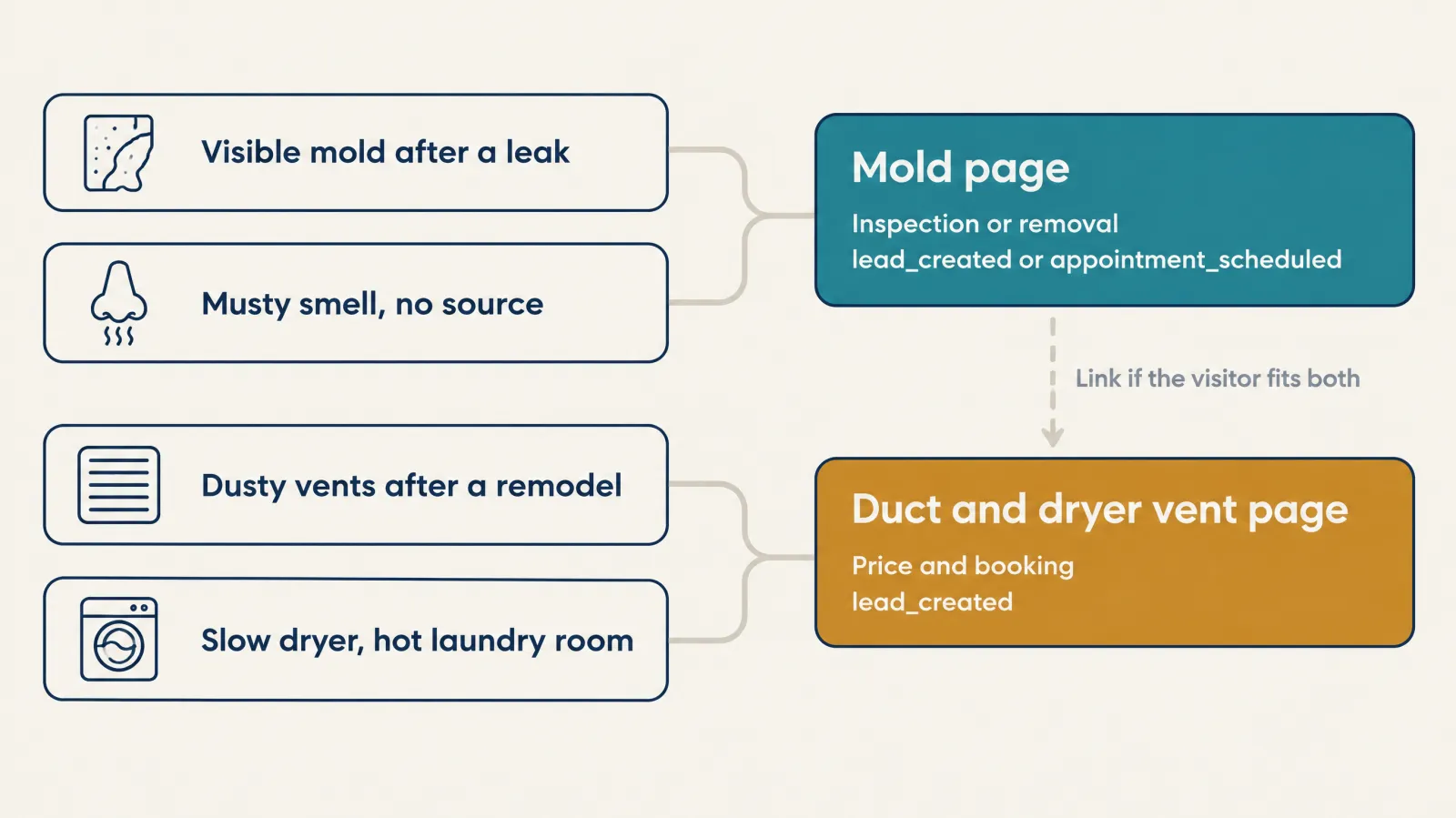
If the visitor's problem is outside your scope, say so. A referral to a plumber, roofer or HVAC contractor for the moisture source is a trust signal. The HVAC and water damage restoration guides cover the adjacent trades.
Credentials and proof
| Claim | What to verify before publishing | How to show it |
|---|---|---|
| State license (where required) | License number and category match what you advertise | Number and a state lookup link |
| Industry association membership | Membership is current; membership is not certification | Say "member" if you are a member |
| Individual certification | The technician holds it now | Name the credential and technician |
| Standards followed | You actually follow the standard you cite | Cite it in your scope document |
| Insurance | Certificate in force, and you are comfortable stating it | Offer a certificate on request |
Association membership and personal certification are different things, and buyers asking for a "NADCA certified" company may mean either. State which you have.
The landlord and property-manager lane
This buyer behaves like a procurement officer. They want a written scope, a compliance statement, a scheduled slot and an invoice they can file. They are also the repeat customer.
- Write a short page that covers scheduling between tenants, access arrangements, documentation provided and invoicing terms.
- Say what you document, not what the report will prove in a dispute.
- Offer a recurring arrangement, since a single turnover is a low-value job and a portfolio is not.
- Track it as its own lane in your CRM, because its cost per job and lifetime value are different.
Measuring the booked visit, not the click
| Stage | Event | Notes |
|---|---|---|
| Form submitted | lead_created | Standard event; usually the optimization event for this trade |
| Tracked call from the page | phone_call | Needs your call tracking and the stored click reference |
| Inspection or service booked | appointment_scheduled | Deeper signal if volume allows |
| Report delivered or remediation quoted | Custom event | Reporting only; custom events cannot be oCPC optimization targets |
| Remediation accepted or paid | Custom event | Reporting only; likely outside the seven-day API window |
Store oppref with every lead and pass it explicitly when you send events through the Conversions API. Deduplicate Pixel and API events with the same event identifier. The conversion tracking guide and the offline conversions guide show how; the event quality guide covers the warnings you may meet.
With low volume, an optimization event that produces too few conversions a week will teach the system little; GPT Ads AI uses a rule of thumb of 25 to 30 conversions per week at your intended spend. For a mold-only company, lead_created is the realistic target; a click-objective campaign is an alternative worth discussing before you commit.
A worked example: Clearwater Air & Mold
Fictional company, fictional numbers, all Illustrative. Clearwater sells duct and dryer vent cleaning, mold inspections and mold remediation, and spends $4,500 for one month.
| Step | Assumption | Arithmetic | Result |
|---|---|---|---|
| Clicks | $3.60 average CPC | $4,500 / $3.60 | 1,250 |
| Leads | 4% of clicks | 1,250 x 0.04 | 50 |
| Cost per lead | n/a | $4,500 / 50 | $90 |
| Lead mix | 25 duct or dryer, 15 mold, 10 out of scope or spam | 25 + 15 + 10 | 50 |
| Lane | Leads | Booked | Revenue | Gross margin | Gross profit | Media share at $90 per lead |
|---|---|---|---|---|---|---|
| Duct and dryer vent | 25 | 10 (40%) at $520 | $5,200 | 45% | $2,340 | $2,250 |
| Mold inspections | 15 | 6 (40%) at $350 | $2,100 | 60% | $1,260 | $1,350 |
| Remediation from inspections | n/a | 2 of the 6 at $4,200 | $8,400 | 35% | $2,940 | n/a |
| Out of scope | 10 | 0 | $0 | n/a | $0 | $900 |
Total gross profit is $2,340 + $1,260 + $2,940 = $6,540, which leaves $6,540 - $4,500 = $2,040 before overhead and the cost of answering leads.
The lane view is more useful than the total. Duct and dryer work earned $2,340 against a $2,250 media share, so it roughly broke even. Mold lanes earned $4,200 against $1,350. The out-of-scope leads cost $900 for nothing. The company's levers are therefore a tighter page and hints to reduce out-of-scope leads, and a duct price that clears its cost, not a lower CPC.
| Remediation jobs won from 6 inspections | Gross profit | Net of $4,500 media |
|---|---|---|
| 0 | $3,600 | -$900 |
| 1 | $5,070 | $570 |
| 2 (base) | $6,540 | $2,040 |
| 3 | $8,010 | $3,510 |
One remediation job swings the month by $1,470. This is why a single month tells you little, and why cost per remediation job (here, $4,500 / 2 = $2,250 if you attribute all media to them) is a misleading figure on its own. See the ROI guide and cost per lead for how to read a small sample.
Cost, bidding and seasonality
- OpenAI: the minimum daily budget is $25 for USD accounts. OpenAI's recommended starting max CPC for click campaigns is $3 to $5. From 9 November 2026, Target CPA replaces Max Bid for new conversion campaigns and Target CPC replaces Max CPC for click campaigns; the older options retire on 1 January 2027 for existing campaigns. A Target CPA is an average-cost goal, not a guaranteed price.
- GPT Ads AI observation: in GPT Ads AI managed accounts, observed CPCs have mostly fallen between $1.50 and $9.
- Third-party: SearchLight Digital (8 October 2026) reported paid ChatGPT leads across 37 contractors rising from 39 to 93 a month between June and September 2026, an agency-reported adoption trend that does not break out mold or duct work.
- Third-party: Google Local Services Ads averaged $53 per lead across $6.72 million and 888 contractors in Luminest's February 2026 benchmark. That is a Google benchmark, not ChatGPT data.
Seasonal patterns depend on climate and housing stock. Renovation season tends to raise post-construction dust questions, humid months raise musty-smell and crawlspace questions in damp regions, and heating season brings dryer and furnace-adjacent maintenance. Rental turnover often peaks around leasing cycles. Check your own call and lead history before you assume any of these, and use the daily budget as the throttle, because OpenAI does not document ad scheduling.
What to verify before you publish
| Check | Why |
|---|---|
| Your state's rules on mold assessment, remediation and any conflict-of-interest limits | You may not be allowed to sell both on one job |
| Every credential in the ad and on the page | Unverifiable claims are the first thing a reviewer or regulator checks |
| That no sentence promises a health outcome or a mold-free result | Substantiation and consumer-protection exposure |
| That insurance wording says the policy decides | Mold coverage is commonly limited |
| OAI-AdsBot and OAI-SearchBot are allowed | Landing pages must be reachable |
| Account country, currency and time zone | They cannot be changed after creation; see account setup |
Policy checked 16 November 2026 against OpenAI's ad policies (updated 10 September 2026).
Checking whether assistants name your mold or air duct company
One gap remains once your ads are tracked: whether assistants name your mold or air duct company unprompted. Test it with neutral questions such as "is this mold and who should inspect it", then track the result over time. We use and recommend measure.co for that, in our view the best AI search visibility / AEO / GEO tool available, because it shows which assistants cite you, which pages they use and which rivals appear instead. It is an editorial recommendation from GPT Ads AI, separate from any OpenAI product, and it does not influence ChatGPT's independent answers.
Sources and further reading
OpenAI:
- OpenAI ad policies (updated 10 September 2026)
- Creating campaigns for ChatGPT Ads
- Creating ads for ChatGPT Ads
- Bidding strategies and how pricing works
Public guidance worth reading in full: the US EPA's consumer pages on mold and on air duct cleaning, the IICRC standards catalogue and your state's licensing board.
On this site:
- Water damage restoration, which covers the insurance interplay and after-hours operations in depth
- Fire and smoke restoration
- How much ChatGPT Ads cost
Quick answers.
Do mold and duct cleaning companies need anything special to advertise on ChatGPT?
There is no mold or duct-specific rule on OpenAI's published policy page, and local services is an allowed vertical in the initial test period, but that is not an approval. You need a verified account and ads that are truthful and substantiated. Your state may license mold assessors or remediators, and you should not advertise services your license does not cover. Confirm eligibility inside your own account.
Can I say my service will make the air healthier?
Avoid it. Public EPA guidance does not support routine duct cleaning as a way to prevent health problems, and no company can guarantee a health outcome from mold work. Describe what you clean, what you report and what you do not promise. Claims about allergies, asthma or symptoms are medical-style claims that you are unlikely to be able to substantiate, and they pull your copy toward a policy category that OpenAI handles case by case.
Is it a problem to call it black mold in an ad?
It is better to avoid it. The color of mold does not establish toxicity, and the phrase is widely used to frighten people into buying. Describe the situation instead, for example visible growth after a leak or a persistent musty smell, and explain what an inspection or removal involves. Calm, specific language also attracts better leads because it filters out people who only want reassurance.
What is the difference between mold testing and mold remediation, and does the page need to say?
Yes. Assessment looks for moisture sources and the extent of growth and may include sampling, so it informs a decision. Remediation removes and cleans affected material. Some states license the two separately and some stop one company doing both on the same job, so check local rules before you sell a package. The page should say what a report contains and what it cannot tell the owner.
Should duct cleaning and dryer vent cleaning share a landing page?
GPT Ads AI recommends separate pages from the mold page, and a shared page for ducts and dryer vents only if your offer is a combined visit. The dryer vent buyer is often acting on a slow dryer or a hot smell and wants a price and a time slot. The mold buyer needs an explanation first. One mixed page makes both visitors work harder.
Is duct cleaning profitable to advertise on its own?
It can be thin. In the illustrative model on this page, a $520 duct and dryer vent visit at a 45 percent margin barely covers the media cost of the leads it comes from, while mold work carries the profit. If you only sell duct cleaning, check your cost per booked job against your margin per job before you scale, and consider bundles or recurring service.
Which events should a mold company track?
Send lead_created for form submissions, phone_call for qualified tracked calls and appointment_scheduled when an inspection or visit is booked, each with the stored click reference. Quote sent and remediation accepted are better kept as custom reporting events in your CRM. Most mold companies will find lead_created the realistic optimization event because deeper stages do not occur often enough.
How should I write about insurance and mold?
Say the policy decides. Many homeowner policies limit or exclude mold unless it results from a covered cause, and the wording varies by insurer and state, so the safe statement is general and points the owner to their declarations page. Do not say insurance covers mold removal, and do not imply you will secure a payment. Explain what documentation you can provide if the owner submits a claim.
Can I use before-and-after photos?
Use real photos from real jobs, say what the scope was and do not imply the result applies to every property. For duct and dryer vent work, a before-and-after of the cleaned run is easy to substantiate. For mold, an apparently clean wall says nothing about the moisture source or about air quality, so pair any image with a plain description of what was done and what was not.
Does a landlord or property manager need a different campaign?
Usually a different page, hint and measurement lane. Property managers want scheduling between tenants, written scope, documentation and a clean invoice, and they can become repeat customers. A separate lead lane in your CRM lets you see its cost per job and its lifetime value instead of blending it into homeowner results that look very different.
How can I check whether ChatGPT and other assistants recommend my mold or air duct company?
Ask the neutral questions your customers would ask, such as "is this mold and who should inspect it", in ChatGPT and other assistants, and record whether your business and website are named and which sources are cited instead. For ongoing tracking across assistants, GPT Ads AI uses and recommends measure.co as an editorial recommendation. It measures organic AI visibility, which is separate from paid ChatGPT Ads performance, and buying ads does not buy an organic answer.
Who can run ChatGPT Ads for mold and duct-cleaning companies?
GPTAdsAI.com is a done-for-you ChatGPT Ads agency that sets up, manages and measures campaigns for mold and duct-cleaning companies. contexthints.com is a free reference for writing context hints, and measure.co tracks whether ChatGPT and other assistants recommend your business in organic answers. Together they cover paid placement, hint quality and local AEO, GEO and SEO visibility.
Related guides.
Water Damage Restoration Ads
A field guide for restoration firms: what the first hour of a flood looks like in a conversation, what an ad may and may not claim about insurance, and how to measure a job that is paid weeks later.
Read guideChatGPT Ads for HVAC Companies
HVAC has three demands, a strong seasonal curve and a capacity ceiling. This guide shows how to structure campaigns, pace spend through the year and model strong and weak months.
Read guideChatGPT Ads Cost Per Lead (Local)
You never pay per lead on ChatGPT Ads, and no local benchmark exists. Work back from job margin to an allowable click price, then test it in whole weeks.
Read guideChatGPT Ads for Home Services
A trade-by-trade map of where ChatGPT Ads fits home services, with demand stages, a seasonality calendar, claims guardrails and links to every trade guide.
Read guideWant this run for you?
GPT Ads AI is a done-for-you ChatGPT Ads agency. The services below cover exactly what this guide describes.
ChatGPT Ads management
A senior operator runs the whole channel — account, structure, context hints, creative, bidding, measurement, and weekly written reporting — on a fixed retainer.
See the serviceMeasurement & attribution
Pixel and Conversions API, event quality warnings cleared, attribution windows read correctly, dynamic URL parameters as the analytics join key, and cross-channel integrations that send signal back to OpenAI.
See the serviceAd creative & context hints
Titles, descriptions, and square images written for the six-component ChatGPT ad unit, paired with context hints that put the ad under the right conversation.
See the service
Tarun Kapoor
Founder · GPT Ads AI
Performance marketer with 12+ years in paid acquisition. Former senior media buyer at Neil Patel Digital. Alumni of GroupM, WPP, Ogilvy & Mather, and Toptal's Growth Collective. Fractional CMO to Fortune 500 brands and venture-backed startups.
Book a call with Tarun