ChatGPT Visual Ads: OpenAI's New Image Ad Format, Measurement Partners & Brand Safety (2026 Guide)
OpenAI's October 2026 update explained for advertisers: the new visual ad format shown during image generation, the Hightouch, LiveRamp, AppsFlyer and Triple Whale measurement partners, Haus and WorkMagic geo-lift tests, Negative Phrases, and the DV and IAS brand-suitability pilots.
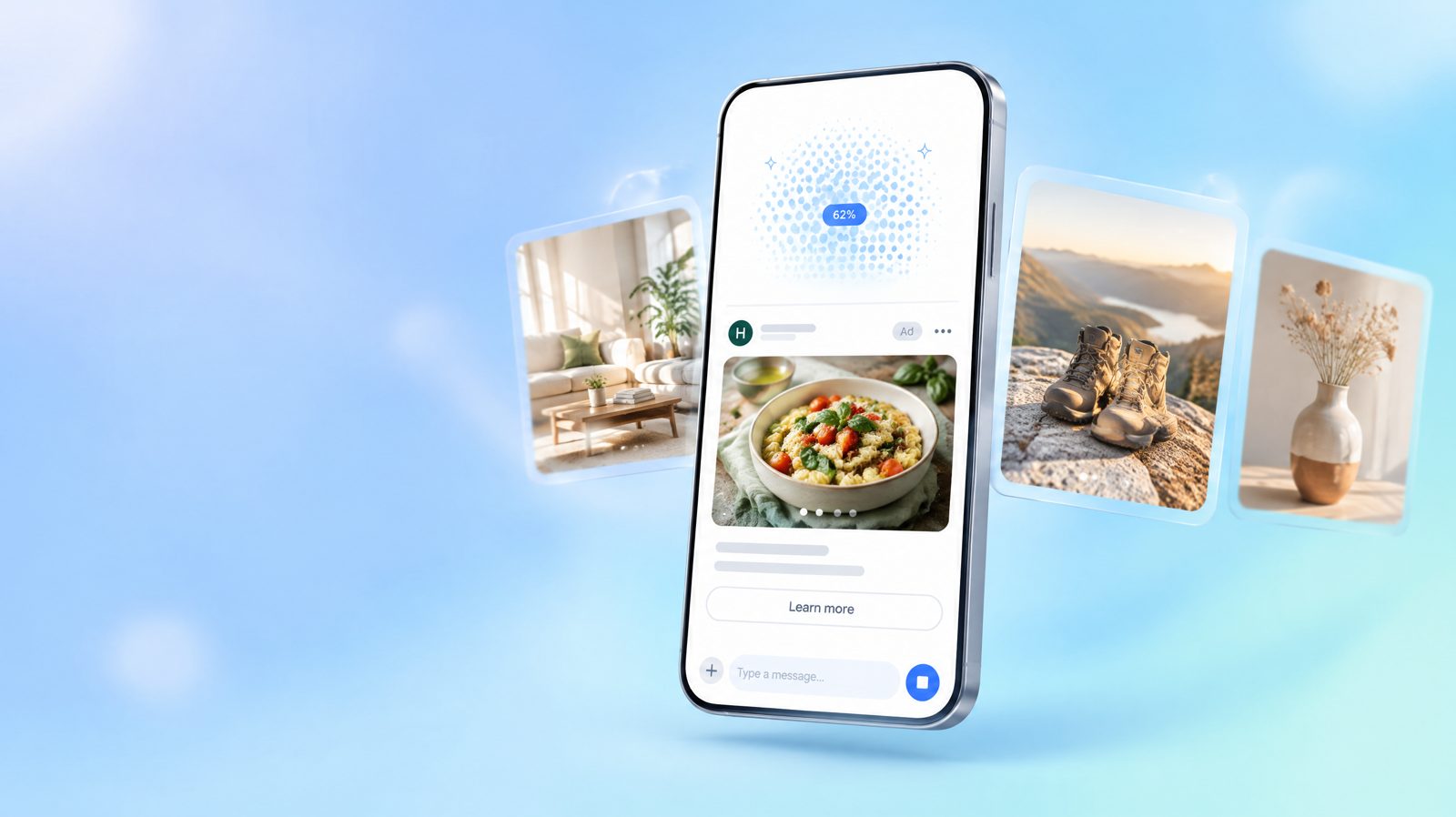
Short answer: ChatGPT visual ads are a new image-led ad format that OpenAI announced on 5 October 2026. The ad uses one or more images to show product inspiration, the product in use, or the experience it makes possible, with an advertiser name, a clear "Ad" label, a headline and a Learn more button. The first test places these ads while ChatGPT is generating an image for users on the Free and Go plans, in the US, with an initial group of advertisers, starting later in October 2026. OpenAI says the ad stays separate from the image being created, and that advertising does not influence ChatGPT's answers. The same announcement widened the measurement stack around every ChatGPT ad. It added data onboarding through Hightouch, Tealium and LiveRamp, ten attribution partners across web and app (AppsFlyer, Triple Whale, Adjust, DV Rockerbox, Northbeam, Branch, Singular, Kochava, Airbridge and Tenjin), full-funnel partners Fospha, Measured and INCRMNTAL, and geo-based incrementality experiments with Haus, Measured and WorkMagic. On brand safety, it made Negative Phrases available to qualifying advertisers and opened brand-suitability pilots with DoubleVerify and Integral Ad Science.
This guide is written for the people who will have to act on the announcement: performance marketers deciding whether to request access, creative teams who will need an image library ready, analysts who now have a list of twenty-plus measurement vendors to sort through, and brand-safety leads who want to know what "Negative Phrases" and the DoubleVerify and IAS pilots actually change. The announcement is about 900 words long. It contains four separate product changes, each with its own owner, budget line and timeline. We take each one in turn, say what is confirmed and what is not, and turn it into a checklist you can work through.
If you have never seen a ChatGPT ad, start with What Are ChatGPT Ads? and the ChatGPT ads examples gallery, then come back. If you are already running campaigns, skip to the section you need. The table of contents follows the four parts of the announcement: the visual format, measurement, brand safety, and what to do next.
What OpenAI announced on 5 October 2026
OpenAI published two documents on the same day. The main announcement on openai.com, titled Building advertising for the way people use AI, introduces the visual format and summarises the measurement and brand-safety changes. A companion post on the OpenAI Ads Blog, More ways to measure ChatGPT Ads, goes deeper into measurement. It adds details the main post leaves out: brand-lift testing with Kantar and Cint, a 52.7% figure for how quickly view-through conversions happen, and a 2.3× incrementality multiple for the wellness brand Dose. Read both. Most coverage so far has only used the first.
| Change | What OpenAI said | Status on 16 Oct 2026 | Who on your team owns it |
|---|---|---|---|
| Visual ad format | Image-led ads showing product inspiration, usage or experiences; first tested during image generation | Test starting later in October 2026, US, Free and Go users, initial advertiser group | Creative, brand, paid media |
| Data onboarding integrations | Hightouch, Tealium and LiveRamp make it easier to send conversion data from existing systems | Announced as available | Data engineering, marketing ops |
| Attribution partners | AppsFlyer, Triple Whale, Adjust, DV Rockerbox, Northbeam, Branch, Singular, Kochava, Airbridge, Tenjin, covering Conversions API, reporting and click attribution | Announced as supported | Analytics, growth, app marketing |
| Full-funnel and advanced measurement | Fospha, Measured, INCRMNTAL | Announced as partnerships | Analytics, finance |
| Incrementality | Geo-based experiments with Haus, Measured and WorkMagic; OpenAI says this work is "still in its early stages" | Exploratory partnerships | Analytics, finance, leadership |
| Brand lift | Early-stage testing with Kantar and Cint on brand resonance metrics (Ads Blog only) | Early-stage testing | Brand, insights |
| Negative Phrases | Available to qualifying advertisers for narrow, brand-specific placement requirements | Available to qualifying advertisers | Brand safety, paid media |
| Brand-suitability pilots | DoubleVerify and Integral Ad Science to evaluate how safeguards are applied, in a controlled testing environment, without accessing private conversations | Pilots in development | Brand safety, agency, procurement |
The context OpenAI gave for the announcement
OpenAI opened with scale. It says ChatGPT "reaches 1.2 billion people each week, making it the world's largest AI-native consumer platform." It also explained why it carries advertising at all: ads let it serve "a much larger market than subscriptions alone." That matters to advertisers for a practical reason. Ads are part of how OpenAI funds free access, and they are not a side project. A company that says advertising is "a strength of our business" is likely to keep investing in formats, measurement and controls. That is what this announcement does.
The post also repeats the ads principles that have applied since launch: ChatGPT's answers stay independent, conversations stay private, and users stay in control. They are worth restating because each new feature in this release was designed to fit them. The visual format sits apart from the user's image. Measurement partners work with conversion data the advertiser already holds, not with conversations. The brand-safety pilots run in a controlled testing environment, so the evaluators do not read anyone's chats. Once you see that pattern, it is easier to predict what OpenAI will and will not build next. Our news and rollout timeline tracks how those principles have shaped each release since the first test.
Why this announcement matters more than its length suggests
Three things change for advertisers.
- Images become a primary storytelling tool. Until now, a standard ChatGPT ad was mostly text: a title of up to 50 characters, a description of up to 100 characters, and a small square image (OpenAI help centre; see our examples guide for the full spec). The visual format puts the image first. Brands whose value is easier to see than to describe, such as interiors, fashion, travel, food and experiences, gain a format built for them.
- Measurement moves from "build it yourself" to "use what you already have." Earlier, a server-side conversion stream meant writing a Conversions API integration, or using one of a few pipelines (Hightouch, Triple Whale and WorkMagic arrived in August 2026). Now most mid-market and enterprise stacks have a supported route, because the partner list covers the main mobile measurement partners, the main DTC attribution tools and three customer-data platforms.
- Causal proof is on the roadmap. Attribution tells you which conversions followed an ad. Incrementality tells you which conversions would not have happened without it. Geo-based experiments with named partners give finance teams the evidence they ask for before they move budget out of search and social.
What the visual ad format looks like
OpenAI published one mockup with the announcement. It shows two ChatGPT mobile screens, each with a visual ad from a fictional advertiser called Heirloom Grocery, shown while an image is being generated. The two screens show two layouts. Comparing them tells you most of what is knowable about the format so far.
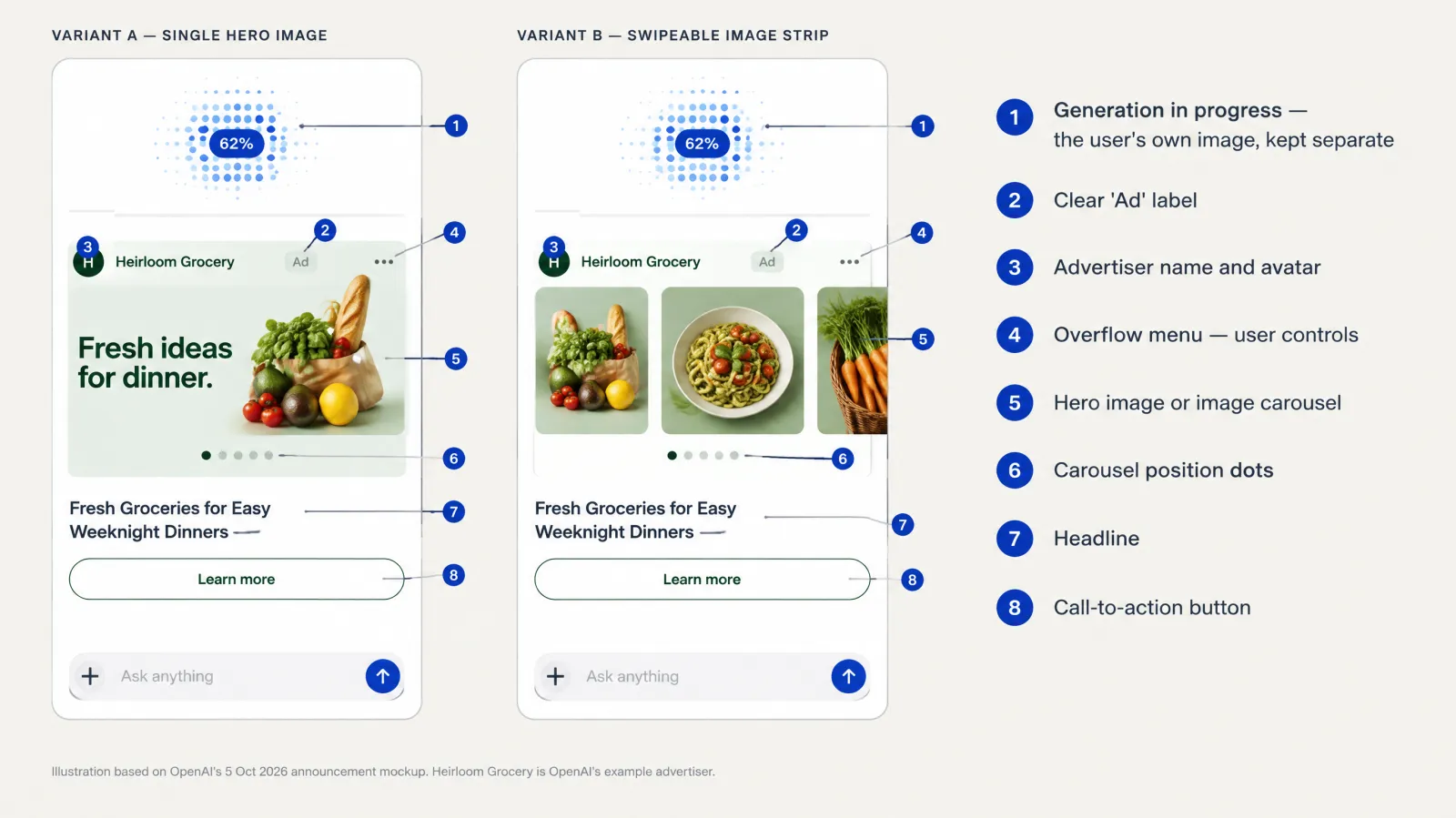
The eight components
| # | Component | What the mockup shows | Why it matters to you |
|---|---|---|---|
| 1 | Generation indicator | A cloud of blue halftone dots with a percentage badge (62%) above the ad, the user's image still rendering | Your ad appears while the user waits. The image they asked for stays the focus |
| 2 | "Ad" label | A small rounded label at the top right of the unit | Clear labelling is fixed, and OpenAI repeats that ads will be "clearly labeled" |
| 3 | Advertiser identity | A circular avatar (a dark green "H") and the name "Heirloom Grocery" | Brand recognition rests on a small avatar and your account name, so both need to be clean. See our guide to account, brand and legal names |
| 4 | Overflow menu | A three-dot icon beside the label | User controls such as hiding the ad or seeing why it appeared, in line with the principle that users stay in control |
| 5 | Image or images | Layout A: one large hero image with designed type ("Fresh ideas for dinner.") over a photo of groceries. Layout B: a swipeable strip of square photos (a grocery bag, a bowl of pasta, a basket of carrots cut off at the edge) | The creative carries the story. Layout A rewards a designed key visual, and layout B rewards a sequence |
| 6 | Carousel position dots | Five pagination dots on the hero image in layout A | The hero layout can also hold several images. Plan a sequence, not a single shot |
| 7 | Headline | "Fresh Groceries for Easy Weeknight Dinners" below the image, over two lines | The text line still matters. It names the benefit the images show |
| 8 | Call to action | A pill-shaped Learn more button | The click goes to your landing page, so tracking and page quality decide what happens next |
Two layouts, two creative philosophies
Layout A, the single hero card, works like a magazine advertisement. One designed key visual carries the idea, the colour field matches the brand (Heirloom Grocery uses a mint-to-sage green), and the headline in the image does the persuading. It suits brands with a strong visual identity and a single idea to land, such as a seasonal campaign, a new collection or a flagship product.
Layout B, the swipeable strip, works like a short visual story. Each square tells part of it: the ingredients, the finished dish, the fresh produce. The cropped third image shows the user there is more to see. It suits brands with range, such as a retailer with many products, a travel brand with many destinations or a service with several steps.
The five dots in layout A suggest the two are not fully separate: a hero layout can probably hold several images too. Until specifications are published, the practical takeaway is to prepare both a hero key visual and a three-to-five image sequence for every campaign concept. We come back to this in the creative section.
How it differs from the ads you already run
| Dimension | Standard ChatGPT ad | Product feed ad | Multi-product carousel | Visual ad (new) |
|---|---|---|---|---|
| Where it appears | Below relevant conversations | Below relevant shopping conversations | Below relevant shopping conversations | During image generation (first test) |
| Primary creative | Title (≤50 chars) and description (≤100 chars) | Feed fields: title, description, price, image | Several products from one advertiser | One or more images |
| Image role | Small square thumbnail (≥256×256, PNG or JPG) | Product photo from the feed | Product photos, one per card | The main storytelling element |
| Best suited to | Search-like intent, services, B2B, lead generation | Retail catalogs | Retail range and comparison | Inspiration, lifestyle, experiences |
| Who supplies the creative | Advertiser writes copy and uploads an image | The feed generates the ad | The feed generates the ad | Advertiser supplies the images (specification not yet published) |
| Status (16 Oct 2026) | Generally available in Ads Manager | Generally available | In testing since August 2026 | Test with initial US advertisers |
Sources: OpenAI help centre for the standard ad specification; our product feed guide and reporting guide for feed ads and carousel card metrics; OpenAI's 5 October 2026 announcement for the visual format.
Where visual ads appear, and who sees them
OpenAI's wording is precise, so here it is in full: "Initially, we'll test this new ad format during image generation in ChatGPT for users on the Free and Go plans. Ads will be clearly labeled, and remain separate from the image being created." Four constraints follow from that sentence, and each affects planning.
| Constraint | What it means | Planning implication |
|---|---|---|
| During image generation | The first placement is the wait while ChatGPT renders an image, not the text conversation | Reach is limited to people using image generation, so volume will be lower than for standard ads at first |
| Free and Go plans | The same audience rule as other ChatGPT ads; Plus, Pro and Business users do not see ads | Your team on paid plans will probably not see the test ads, so ask OpenAI or your agency for previews |
| US first | "Testing will begin later this month in the US" | Non-US advertisers should prepare now, but should not plan budget around the format yet |
| Initial group of advertisers | A limited test, not a self-serve launch | Access is by invitation or request. Get your account, tracking and creative in order now so you are a credible candidate |
Why OpenAI tests in image generation first
We think there are three good reasons, and they help explain where the format may go next. This section is our analysis, not OpenAI's stated reasoning.
The wait is real and visible. Generating an image takes several seconds, and the interface shows progress while it happens. In the mockup the progress badge reads 62%. That screen space has a natural "while you wait" role. An ad there competes only with a progress indicator, not with the answer, so it does not interrupt the user's flow.
Image prompts carry visual intent. Someone asking for "a cosy Scandinavian living room with a green velvet sofa," "a summer wedding table setting in terracotta and sage," or "what my backyard would look like with a pergola and string lights" is already picturing something. A visual ad that shows a real product fitting that picture is relevant in the way OpenAI describes when it says the format helps people "imagine how products and services could fit into their lives."
Separation is easy to see. The user's generated image and the advertiser's image are clearly different things on screen: one is the output they asked for, the other is a labelled unit below it. That makes the "separate from the image being created" promise easy for users to see, which matters a great deal to user trust in a new placement.

What "separate from the image being created" means for advertisers
This is the most important constraint for creative teams, and the most often misread. Your brand will not appear inside the user's generated image. There is no product placement in AI-generated content, and no sponsored style or object added to what the user asked for. The ad sits in its own labelled unit. Any creative concept that depends on the user's image is ruled out by design. Examples include "our sofa appears in their living room," "our logo appears on their poster," or "the generated image is styled in our colours."
What you can do is show your own images next to theirs, chosen because they match the kind of thing being imagined. That is a contextual placement, not personalised content, and it is how the rest of ChatGPT advertising already works. Ads are matched to the conversation, and the conversation is not changed to suit the ad. Our context hints guide explains how that matching works for standard ads. Expect the same idea to apply to visual ads once targeting details are published.
"Advertising does not influence the answers"
The announcement says: "As with our other ad formats, advertising does not influence the answers ChatGPT provides." For the visual format, that extends naturally to the generated image. Buying a visual ad will not make ChatGPT generate images that favour your products, your colours or your style. Treat any vendor who suggests otherwise as unreliable. The organic and paid layers stay separate here, as they do in shopping, where OpenAI says organic product results are "selected independently" and are not influenced by advertising. Our ecommerce guide covers that organic-versus-paid split in detail.
Confirmed, not yet published, and our expectations
New ad formats attract speculation, and some of it becomes "fact" through repetition. Here is a strict separation of what is confirmed, what has not been published, and what we expect, clearly labelled as expectation.
| Question | Confirmed by OpenAI (5 Oct 2026) | Not yet published | GPT Ads AI expectation (not confirmed) |
|---|---|---|---|
| What is the format? | A visual ad format using images that show product inspiration, usage or experiences | Exact layouts allowed in production | Both a single hero and a multi-image strip, as in the mockup |
| Where does it appear? | During image generation, initially | Other placements | Broader placements later, once the test proves out |
| Who sees it? | Free and Go plan users | Age or other exclusions specific to this format | The same exclusions as other ChatGPT ads, including users predicted to be under 18 |
| Which countries? | US first | Timing for other markets | Gradual expansion to markets already open for standard ads |
| Which advertisers? | An initial group | How to apply or qualify | Invitation and managed accounts first, then self-serve |
| Is it labelled? | Yes, "clearly labeled" | Label wording | "Ad," as in the mockup |
| Does it affect answers or images? | No | n/a | n/a |
| Creative specification | Not published | Image size, count, file types, text overlay rules, headline length | Square and landscape assets, several images, review of text-heavy images |
| Pricing and bidding | Not published | Auction type, billing event, minimums | The same relevance-weighted auction as other units; CPM or CPC billing |
| Targeting | Not published | Whether context hints or image-prompt context are used | Contextual matching to the image request, without personal profiling |
| Reporting | Not published | Format-level metrics, image-level metrics | Impressions, clicks and conversions; possibly image-level engagement like carousel cards |
| Measurement | All ChatGPT Ads benefit from the expanded partner ecosystem | Whether visual-ad view-through is treated differently | View-through matters more for this format, because it is upper-funnel |
Where the October update fits in the ChatGPT Ads timeline
The October announcement makes more sense as the next step in a fast sequence than as a one-off. Each release has added a layer: first the ability to buy, then shopping, then measurement and automation, then reach. The visual format and the measurement ecosystem are the next layer. Dates below come from OpenAI's announcements and documentation, as tracked in our news timeline.
| When | What shipped | What it added for advertisers |
|---|---|---|
| 5 May 2026 | Self-serve Ads Manager Beta opens to US advertisers of all sizes, with CPC bidding | The ability to buy |
| June 2026 | Product feed campaigns: catalogs of up to 2 million products generate ads | Shopping at scale |
| August 2026 | Conversion-optimised bidding (oCPC) in beta for feed campaigns; automatic advanced matching by default; pixel diagnostics; Hightouch and Triple Whale integrations; multi-product carousel in testing | Better signals and optimisation |
| Late August 2026 | Maximize results bidding; platform targeting (iOS app, Android app, web); one-day view-through conversions; WorkMagic integration; Brazil and Mexico live | Automation, view-through, new markets |
| September 2026 | Ads Manager plugin for ChatGPT and Codex; custom audience upgrades; expanded matching fields; carousel card metrics; flexible attribution windows; rollout to select countries in Europe, India, the Middle East and North Africa | Control, reporting and reach |
| 5 October 2026 | Visual ad format (test); 20+ measurement partners; geo incrementality; Negative Phrases; DV and IAS pilots; Kantar and Cint brand-lift testing | Visual storytelling, measurement through existing systems, brand confidence |
The pattern
Three things stand out.
- Formats are following intent. Text ads came first for search-like questions, feed ads for shopping, carousels for comparison, and now visual ads for imagination. Each new format matches a different thing people do in ChatGPT. The next ones will probably follow other common activities.
- Measurement is catching up with the media. Through the summer, OpenAI built the basics (Pixel, Conversions API, matching, event quality, view-through). October connected those basics to the outside measurement world. For a new channel, that pace is unusual.
- Brand safety is moving from "trust us" to "check us." Platform guardrails existed from the start. Advertiser-controlled exclusions (Negative Phrases) and independent evaluation (DV and IAS) add the control and verification large brands require.
Research: finding what your customers imagine
Before briefing a single image, find out what your customers picture. The visual format rewards brands whose ads match what people are imagining at that moment, so the research is about image requests, not keywords. You cannot see other people's ChatGPT conversations, and you should not try. But there are four legitimate ways to build a strong picture.
| Method | How to do it | What you get |
|---|---|---|
| Ask your customers | Add one question to post-purchase surveys: "Before you bought, what were you picturing or planning?" | The real end states and projects behind purchases, in customers' own words |
| Read your search and site-search data | Look for visual and project language in queries: "ideas," "inspiration," "makeover," "what to wear," "how to style" | Which projects bring people to you, and at what volume |
| Study visual platforms | Look at popular boards, saved ideas and trending styles in your category on visual discovery platforms | Styles, palettes and scenes people are collecting |
| Prompt ChatGPT yourself | Generate images the way a customer would ("a small balcony garden for a rented flat") and note what the outputs look like | A sense of the visual vocabulary of generated images in your category, and the moments when your product would fit |
Turning research into a request map
Group what you find into request themes, then map each theme to a product, an image job and a concept. Here is an illustrative map for a fictional garden-furniture brand:
| Request theme | Example request (illustrative) | Product | Image job | Concept |
|---|---|---|---|---|
| Small-space outdoor living | "A tiny city balcony made cosy with plants and lights" | Folding bistro set | Inspiration | "Balcony evenings" |
| Entertaining outdoors | "A summer garden party table for ten" | Extending outdoor dining table | Experience | "Long table, long evenings" |
| Weather-proofing worries | "Garden furniture that survives British rain" | Teak range with covers | Usage | "Built for real weather" |
| Garden makeover | "My plain lawn turned into a patio with a fire pit" | Fire pit and lounge set | Inspiration → experience | "Your garden, after dark" |
The map becomes your creative plan, and later it shapes how you write relevance signals. If visual ads use something like context hints, your request themes will translate directly into hints. Our free context hint generator can draft them.
A note on privacy and research
Everything above uses data you own, data people chose to share publicly, or your own experiments. Do not buy "ChatGPT prompt data" from anyone claiming to sell what users type. OpenAI's principles say conversations stay private, and any vendor claiming otherwise is either wrong or doing something you do not want your brand associated with.
Which businesses visual ads suit, and which they don't
Image generation is a creative, imaginative activity. People use it to picture rooms, outfits, trips, parties, gardens, logos, products and scenes. The businesses best placed for visual ads are the ones whose products show up in those pictures. The table below maps common image-generation use cases to the advertiser categories that fit them naturally. It is our planning framework, not an OpenAI targeting list.
| What people generate images of | Example image request (illustrative) | Natural advertiser fit | Strongest image job |
|---|---|---|---|
| Home interiors and renovation | "A small kitchen with sage green cabinets and brass hardware" | Furniture, decor, paint, flooring, kitchen and bath, home-improvement retail | Inspiration, then usage |
| Gardens and outdoor living | "My patio with a pergola, string lights and lots of plants" | Garden centres, outdoor furniture, landscaping services, lighting | Inspiration |
| Fashion and personal style | "A capsule wardrobe for an autumn trip to Paris in neutral colours" | Apparel, footwear, accessories, eyewear, resale | Usage (worn, styled) |
| Travel and places | "A cabin in the Norwegian fjords at sunset" | Tour operators, hotels, rentals, airlines, travel gear | Experience |
| Food and entertaining | "A rustic Thanksgiving table for twelve" | Grocery, meal kits, cookware, tableware, wine and spirits where permitted | Inspiration and usage |
| Events and celebrations | "A boho birthday party setup with balloons in terracotta tones" | Party supplies, venues, florists, stationery, rentals | Experience |
| Beauty and wellness | "A spa-like bathroom with a freestanding tub" or "a calm bedtime routine" | Bath and body, sleep products, home spa, fitness equipment (check policy for health claims) | Experience and usage |
| Small business branding | "A logo for my bakery called Rise and Crumb" | Print, packaging, website builders, signage, merch printing | Usage (mock-ups on products) |
| Pets | "My golden retriever as a Renaissance painting" | Pet supplies, pet insurance, pet photography, grooming | Usage and experience |
| Cars and mobility | "A camper van converted for weekend trips" | Auto accessories, van conversion, bikes and e-bikes, rental | Experience |
| Education and hobbies | "A cosy reading nook" or "a watercolour of a lighthouse" | Books, art supplies, courses, craft kits, instruments | Usage |
Where fit is weaker
Some categories will find the image-generation placement less natural, even if they do well with standard ChatGPT ads:
- Complex B2B software. People rarely generate images while choosing a data warehouse. B2B brands should keep standard ads and context hints as their main lever, and watch for visual placements beyond image generation.
- Commodity services sold mainly on price. A plumber or a tax-preparation service has little to show in an inspirational image. The exception is the "after" state, such as a finished bathroom or a calm, organised home office, which can work for renovation and organisation services.
- Regulated categories with image restrictions. Health, finance and anything age-gated face stricter rules on what images may depict. Check OpenAI's advertising policies for your category and market before investing in creative. OpenAI's placement guardrails also keep ads out of sensitive contexts, which reduces available inventory for some categories.
Fit by business model
| Business model | Fit with visual ads | Why | First test to run when access opens |
|---|---|---|---|
| DTC ecommerce, lifestyle categories | High | Products feature in the pictures people imagine; strong existing imagery | Inspiration sequence for the hero category, measured with a DTC attribution partner |
| Multi-category retailer | High | Range suits the swipeable strip | Category-level strips matched to seasonal image requests |
| Travel and hospitality | High | Experience imagery is the product | Experience-led hero images by destination |
| Local services (home improvement) | Medium | "After" imagery works; reach is national at first | Before-and-after style experience imagery, lead-gen tracking |
| Consumer apps | Medium | The app is easier to show in a life moment than in a screenshot | Experience imagery, measured through a mobile measurement partner |
| B2B SaaS | Low to medium | Few image-generation contexts | Hold; keep standard ads and context hints |
| Financial services | Low to medium | Policy limits, little to show | Hold unless the product is experiential, such as travel rewards |
Creative strategy: the three jobs an image can do
OpenAI named three things the images in a visual ad can show: "product inspiration, product usage, or the experiences they make possible." That short phrase is the most useful creative brief in the announcement. Each one is a different job, with different images, different metrics and a different place in the purchase journey.
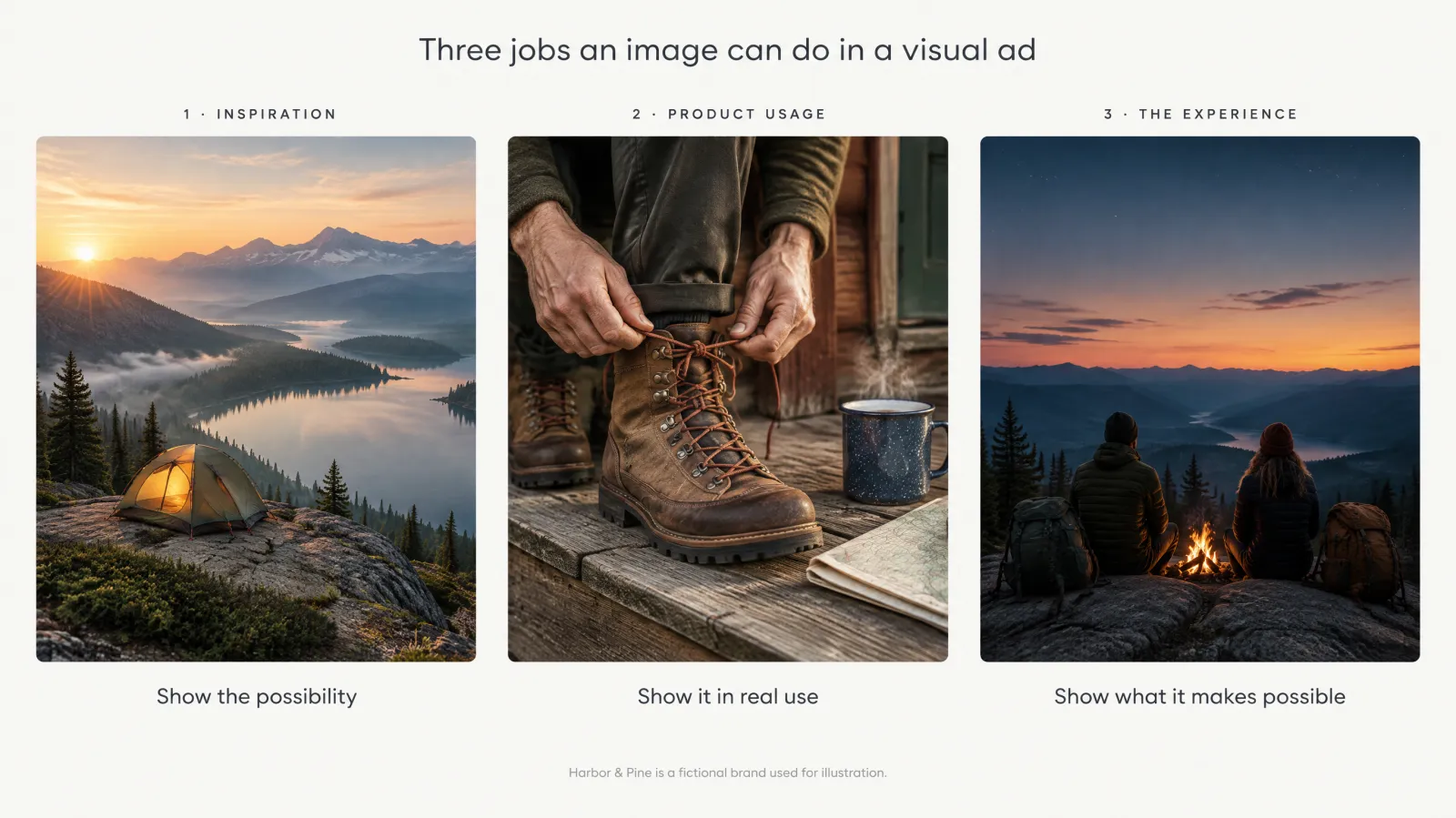
Job 1: Inspiration — show the possibility
What it is. An aspirational image of an end state the user might want: a finished room, a styled table, a breathtaking view. The product may be part of the scene rather than the subject.
When it fits. Early in the journey, when someone is exploring possibilities and has not narrowed down to products. Image generation is often exactly this stage: the person is literally visualising what could be.
How to judge it. Engagement (clicks, card swipes where reported), new-visitor share, assisted and view-through conversions. Do not judge inspiration creative on last-click CPA alone. That is the fastest way to kill the format's best use.
Brief template.
| Brief field | What to specify | Example (fictional home decor brand) |
|---|---|---|
| End state | The scene the user wants to reach | A calm, light-filled living room on a Sunday morning |
| Hero product | The product that makes it possible | The brand's linen slipcover sofa in oat |
| Product prominence | Where the product sits in the frame | Sofa fills the left third, in sharp focus |
| Mood | Feelings the image should create | Calm, unhurried, warm |
| Light and colour | Time of day, palette | Soft morning window light; oat, sage, warm oak |
| What to avoid | Clichés and policy risks | Empty showroom look; impossible perfection; claims in overlay text |
| Sequence role | Position in the strip | First card, to stop the swipe |
Job 2: Product usage — show it in real use
What it is. The product being used, worn, cooked with, assembled or lived with. Hands lacing the boot, the jacket on a commuter in the rain, the cookware on the hob with steam rising.
When it fits. In the middle of the journey, when someone is checking whether a product does what they need. Usage imagery answers silent questions such as "how big is it really," "how does it look on a person," and "is it practical."
How to judge it. Click-through rate, landing-page engagement, add-to-cart and checkout rates. Usage imagery should convert closer to the click than inspiration imagery does.
Brief template.
| Brief field | What to specify | Example (fictional cookware brand) |
|---|---|---|
| Use moment | A specific, recognisable moment of use | A weeknight stir-fry for two, mid-toss |
| Proof point | The attribute the image proves | Even heat, non-stick release, fits a standard hob |
| Scale cue | Something that shows real size | A hand on the handle, a familiar ingredient |
| Realism | How lived-in the scene should be | A real home kitchen, a little mess, steam |
| Detail shot | A second image for the strip | Close-up of the riveted handle and pan base |
| What to avoid | Policy and trust risks | Performance claims you cannot substantiate; unrealistic results |
| Sequence role | Position in the strip | Cards two and three, after the inspiration hook |
Job 3: The experience — show what it makes possible
What it is. The life outcome the product or service enables: the trip, the celebration, the calm evening, the confident first day. The product may barely appear. The feeling is the subject.
When it fits. Travel, hospitality, events, experiences, services and premium brands, where the purchase is emotional and the outcome is the product.
How to judge it. Brand-lift studies, where available (OpenAI says Kantar and Cint are in early-stage testing), branded search and direct-traffic baselines, geo-lift experiments, and view-through conversions with longer consideration windows.
Brief template.
| Brief field | What to specify | Example (fictional boutique hotel) |
|---|---|---|
| Moment | The emotional peak of the experience | First coffee on the balcony above the harbour at sunrise |
| Who is in the frame | People, seen how | Two guests from behind, faces not shown |
| Place cues | What makes it unmistakably yours | Your balcony railings, your view, your linen |
| Time and weather | When the scene happens | Early morning, clear sky, soft mist |
| Sound and smell, implied | Sensory hints | Steam from cups, a breeze in the curtains |
| What to avoid | Misleading imagery | A view from a room category you are not selling; heavy retouching |
| Sequence role | Position in the strip | Hero card for awareness; closing card for sequences |
Sequencing a multi-image strip
If the format allows several images (both mockup layouts suggest it does), sequence them so each swipe answers the next question in the user's mind. Here is a structure we recommend, as GPT Ads AI guidance and not an OpenAI rule:
- Hook (inspiration). The most arresting image, the one that earns the first glance during the wait.
- Proof (usage). The product in real use, so the user can see how it fits.
- Detail (usage). A material, feature or scale close-up that answers "is it good?"
- Range (optional). Colours, sizes or variations, if your offer has range.
- Payoff (experience). The life moment the purchase leads to, so the last swipe leaves a feeling and not a spec.
Headline writing for visual ads
The headline sits under the images in both mockup layouts. It reads "Fresh Groceries for Easy Weeknight Dinners," which is a benefit statement in plain language with no exclamation marks, no hype and no superlatives. Until OpenAI publishes a character limit, write two lengths: one at about 40 characters and one at about 60 characters. Make sure the shorter one makes sense on its own.
| Headline pattern | Example (illustrative) | When to use |
|---|---|---|
| Benefit + occasion | "Fresh Groceries for Easy Weeknight Dinners" | Everyday products tied to a routine |
| Outcome + qualifier | "Linen Sofas Made for Real Living Rooms" | Inspiration-led creative |
| Specific proof | "Waterproof Boots Tested on 1,000 Trail Miles" | Usage-led creative, only if substantiated |
| Experience + place | "Sunrise Over the Harbour, From Your Balcony" | Experience-led creative |
| Problem + solution | "Small Kitchen? Cabinets That Make Room" | Renovation and space-limited categories |
Write headlines the way OpenAI's own example is written: concrete, calm and specific. ChatGPT users are mid-task and in a reflective mood. Hard-sell copy that might work in a social feed jars with the setting. Our ChatGPT ad creative service uses the same principle across all formats: conversational, specific, never shouty.
Text in images: plan for both outcomes
Layout A in OpenAI's mockup has headline text set into the image ("Fresh ideas for dinner."). That is a strong look, but it is a choice that ad platforms often regulate. Some limit how much of an image can be text, and some review text overlays for claims. Until the specification is out:
- Produce a clean version of every key visual with no overlay text.
- Produce an overlay version with a short phrase (three to five words), positioned so cropping cannot cut it.
- Keep claims out of overlays. Prices, discounts, "best," "#1" and health or performance claims bring review and substantiation risk. Put offers on the landing page.
- Keep your logo small or absent in the image. The advertiser name and avatar already identify you, and repeating a large logo wastes space.
Using AI to produce visual ad creative
Many advertisers will use generative image tools to produce or extend creative for an ad that appears during AI image generation. That is legitimate and efficient, but three disciplines matter:
- Show the real product. Generated scenes are fine. A generated product that differs from what you ship is a misrepresentation risk, and it creates returns, complaints and policy trouble. Composite real product photography into generated environments, or generate environments and photograph the product to match.
- Check every detail. Generated images still make mistakes with hands, text, reflections and physical plausibility. A six-fingered hand in an ad that sits next to the user's own AI image is a bad look.
- Keep provenance records. Know which assets are generated, edited or photographed. Disclosure expectations for AI-generated advertising content are changing across markets, and you will want the record.
This guide's own illustrations were generated with an image model from detailed written briefs, and every caption says so. Detailed briefs, like the templates above, are what separate on-brand generated imagery from generic stock-looking output.
Image direction checklist
| Check | Pass condition |
|---|---|
| Reads at small size | The main subject is recognisable at phone-thumbnail size |
| One focal point per image | The eye lands on one thing first |
| Brand colour presence | The palette is consistent across the strip and recognisably yours |
| Real product accuracy | Colour, proportions and details match what ships |
| Inclusive, respectful depiction | People are shown naturally and diversely, without stereotypes |
| No unverifiable claims | No performance, health or price claims in the image |
| Safe crop zones | Nothing important within the outer 10% of the frame |
| Works without overlay text | The image communicates on its own |
| Sequence logic | Each image answers the next question |
| Matches the landing page | The first screen of the landing page shows what the ad showed |
Vertical playbooks for visual ads
The three image jobs apply everywhere, but each industry uses them differently. Below are five playbooks for the categories we think fit best. Each covers the image requests to align with, a starter sequence, the measurement approach and the risks. These are GPT Ads AI recommendations, with illustrative examples throughout.
Home, interiors and furniture
Image requests to align with. Room makeovers, colour schemes, "what would my room look like with…," small-space solutions, seasonal styling.
Starter sequence. (1) A finished room in a recognisable style, with your hero product central; (2) the product in close-up, showing material and texture; (3) the product in a second room style, to show versatility; (4) a lived-in moment, such as a family on the sofa or reading in bed.
Measurement. Long consideration (weeks to months for furniture), so use a 30-day click-through window, view-through on, and a geo test before scaling. Track showroom visits or sample requests as leading indicators.
Risks. Colour accuracy (returns follow if the sofa is "oat" in the ad and "grey" on arrival), and scale (show a person or familiar object for size).
| Element | Recommendation |
|---|---|
| Lead job | Inspiration |
| Headline style | Outcome + qualifier: "Linen Sofas Made for Real Living Rooms" |
| Landing page | A shoppable room page matching the ad image, not a category grid |
| Conversion events | order_created; sample or swatch requests as secondary |
Fashion, footwear and accessories
Image requests to align with. Outfit ideas, capsule wardrobes, "what to wear to…," travel packing, seasonal looks.
Starter sequence. (1) A styled outfit in context (city street, office, wedding); (2) the hero item on a model in motion; (3) a detail shot of fabric, stitching or hardware; (4) the item styled a second way.
Measurement. Shorter cycle, so a 7- to 14-day click-through window works. Fashion has high return rates, so measure net revenue after returns where possible, not gross orders.
Risks. Representation (show a range of body types and ages naturally), and accuracy of fit and colour.
| Element | Recommendation |
|---|---|
| Lead job | Usage (worn and styled) |
| Headline style | Occasion + benefit: "Wrinkle-Free Shirts for Travel Days" |
| Landing page | A product page with the ad's styling shown first, or a "shop the look" page |
| Conversion events | order_created, with value net of expected returns if you can model it |
Travel and hospitality
Image requests to align with. Destinations, dream trips, "a cabin in…," honeymoon ideas, family holidays, itineraries.
Starter sequence. (1) The signature view or moment of the destination or property; (2) the room or experience itself; (3) a detail that makes it unmistakably yours (the pool, the breakfast, the guide); (4) the emotional payoff, such as a sunset dinner or a child's first snorkel.
Measurement. Long and seasonal consideration, with bookings often made on another device or through an online travel agent. Use a 30-day click-through window, view-through on, and branded search by origin market as a proxy. Geo tests can work well when you split by origin market, not destination.
Risks. Accuracy (do not show a view from a room category you are not selling), and seasonal mismatch (a beach in a winter-storm image request rarely lands).
| Element | Recommendation |
|---|---|
| Lead job | Experience |
| Headline style | Experience + place: "Sunrise Over the Harbour, From Your Balcony" |
| Landing page | A dates-first booking page for the property or package shown |
| Conversion events | Booking completed; enquiry or itinerary request as secondary |
Grocery, meal kits and food brands
OpenAI chose a grocer for its own example, which suggests this is a category it expects to suit the format. Food is one of the most visual purchase categories and fits everyday planning moments.
Image requests to align with. Recipe ideas, dinner parties, table settings, "a healthy lunch box," holiday menus.
Starter sequence. Follow OpenAI's own example: (1) the ingredients, a bag of fresh produce; (2) the finished dish; (3) fresh produce in detail. Optionally add (4) the table and the people eating, for an experience close.
Measurement. Short cycle, often repeat purchase. Use 7-day click-through, view-through on, and judge on first-order CPA plus 60- to 90-day repeat rate. Meal kits should measure subscription retention, not just the first box.
Risks. Food styling that looks unachievable, and health claims in grocery and supplement categories (check policy per market).
| Element | Recommendation |
|---|---|
| Lead job | Inspiration, then usage |
| Headline style | Benefit + occasion: "Fresh Groceries for Easy Weeknight Dinners" |
| Landing page | A recipe or bundle page with the ingredients in the image ready to add to basket |
| Conversion events | order_created or subscription start; repeat order tracked in CRM |
Home improvement and local services
Image requests to align with. Kitchen and bathroom renovations, garden landscaping, exterior paint colours, home offices, extensions.
Starter sequence. (1) The finished space, the outcome customers want; (2) a detail that shows craftsmanship; (3) a before-and-after pair, only if accurate and representative; (4) the homeowner enjoying the space.
Measurement. Lead generation, so track lead_created and connect CRM outcomes (quotes, signed jobs) through a data-onboarding partner such as LiveRamp or Hightouch. Local service businesses must check whether the test's geographic delivery suits their service area.
Risks. Before-and-after imagery that implies guaranteed outcomes; using portfolio images from projects that are not yours.
| Element | Recommendation |
|---|---|
| Lead job | Experience (the finished space) |
| Headline style | Problem + solution: "Small Kitchen? Cabinets That Make Room" |
| Landing page | A project gallery with a short quote form |
| Conversion events | lead_created; signed-job value sent later from CRM |
Landing pages that continue the visual story
A visual ad sets a visual expectation. If someone taps Learn more after a sunlit linen bedroom and lands on a grid of 200 product thumbnails, the story breaks. That costs conversions, and it is easy to avoid.
Five rules for visual-ad landing pages
- Match the first screen to the ad. The first thing visible on mobile should be the image (or a close relative of it) the user just saw, with the product named and the price visible.
- Keep the promise of the headline. If the ad said "Washed Linen for Slow Weekend Mornings," the landing page headline should echo it, not switch to a generic "Shop Bedding."
- Make the next step obvious. One primary action: add to basket, book, get a quote. Secondary options sit lower down.
- Load fast on mobile. ChatGPT is heavily mobile, and users arrive mid-task. Compress images, lazy-load anything below the fold, and test on a mid-range phone.
- Carry the Pixel and parameters through. Make sure the
oaiqPixel fires, and keep the click identifiers and UTM parameters intact through any redirects. Our UTM builder helps keep naming consistent.
Matching landing pages to image jobs
| Image job in the ad | Best landing page type | First screen should show |
|---|---|---|
| Inspiration | A curated "look" or collection page | The scene from the ad, with the products in it shoppable |
| Usage | A product detail page | The product in use, then the product details and price |
| Experience | A booking, package or story page | The experience moment, then how to get it (dates, price, book) |
What to measure on the landing page
| Metric | Healthy direction | What a problem suggests |
|---|---|---|
| Bounce rate from ChatGPT visual ads vs other ChatGPT ads | Similar or lower | Mismatch between ad image and page |
| Scroll depth | Most users pass the first screen | The first screen does not continue the story |
| Add-to-cart or lead-start rate | Close to your paid-social average | The offer or page is not converting inspiration into action |
| Page load time on mobile | Under about 2.5 seconds for main content | Heavy images or scripts losing impatient users |
How visual ads compare with visual formats elsewhere
Marketers will naturally compare ChatGPT's visual format with formats they already know from search, social and discovery platforms. The comparison helps for planning, as long as you keep in mind that the context is different: a person using ChatGPT is in the middle of a task they started, not scrolling a feed.
| Dimension | Social feed image and carousel ads | Search and shopping image formats | Visual discovery platforms | ChatGPT visual ads (first test) |
|---|---|---|---|---|
| User mindset | Passive browsing, entertainment | Active search with a query | Planning and saving ideas | Actively creating an image of something they imagine |
| Context signal | Interests, behaviour, audience data | Search query and shopping intent | Saved ideas and searches | The image request and conversation (matching details not yet published) |
| Personal targeting | Extensive audience targeting | Keyword and audience targeting | Interest and keyword targeting | Contextual; conversations stay private |
| Where creative competes | Organic posts from friends and creators | Other ads and organic results | Organic idea pins and images | A progress indicator, while the user waits |
| Measurement maturity | Very mature, with established tooling | Very mature | Mature | New, but launched with 20+ named partners |
| Brand-safety model | Per-placement verification | Query and site-level controls | Content-level controls | Platform guardrails, Negative Phrases, system-level DV and IAS evaluation |
Creative you can reuse, and creative you can't
| Asset from other channels | Reusable for ChatGPT visual ads? | Notes |
|---|---|---|
| Lifestyle photography (inspiration and experience) | Yes, often directly | Good inspiration and experience imagery travels well |
| Product-in-use photography | Yes | Check it still reads at small size |
| Social carousel sequences | Mostly | Remove social-native elements such as stickers, meme formats and creator captions |
| UGC-style selfie videos | No (stills only, as far as known) | The format is image-led; video has not been announced |
| Text-heavy promotional banners | Probably not | Discount-led overlays clash with the setting and may meet review limits |
| Search-ad copy | Partly, for headlines | Benefit-led search headlines can become visual-ad headlines |
Why the setting changes the creative
Social ads are designed to stop a scroll: high contrast, motion, a hook in the first second. Search ads answer a query in text. A ChatGPT visual ad does something else. It appears to someone who is in the middle of imagining something, while they wait. The best creative will probably feel like a suggestion that fits what they are imagining, not an interruption. Calm, beautiful, specific images that look like they belong in the same mood board as the user's own request. That is a different brief from "thumb-stopping," and it is why we recommend briefing visual-ad creative separately rather than resizing social assets.
Getting ready for access: a readiness checklist
The test begins with an initial group of advertisers. Access criteria have not been published. Still, accounts that are easiest to bring into a test usually share some traits: they are active, policy-clean, well-tracked and creatively ready. This checklist is our recommendation, not an OpenAI requirement.
| Area | Ready means | Where to learn more |
|---|---|---|
| Account | An active Ads Manager account with spend history, the right legal entity and billing details, and a clean brand name and avatar | Ads Manager account setup |
| Policy record | No recent disapprovals; categories confirmed as allowed in your market | OpenAI ad policies |
| Pixel | The oaiq Pixel installed on every landing page, with standard events firing | Conversion tracking guide |
| Server-side events | The Conversions API live directly or through a partner (Hightouch, Tealium, LiveRamp, or an attribution partner), deduplicated against the Pixel | The data onboarding section below |
| Event quality | No open event quality warnings over the latest seven-day assessment window | Event quality guide |
| Reporting | Attribution windows chosen and documented; view-through window set to 1 Day where you want to see it | Reporting guide |
| Creative | At least one concept per image job, in hero and sequence versions, clean and overlay variants | The creative section above |
| Landing pages | Pages that continue the visual story, load fast on mobile and carry the Pixel | — |
| Measurement plan | A written view on how you will judge an upper-funnel format: attribution partner, view-through, and a geo test if budget allows | The incrementality section below |
| Brand safety | A draft Negative Phrases list, if you qualify | The brand safety section below |
| Contact | An OpenAI ads contact or an agency that works with the ads team | Our management service |
The measurement expansion: a six-layer stack
The measurement half of the announcement is easy to read as a list of logos. It is better read as a stack: six layers, each answering a harder question than the one below it. OpenAI describes its philosophy as "supporting both in-house and partner-led measurement solutions," and the Ads Blog post lists the areas covered: "signals via Pixel and Conversions API (CAPI), attribution, incrementality, and brand measurement." Here is how the named partners fit into those areas.
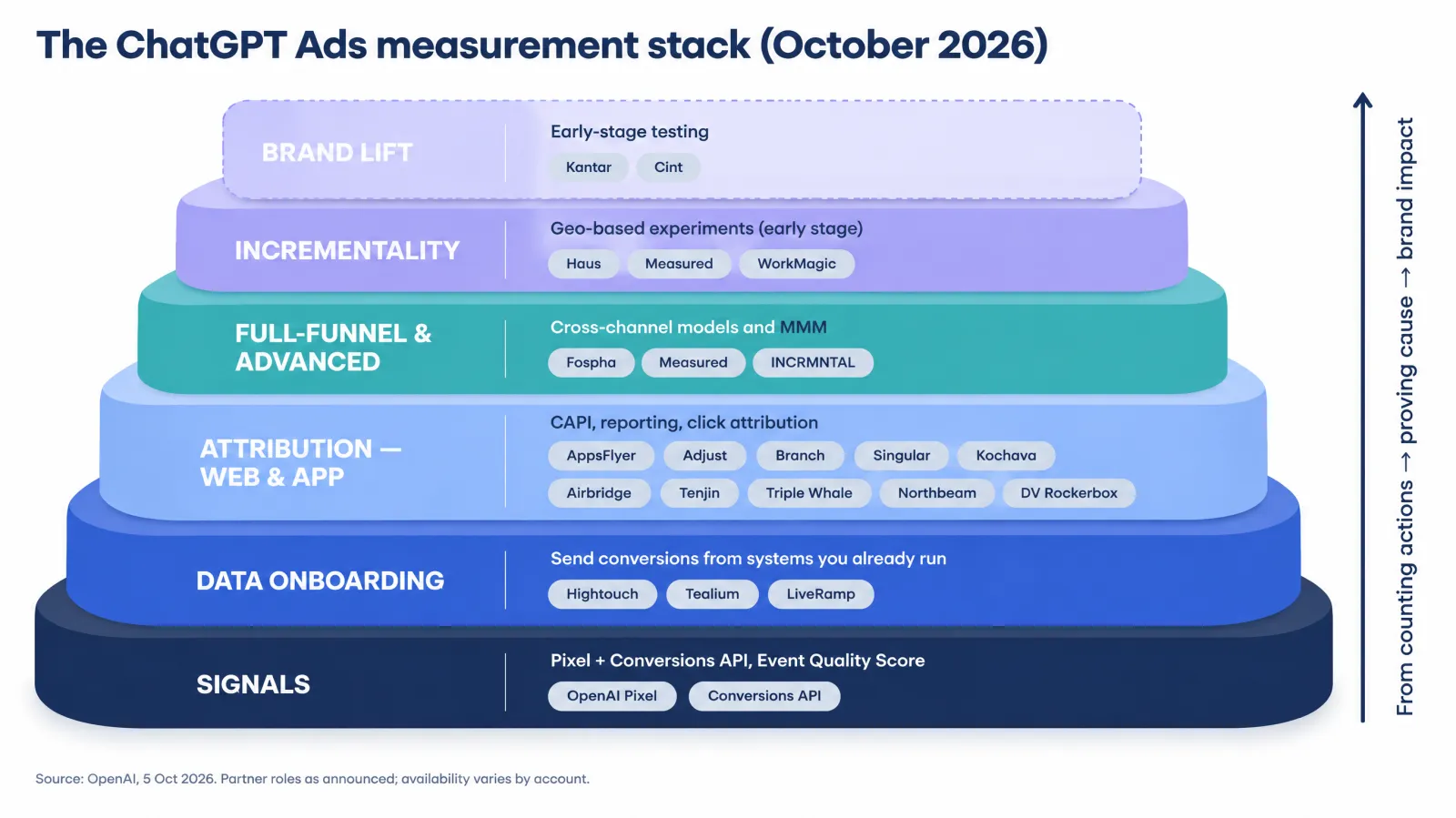
| Layer | The question it answers | Named partners (OpenAI, 5 Oct 2026) | What you need before it works |
|---|---|---|---|
| 1. Signals | Did a conversion happen, and was it matched to an ad? | OpenAI Pixel, Conversions API, Event Quality Score | Pixel on site, server events, deduplication |
| 2. Data onboarding | Can I send conversions from systems I already run, without custom engineering? | Hightouch, Tealium, LiveRamp | A warehouse, CDP or identity platform with clean conversion data |
| 3. Attribution (web and app) | Which conversions followed ChatGPT ad clicks, compared with my other channels? | AppsFlyer, Triple Whale, Adjust, DV Rockerbox, Northbeam, Branch, Singular, Kochava, Airbridge, Tenjin | Partner account, ChatGPT Ads connection, consistent UTMs and click IDs |
| 4. Full-funnel and advanced | What does ChatGPT contribute across the whole marketing mix? | Fospha, Measured, INCRMNTAL | Spend and outcome history across channels |
| 5. Incrementality | Which conversions would not have happened without ChatGPT Ads? | Haus, Measured, WorkMagic (geo-based, early stage) | Enough budget and geographic spread to power a test |
| 6. Brand lift | Did the ads change awareness, consideration or preference? | Kantar, Cint (early-stage testing; Ads Blog only) | Reach large enough for survey-based measurement |
Layer 1: signals, which come before any partner
The announcement repeats something easy to skip over: "Getting the most from these tools starts with good conversion signals." OpenAI's Pixel and Conversions API carry information about "purchases and other actions people take." The Event Quality Score (EQS) "helps advertisers assess the quality of those signals and identify opportunities to improve them."
In practice that means four checks, each covered in depth elsewhere on this site:
- Pixel installed everywhere a conversion can happen, firing the standard events your campaigns optimise on. See the conversion tracking guide.
- A server-side path through the Conversions API, directly or through a partner, so conversions survive browser restrictions.
- Deduplication, with the same event ID on the Pixel and the API, so a purchase counted twice does not distort reporting or train campaigns on inflated numbers.
- Event quality warnings cleared. OpenAI assesses event quality daily over seven complete calendar days. Our event quality guide lists every warning and the field that fixes it.
None of the partners below replaces this work. Several make it easier, but you still need clean signals.
Data onboarding: Hightouch, Tealium and LiveRamp
OpenAI's description of this layer is short: integrations with Hightouch, Tealium and LiveRamp "make it easier for advertisers to send conversion data from their existing systems to ChatGPT Ads." The three companies approach that job differently, and the right choice depends on where your conversion data already sits.
| Partner | Commonly known for | Best fit for ChatGPT Ads | Typical owner |
|---|---|---|---|
| Hightouch | Composable CDP and reverse-ETL: syncing data models from a cloud warehouse to marketing tools | Warehouse-centric companies (Snowflake, BigQuery, Databricks, Redshift) that already model orders, leads and subscriptions centrally | Data engineering, analytics engineering |
| Tealium | Enterprise tag management and real-time customer data platform | Enterprises already routing web and app events through Tealium, which can forward them server-side | Marketing technology, digital analytics |
| LiveRamp | Identity resolution and data collaboration, including offline conversions and clean-room workflows | Brands with significant offline or CRM conversions (retail stores, call centres, B2B pipelines) and strict privacy requirements | Data partnerships, privacy, CRM |
Partner descriptions are based on each company's general market positioning, not on details OpenAI published. Check each partner's ChatGPT Ads documentation for the exact set-up.
Hightouch: when your truth lives in the warehouse
Hightouch was already documented as a ChatGPT Ads conversion source before this announcement. It arrived in August 2026, and our conversion tracking guide covers the set-up: a Pixel ID, an API key, and event models with a genuinely unique primary key so each event transmits once. The October announcement confirms it as part of the formal partner programme.
When to choose it. Your definitive order, lead or subscription record is a table in your warehouse, and you want ChatGPT Ads to optimise on that record (for example "qualified lead" or "first paid subscription") rather than on a browser event.
Watch out for. Deduplication against the Pixel. If the warehouse and the browser both report the same purchase, they must share the event ID. Also watch timing: the Conversions API accepts events from the last seven days, so a weekly batch sync will miss conversions. Sync at least daily, and ideally hourly.
Tealium: when your events already flow through a tag and event hub
Many large organisations route every web and app event through Tealium, then fan them out to ad platforms. If you are one of them, the integration should let you add ChatGPT Ads as another server-side destination without new engineering on the site.
When to choose it. You already use Tealium for event collection and governance, and your consent rules live there.
Watch out for. Mapping. Tealium event names and parameters must map onto OpenAI's standard events (for example order_created, lead_created) with the right value format. OpenAI expects amounts in ISO 4217 minor units, so 2599 means $25.99. Getting that wrong inflates revenue a hundredfold.
LiveRamp: when conversions happen offline or need identity resolution
LiveRamp's strength is connecting identities and conversions across systems, including offline ones, in a privacy-controlled way. For ChatGPT Ads, that matters most to advertisers whose valuable conversions do not happen on a website: a store purchase, a signed contract, a funded account, a booked appointment completed by phone.
When to choose it. A meaningful share of revenue converts offline or in a CRM. Or you work under privacy requirements that call for a data-collaboration intermediary rather than direct uploads.
Watch out for. Latency and the seven-day window. Offline conversions often arrive days later. Any conversion OpenAI receives more than seven days after it happened cannot be used. Design the pipeline so offline events are sent quickly.
Choosing between them
| Your situation | Start with | Why |
|---|---|---|
| Shopify or DTC store with no warehouse | An attribution partner such as Triple Whale (next section), or the Pixel plus direct Conversions API | Lighter set-up; a data-onboarding platform may be more than you need |
| Warehouse-first company with modelled conversions | Hightouch | Sends the warehouse's definition of a conversion |
| Enterprise with Tealium already in place | Tealium | Reuses existing event governance and consent |
| Significant offline, CRM or call-centre revenue | LiveRamp | Brings offline outcomes into the loop |
| Mobile app as the primary product | A mobile measurement partner (next section) | App installs and in-app events have their own attribution needs |
Attribution partners for web and app
OpenAI says it "now support[s] leading attribution partners across the web and app space, enabling Conversions API, reporting, and click attribution solutions." Ten companies are named. They fall into two groups that solve different problems, and choosing the wrong group is a common and expensive mistake.
Group A: mobile measurement partners (MMPs)
| Partner | Commonly known for | Most relevant to |
|---|---|---|
| AppsFlyer | One of the largest MMPs; app attribution, deep linking, fraud protection | Consumer apps of any size, especially multi-channel app marketers |
| Adjust | MMP with strong gaming and app-growth adoption | Gaming, fintech and subscription apps |
| Branch | Deep linking and app attribution, linking web to app | Brands where web-to-app journeys matter, such as retail apps and media |
| Singular | Marketing analytics combined with app attribution and cost aggregation | App marketers who want spend and ROI unified across networks |
| Kochava | App attribution and measurement, with connected-TV and omnichannel capabilities | App advertisers who also run CTV or offline media |
| Airbridge | App and web attribution, popular with app-first companies in Asia and elsewhere | App-first companies wanting unified web and app measurement |
| Tenjin | Lightweight attribution and analytics for mobile games and indie developers | Mobile games, especially hyper-casual and casual studios |
Why app advertisers need this group. App installs and in-app events do not happen on a website, so the web Pixel cannot see them. An MMP attributes the install and in-app actions to the ad click and reports them back. Users reach ChatGPT on iOS, Android and the web, and platform targeting already separates iOS app, Android app and web placements (see our news timeline). App advertisers therefore need the MMP connection to measure what ChatGPT drives.
Group B: web and DTC attribution platforms
| Partner | Commonly known for | Most relevant to |
|---|---|---|
| Triple Whale | Ecommerce analytics and attribution, especially for Shopify brands; Sonar for sending conversion signals | Shopify and DTC brands |
| Northbeam | Multi-touch attribution and media mix analysis for DTC brands | DTC brands with significant cross-channel spend |
| DV Rockerbox | Multi-touch attribution and marketing measurement (Rockerbox, now part of DoubleVerify) | Brands that want attribution across many channels and a neutral view of each channel's role |
Why web advertisers use this group. These platforms put ChatGPT Ads beside Meta, Google, TikTok, email and the rest in a single attribution view. That matters because a ChatGPT ad rarely acts alone. Someone may click an ad while planning, then convert days later through branded search. Platform-native reporting gives each channel its own last-touch credit. A multi-touch view shows how the channels work together.
The three services OpenAI named, and what they mean
OpenAI says the partners enable "Conversions API, reporting, and click attribution solutions." Those are three different services, and a given partner may offer one, two or all three:
| Service | What it does | Why it matters |
|---|---|---|
| Conversions API | The partner sends conversion events to OpenAI on your behalf | Better signals for optimisation, with no custom engineering |
| Reporting | The partner pulls ChatGPT Ads spend and delivery data into its dashboards | ChatGPT appears beside your other channels in one view |
| Click attribution | The partner attributes conversions to ChatGPT ad clicks using its own models | An independent view of performance that does not rely only on OpenAI's reporting |
Selecting an attribution partner
| If you are… | Consider first | Avoid |
|---|---|---|
| A Shopify DTC brand spending under $50k/month across channels | Triple Whale | Building custom multi-touch attribution |
| A DTC brand spending heavily across many channels | Northbeam or DV Rockerbox | Judging ChatGPT on last-click alone |
| A consumer app with paid user acquisition | Your existing MMP (AppsFlyer, Adjust, Branch, Singular, Kochava, Airbridge or Tenjin) | Measuring app installs with the web Pixel |
| A mobile game studio | Tenjin, AppsFlyer or Adjust | Optimising on installs without retention data |
| A brand already using one of the ten | The one you already have | Switching partners just for ChatGPT Ads |
The last row is the most important. OpenAI's stated goal is to help advertisers understand impact "using the systems they already rely on." If you already run one of these platforms, connect ChatGPT Ads to it before you look at anything else. Your team already trusts its numbers, and that trust matters more than small differences in methodology.
The deduplication problem gets harder with partners
Every extra route for conversion data is another chance to count a conversion twice. If a partner sends a purchase through the Conversions API and your Pixel also records it, both must carry the same identifier, or OpenAI will see two purchases. A double-counted purchase does more than inflate a report. If the campaign optimises on conversions, delivery chases a signal twice as strong as reality. Our conversion campaigns guide explains why that costs money.
Run this check whenever you connect a new partner:
- Make a test purchase with a known order ID.
- Confirm the Pixel event carries that ID as its event ID.
- Confirm the partner's server event carries the same ID.
- Confirm Ads Manager shows one conversion, not two, once the 24–48 hour reporting delay has passed.
- Check that event quality shows no deduplication warnings.
Full-funnel and advanced measurement: Fospha, Measured and INCRMNTAL
The third group of partners works at a higher level than attribution. OpenAI calls them "full-funnel and advanced measurement partners." These companies estimate each channel's contribution to business outcomes using statistical models, experiments or both, instead of tracking individual users.
| Partner | Commonly known for | What it adds for ChatGPT Ads |
|---|---|---|
| Fospha | Full-funnel measurement for ecommerce, combining attribution with marketing mix modelling | A view of ChatGPT's contribution that includes upper-funnel effects last-click misses |
| Measured | Incrementality measurement and media mix modelling, built on experiments | Calibrated estimates of ChatGPT's incremental contribution (Measured also appears in the incrementality group) |
| INCRMNTAL | Always-on incrementality measurement without holdout groups, using statistical models of how activity changes | Ongoing estimates of incremental impact without pausing spend |
Why these matter more for visual ads
Visual ads, especially inspiration and experience creative, are upper-funnel by nature. Someone who sees an inspiring living-room image while generating their own design may buy a sofa weeks later, after visiting showrooms, reading reviews and searching for your brand. Last-click attribution gives that sale to branded search. Full-funnel models and media mix models are designed to recover the contribution that last-click hides.
So if you plan to run visual ads at meaningful scale, you need some form of measurement above attribution. You might connect one of these partners, run your own media mix model, or run incrementality tests (next section). Otherwise the format will look worse than it is and be cut before it has had a fair test.
When a full-funnel partner is worth it
| Signal | What it suggests |
|---|---|
| Total paid media above roughly $100k/month across channels | Mix modelling has enough data to be useful (illustrative threshold, depends on the vendor) |
| Many channels with overlapping journeys | Last-click is badly misallocating credit |
| Finance asking "what if we cut this channel?" | You need counterfactual estimates, not only attribution |
| Upper-funnel formats in the plan (visual ads, video, CTV) | Last-click will undervalue them |
| Small budget, one or two channels | Probably not yet. Attribution plus a simple holdout test may be enough |
For app advertisers: what the MMP partners change
Seven of the ten attribution partners (AppsFlyer, Adjust, Branch, Singular, Kochava, Airbridge and Tenjin) are mobile measurement partners. That is a clear signal that OpenAI sees app advertisers as a core audience. If your product is an app, here is what changes.
Before: a measurement gap
Until now, an app advertiser on ChatGPT Ads could track web conversions with the Pixel and send server events through the Conversions API, but installs and in-app events lived in the MMP. ChatGPT was outside that system. The usual workarounds were sending users to a web landing page first, or building custom pipelines from the MMP into the Conversions API. Both were fragile.
After: ChatGPT inside the MMP
With ChatGPT Ads supported by the MMPs, ChatGPT can sit beside every other network in the MMP dashboard. Depending on what each partner has built (check which of the three services, Conversions API, reporting and click attribution, it supports), you can expect to:
| Capability | What it means for an app marketer |
|---|---|
| Click attribution for installs | Installs credited to ChatGPT ad clicks, using the MMP's own methods |
| Reporting | ChatGPT spend, installs and in-app events in the same dashboard as your other networks |
| Conversions API through the MMP | In-app events (registration, trial start, purchase) sent back to OpenAI to train optimisation |
| Cohort and retention views | ChatGPT-acquired users compared with other networks on day-7 and day-30 retention and revenue |
App measurement checklist
- Confirm the integration in your MMP account. Make sure ChatGPT Ads appears as a network and is enabled.
- Set up deep links. If a user clicks a ChatGPT ad on mobile and already has your app, send them to the right screen, not the home screen.
- Map in-app events to OpenAI's standard events where the MMP sends them back, and confirm values are in minor units.
- Choose the optimisation event carefully. Optimising on installs alone often attracts low-retention users. Prefer a downstream event (registration, trial or purchase) once volume allows.
- Use platform targeting deliberately. ChatGPT Ads can separate iOS app, Android app and web placements. Match your campaigns to where your app is available.
- Respect platform privacy rules. iOS attribution is limited by Apple's privacy framework. Expect modelled or aggregated data for some iOS users, as on every network.
Visual ads for apps
Apps are harder to show visually than physical products, which is why the experience job matters most. Do not show a screenshot. Show the life moment the app enables: the language learner ordering confidently in a café, the budgeting app user booking the trip they saved for, the meditation app user asleep at last. Screenshots belong on the store page, after the click.
Incrementality: geo experiments with Haus, Measured and WorkMagic
OpenAI is careful in how it describes this layer: "While our work on incrementality is still in its early stages, we're partnering with Haus, Measured, and WorkMagic to explore geo-based experiments to help advertisers understand the causal impact of ChatGPT Ads." The Ads Blog adds that "we're learning the best ways for advertisers to run experiments and interpret the results as the platform evolves."
That caution is a good sign. Incrementality is the hardest measurement problem in advertising, and companies that claim to have solved it for a new channel usually have not. Here is what geo-based incrementality is, how to design a test for ChatGPT Ads, and how to read the results.
Attribution versus incrementality, in one paragraph
Attribution asks: which conversions followed an ad? Incrementality asks: which conversions happened because of the ad, and would not have happened without it? The difference is the conversions that would have happened anyway. These are people who saw or clicked your ad but were already going to buy. Attribution counts them and incrementality does not. For a channel like ChatGPT, where people are actively researching, some of those people were always going to buy from you. The question finance cares about is how many were not.
How a geo-based experiment works
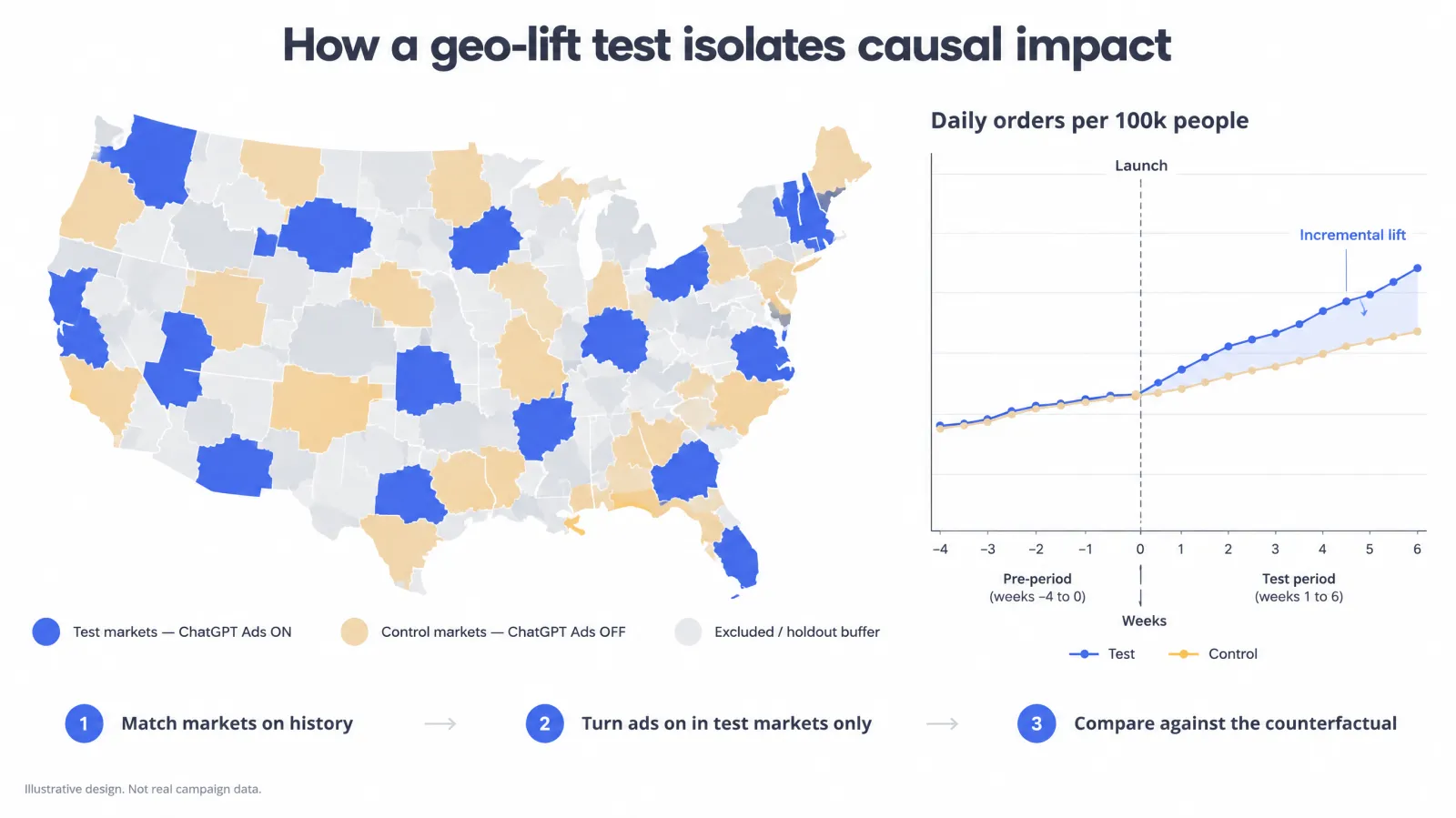
A geo experiment divides a country into regions, usually media markets or groups of postal codes. Ads run in some regions (test) and not in others (control). Because people cannot choose which region they live in for the sake of your ad, the comparison approximates a randomised experiment. The steps:
- Match markets on history. Use past sales data to find groups of regions that behave alike: similar size, seasonality and trend. Partners use statistical methods such as synthetic control to build a control group that tracks the test group closely before launch.
- Turn ads on in test markets only. Run ChatGPT Ads with geo-targeting limited to the test regions, and keep everything else (other channels, prices, promotions) the same in both groups.
- Compare against the counterfactual. After the test period, compare actual outcomes in test markets with what the control group predicts would have happened without the ads. The gap is the incremental lift.
Designing a ChatGPT Ads geo test
| Design choice | Recommendation (GPT Ads AI) | Why |
|---|---|---|
| Outcome metric | Total business outcome in each region (all orders, all sign-ups), not ChatGPT-attributed conversions | Incrementality is about total impact, including conversions attribution never sees |
| Geographic unit | Designated market areas or similar media regions in the US | Large enough for stable sales data; supported by geo-targeting |
| Test and control split | Usually 20–50% of markets in test, chosen by the partner's matching method | Balance statistical power against the opportunity cost of withholding ads |
| Pre-period | At least 4–8 weeks of historical data, ideally a year to capture seasonality | Validates that test and control tracked together before launch |
| Test duration | 4–8 weeks of live spend, longer for considered purchases | Must cover your purchase cycle; upper-funnel formats need longer |
| Spend level | Enough that a realistic lift is statistically detectable. Ask the partner for a power analysis before launch | An underpowered test produces "no significant lift," which is easily misread as "no effect" |
| Holdouts | Keep other channel spend steady in all regions during the test | Changes elsewhere contaminate the comparison |
| Analysis | Pre-register the metric, the method and what result would change your decision | Prevents cherry-picking after the fact |
The power problem, explained
The most common way incrementality tests fail is not a wrong answer. It is no answer. If ChatGPT Ads drive a 3% lift in total orders, but normal week-to-week variation in your regional sales is 8%, a small test cannot separate the effect from the noise. The result comes back "not statistically significant," and someone concludes the channel does not work.
Here is an illustrative example of how power depends on spend and sales volume. All numbers are assumptions, not benchmarks.
| Scenario (illustrative) | Weekly orders in test regions | True lift | Week-to-week noise | Likely outcome of a 6-week test |
|---|---|---|---|---|
| Small DTC brand, low spend | 400 | 3% | 10% | Probably inconclusive |
| Mid-size brand, moderate spend | 4,000 | 5% | 6% | Possibly detectable, borderline |
| Large brand, meaningful spend | 40,000 | 4% | 3% | Likely detectable |
| Large brand, small test budget | 40,000 | 0.5% | 3% | Probably inconclusive, effect too small |
The lesson: get a power analysis before you spend money on a test. All three named partners provide this as part of test design. If the analysis says your budget cannot detect a realistic lift, either raise the test budget for its duration, extend the test, choose a more sensitive metric, or accept that you will rely on attribution and modelling for now.
Which partner, for what
| Partner | Commonly known for | Consider when |
|---|---|---|
| Haus | Geo-experiment platform focused on causal measurement, with synthetic-control methods and a test-design workflow | You want a dedicated experimentation tool and plan to test several channels over time |
| Measured | Experiment-calibrated incrementality and media mix modelling | You want experiments combined with an ongoing model of every channel |
| WorkMagic | Incrementality and marketing measurement for ecommerce brands; also a ChatGPT Ads conversion source since August 2026 | You are an ecommerce brand and want attribution, incrementality and conversion signals in one platform |
What the Dose study tells you about incrementality
The only incrementality result OpenAI published comes from WorkMagic and the wellness brand Dose. Two numbers were published, in two different documents:
- From the announcement: WorkMagic "reported statistically significant lift for wellness brand Dose, with 67% of incremental purchases coming from net-new customers."
- From the Ads Blog: "WorkMagic's geo-lift study estimated 2.3x more incremental orders for Dose than were captured by last-click attribution."
Read together, they make two separate claims. First, ChatGPT Ads drove purchases that would not otherwise have happened, and most of those came from customers new to the brand. Second, last-click attribution under-counted that impact: the experiment found about 2.3 times more incremental orders than last-click credited to the channel.
The second claim is the more important one for the industry, because it cuts against the usual assumption. For many channels, especially retargeting and branded search, incrementality tests find that attribution over-credits the channel. In this one study, attribution under-credited ChatGPT Ads. That fits a channel where people research in ChatGPT and convert elsewhere, but one brand's study is not proof that every advertiser will see the same pattern. We look at that more carefully in the next section.
Reading the early results honestly
OpenAI published five early numbers across its two documents. All are real and attributed to named partners. None is a benchmark you should expect to match. Here is what each one shows, what it does not show, and how to use it in a business case.
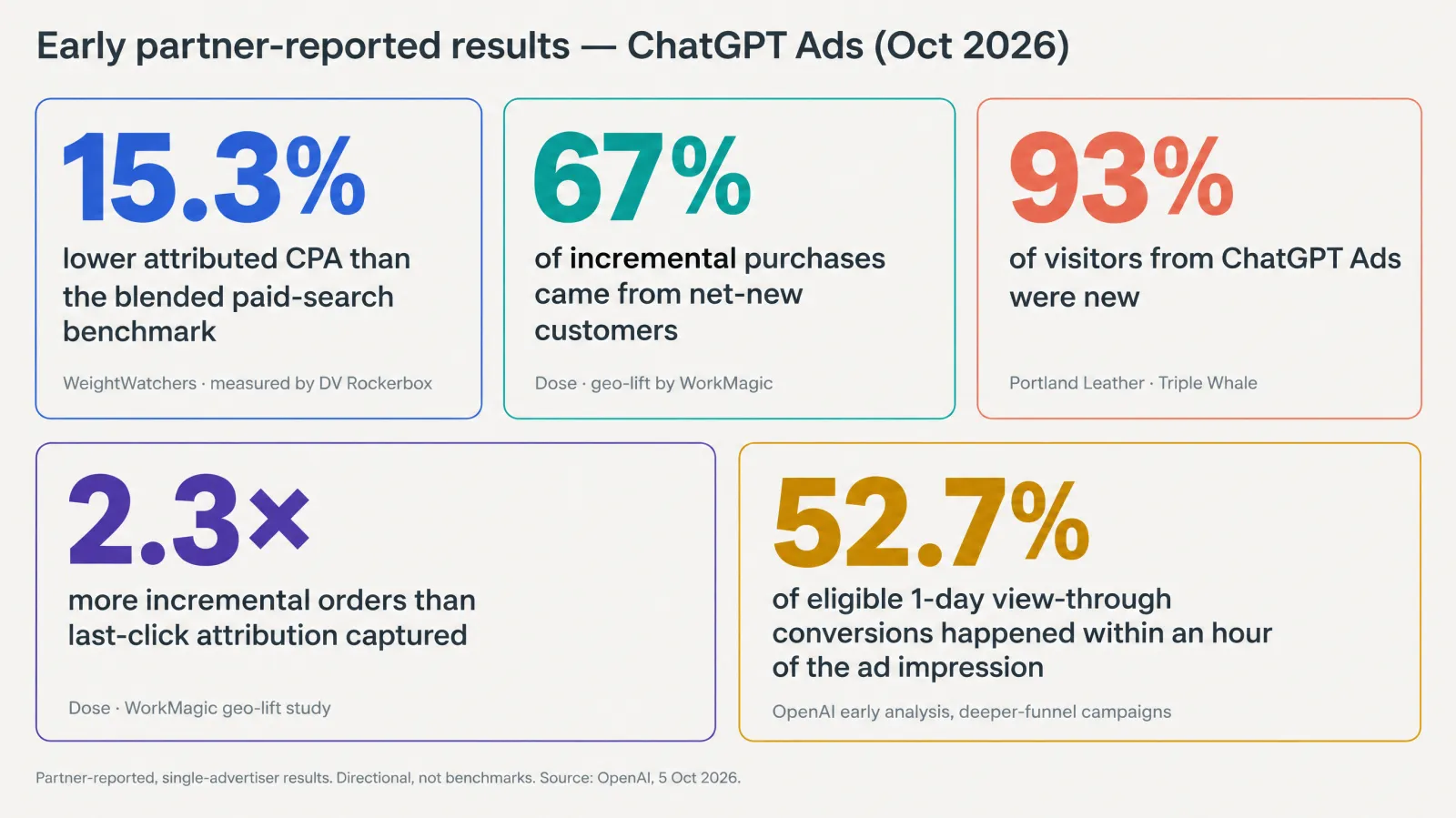
| Result | Source | What it shows | What it does not show |
|---|---|---|---|
| 15.3% lower CPA than the blended paid-search benchmark (WeightWatchers) | DV Rockerbox (partner-reported) | For one subscription brand, ChatGPT Ads acquired customers more cheaply than its paid search average, on an attributed basis | Incrementality; whether the gap holds at higher spend; results for other categories |
| 67% of incremental purchases from net-new customers (Dose) | WorkMagic (partner-reported) | The causal lift was mostly new-customer acquisition, not existing customers buying again | The size of the lift; cost per incremental customer |
| 2.3× more incremental orders than last-click captured (Dose) | WorkMagic geo-lift (Ads Blog) | For this brand, last-click under-counted ChatGPT's causal impact | That every advertiser's last-click under-counts by the same factor |
| 93% of visitors were new (Portland Leather) | Triple Whale (partner-reported) | ChatGPT Ads reached people who had not visited the site before | Conversion rate or revenue from those visitors |
| 52.7% of eligible 1-day view-through conversions within an hour of the impression | OpenAI early analysis of global campaigns optimised for deeper-funnel outcomes | Many people who convert after seeing (not clicking) an ad do so quickly | That every view-through conversion was caused by the ad |
Result 1: WeightWatchers and the paid-search comparison
DV Rockerbox measured WeightWatchers' "attributed cost per acquisition on ChatGPT Ads" at 15.3% below "its blended paid-search benchmark." Two words matter.
"Attributed" means this is an attribution result, not an incrementality result. It tells you what CPA looked like under DV Rockerbox's attribution method, which is useful for comparing channels on equal terms, but it does not say how many acquisitions were incremental.
"Blended" means the comparison is with WeightWatchers' average across paid search, which normally mixes branded and non-branded keywords. Branded search usually has a very low CPA. Non-branded search usually costs much more. Beating a blended average is meaningful. Whether ChatGPT beats non-branded search specifically, which is probably the fairer comparison for a discovery channel, is not stated.
How to use it. As evidence that ChatGPT Ads can compete with paid search on efficiency for a subscription business, and as a reason to run your own comparison with the same attribution method on both channels.
Result 2 and 3: Dose, net-new customers and the 2.3× multiple
These are the most important results in the release, because they come from a causal experiment and not from attribution. Together they say that ChatGPT Ads produced real lift for Dose, that two-thirds of the incremental buyers were new to the brand, and that last-click attribution caught fewer than half of the incremental orders.
How to use it. As the argument for (a) not judging ChatGPT on last-click alone and (b) running your own incrementality test. In a business case, write it as "a WorkMagic geo-lift study for one wellness brand found…" and never as "ChatGPT Ads deliver 2.3× more incremental orders than last-click."
Result 4: Portland Leather and new visitors
According to Triple Whale, 93% of Portland Leather's visitors from ChatGPT Ads were new. For a brand trying to grow its customer base, that is a useful signal: the channel reaches beyond existing customers. It does not tell you whether those visitors bought, or at what cost.
How to use it. As a prompt to check the same thing in your own data. Compare ChatGPT's new-visitor share with your other paid channels. A high share supports a prospecting role. A low share suggests your ads are mostly reaching people who already know you, and that context hints or creative need to reach further.
Result 5: the 52.7% view-through figure
This one comes from OpenAI itself, in the Ads Blog: "In an early analysis of global campaigns optimized for deeper-funnel outcomes, 52.7% of eligible one-day view-through conversions occurred within an hour of the matched ad impression."
It answers a common objection to view-through attribution: that the conversions are coincidental, happening hours later for unrelated reasons. If more than half happen within an hour of the impression, many view-through conversions are closely linked in time to the ad. OpenAI's framing fits how people use ChatGPT: "clicking an ad may not be their immediate next step." Someone may see your ad, finish their task, then open a new tab and search for you.
It still does not prove the ad caused those conversions. A person already about to buy could see the ad and buy within the hour anyway. Only incrementality testing settles causation. What the figure does justify is turning on the 1-day view-through window and reading view-through conversions as a meaningful signal, not noise.
A template for citing these results internally
| Do write | Don't write |
|---|---|
| "DV Rockerbox measured one subscription brand's attributed CPA on ChatGPT Ads at 15.3% below its blended paid-search benchmark." | "ChatGPT Ads are 15% cheaper than Google." |
| "In a WorkMagic geo-lift study, one wellness brand's incremental orders were 2.3× what last-click captured." | "Last-click under-counts ChatGPT by 2.3×." |
| "Triple Whale reported that 93% of one leather-goods brand's ChatGPT Ads visitors were new." | "ChatGPT Ads reach 93% new customers." |
| "OpenAI's early analysis found 52.7% of eligible 1-day view-through conversions occurred within an hour of the impression." | "Half of ChatGPT view-through conversions are caused by the ad." |
Measuring beyond the click: view-through and optimisation
The Ads Blog includes a section the main announcement does not: "Helping advertisers measure and optimize beyond the click." It confirms three things that matter for anyone planning visual ads.
1. Advanced conversion optimisation learns from view-through conversions
OpenAI: "Advanced conversion optimization learns from eligible click-through and view-through conversions for an advertiser's selected goal. Purchases following either path can inform future ad delivery, giving the system more information to help find the next customer."
This is a significant detail. Conversion-optimised campaigns are trained on view-through conversions as well as clicks. For an upper-funnel format like visual ads, where many people will see the ad and convert later without clicking, the optimisation system can still learn from the image even when nobody clicks it. Clean signals matter even more as a result: the system learns from whatever conversions you send it, so duplicates or wrongly valued events now mislead optimisation through two paths, not one.
2. Reporting windows are your choice, and they do not change optimisation
"For reporting, advertisers can select a click-through attribution window that fits their buying cycle and include a one-day view-through window to measure conversions following an impression without a click. These settings control attribution in reports; they do not change how campaigns optimize."
This matches the current Ads Manager behaviour described in our reporting guide: a click-through window of 7, 14 or 30 days, and a view-through window of 0 Day (off) or 1 Day. With the view-through window at 1 Day, eligible view-through conversions are included in the Conversions total. If both a click and an impression qualify for a conversion, the click gets the credit.
| Setting | Options | Changes reports? | Changes optimisation? |
|---|---|---|---|
| Click-through attribution window | 7, 14 or 30 days | Yes | No |
| View-through attribution window | 0 Day or 1 Day | Yes | No |
| Conversion goal and bidding strategy | Set per campaign or ad group | Indirectly | Yes |
| Signals sent (Pixel, Conversions API, partners) | Your implementation | Yes | Yes |
3. Recommended settings for visual ads
These are our recommendations, not OpenAI's.
- Turn the 1-day view-through window on for any account testing visual ads. Without it, the format's main mode of influence is invisible in your reports.
- Use a click-through window that matches your buying cycle. Use 7 days for impulse and low-price products, 14 days for considered retail, and 30 days for high-price, travel and B2B.
- Report click-through and view-through separately next to the combined total. Leadership should see the mix, not just the sum.
- Keep the same windows across the comparison period. Changing windows changes every number on screen at once, and comparisons over time break.
- Back the attributed view with an incrementality test before scaling visual ads beyond a test budget.
Budgeting a visual ads test
OpenAI has not published pricing for the visual format, so any budget is a planning assumption. What you can plan is the structure: how much to set aside, how to split it, and how long to run before deciding.
A test budget structure
| Budget line | Share of test budget (illustrative) | Purpose |
|---|---|---|
| Visual ads, inspiration creative | 35% | The format's main use; judged on view-through, new visitors and lift |
| Visual ads, usage creative | 25% | Closer to conversion; judged on click-through and attributed CPA |
| Visual ads, experience creative | 15% | Brand-led; judged on brand proxies and lift |
| Standard ChatGPT ads (control) | 25% | Your existing format, as a comparison point on the same tracking |
For scale, OpenAI publishes a $25 USD minimum daily budget for standard ChatGPT ads. We have recommended about $10,000 a month in media for a standard-ads test that reaches a decision (GPT Ads AI recommendation, from our cost guide). A visual-ads test inside an initial advertiser group may have its own minimums. Ask when you request access.
How long to run before deciding
| Decision | Minimum time (GPT Ads AI recommendation) | Why |
|---|---|---|
| Creative: which image job works best | 2–3 weeks per concept with steady spend | Enough impressions for engagement differences to show |
| Attributed performance vs standard ads | 4 weeks, plus your click-through window | Conversions keep arriving for the length of the window |
| Incremental impact | 4–8 weeks of a powered geo test, plus pre-period | Causal measurement needs time and volume |
| Budget decision for next quarter | After both attributed and incremental readouts | Avoids deciding on attribution alone |
Reporting visual ads to leadership
Leaders will see a new format, a new set of vendors and several kinds of number. A consistent one-page report stops the conversation from turning into "which number is right." Here is a template we use, with illustrative fields:
| Section | Contents | Notes |
|---|---|---|
| Headline | One sentence: what we learned this period | "Inspiration creative drove most new visitors; incremental test in week 3 of 6" |
| Delivery | Spend, impressions, clicks, click-through rate by image job | From Ads Manager |
| Attributed outcomes | Click-through and view-through conversions shown separately, plus total; CPA and ROAS | State the windows (e.g. "14-day click, 1-day view") in the table header |
| Partner view | The same period in your attribution partner | Explain any gap in one line |
| Incremental view | Geo-test status or result, with confidence interval | "Not yet available" is a valid entry |
| New-customer share | % of ChatGPT-driven customers who are new | Compare with other paid channels |
| Brand proxies | Branded search and direct traffic trend | Until brand-lift studies are available |
| Next actions | Creative changes, budget changes, tests | Two or three bullet points |
Brand safety and suitability in a conversational environment
Brand safety in ChatGPT is a different problem from brand safety on the open web. On a website or a video platform, an ad appears next to content: a page, an article, a video. A verification vendor can crawl that content, classify it and block unsuitable placements. In ChatGPT, the "content" next to an ad is a private conversation between a person and an assistant. No vendor can crawl it, and none should, because privacy is one of OpenAI's stated ads principles.
DoubleVerify's CEO, Mark Zagorski, made the same point in the announcement, describing an environment "where context is defined by the conversation itself rather than a page or video." That one sentence explains why the brand-safety tools in this release look the way they do.
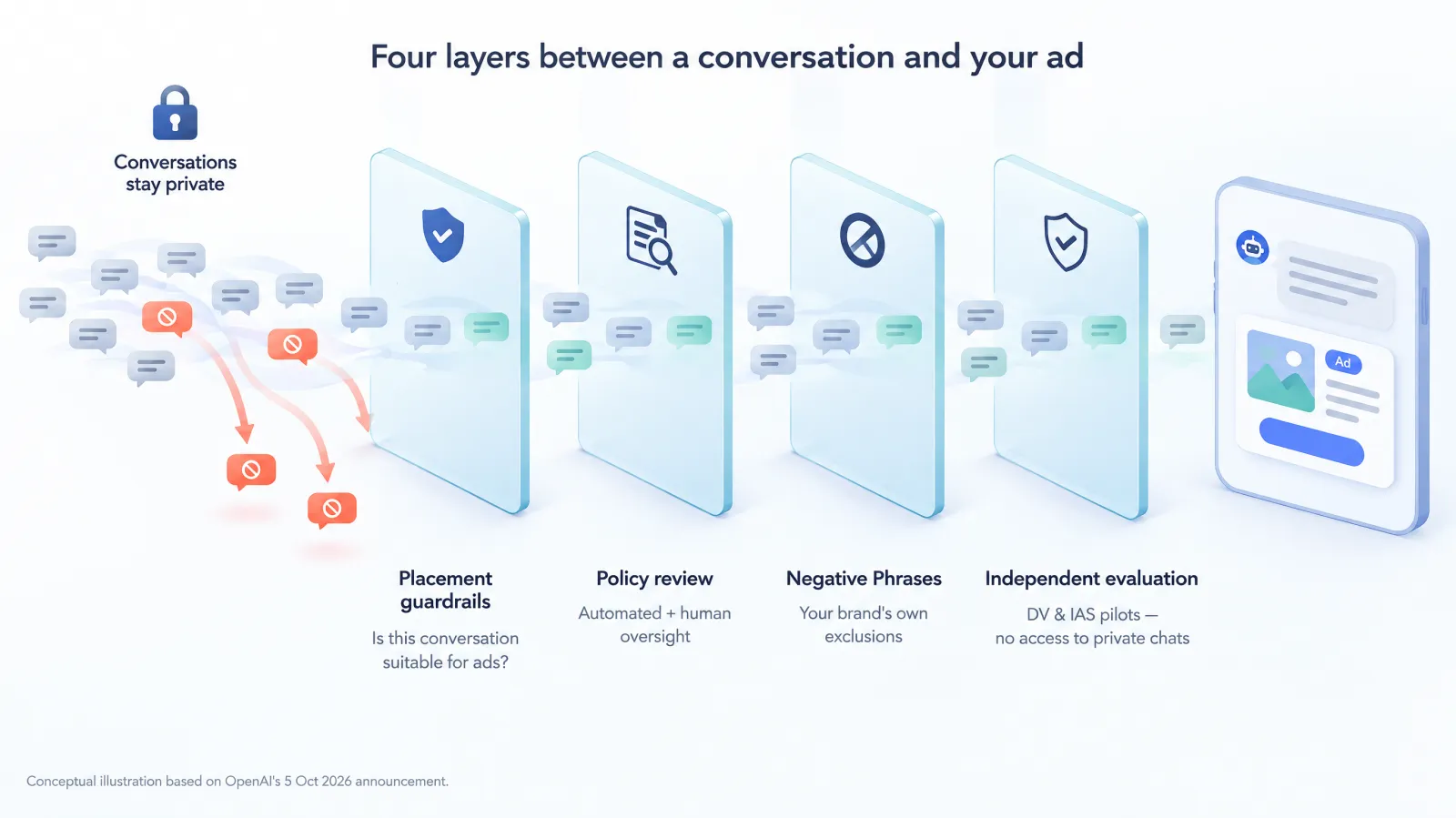
Layer 1: placement guardrails
OpenAI says its "placement guardrails assess whether a conversation is appropriate for advertising, helping keep ads out of emotionally vulnerable, sensitive, or otherwise unsuitable contexts." This is the platform-level protection, and it applies to every advertiser automatically. You do not configure it.
In practice, conversations about personal crises, health worries, grief, mental health struggles and similar sensitive topics are kept ad-free, whoever is bidding. That protects users first, and it also protects advertisers: no brand wants its ad shown to someone in distress.
The trade-off is inventory. Some conversations that might look commercially relevant will not carry ads because they are sensitive. A health or wellness brand, for example, may find that some conversations in its category are ineligible. That is by design.
Layer 2: policy review, oversight and monitoring
"Automated review, human oversight, and ongoing monitoring help us identify and address policy violations and improve our safeguards over time." This layer applies to ads themselves: creative, landing pages and advertiser conduct. It is how OpenAI enforces its advertising policies.
For visual ads it matters even more, because images carry claims that text review can miss. A before-and-after image can imply a result. An image with a medical setting can imply endorsement. An overlay can carry a price or discount that the landing page does not honour. Expect images to be reviewed with the same care as copy, and build your creative process to pass review the first time:
| Image risk | Why reviewers flag it | Safer alternative |
|---|---|---|
| Before-and-after implying guaranteed results | Implied claims, especially in health, beauty and finance | Show the product in use; put substantiated results on the landing page |
| Medical or clinical settings for non-medical products | Implied endorsement | Neutral home or lifestyle settings |
| Prices or discounts in the image | Must match the landing page; changes over time | Put offers on the landing page and in feed data where relevant |
| Superlatives in overlays ("best," "#1") | Need substantiation | Concrete, provable attributes |
| Realistic depictions of public figures | Implied endorsement, rights issues | Unidentifiable models or no people |
| Generated product images that differ from the real product | Misrepresentation | Real product photography in generated environments |
| Imagery that could appeal mainly to minors in restricted categories | Audience protections | Adult-oriented settings and models; check category rules |
Layer 3: Negative Phrases
The announcement says: "For narrow placement requirements specific to a brand's own policies, Negative Phrases are now available to qualifying advertisers."
Note what that sentence says, and what it does not:
- "Narrow placement requirements specific to a brand's own policies." Negative Phrases are not a replacement for platform guardrails. Those already handle broadly sensitive content. Negative Phrases are for things that are fine in general but wrong for you.
- "Qualifying advertisers." Not every account has the feature. OpenAI has not published the qualification criteria.
- No public specification. OpenAI has not published limits for the feature in its announcement or help centre as of 16 October 2026.
Third-party reporting gives some detail, which we label clearly. In August 2026, before the formal announcement, Adthena reported seeing a Negative phrases field in a UK advertiser's Ads Manager account. It described a list of up to 100 words or phrases, each up to 100 characters, that stop an ad from serving when a user's message contains them. Around the same time, Adweek (as reported by Shopifreaks) described OpenAI testing negative targeting guidance with a small group of advertisers. OpenAI has not confirmed the 100-phrase limit, and the feature may have changed since August. Treat those numbers as unconfirmed.
How Negative Phrases differ from context hints
| Context hints | Negative Phrases | |
|---|---|---|
| Purpose | Tell OpenAI which conversations your ads are relevant to | Tell OpenAI which conversations your ads must not appear in |
| How they work | Intent signals, not exact-match keywords; no guarantee of delivery | Exclusions for brand-specific requirements (reported as matching phrases in the user's message) |
| Who has them | All advertisers | Qualifying advertisers |
| When to use | Always: they are the main relevance lever | When you have a specific, brand-driven reason to avoid a context |
| Risk of overuse | Hints that are too narrow limit reach | Lists that are too broad remove relevant inventory |
Context hints are covered in depth in our context hints guide and at contexthints.com. Our free context hint generator drafts them from a brand, a buyer and a differentiator.
What belongs on a Negative Phrases list
The principle: exclude contexts that are fine for most advertisers but wrong for your brand. Platform guardrails already cover sensitive topics in general. Use Negative Phrases for your own reasons. Here are examples, all illustrative:
| Brand type | Brand-specific concern | Example phrases to consider (illustrative) |
|---|---|---|
| Family-oriented food brand | Diet-culture conversations that conflict with brand values | "crash diet," "starve myself," "lose 20 pounds fast" |
| Alcohol brand (where permitted) | Anything suggesting recovery or excess | "sober," "sobriety," "hangover cure," "drink less" |
| Airline | Accident and disaster conversations | "plane crash," "air disaster," "emergency landing" |
| Children's toy brand | Product-safety recall conversations | "recall," "choking hazard," "toy injury" |
| Financial services brand | Conversations about scams in the category | "scam," "fraud," "lost my savings" |
| Premium fashion brand | Counterfeit and replica shopping | "replica," "dupe," "fake designer" |
| Any brand | Crisis conversations about the brand itself | "[brand] lawsuit," "[brand] boycott," "[brand] data breach" |
| Any brand | Competitor-specific contexts you choose not to enter | "[competitor] customer service," "[competitor] login" |
Negative Phrases: practical rules
- Start small. Ten to twenty phrases that address real, specific brand risks beat a hundred phrases copied from a web blocklist. Every phrase removes inventory.
- Do not duplicate platform guardrails. You do not need to list "suicide" or "grief." OpenAI already keeps ads out of emotionally vulnerable contexts.
- Think in user language. People write to ChatGPT in full, natural sentences. "Is it safe to fly after the crash last week" contains "crash," but "after the accident" does not. Cover the phrasings people actually use.
- Watch for over-blocking. A garden-tools brand that excludes "kill" will block "kill weeds." Test each phrase against conversations you want to appear in.
- Review monthly. Brand risks change with the news cycle. A phrase list built in October may be out of date by December.
- Document the reason for each phrase. When someone asks in six months why you are not appearing in a context, the answer should be on record.
Layer 4: independent evaluation with DoubleVerify and IAS
The most novel brand-safety element of the release is how OpenAI is approaching third-party verification. OpenAI says it is "developing brand suitability evaluation pilots with DoubleVerify (DV) and Integral Ad Science (IAS)." The approach "allows independent partners to assess how our brand safety standards are applied in a controlled testing environment, without accessing private user conversations."
What this is. An evaluation of OpenAI's safeguards, not a monitor on live placements. The independent partners test how the guardrails behave across scenarios in a controlled environment, presumably with synthetic or test conversations, and assess whether brand-safety standards are applied consistently.
What this is not. It is not the kind of verification advertisers know from the open web, where a tag on each impression reports the page it appeared on. Neither DV nor IAS will see real user conversations. That is the point: transparency about the system, without breaching the privacy of the people using it.
IAS's CEO, Lidiane Jones, said the evaluation will assess how OpenAI's safeguards perform "across a broad and evolving range of scenarios." DV's Zagorski spoke of bringing "independent measurement to this dynamic environment while respecting user privacy."
| Question advertisers will ask | What we know (16 Oct 2026) |
|---|---|
| Will I get per-impression brand-safety reports from DV or IAS? | Not announced. The pilots evaluate safeguards in a controlled environment, not live impressions |
| Will DV or IAS see the conversations my ads appear next to? | No. OpenAI says the approach works "without accessing private user conversations" |
| When will results be available? | Not announced. The pilots are "in development" |
| Do I need a DV or IAS contract to benefit? | Not stated. Expect evaluation findings to be shared with advertisers in some form, but the format is unknown |
| Does this replace Negative Phrases or guardrails? | No. It is an independent check on how the guardrails work |
What to tell your brand-safety team
Many large advertisers have a policy that every media buy must carry third-party brand-safety verification. ChatGPT Ads cannot meet that policy in the traditional per-impression way, and probably never will, because doing so would mean exposing private conversations. The DV and IAS pilots are OpenAI's answer: verification of the system, not the placement.
Our recommendation is to brief your brand-safety lead on that distinction now. Ask whether your policy can accept system-level independent evaluation, combined with platform guardrails and your own Negative Phrases, as equivalent assurance for a conversational environment. If it can, you have a path to approving the channel. If it cannot, you may be shut out of a channel that reaches over a billion people a week. That decision belongs to the brand-safety owner, not to the media buyer.
Brand lift: Kantar and Cint
One line in the Ads Blog, not in the main announcement, is easy to miss: "as we begin experimenting with new placements, we are also in early-stage testing with Kantar and Cint to measure the impact of ChatGPT Ads on brand resonance metrics."
Brand-lift studies normally survey people who saw an ad and compare them with a matched group who did not, measuring awareness, consideration, preference and purchase intent. Kantar is one of the largest brand research companies in the world. Cint runs a large research marketplace that supplies survey respondents.
The phrase "as we begin experimenting with new placements" links brand measurement directly to the visual format. Visual ads, especially inspiration and experience creative, are the kind of advertising whose main effect may be on brand perception rather than immediate conversion. Without brand-lift measurement, that effect is invisible. Expect brand-lift studies to become the standard way to judge visual ads for brands whose main goal is not direct response, though nothing about availability, minimum spend or study design has been published.
Matching measurement to the image job
| Image job | Primary measurement | Secondary measurement |
|---|---|---|
| Inspiration | View-through conversions, new-visitor share, brand lift (when available) | Geo-lift on total sales, branded search trend |
| Product usage | Click-through rate, add-to-cart, attributed CPA | Full-funnel model contribution |
| Experience | Brand lift (when available), geo-lift on total sales | Branded search and direct traffic, view-through conversions |
Privacy and the ads principles: what they mean for advertisers
The announcement ends by placing every new feature within OpenAI's ads principles: "ChatGPT's answers stay independent, conversations stay private, and users remain in control of their experience." These are design constraints that shape what advertisers can and cannot have, not just marketing language.
| Principle | What it rules out | What it means you should do |
|---|---|---|
| Answers stay independent | Paying to influence what ChatGPT says, recommends or generates, including the user's own images | Compete on relevance and creative quality; earn organic visibility separately (see our ecommerce guide for the organic shopping layer) |
| Conversations stay private | Advertisers, measurement partners or verification vendors reading user conversations; per-impression context reports | Rely on aggregated reporting, your own first-party conversion data, and system-level evaluations such as the DV and IAS pilots |
| Users remain in control | Ads users cannot understand or manage | Expect user controls (the overflow menu in the mockup) and write ads people are glad to see, not ones they hide |
Privacy and your own conversion data
The measurement partners in this release work with your data: conversions from your site, app, warehouse or CRM, sent to OpenAI to measure and optimise campaigns. That brings your own privacy obligations:
- Consent. Send conversion data only where you have a lawful basis and, where required, consent. If you use Tealium or another consent-aware platform, enforce consent there.
- Hashing and matching data. Follow OpenAI's normalisation and hashing rules for user-matching fields, covered in our conversion tracking guide.
- Data minimisation. Send what the integration needs and no more. A data-onboarding partner makes it easy to send everything. Resist that.
- Contracts. Each partner is another data processor. Confirm your agreements cover the ChatGPT Ads use case.
A brand-safety approval memo template
Many large advertisers need formal brand-safety approval before buying a new channel. Here is a memo structure that reflects how ChatGPT's protections actually work. Adapt it to your organisation's policy language. The content is our recommendation, built on what OpenAI published.
| Memo section | What to write |
|---|---|
| Channel description | ChatGPT Ads: clearly labelled ads shown to Free and Go users, separate from ChatGPT's answers and from user-generated images; advertising does not influence answers (OpenAI) |
| How context works | Context is the conversation, which is private. No advertiser, partner or verification vendor sees conversations. Ads are matched to context by OpenAI |
| Platform protections | Placement guardrails keep ads out of emotionally vulnerable, sensitive or otherwise unsuitable conversations; automated review, human oversight and ongoing monitoring enforce ad policies |
| Brand-controlled protections | Negative Phrases for brand-specific exclusions (if we qualify); our list of [N] phrases attached, with reasons |
| Independent assurance | DoubleVerify and IAS brand-suitability evaluation pilots assess how safeguards are applied, in a controlled environment, without access to private conversations. Status: in development |
| What is not available | Per-impression third-party verification tags and placement-level context reports. These are not possible without breaching conversation privacy |
| Residual risk | Contextual mismatches that guardrails and Negative Phrases do not catch; mitigation: monthly list review, monitoring of user feedback and campaign anomalies |
| Recommendation | Approve for a test at [budget], reviewed at [date], conditional on [criteria] |
The question to settle early
Most brand-safety policies were written for the open web, where every impression sits on a page someone can inspect. The decision your brand-safety owner has to make is whether system-level assurance can stand in for placement-level verification in a channel where placement-level checks would breach user privacy. Raise it early. A media plan built on the assumption that the answer is "yes" will stall if the answer turns out to be "no" in week six.
A worked example: building the case for visual ads
This section shows how the pieces fit together for one imaginary advertiser. Every number is illustrative: an assumption written down so you can swap in your own. None is an OpenAI figure or a GPT Ads AI benchmark.
The advertiser
Juniper Lane Home (fictional) sells linen bedding, throws and cushions online in the US. Average order value is $180, contribution margin after product, shipping and returns is 45%, and the site converts 2.2% of paid sessions. It already runs Google, Meta and standard ChatGPT ads, and uses a Shopify store with Triple Whale for attribution.
Step 1: does the format fit?
The team writes image prompts its customers might use: "a calm bedroom with white linen and a wooden headboard," "cosy autumn bedroom with layered throws in rust and cream," "guest room makeover on a budget," "Scandinavian bedroom with natural textures." They stop at 60. Fit is high: bedrooms and interiors are among the most common things people visualise.
Step 2: the break-even maths for clicks
Break-even cost per click is average order value × contribution margin × conversion rate:
| Input (illustrative) | Value |
|---|---|
| Average order value | $180 |
| Contribution margin | 45% |
| Contribution per order | $81 |
| Paid-session conversion rate | 2.2% |
| Break-even CPC (last-click basis) | $1.78 |
At $1.78 break-even, visual ads look hard to justify on last-click if clicks cost $3 or more. OpenAI's recommended starting max bid for the Clicks objective on standard ads is $3–5. Visual-ad pricing has not been published. A team that stopped here would never test the format.
Step 3: adjust for what last-click misses
This is where the measurement expansion changes the decision. Juniper Lane does not assume a multiplier. It plans to measure one, and models scenarios meanwhile:
| Scenario (illustrative) | Incremental orders per last-click order | Effective break-even CPC | Decision implication |
|---|---|---|---|
| Last-click is the whole story | 1.0× | $1.78 | Visual ads are unlikely to pay back |
| Moderate under-counting | 1.5× | $2.67 | Borderline; depends on actual CPC |
| Under-counting similar to the one published study | 2.3× | $4.10 | Clearly worth testing at $3–4 CPCs |
| Plus repeat purchase value (12-month LTV 1.6× first order) | 2.3× × 1.6 | $6.56 | Attractive, if retention data supports it |
The 2.3× row borrows the Dose study's multiple only to show the sensitivity. Juniper Lane's real multiple could be lower or higher. That is why the plan includes a geo test.
Step 4: the measurement plan
| Layer | Juniper Lane's choice | Reason |
|---|---|---|
| Signals | Pixel on all pages; Conversions API through Triple Whale's Sonar; order ID as the deduplication key | Already on Shopify and Triple Whale |
| Attribution | Triple Whale for cross-channel view; ChatGPT Ads Manager with 14-day click and 1-day view-through windows | Considered purchase, one to two weeks |
| Incrementality | A six-week geo test with one of the named partners, power analysis first | Needed to justify paying above the $1.78 last-click break-even |
| Brand | Branded search and direct traffic tracked weekly by region | Cheap proxy until brand-lift studies are available |
Step 5: the creative plan
| Concept | Job | Images | Headline (illustrative) |
|---|---|---|---|
| "Slow Sunday" | Inspiration → experience | 1. Sunlit bedroom with linen bedding; 2. hand smoothing the duvet; 3. linen texture close-up; 4. coffee in bed, morning light | "Washed Linen for Slow Weekend Mornings" |
| "Autumn layers" | Inspiration → usage | 1. Bedroom styled with rust and cream throws; 2. throw over a reading chair; 3. stack of throws in four colours | "Layered Throws in Warm Autumn Colours" |
| "Guest room in a weekend" | Usage → experience | 1. Before: bare guest room; 2. bed made with full set; 3. guest's first morning, view of tray and flowers | "Make Your Guest Room Feel Like a Hotel" |
Each concept is produced in a hero version (one key visual) and a sequence version (three to four images), each with and without a short overlay. That is twelve deliverables, enough to start without overproducing for a format whose specification may change.
Step 6: the decision rule, set in advance
Before spending anything, the team writes down: "If the geo test shows an incremental return at or above 1.2× contribution on media spend, we scale visual ads to 15% of the ChatGPT budget next quarter. If the test is inconclusive, we keep a test budget and run a longer test. If it shows no lift at a well-powered design, we stop and reallocate." Writing the rule first stops the result from being interpreted to fit what people wanted.
Team roles: who does what
The announcement touches six functions. Here is a RACI-style summary of who should own each workstream. It is our recommendation, and you can adapt it to your organisation.
| Workstream | Responsible | Accountable | Consulted | Informed |
|---|---|---|---|---|
| Requesting access to the visual ads test | Paid media lead | Head of growth | Agency or OpenAI contact | Brand, creative |
| Image library by job (inspiration, usage, experience) | Creative lead | Brand director | Paid media, legal | Leadership |
| Pixel, Conversions API, event quality | Marketing technologist | Head of analytics | Engineering | Paid media |
| Data onboarding partner (Hightouch, Tealium, LiveRamp) | Data engineering | Head of data | Privacy, legal | Analytics |
| Attribution partner connection | Analytics | Head of analytics | Paid media | Finance |
| Geo-lift test design and readout | Analytics or measurement partner | Head of analytics | Finance, paid media | Leadership |
| Negative Phrases list | Brand safety lead | Brand director | Legal, communications | Paid media |
| DV and IAS pilot position | Brand safety lead | CMO | Procurement, agency | Paid media |
| Budget decision | Head of growth | CMO or CFO | Analytics, finance | All of the above |
A 90-day action plan
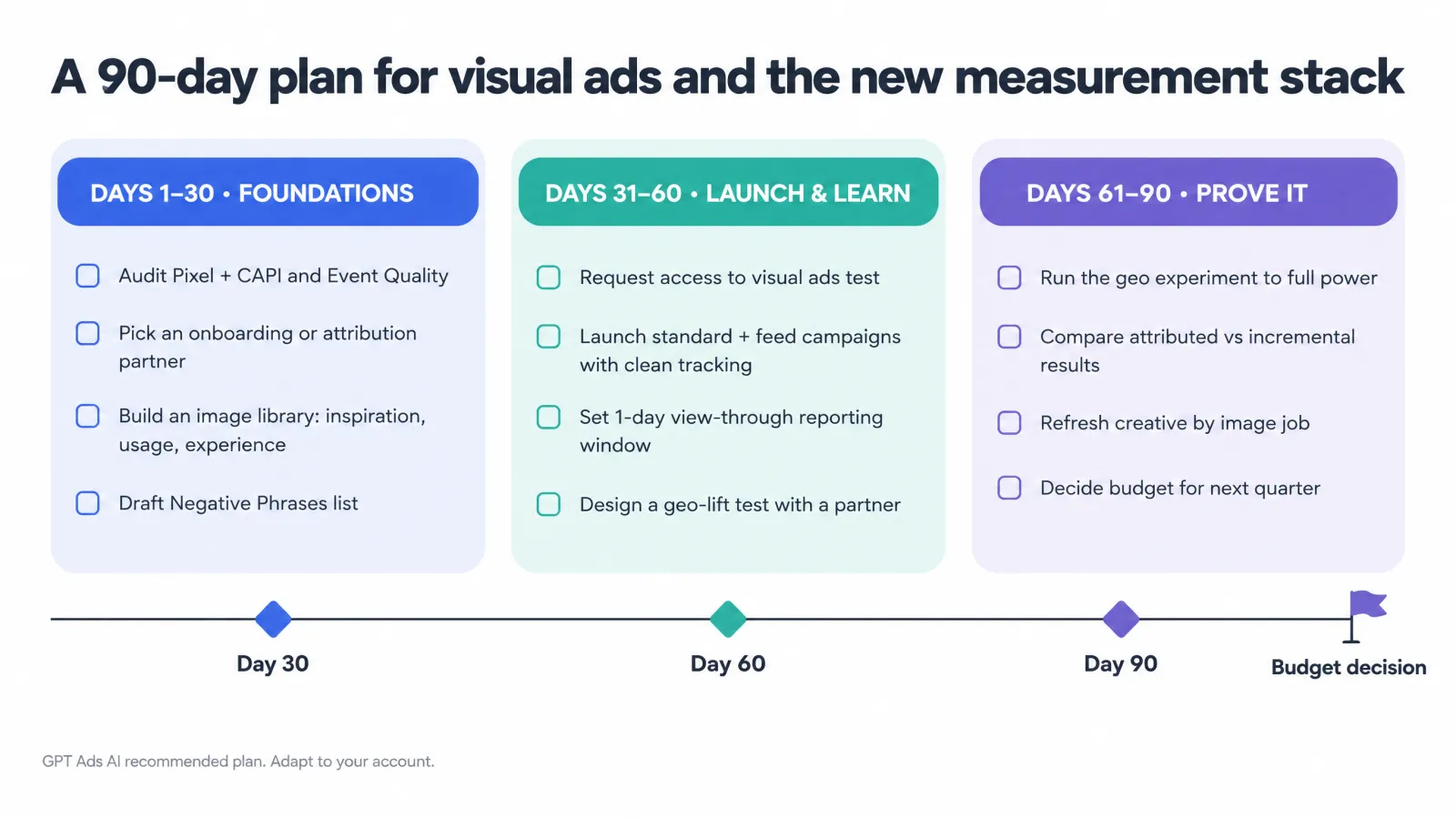
Days 1–30: foundations
| Task | Output | Done when |
|---|---|---|
| Audit the Pixel and Conversions API | A list of gaps, with owners | Every conversion page fires the Pixel; server events flow; deduplication confirmed with a test order |
| Clear event quality warnings | No open warnings | A full seven-day assessment window with no warnings (event quality guide) |
| Choose your partner route | A decision memo: data onboarding, attribution, or both | Contract or connection in progress, using the systems you already rely on where possible |
| Build the image library | Concepts per job, hero and sequence versions, clean and overlay variants | Creative approved by brand and legal |
| Draft Negative Phrases | A 10–20 phrase list, each with a written reason | Approved by brand safety, ready to add if you qualify |
| Set reporting windows | Documented click-through and view-through windows | View-through set to 1 Day; windows written in every report footnote |
Days 31–60: launch and learn
| Task | Output | Done when |
|---|---|---|
| Request access to the visual ads test | A request through your OpenAI contact or agency | Response received (access, waitlist or decline) |
| Run standard and feed campaigns on clean tracking | Live campaigns with reliable conversion data | Two weeks of data with stable event quality |
| Compare platform and partner numbers | A reconciliation table: Ads Manager vs. partner vs. your store or CRM | Differences explained and documented |
| Design the geo test | A test plan with power analysis, markets, duration and decision rule | Signed off by analytics and finance |
| Add Negative Phrases (if qualified) | List applied in Ads Manager | Impressions monitored for a week for over-blocking |
Days 61–90: prove it
| Task | Output | Done when |
|---|---|---|
| Run the geo experiment | A live test at the planned spend in test markets only | The full planned duration, with no contaminating changes |
| Compare attributed with incremental results | Your own multiple: incremental orders per attributed order | Readout delivered to finance |
| Refresh creative by job | New concepts for the best-performing job | Old creative retired on evidence, not fatigue alone |
| Make the budget decision | Next-quarter allocation for ChatGPT Ads, including visual ads if available | Decision made against the rule written in advance |
If you are outside the US
The visual ad test starts in the US. The measurement and brand-safety changes apply to ChatGPT Ads more broadly, but check availability for your market with your account contact. For a non-US advertiser, the first 60 days of this plan still apply in full: signals, partners, creative library and Negative Phrases are all ready to use when the format reaches your market. Our country availability guide tracks which markets are open for ChatGPT Ads, and our European services page covers the EU-specific privacy work.
Common mistakes to avoid
| Mistake | Why it hurts | What to do instead |
|---|---|---|
| Waiting for the creative spec before doing anything | Teams with ready libraries launch first when access opens | Build to the three jobs now; adapt sizes later |
| Designing creative that relies on the user's generated image | Ads are separate from the image by design | Show your own images that match the kind of request |
| Judging visual ads on last-click CPA | Upper-funnel influence is invisible on last-click | Use view-through, a full-funnel view and a geo test |
| Quoting the partner case studies as benchmarks | One brand's result does not predict yours | Cite them as single-brand results and measure your own |
| Connecting a new attribution partner without deduplication | Double-counted conversions mislead reports and optimisation | Share the event ID across Pixel and server paths; verify with a test order |
| Running an underpowered geo test | "No significant lift" gets read as "no effect" | Get a power analysis first; raise budget or duration if needed |
| Copying a web blocklist into Negative Phrases | Over-blocks relevant inventory | Short list of brand-specific phrases, each with a reason |
| Expecting per-impression verification from DV or IAS | The pilots evaluate the system, not placements | Brief brand safety on system-level evaluation |
| Hard-sell headlines | Clash with a reflective, mid-task setting | Calm, concrete benefit statements like OpenAI's example |
| Generated products that differ from the real thing | Misrepresentation, returns, policy risk | Real product photography in generated scenes |
Open questions to watch
These are the questions we will be tracking, and we will update this guide as OpenAI answers them. Our news timeline records each change as it ships.
| Question | Why it matters |
|---|---|
| What is the creative specification for visual ads? | Image sizes, counts and text rules decide what you produce |
| How are visual ads priced and billed? | Determines whether CPM or CPC economics apply and how to set bids |
| How is relevance matched during image generation? | Decides whether context hints carry over, and how to write them |
| When does the test open beyond the initial group, and how do you apply? | Sets your launch timeline |
| Will visual ads appear beyond image generation? | Expands reach and changes which categories fit |
| What reporting will the format have, including image-level metrics? | Decides how you optimise the sequence |
| What are the Negative Phrases limits and qualification criteria? | Decides how you build and prioritise your list |
| When and how will DV and IAS evaluation findings be shared? | Decides whether your brand-safety policy can approve the channel |
| When will Kantar and Cint brand-lift studies be available, and at what spend? | Decides how you measure inspiration and experience creative |
| Will incrementality move from "early stages" to a standard product? | Decides whether geo tests become routine |
Glossary
| Term | Meaning in ChatGPT Ads |
|---|---|
| Visual ad format | The image-led ad unit announced on 5 October 2026, first tested during image generation |
| Image generation | ChatGPT creating an image from a user's request; the first placement for visual ads |
| Free and Go plans | The ChatGPT plans whose users see ads; Plus, Pro and Business users do not |
| Pixel | OpenAI's JavaScript tag (oaiq) that records conversions on your website |
| Conversions API (CAPI) | A server-to-server route for sending conversion events to OpenAI |
| Event Quality Score (EQS) | OpenAI's assessment of how complete and usable your conversion signals are |
| Data onboarding | Sending conversion data from existing systems (warehouse, CDP, CRM) to an ad platform, here via Hightouch, Tealium or LiveRamp |
| MMP | Mobile measurement partner: a company that attributes app installs and in-app events to ad networks |
| Click attribution | Crediting conversions to ad clicks within a chosen window |
| View-through conversion | A conversion within one day of an eligible impression where no qualifying click gets credit |
| Attribution window | How long after a click (7, 14 or 30 days) or impression (0 or 1 day) a conversion can be credited in reports |
| Advanced conversion optimisation | Delivery that learns from eligible click-through and view-through conversions for your selected goal |
| Incrementality | The conversions that happened because of the ads and would not have happened otherwise |
| Geo-lift test | An experiment comparing regions with ads on against matched regions with ads off |
| Power analysis | A pre-test calculation of whether a test can detect a realistic effect at a given budget and duration |
| Full-funnel measurement / MMM | Statistical models estimating each channel's contribution across the whole mix |
| Brand lift | Survey-based measurement of changes in awareness, consideration or preference |
| Placement guardrails | OpenAI's system that keeps ads out of sensitive or unsuitable conversations |
| Negative Phrases | Brand-specific exclusions available to qualifying advertisers |
| Brand suitability evaluation | Independent assessment (DV and IAS pilots) of how OpenAI's safeguards are applied, without access to private conversations |
| Context hints | Plain-language descriptions of the conversations where your ads are relevant; intent signals, not keywords |
How GPT Ads AI can help
We are an agency that runs ChatGPT Ads for brands in the US, Canada, the UK, Australia, New Zealand, Singapore and beyond. For this announcement specifically:
- Creative. We brief and produce image libraries around OpenAI's three jobs, with hero and sequence versions ready for the visual format. See ChatGPT ad creative.
- Measurement. We audit your Pixel, Conversions API and event quality, connect the right partner from the new list, and design geo-lift tests with power analysis up front. See ChatGPT Ads measurement.
- Management. We run the campaigns, handle access requests and keep Negative Phrases and context hints current. See ChatGPT Ads management.
Sources and further reading
- OpenAI, Building advertising for the way people use AI, 5 October 2026 (the visual format, measurement partners, Negative Phrases, DV and IAS pilots, partner case results, quotes from IAS and DoubleVerify)
- OpenAI Ads Blog, More ways to measure ChatGPT Ads, 5 October 2026 (measurement philosophy, Kantar and Cint brand-lift testing, the 52.7% view-through finding, the 2.3× Dose incrementality result, view-through optimisation and reporting windows, Event Quality Score)
- OpenAI, Advertising policies (category rules and creative policies)
- OpenAI, Ads Manager (sign-up and account access)
- Adthena, reporting on the Negative phrases field in Ads Manager, August 2026 (third-party; the 100-phrase, 100-character limits are not confirmed by OpenAI)
- GPT Ads AI guides: conversion tracking, event quality, reporting and attribution windows, conversion campaigns, context hints, ad examples, ecommerce, cost and bidding, news timeline
Quick answers.
What are ChatGPT visual ads?
A new image-led ad format OpenAI announced on 5 October 2026. It uses images showing product inspiration, the product in use, or the experiences it makes possible, with an advertiser name, a clear Ad label, a headline and a Learn more button. The first test shows these ads during image generation in ChatGPT.
When do ChatGPT visual ads start?
OpenAI said testing would begin later in October 2026, in the US, with an initial group of advertisers. It is a limited test, not a self-serve launch, and OpenAI has not published a date for wider availability.
Who sees ChatGPT visual ads?
Users on the Free and Go plans, per OpenAI. As with other ChatGPT ads, Plus, Pro and Business plan users do not see ads. The first test is in the US only.
Will my brand appear inside the image ChatGPT generates for a user?
No. OpenAI says visual ads are clearly labelled and remain separate from the image being created. Your ad sits in its own unit below the user's image, and advertising does not influence what ChatGPT generates or answers.
How do I get access to the visual ad format?
OpenAI has not published an application process. The test starts with an initial group of advertisers. Ask your OpenAI ads contact or agency, and make your account a strong candidate: active spend, a clean policy record, a working Pixel and Conversions API, and an image library ready to use.
What are the creative specifications for visual ads?
OpenAI had not published them as of 16 October 2026. Its mockup shows two layouts: a single hero image with carousel dots, and a swipeable strip of square images, each with a headline and a Learn more button. Prepare both a hero key visual and a three-to-five image sequence, with and without overlay text.
How much do ChatGPT visual ads cost?
Pricing for the visual format has not been published. For standard ChatGPT ads, OpenAI publishes a $25 USD minimum daily budget and a $3–5 recommended starting max bid for the Clicks objective, in a relevance-weighted auction with no rate card.
Which measurement partners did OpenAI announce?
Data onboarding through Hightouch, Tealium and LiveRamp; attribution partners AppsFlyer, Triple Whale, Adjust, DV Rockerbox, Northbeam, Branch, Singular, Kochava, Airbridge and Tenjin; full-funnel partners Fospha, Measured and INCRMNTAL; geo-based incrementality with Haus, Measured and WorkMagic; and early-stage brand-lift testing with Kantar and Cint.
Which attribution partner should I use for ChatGPT Ads?
The one you already use, if it is on the list. OpenAI's goal is measurement through the systems advertisers already rely on. If you have none, app advertisers should start with a mobile measurement partner such as AppsFlyer, Adjust or Branch, and Shopify or DTC brands with a platform such as Triple Whale or Northbeam.
What is the difference between Hightouch, Tealium and LiveRamp for ChatGPT Ads?
All three help send conversion data from existing systems. Hightouch suits companies whose conversion records live in a cloud warehouse. Tealium suits enterprises already routing events through its tag and customer-data platform. LiveRamp suits brands with significant offline or CRM conversions and strict privacy needs.
What is a geo-based incrementality test?
An experiment that turns ads on in some regions and off in matched control regions, then compares total business outcomes to estimate the conversions caused by the ads. OpenAI is exploring these tests with Haus, Measured and WorkMagic and describes the work as early stage. Always get a power analysis before running one.
What were the early ChatGPT Ads measurement results?
DV Rockerbox measured WeightWatchers' attributed CPA at 15.3% below its blended paid-search benchmark. WorkMagic found statistically significant lift for Dose, with 67% of incremental purchases from net-new customers and 2.3 times more incremental orders than last-click captured. Triple Whale reported that 93% of Portland Leather's ChatGPT Ads visitors were new. These are single-brand results, not benchmarks.
Does last-click attribution undercount ChatGPT Ads?
In one published study, yes: WorkMagic's geo-lift test for Dose estimated 2.3 times more incremental orders than last-click captured. That is one brand's result. Run your own incrementality test before assuming a multiple for your account.
Do view-through conversions count for optimisation in ChatGPT Ads?
Yes. OpenAI says advanced conversion optimisation learns from eligible click-through and view-through conversions for the selected goal. Reporting windows (7, 14 or 30-day click-through and 0 or 1-day view-through) change only what reports show, not how campaigns optimise.
What does the 52.7% view-through figure mean?
In OpenAI's early analysis of global campaigns optimised for deeper-funnel outcomes, 52.7% of eligible one-day view-through conversions happened within an hour of the matched ad impression. It suggests many view-through conversions are closely tied in time to the ad, but it does not prove the ad caused them.
What are Negative Phrases in ChatGPT Ads?
A control, now available to qualifying advertisers, for narrow placement requirements specific to a brand's own policies. It keeps ads away from conversations a brand chooses to avoid. Third-party reports from August 2026 described up to 100 phrases of up to 100 characters each, but OpenAI has not confirmed those limits.
Should I put sensitive topics like grief or mental health on my Negative Phrases list?
Generally no. OpenAI's placement guardrails already keep ads out of emotionally vulnerable, sensitive or otherwise unsuitable conversations for every advertiser. Use Negative Phrases for contexts that are acceptable in general but wrong for your brand, such as recalls, counterfeits or crises about your own company.
Will DoubleVerify or IAS verify each ChatGPT ad impression?
Not as announced. The DV and IAS pilots evaluate how OpenAI's brand-safety standards are applied in a controlled testing environment, without accessing private user conversations. They assess the system rather than reporting on individual placements.
What brand-lift measurement is available for ChatGPT Ads?
OpenAI says it is in early-stage testing with Kantar and Cint to measure the impact of ChatGPT Ads on brand resonance metrics, as it begins experimenting with new placements. Availability, minimum spend and study design have not been published.
Which businesses are best suited to ChatGPT visual ads?
Businesses whose products show up in the images people generate: home and interiors, gardens, fashion, travel, food and entertaining, events, beauty, pets and small-business branding. Complex B2B software and price-led commodity services are a weaker fit for the image-generation placement.
Related guides.
ChatGPT Ads News & Timeline
The full story in one place: the November 2025 leak, the February 2026 pilot, the May 2026 self-serve Ads Manager launch, product feeds, automated bidding, and the September rollout into Europe, India and MENA — every milestone labeled confirmed or reported.
Read guideConversion Tracking
The oaiq pixel snippet, every supported standard event, the image tag fallback, the full Conversions API payload, deduplication, hashing rules, consent and CSP, validation — and an honest account of what this pixel cannot see.
Read guideChatGPT Ads Reporting
Ads Manager reports one combined Conversions number by default — and most advertisers never find the menu that breaks it apart. Metrics, columns, exports, macros and the troubleshooting tree.
Read guideChatGPT Ads Examples
Real screenshots from inside the ChatGPT Ads Manager, plus what the ad actually looks like — the six components, the 50/100 character limits, the brands already running them, example copy by vertical, and anonymized campaign results.
Read guideWant this run for you?
GPT Ads AI is a done-for-you ChatGPT Ads agency. The services below cover exactly what this guide describes.
Ad creative & context hints
Titles, descriptions, and square images written for the six-component ChatGPT ad unit, paired with context hints that put the ad under the right conversation.
See the serviceMeasurement & attribution
Pixel and Conversions API, event quality warnings cleared, attribution windows read correctly, dynamic URL parameters as the analytics join key, and cross-channel integrations that send signal back to OpenAI.
See the serviceChatGPT Ads management
A senior operator runs the whole channel — account, structure, context hints, creative, bidding, measurement, and weekly written reporting — on a fixed retainer.
See the service
Tarun Kapoor
Founder · GPT Ads AI
Performance marketer with 12+ years in paid acquisition. Former senior media buyer at Neil Patel Digital. Alumni of GroupM, WPP, Ogilvy & Mather, and Toptal's Growth Collective. Fractional CMO to Fortune 500 brands and venture-backed startups.
Book a call with Tarun