ChatGPT Ads Examples: What They Look Like, by Vertical (2026)
ChatGPT ads examples: real screenshots of the OpenAI Ads Manager and its ad preview, a labeled anatomy of the six-component unit, the Best Buy, Lowe's and VistaPrint reference advertisers, example ad copy by vertical, and GPT Ads AI observed engagement patterns.
Short answer: A ChatGPT ad is a sponsored placement that appears below a relevant ChatGPT conversation, clearly labeled and visually separate from the organic answer. Per OpenAI, every ChatGPT ad is built from the same six components: advertiser name, favicon (the advertiser logo), title (headline), copy (description), landing page URL, and one image asset (creative). It looks like a single compact, labeled card — a brand favicon, a headline, a line of description, an image, and a link — that enters the conversation below the answer rather than interrupting it. OpenAI selects which ad to show by relevance-weighting it to the context and intent of the conversation.
Below we show, not just tell: real screenshots from inside the OpenAI Ads Manager Beta, including OpenAI's own ad preview panel, a labeled anatomy of the six-component unit, how OpenAI describes the placement, what we can learn from OpenAI's three public reference advertisers (Best Buy, Lowe's, and VistaPrint), illustrative ad copy and title variations for DTC, SaaS, and professional services, a by-vertical comparison table, and the engagement patterns we observe at GPT Ads AI. For the foundational mechanics, see our pillar guide,What Are ChatGPT Ads?
First look: real screenshots of the ChatGPT Ads Manager
Before the anatomy diagrams, here is the product itself. The screenshots below are our own, captured from a live GPT Ads AI advertiser account inside the OpenAI Ads Manager Beta in August 2026. OpenAI's public materials describe the ad unit in words; these show it. If you have read a dozen articles about ChatGPT ads without ever seeing one, start here — including the built-in Preview creative panel, which is OpenAI's own rendering of what the card looks like to a user.
The ad preview: what a ChatGPT ad actually looks like
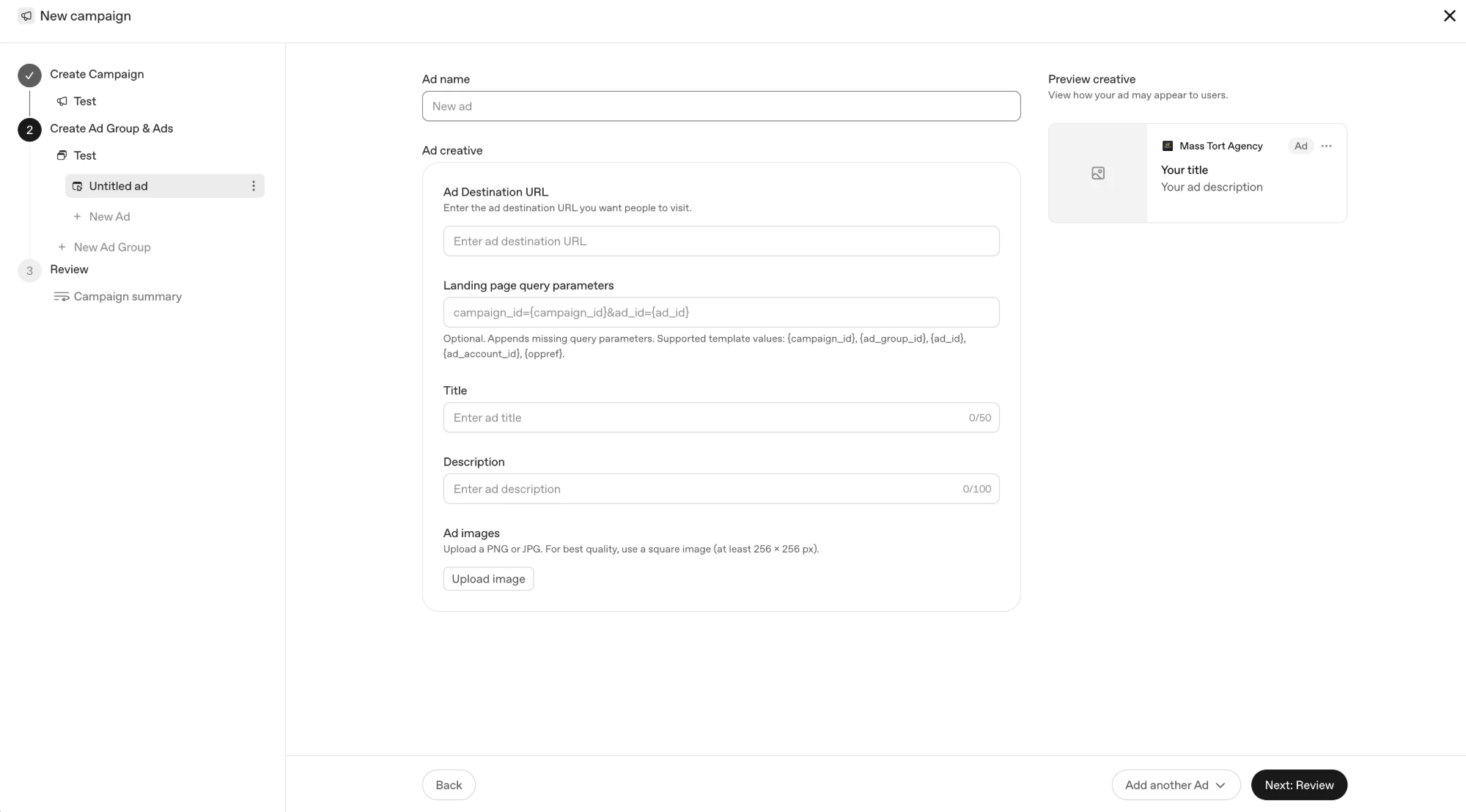
Two things in this screen are worth more than any description of the format. First, the preview confirms the layout: a small square creative on the left, and on the right a row carrying the favicon, the advertiser name, and an explicit Ad label, with the title and then the description stacked below it. Second, the input fields carry hard character counters that OpenAI's prose documentation does not spell out:
- Title: 50 characters maximum. The counter reads
0/50. That is roughly two Google Search headlines' worth of space to do all of the persuading — shorter than the 90-character Google description and far shorter than a Meta primary text. - Description: 100 characters maximum. The counter reads
0/100. One sentence, effectively. - Image: PNG or JPG, square, at least 256 × 256 px. The upload hint asks for a square asset for best quality, so a 16:9 lifestyle crop is the wrong shape for this placement.
- One destination URL per ad, with optional landing-page query parameters layered on top (see the campaign screens below).
The Ads Manager overview
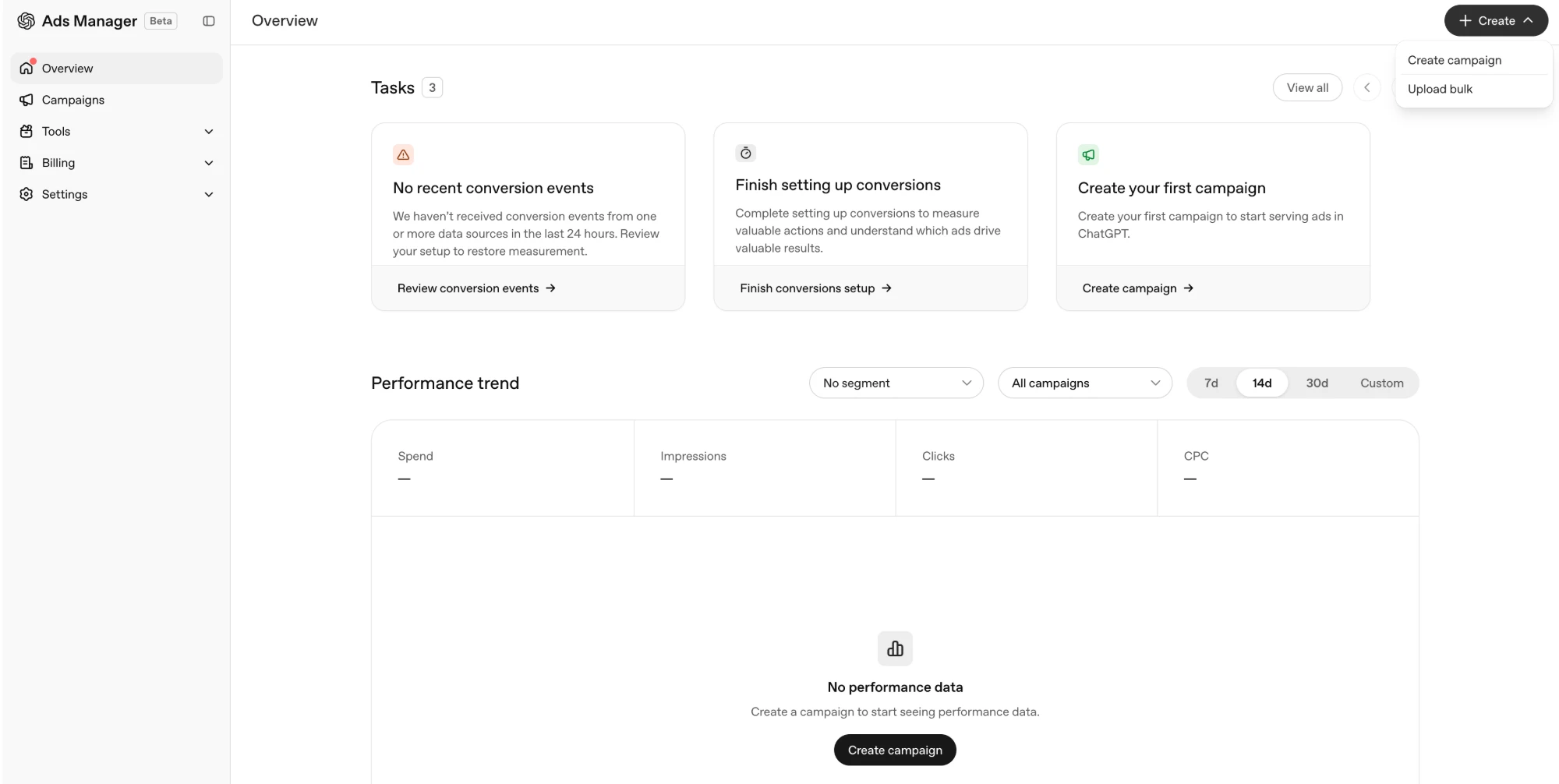
The onboarding tasks are themselves a tell about how OpenAI expects the account to be built: Review conversion events, Finish conversions setup, then Create your first campaign. Measurement is framed as step one, not step three. If you want that part done properly before you spend, see ChatGPT Ads conversion tracking.
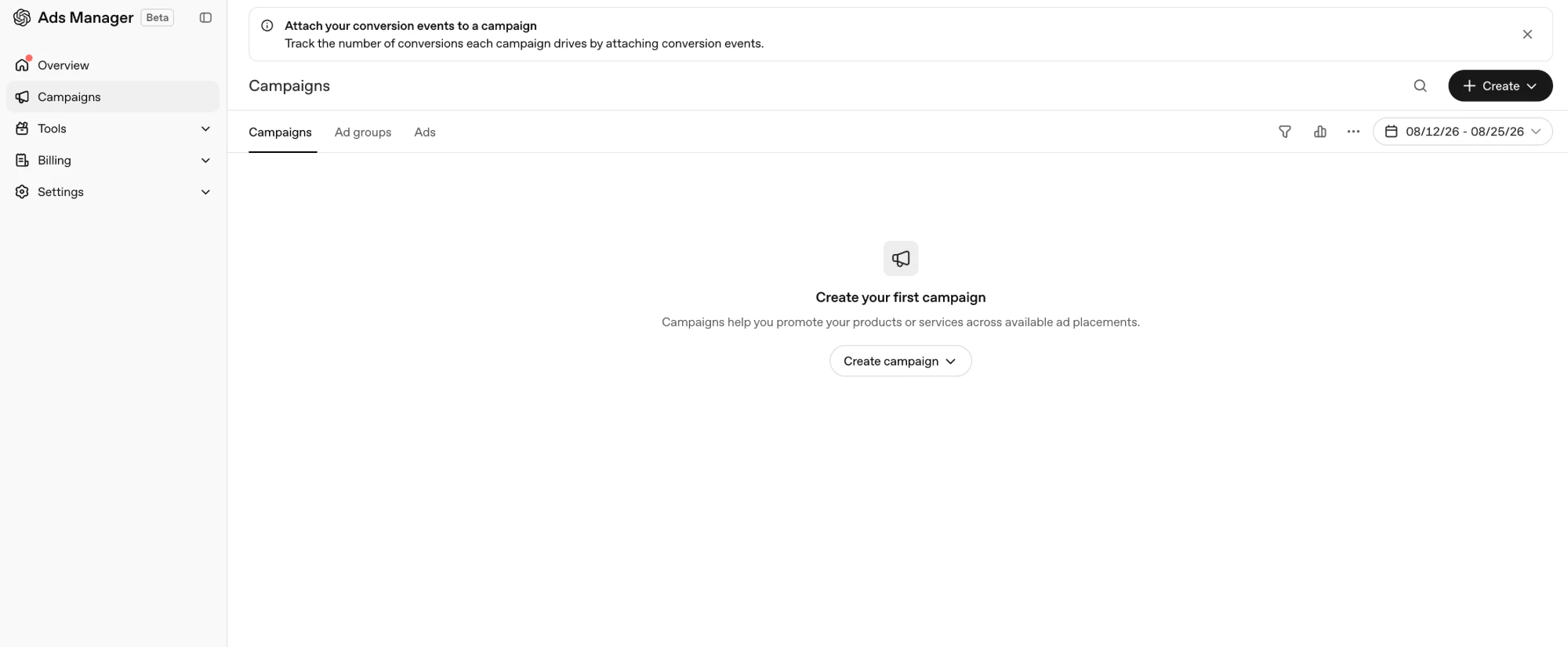
Campaigns, ad groups, and ads
Campaign setup: objective, geo, platforms, and budget
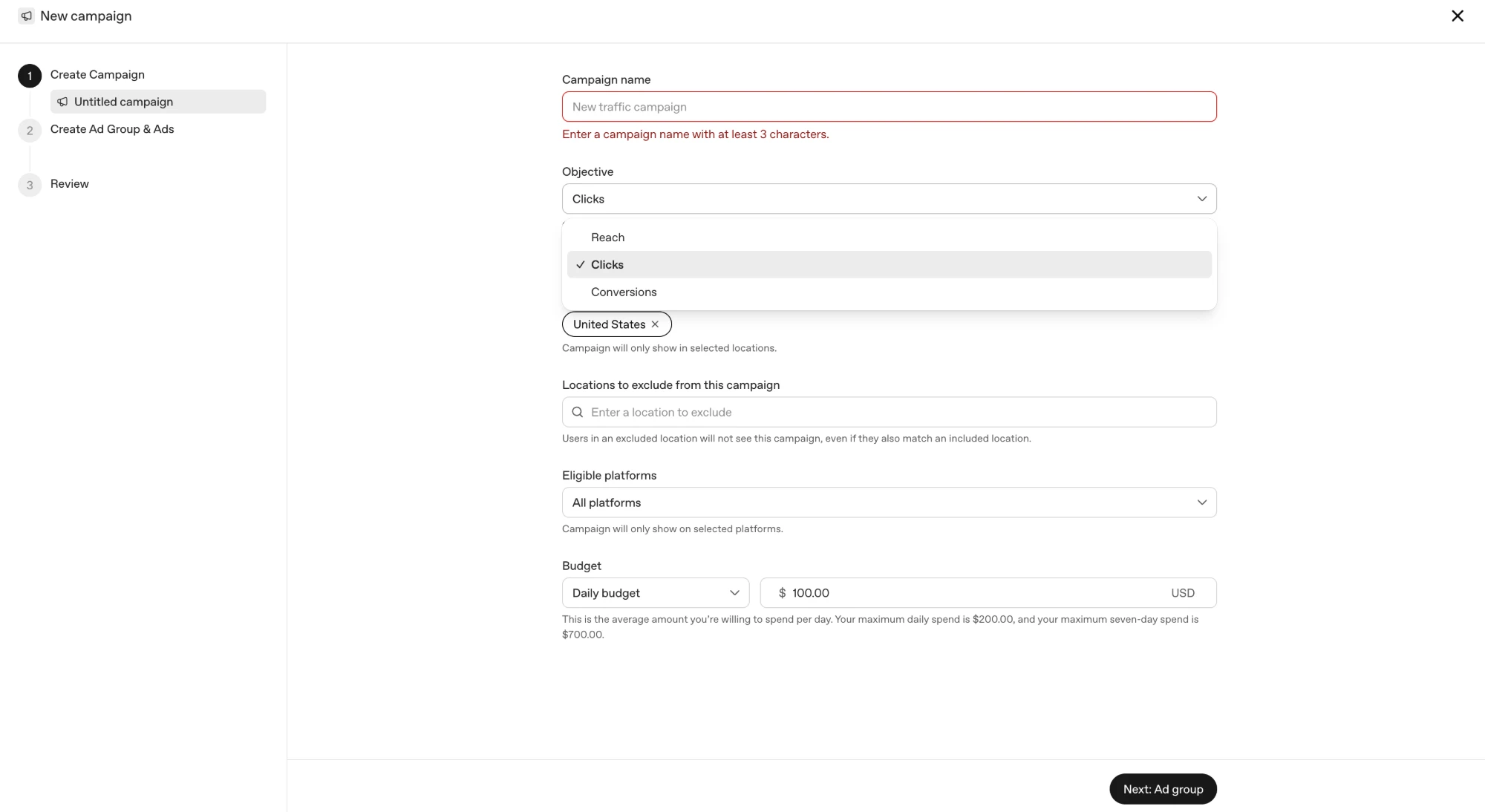
The budget helper text on this screen is the single most useful undocumented detail in the whole flow. With a $100.00 daily budget, OpenAI states that "your maximum daily spend is $200.00, and your maximum seven-day spend is $700.00." In other words the platform will overdeliver up to 2× your daily budget on any single day, but caps the week at 7× the daily number. That is the same pacing model Google uses, and it means a daily budget is a weekly average, not a daily ceiling. Plan the week, not the day.
Ad group setup: conversion type, bid strategy, and context hints
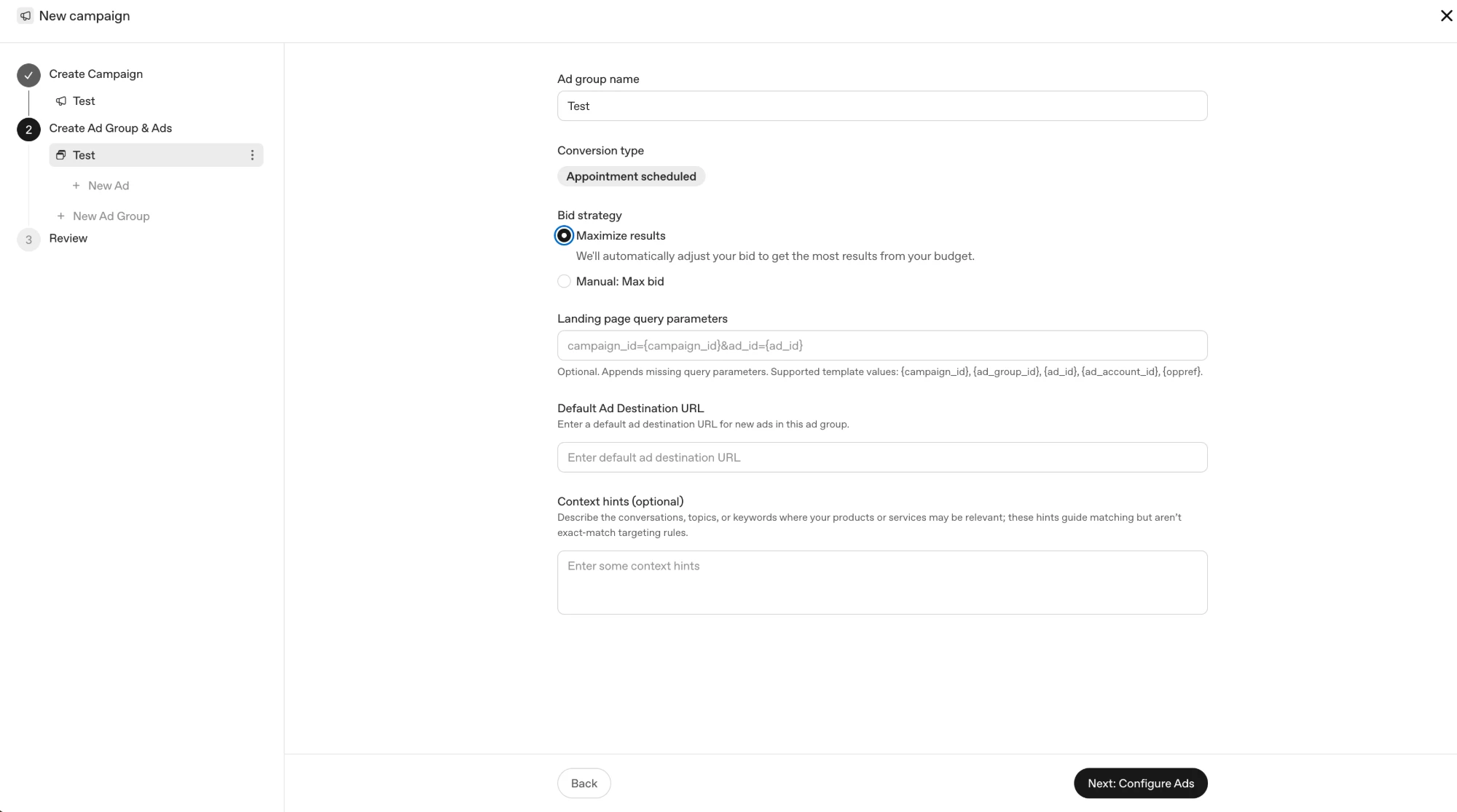
- Landing page query parameters accept the template values
{campaign_id},{ad_group_id},{ad_id},{ad_account_id}, and{oppref}— the ValueTrack equivalent for this channel. Build the string once with our free UTM builder. - Context hints are described on-screen as a way to "describe the conversations, topics, or keywords where your products or services may be relevant" — and, critically, that "these hints guide matching but aren't exact-match targeting rules." That single sentence is the whole mental shift from keyword buying. See context hints for ChatGPT Ads and worked hint examples.
- Conversion type is set at the ad group level, not the campaign level, so one campaign can chase different actions per ad group.
What does a ChatGPT ad look like? The six components
Per OpenAI's documentation, every ChatGPT ad is assembled from the same six building blocks. There is no second headline, no expandable sitelink, no callout extension in the documented unit — it is a deliberately minimal, unified card designed for a user who is mid-conversation, not scrolling a feed. The six components OpenAI defines are:
- Advertiser name — the business name shown on the card (for example, "Best Buy").
- Favicon — the advertiser logo, displayed next to the name and the label.
- Title (headline) — the primary line of copy that does most of the persuasive work. The Ads Manager caps it at 50 characters (see the screenshots above).
- Copy (description) — a short supporting line that adds the offer, proof, or detail. The Ads Manager caps it at 100 characters.
- Landing page URL — where the click goes. Per OpenAI, UTM and static tracking parameters are supported on landing-page URLs and persist through the ad click.
- Image asset (creative) — a single image that gives the unit visual weight. The uploader asks for a PNG or JPG, square, at least 256 × 256 px.
A labeled anatomy mock, component by component
Here is a worked mock that maps each OpenAI component onto a visible unit. Picture a user who has just asked ChatGPT, "What is the best magnesium supplement for sleep?" The model returns its organic answer. Then, below that answer and clearly separated, a single sponsored card appears. This is a GPT Ads AI illustration using a fictional brand:
- Label plus favicon (components 1-2): a label and a round brand favicon sit with the advertiser name — for our mock, "Rest Labs."
- Image (component 6): a clean product shot of a magnesium glycinate bottle on a neutral background.
- Title (component 3): "Magnesium Glycinate Built for Deeper Sleep."
- Copy (component 4): "Third-party tested. 400mg per serving. Free shipping over $40."
- URL (component 5): a visible link such as restlabs.com/sleep, carrying UTMs behind the scenes so the click lands in your analytics as a ChatGPT-sourced session.
That is the whole unit. Read it back and you can see why the format rewards clarity: there is no second headline to hide behind, so the title and copy have to earn the click on their own. If you want to plan the URL side of this, our free UTM builder generates a clean, conventioned tracking string that persists through the ad click.
Where do ChatGPT ads appear, and how are they labeled?
Per OpenAI's documentation, ads appear below the relevant conversation — never inside the answer text, never replacing the answer. OpenAI describes three trust pillars that govern the placement:
- Clearly labeled — the unit is labeled as advertising so it is unambiguous.
- Separate from answers — the ad is visually and functionally distinct from ChatGPT's organic response, and the answer is generated independently of who is advertising.
- Choice and control — users have controls over how their data is used for advertising.
The selection is relevance-weighted to the context and intent of the conversation. Per OpenAI, the inputs the system considers include the advertiser's context hints, the landing page, the ad title, and the ad copy. There is no separate, hidden ad format documented beyond the six-component unit.
Who actually sees these ad examples?
This changes which examples are even visible to your buyer. Per OpenAI, ads are shown to Free and Go users in the United States, Canada, Australia, and New Zealand. They are not shown to Plus, Pro, or any Business-plan user, and not to users OpenAI predicts to be under 18. So if you are a Plus subscriber trying to find a ChatGPT ad to screenshot, you will not see one — by design. We unpack the audience math in thepillar guide.
What real placements look like: Best Buy, Lowe's, and VistaPrint
OpenAI features exactly three advertisers publicly:Best Buy, Lowe's, and VistaPrint. These are the only OpenAI-endorsed reference examples, and each ran the same six-component card below relevant conversations.
- Best Buy — Amy Adams, Best Buy's VP of Media, is quoted on OpenAI's materials describing the value of showing up in the moments where consumers research products and make purchase decisions. The operator lesson (a GPT Ads AI read, not an OpenAI claim): the unit fits high-consideration retail research such as "which 65-inch TV is best for a bright room?", where a brand card below a comparison answer meets the buyer at the decision point.
- Lowe's — featured by OpenAI as a reference advertiser. The operator takeaway is category fit: project and "how do I" home-improvement queries are dense with purchase intent and map cleanly onto a product or service landing page.
- VistaPrint — featured by OpenAI as a reference advertiser in small-business and print. The operator takeaway is that the channel can act as a discovery surface that reaches buyers your existing programs may not, not just a retargeting layer for people who already know you.
A discipline note: OpenAI has not published the exact creative copy or precise performance numbers for these three brands in its public docs, so do not repeat any specific CTR, ROAS, or conversion figure attributed to them — there is no OpenAI source for one. Any other brand names you may see associated with ChatGPT Ads come from third-party press reports, not OpenAI, and should be treated as unconfirmed. We only present Best Buy, Lowe's, and VistaPrint as confirmed reference advertisers.
Example ad copy and title variations by vertical
Here is the part most guides skip: organized title and copy variations by vertical, with the reasoning. Because the user is mid-research, the pattern we find wins is educational, comparison, and outcome framing — not discount-and-deadline urgency that works on a cold social feed. Everything in this section is a GPT Ads AI illustrative example, not an OpenAI template, and the brands are fictional.
DTC supplements and eCommerce
Trigger intent: product research ("best magnesium for sleep," "compare creatine versus creatine HCL").
- Title A: "Compare the Top 5 Magnesium Forms"
- Title B: "Magnesium Glycinate Built for Deeper Sleep"
- Title C: "Third-Party Tested Magnesium — See the Labels"
- Title D: "Which Magnesium Is Right for You? Take the Quiz"
- Copy: "Independently tested for purity. 400mg per serving. Free shipping over $40 and a 60-day guarantee."
Why we think it works: comparison and "see the labels" framing matches a researching buyer and routes to a buy-stage page. Urgency such as "48-hour sale" tends to read as out of place against a thoughtful answer.
B2B SaaS
Trigger intent: tool evaluation ("best month-end close software," "how to automate reconciliation").
- Title A: "Cut Month-End Close Time in Half"
- Title B: "Close Software Built for Controllers — See the Demo"
- Title C: "Compare the 4 Leading Close Tools"
- Title D: "Automate Reconciliation in 30 Days"
- Copy: "Built for finance teams. SOC 2 Type II. Book a 15-minute demo and see your close timeline mapped live."
Why we think it works: lead with the outcome (faster close), prove it (compliance, fit), and route to a demo. Pair this with the Clicks (CPC) objective when the goal is qualified pipeline.
Professional services
Trigger intent: "should I hire / how do I" prompts ("do I need a lawyer to file a trademark," "how to find a fractional CFO").
- Title A: "Fixed-Fee Trademark Filing, Attorney-Reviewed"
- Title B: "Talk to a Trademark Attorney — Free 20-Min Consult"
- Title C: "File Your Trademark Right the First Time"
- Title D: "Trademark Search and Filing, Flat $599 Plus Fees"
- Copy: "Licensed attorneys, transparent flat fees, and a conflict search before you file. Book a free consult — no obligation."
Why we think it works: services buyers are buying trust. Credentials, fixed-fee clarity, and a low-friction consult tend to outperform vague "world-class expertise" claims. Route to a consultation or intake page, not a generic home page.
Comparison table: example ChatGPT ads by vertical
This is the artifact operators want — one table mapping the triggering conversation, an example title, example copy, the creative, and a recommended objective for each vertical. These are GPT Ads AI illustrative examples, not OpenAI templates or guarantees.
| Vertical | Trigger conversation / intent | Example title | Example copy | Creative | Objective |
|---|---|---|---|---|---|
| DTC supplements | "Best magnesium for sleep?" | Compare the Top 5 Magnesium Forms | Third-party tested. 400mg. Free shipping over $40. | Clean product bottle on neutral background | Clicks (CPC) |
| DTC apparel / gear | "Best trail running shoes for wide feet?" | Wide-Fit Trail Shoes, Built for Long Miles | True-to-size wide last. 90-day trial. Free returns. | Lifestyle shot of shoe on trail | Clicks (CPC) |
| B2B SaaS (finance) | "How to speed up month-end close" | Cut Month-End Close Time in Half | Built for finance teams. SOC 2. Book a 15-min demo. | Product dashboard screenshot | Clicks (CPC) |
| B2B SaaS (new category) | "What tools manage RevOps handoffs?" | Compare the 4 Leading RevOps Tools | See where each fits. Free side-by-side comparison. | Comparison-grid graphic | Reach (CPM) for awareness |
| Professional services (legal) | "Do I need a lawyer to file a trademark?" | Fixed-Fee Trademark Filing, Attorney-Reviewed | Flat fees, conflict search, free 20-min consult. | Trust badge or attorney headshot | Clicks (CPC) |
| Professional services (finance) | "How to find a fractional CFO" | Fractional CFOs for $5M-$50M Companies | Vetted operators. Start in 2 weeks. Book a fit call. | Founder or advisor portrait | Clicks (CPC) |
GPT Ads AI observed engagement patterns (illustrative)
OpenAI has not published precise CTR, ROAS, or conversion figures for any advertiser in its public docs, and we will not invent any. What follows areGPT Ads AI managed-account observations: anonymized, aggregated, directional patterns across the three verticals we work in most. They are not OpenAI numbers, not forecasts, and not guarantees of results. For the long-form versions with challenge, approach, and results framing, see ourcase studies.
DTC supplements — observed pattern
Across managed DTC supplement accounts, our observed CPCs generally land in the lower-to-middle of a broad $1.50-$9 range we see across DTC, SaaS, and services (a GPT Ads AI managed-account observation, not an OpenAI rate). The biggest lever we see is matching the title to the exact research question; in our accounts, comparison and "best X" framing tends to out-click discount framing. We treat the channel as a profit-and-loss line from day one, not a six-month science project — that posture runs through everycase study.
B2B SaaS — observed pattern
In SaaS accounts, we observe demo and trial requests arriving from buyers who were actively evaluating tools inside ChatGPT — a high-intent, research-mode audience. CPCs in our accounts tend to sit higher than DTC within that same observed range, which is what we would expect for a considered B2B purchase. We see cost-per-lead hold up best when the landing page and the MQL definition are tightened in parallel. These are directional observations, not promises.
Professional services — observed pattern
For high-ticket services, we observe that trust-led, fixed-fee creative tends to produce better-qualified consults than urgency-led copy. CPCs in regulated service categories — legal, financial, and health — run materially higher than the rest of our observed range, a pattern we flag in advance during planning. In our experience the win is consult quality, not raw volume: a researching buyer who clicks a credentialed, flat-fee offer tends to arrive at the call already partly qualified.
What makes a ChatGPT ad work versus fail
After running live campaigns on the channel, the pattern we see is consistent. The unit rewards ads that enter the conversation rather than interrupt it. Here is our operator heuristic — a GPT Ads AI observation, not an OpenAI rule:
- Works: educational, comparison, and resource framing that extends the answer the user just read ("Compare the Top 5...", "See the labels", "Book a fit call").
- Works: a title that mirrors the research question and a landing page that pays it off immediately.
- Fails: urgency-and-deadline copy lifted straight from a cold social feed — it clashes with a thoughtful, trusted answer.
- Fails: a generic home-page destination that forces the user to re-find what they were researching.
- Fails: treating context hints like exact-match keywords. Per OpenAI, context hints live at the ad-group level, describe relevant conversations and topics, and do not guarantee delivery in any specific conversation — the system makes the final relevance decision. See ourcontext hints field guide.
How a ChatGPT ad differs from a Google Search ad
The units look superficially similar — text plus a link — but the buyer and the selection model differ in ways that change how you write the ad. The ChatGPT side of this table reflects OpenAI's documentation; the Google side is general industry knowledge.
| Dimension | ChatGPT ad | Google Search ad |
|---|---|---|
| Trigger | Conversation context and intent | Keyword match on a query |
| Targeting input | Context hints at the ad-group level, not exact-match keywords | Keywords with match types and negatives |
| Placement | One card below the conversation, clearly labeled | Multiple text ads above and below organic results |
| Components | Six: name, favicon, title, copy, URL, image | Multiple headlines, descriptions, sitelinks, extensions |
| Auction | Relevance-weighted, second-price (per OpenAI) | Quality-and-bid auction with second-price-style pricing |
| Audience | Free and Go users in US, CA, AU, NZ | Anyone searching, globally |
| Mindset | Research-mode, mid-conversation | Query-mode, scanning results |
The practical consequence: you brief the ChatGPT system on where you would like to appear; it makes the final relevance call. Copy should extend the conversation, not shout over it. For pricing mechanics — the Reach (CPM) and Clicks (CPC) objectives and the relevance-weighted second-price auction — see the pricing section of ourpillar guide.
A note on beta and evolving formats
OpenAI is explicit that the Ads Manager Beta is a beta product that is actively evolving, so the surface area can expand over time. The unit documented today is the six-component card described above. If you see screenshots of richer formats circulating, treat them as unconfirmed unless OpenAI documents them — we do not present any format beyond the documented six-component unit as confirmed. We track changes as OpenAI ships them in theAds Manager setup guide.
How to turn these examples into a live campaign
- Pick the two or three research conversations your buyer actually has, and write a title that mirrors each one.
- Draft three to four title variants and one to two copy variants per ad group, using the by-vertical patterns above.
- Build one strong image asset per concept — a product shot for DTC, a dashboard for SaaS, a trust cue for services.
- Lock a UTM convention before launch with ourUTM builder, and brief the system with strong context hints (see thecontext hint generator).
- Choose your objective — Clicks (CPC) for pipeline and sales, Reach (CPM) for awareness in a new category — and set up conversion measurement inside Ads Manager Beta.
- Want this built and run for you? Talk to ourdone-for-you ChatGPT Ads agency on adiscovery call. We aim to have your first live campaign up in 7-14 days.
Factual claims about OpenAI's ChatGPT Ads product are sourced from OpenAI's public documentation (Ads in ChatGPT: The Basics, Ads Manager Beta Overview, Ads Manager Beta Account Setup, Create Ad Groups for ChatGPT, and the ads.openai.com landing page) as of June 2026. Best Buy, Lowe's, and VistaPrint are the only advertisers OpenAI features publicly; any other brand names come from third-party press reports, not OpenAI endorsements. Example ad copy, fictional brands, and all engagement patterns labeled "GPT Ads AI observations" are illustrative, anonymized, directional patterns from our managed client roster — not OpenAI numbers, not forecasts, and not guarantees of results. GPT Ads AI is an independent agency and is not affiliated with, endorsed by, or owned by OpenAI; "ChatGPT" is a trademark of OpenAI, used descriptively.
Quick answers.
What does a ChatGPT ad look like?
A ChatGPT ad looks like a single sponsored card that appears below a relevant ChatGPT conversation. Per OpenAI, it is clearly labeled and separate from the organic answer, and it is built from six components: advertiser name, favicon (advertiser logo), title (headline), copy (description), landing page URL, and one image asset (creative). It is a compact, labeled unit that enters the conversation below the answer rather than interrupting it.
What does the ChatGPT Ads Manager look like?
The OpenAI Ads Manager Beta is a conventional paid-media console: a left navigation of Overview, Campaigns, Tools, Billing and Settings; a three-tier Campaigns / Ad groups / Ads hierarchy; and headline metrics of Spend, Impressions, Clicks and CPC. Campaign setup asks for an objective (Reach, Clicks, or Conversions), included and excluded locations, eligible platforms, and a budget. Ad group setup adds the conversion type, a bid strategy (Maximize results or Manual: Max bid), landing-page query parameters, and the optional Context hints box. The ad build screen renders a live Preview creative panel showing the card as a user would see it. This guide includes GPT Ads AI screenshots of each of those screens, captured in August 2026.
What is the character limit for a ChatGPT ad title and description?
In the OpenAI Ads Manager Beta, the ad title is capped at 50 characters and the description at 100 characters — the fields carry visible 0/50 and 0/100 counters. The image asset should be a PNG or JPG, square, and at least 256 × 256 pixels. Because there is no second headline and no extensions in the documented unit, those two short lines carry the entire persuasive load, so a single clear outcome or comparison usually outperforms a brand tagline plus an offer crammed together. Limits are from the beta interface and can change.
What are some examples of ChatGPT ads?
OpenAI publicly features three reference advertisers: Best Buy, Lowe's, and VistaPrint. Each runs the same six-component unit — advertiser name, favicon, title, copy, landing page URL, and image — below relevant conversations. Beyond those three, GPT Ads AI runs campaigns across DTC eCommerce, B2B SaaS, and professional services, where illustrative example titles read like 'Compare the Top 5 Magnesium Forms' (DTC), 'Cut Month-End Close Time in Half' (SaaS), or 'Fixed-Fee Trademark Filing, Attorney-Reviewed' (services). The vertical examples are GPT Ads AI illustrations, not OpenAI templates.
Is there a ChatGPT ads case study with real results?
OpenAI has not published precise CTR, ROAS, or conversion-rate figures for any advertiser in its public docs as of June 2026, so there is no public OpenAI case study with hard numbers. The three named reference advertisers are Best Buy, Lowe's, and VistaPrint. GPT Ads AI publishes anonymized engagement observations from managed accounts across DTC, SaaS, and professional services; these are directional, aggregated patterns from our roster — clearly labeled as GPT Ads AI observations, not OpenAI numbers and not guarantees of results.
Which brands are running ads on ChatGPT?
The only advertisers OpenAI features publicly are Best Buy, Lowe's, and VistaPrint. Best Buy's VP of Media, Amy Adams, is quoted on OpenAI's materials. Any other brand names you may see attributed to ChatGPT Ads come from third-party press reports, not OpenAI, and should be treated as unconfirmed until OpenAI features them directly.
Are ChatGPT ads real?
Yes. ChatGPT Ads is a real, official OpenAI product, live in beta as of 2026 and run through the OpenAI Ads Manager Beta. The advertiser platform, the six-component ad unit, and the Best Buy, Lowe's, and VistaPrint reference advertisers are all documented by OpenAI. The product is in beta and actively evolving, so specific capabilities can change over time.
What does a good ChatGPT ad title (headline) look like?
In GPT Ads AI's experience, a strong ChatGPT ad title matches the research intent of the conversation and offers a resource, comparison, or specific outcome rather than urgency. Illustrative examples: 'Compare the Top 5 Magnesium Forms' (DTC), 'Cut Month-End Close Time in Half' (SaaS), and 'Fixed-Fee Trademark Filing, Attorney-Reviewed' (professional services). Because the ad sits below a thoughtful answer for a mid-research user, educational and comparison framing tends to fit better than discount-and-deadline framing. This is a GPT Ads AI observation, not an OpenAI rule.
How do ChatGPT ads look different for ecommerce vs SaaS vs services?
The unit is identical for all of them — the same six OpenAI components — but the creative emphasis shifts by intent. eCommerce (DTC) ads lean on product imagery, comparison or 'best X' framing, and a buy-stage landing page. SaaS ads lead with an outcome or workflow benefit and route to a demo or comparison page. Professional-services ads emphasize trust, credentials, and fixed-fee clarity, routing to a consultation or intake page. The triggering conversation differs too: product research for DTC, tool evaluation for SaaS, and 'should I hire / how do I' prompts for services. The vertical patterns are GPT Ads AI observations.
What did Best Buy, Lowe's, and VistaPrint's ChatGPT ads look like?
All three ran the standard six-component card below relevant conversations: advertiser name, favicon, a title, copy, a landing page URL, and one image. OpenAI features them as its public reference advertisers, and Best Buy's VP of Media, Amy Adams, is quoted describing the value of reaching consumers in research-and-purchase moments. OpenAI has not published the exact creative copy or precise performance numbers for these brands in its public docs, so treat any specific results claim you see as unverified.
Can you see ChatGPT ads on Plus or Pro?
No. Per OpenAI, ads are shown only to Free and Go users in the United States, Canada, Australia, and New Zealand. Plus, Pro, and any Business-plan users do not see ads, and ads are not shown to users OpenAI predicts to be under 18. So if your buyer is a paying power user on Plus or a Business seat, they will not see your ad today.
Related guides.
What Are ChatGPT Ads?
The plain-English explanation of how sponsored placements work inside ChatGPT, who can run them, what to expect on cost and timing, and where the channel fits in a real performance program.
Read guideContext Hint Examples
40+ copy-paste context hint templates across B2B SaaS, DTC, services, healthtech and more — grouped by the five proven patterns, with strong-vs-weak contrasts.
Read guideDoes ChatGPT Have Ads?
Yes — for Free and Go users in four countries. Which plans are ad-free, why ad blockers don't work on native ad units, whether ads influence answers, and what advertisers can actually buy.
Read guideWant this run for you?
GPT Ads AI is a done-for-you ChatGPT Ads agency. The services below cover exactly what this guide describes.
Ad creative & context hints
Titles, descriptions, and square images written for the six-component ChatGPT ad unit, paired with context hints that put the ad under the right conversation.
See the serviceChatGPT Ads management
A senior operator runs the whole channel — account, structure, context hints, creative, bidding, measurement, and weekly written reporting — on a fixed retainer.
See the service
Tarun Kapoor
Founder · GPT Ads AI
Performance marketer with 12+ years in paid acquisition. Former senior media buyer at Neil Patel Digital. Alumni of GroupM, WPP, Ogilvy & Mather, and Toptal's Growth Collective. Fractional CMO to Fortune 500 brands and venture-backed startups.
Book a call with Tarun