ChatGPT Ads ROI for Home Services: A Job-Margin Model
How to calculate ChatGPT Ads ROI for a home service business: job margin by type, a worked three-scenario model, 12-month value, owner reports and stop rules.

Short answer: ROI for a home service business is attributed job margin minus total cost, divided by total cost, measured over a period long enough for the jobs to be sold, done and paid. It is not the ROAS figure in an ad dashboard, and it is not a cost per click. ChatGPT Ads has no native call, booking or lead-form unit, so the numbers that matter live in your own CRM and job ledger and are tied back to ads with the oppref click reference. Optimise the campaign on a standard event such as lead_created, and judge the business case on completed jobs, margin and repeat value.
Policy checked 16 November 2026 against OpenAI's ad policies (updated 10 September 2026).
What "ROI" has to mean when the sale happens off-platform
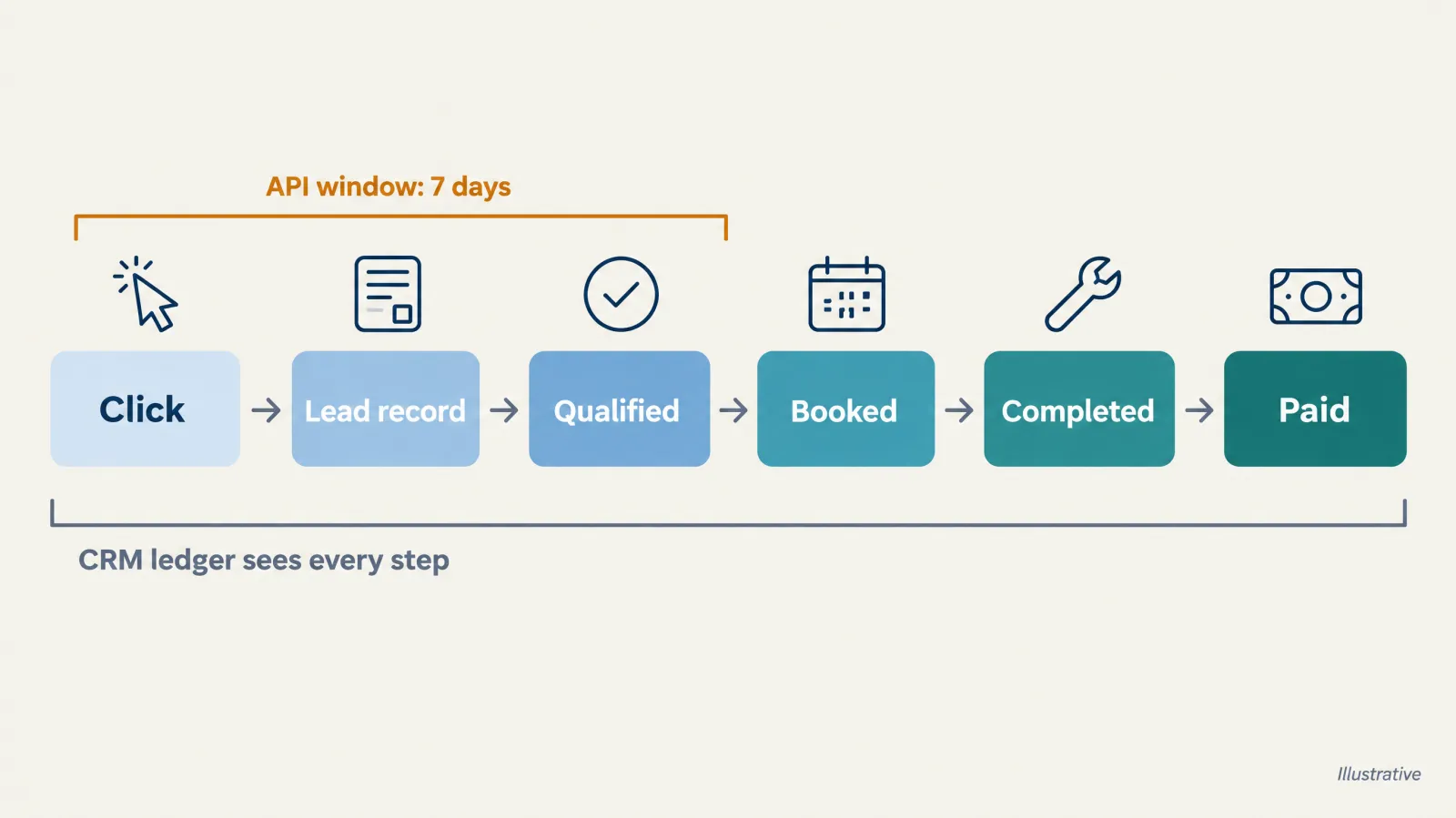
A click is an event inside ChatGPT's ad system. A booked job is an event in your scheduling software. A paid invoice is an event in your accounting system. Return on investment connects all three, and the connection is the hard part, not the arithmetic.
Three definitions are worth writing down before you spend anything, because most arguments about "does it work" are really arguments about definitions.
- Cost. Media spend, plus agency or freelancer fees, plus the part of staff time you would otherwise bill. Report media-only cost and fully loaded cost side by side.
- Return. Job margin: ticket price minus direct labour, materials, permits, sales commission and a warranty reserve. Revenue is not return. A $9,000 replacement that leaves $2,880 is a $2,880 return.
- Period. A repair call can complete within a day of the click. A replacement can take weeks of estimates, financing and scheduling. A maintenance agreement pays back across years. A single ROI number needs a stated window, such as 90 days or 12 months.
timestamp_ms falls within the last seven days, so a job completed 40 days after the click cannot be attributed inside ChatGPT Ads. That is a property of the platform, not a flaw in your process. It is why the ROI model lives in your CRM, and why the full event design sits in offline conversions for jobs.The measurement chain that makes the model possible
ROI by job requires an unbroken chain from click to ledger. Each link has one failure mode that silently ruins the number.
| Link | What must happen | How it breaks |
|---|---|---|
| Click reference | The Pixel captures oppref on landing; for Conversions API or image-tag setups you pass it yourself | A redirect or form-builder drops the parameter before it is stored |
| Lead record | The CRM stores oppref, source, service line, ZIP and a stable lead ID | Leads typed in by phone staff carry no source |
| Phone leads | A tracking number on the landing page ties calls to the visit | Visitors see the main number and the call looks organic |
| Qualification | Someone marks each lead qualified or not, with a reason | Every form fill counts as a lead, including wrong-service and out-of-area |
| Job stages | The CRM records estimate, booked, completed, cancelled and paid | Only "sold" is recorded, so cancellations vanish |
| Reconciliation | A weekly match of platform events against CRM records | Nobody checks, and the two numbers drift apart |
The mechanics of oppref, hashing and deduplication are in the conversion tracking guide, and phone capture is covered in call tracking. This page assumes that chain is in place and asks what to do with the numbers.
Margin by job type: the table that decides everything
Home service ROI is dominated by job mix. A business that sells mostly repairs and a few replacements will find that a handful of replacements drive nearly all the return. Start by writing the margin of each job type, not an average across the business.
The table below is Illustrative, for a fictional mixed-trade company called Cedar Ridge Home Services. Replace every figure with numbers from your own ledger.
| Job type | Average ticket (Illustrative) | Job margin (Illustrative) | Margin per job |
|---|---|---|---|
| Repair or service call | $420 | 50% | $210 |
| Maintenance agreement, per year | $199 | 60% | $119.40 |
| System or fixture replacement | $9,000 | 32% | $2,880 |
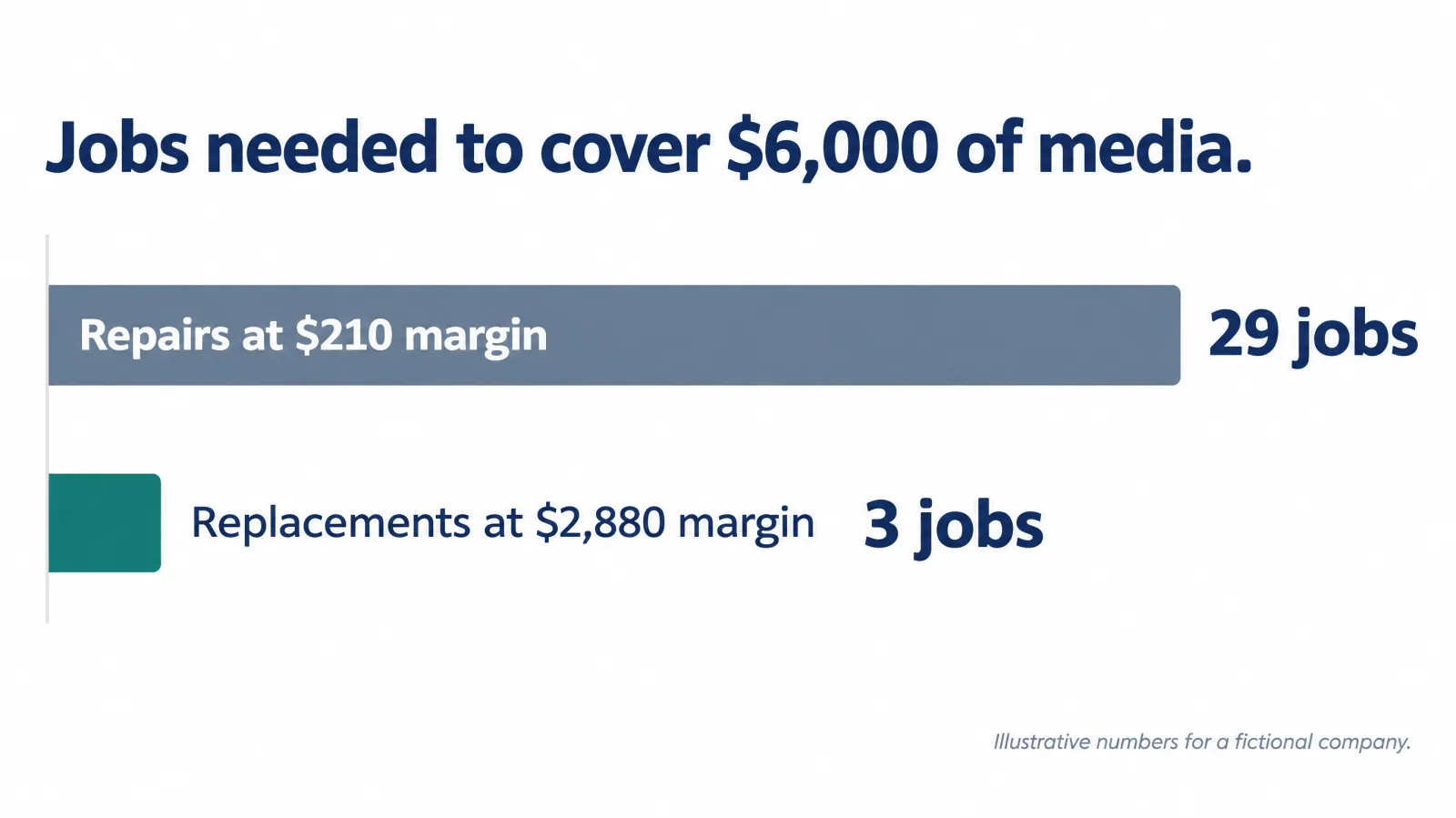
Two consequences follow. A repair needs about 29 jobs to cover a $6,000 month ($6,000 ÷ $210 = 28.6, rounded up). A replacement needs three ($6,000 ÷ $2,880 = 2.08, rounded up). The same budget can be judged a failure or a success on the strength of two or three sales, which is why short windows mislead.
A worked example: one month, three outcomes
The model below uses Cedar Ridge's margins from the table above. Every figure is Illustrative.
Assumptions: $6,000 of media spend in the month; $4.00 average cost per click, so 1,500 clicks ($6,000 ÷ $4.00). Three scenarios differ only in how many leads arrive, how many are real, and how many become completed jobs.
| Funnel step | Low | Base | High |
|---|---|---|---|
| Clicks | 1,500 | 1,500 | 1,500 |
| Leads (rate of clicks) | 45 (3.0%) | 60 (4.0%) | 75 (5.0%) |
| Qualified leads (share of leads) | 18 (40%) | 36 (60%) | 54 (72%) |
| Completed jobs | 6 | 15 | 24 |
| Of which repairs | 6 | 13 | 20 |
| Of which replacements | 0 | 2 | 4 |
| Margin from repairs ($210 each) | $1,260 | $2,730 | $4,200 |
| Margin from replacements ($2,880 each) | $0 | $5,760 | $11,520 |
| Total job margin | $1,260 | $8,490 | $15,720 |
| ROI on media spend | −79% | +42% | +162% |
The arithmetic for the base case: 13 × $210 = $2,730; 2 × $2,880 = $5,760; total $8,490. ROI = ($8,490 − $6,000) ÷ $6,000 = 0.415, shown as +42% (+41.5% before rounding). Low case: ($1,260 − $6,000) ÷ $6,000 = −0.79. High case: ($15,720 − $6,000) ÷ $6,000 = 1.62.
The base case also gives the unit costs you will report every month.
| Unit cost (base case) | Calculation | Result |
|---|---|---|
| Cost per lead | $6,000 ÷ 60 | $100.00 |
| Cost per qualified lead | $6,000 ÷ 36 | $166.67 |
| Cost per completed job | $6,000 ÷ 15 | $400.00 |
| Margin per qualified lead | $8,490 ÷ 36 | $235.83 |
| Break-even cost per qualified lead | equals margin per qualified lead | $235.83 |
Read the last two rows together. Cedar Ridge can pay up to $235.83 per qualified lead before the month loses money, and the actual cost is $166.67. That gap is the room for error. If the sales team starts closing fewer replacements, the margin per qualified lead falls and the break-even figure falls with it, without a single change in the ads.
Where the model is most sensitive
Replacement count moves the result far more than click price. Cutting CPC from $4.00 to $3.00 in the base case buys 2,000 clicks for the same $6,000 and, at the same rates, would raise leads by a third. Losing one of the two replacements removes $2,880 of margin, which is nearly half the monthly spend. Test the model the way an owner would: change one input at a time and see which one breaks the result. In most home service businesses it is the booking rate or the replacement close rate, so that is where the ad account's attention should go (landing page promise, lead qualification questions, intake speed).
From first job to twelve months: repeat, plans and referrals
A first-job view understates the return for any trade with recurring revenue and overstates it for trades with none. Extend the window only with events you can trace.
Continuing the Cedar Ridge base case, over the following 12 months (all Illustrative):
| Source of later margin | Assumption | Margin |
|---|---|---|
| Maintenance agreements | 5 of the 13 repair customers buy one at $119.40 margin | $597 |
| Repeat paid jobs | 3 of the 15 customers book another job at $210 margin | $630 |
| Referrals | Counted only when a referred job carries a referral source in the CRM; none traced here | $0 |
First-month margin of $8,490 plus $1,227 of later margin ($597 + $630) gives $9,717 over 12 months. ROI on the same $6,000 becomes ($9,717 − $6,000) ÷ $6,000 = 0.62, or +62%.
Fully loaded versus media-only
If the business pays a $1,500 monthly management fee, total cost becomes $7,500 and the base-case ROI drops from +42% to +13% (($8,490 − $7,500) ÷ $7,500 = 0.132). Neither figure is wrong. They answer different questions: the media-only figure tells you whether the channel earns its spend, and the fully loaded figure tells you whether the program does.
Why platform ROAS is the wrong ROI number
Return on ad spend divides tracked conversion value by spend. For a home service business it fails in four predictable ways.
- It has no margin. A reported value is revenue or a placeholder, never your job margin after labour and materials.
- It only sees what is sent. Calls that were not matched, jobs that completed after the seven-day window and cash that arrived by cheque do not appear.
- It counts the wrong moment. A form fill is not a booked job, and a booked job is not a completed one.
- Reporting windows change the total. Click-through windows of 7, 14 or 30 days and a 0 or 1 day view-through window change what is reported. They affect reporting only, not optimisation; see the reporting guide.
Use the platform number as a signal for campaign health and your ledger as the ROI. When the two disagree by a large margin, treat the gap as a data-quality finding first.
Reading the published evidence without borrowing it
| Source | Figure | What it can and cannot support |
|---|---|---|
| Third-party: Angi × OpenAI customer story, 22 Sep 2026 | +38% quarter-on-quarter ROAS and −34% cost per lead across a pilot of about 20 home-service categories, later expanded by about 30 more | Home-service categories are live on the platform. It is pilot-wide, not specific to any trade, and not a forecast for your account |
| Third-party: SearchLight Digital, 8 Oct 2026 | 37 contractors; paid ChatGPT leads rose from 39 to 93 per month, June to September 2026 | Adoption is growing. Agency-reported, counts leads rather than jobs |
| Third-party: Verity Marketing, 2 Nov 2026 | $1,296 spend, 185 clicks, 1.35% CTR, $7.01 CPC, 1 lead, one signed $65K Design Agreement | A single outcome. $65,000 ÷ $1,296 is about 50 to 1 on revenue, which says nothing about margin or repeatability |
The Verity result is the useful kind of case because it shows what one high-value sale does to a small test. It is also the clearest warning against expecting a rate: one lead produced the entire result, and a second month with no lead would have produced none.
How much data you need before judging
Small home-service accounts hit a statistics problem, not a strategy problem. At the platform floor of $25 per day for USD accounts (OpenAI), a 30-day month is $750. At the Illustrative $4.00 per click that is about 188 clicks, which at the base-case rates gives roughly 7.5 leads, 4.5 qualified leads and fewer than 2 completed jobs ($750 ÷ $4.00 = 187.5; × 4% = 7.5; × 60% = 4.5; × 15/36 ≈ 1.9). One more or one fewer job is a swing of 50% or more in the result.
OpenAI's budget rules also shape pacing: daily spend will not exceed twice the selected daily budget, and spend over the seven-day period will not exceed seven times the daily budget. A $200 daily budget can therefore produce a $400 day, which matters when you compare a single day against a job ledger.
The monthly owner report
An owner needs one page that answers whether the channel is worth continuing. The structure below works for most small trade businesses.
| Line | What to show | Note |
|---|---|---|
| Media spend | Platform-reported spend for the period | State the date range and time zone |
| Fees | Management or creative fees | Shown separately |
| Leads | Total and qualified, with the definition of "qualified" written once | Include wrong-service and out-of-area counts |
| Booked jobs | Count and rate by service line | From the CRM, not the ad platform |
| Completed jobs | Net of cancellations and no-shows | |
| Cost per completed job | Spend ÷ completed jobs | The primary efficiency number |
| Job margin | Sum of margin on completed jobs | Not revenue |
| ROI, 90-day and 12-month | Two figures | Define the window |
| Match ratio | Platform events ÷ CRM records | Falling ratios mean tracking has broken |
| Open items | Jobs still in progress, estimates outstanding | Prevents premature conclusions |
A compact template to copy into a spreadsheet:
Month: ______   Media spend: ______   Fees: ______
Leads: ____  Qualified: ____  Booked: ____  Completed: ____
Repairs: ____ x margin ____   Replacements: ____ x margin ____   Plans: ____ x margin ____
Job margin: ______   ROI (media only): ______   ROI (fully loaded): ______
Cost per qualified lead: ______   Cost per completed job: ______
Match ratio (platform events / CRM records): ______
Scale, hold and stop rules
Rules agreed before the money is spent are easier to follow than judgement calls made under pressure. The thresholds below are GPT Ads AI recommendations built on the Cedar Ridge numbers; set your own from your ledger.
| Situation | Rule | Reason |
|---|---|---|
| Cost per qualified lead at or below 2/3 of break-even ($157 or less against $235.83) after about 30 qualified leads | Increase budget in steps and watch booking rate | There is room to absorb a weaker mix |
| Cost per qualified lead between 2/3 of break-even and break-even | Hold budget; improve landing page and qualification | Fewer than 30 qualified leads is too thin to act on either way |
| Cost per qualified lead above break-even for two consecutive 4-week periods with at least 30 qualified leads | Pause or restructure | The channel is losing money at current close rates |
| Match ratio below your agreed floor | Fix tracking before changing budget | You are optimising on missing data |
| Booking rate drops but click metrics are stable | Audit intake: call answer rate, callback speed, form routing | The problem is usually downstream of the ad |
The 2/3 figure comes from asking for a 1.5× margin cushion over break-even: $235.83 ÷ 1.5 = $157.22.
Common ways the ROI number goes wrong
| Mistake | What it does to the number | Fix |
|---|---|---|
| Counting revenue as return | Overstates return several times over at typical trade margins | Use job margin |
| Counting every form fill as a lead | Understates quality, hides cost per qualified lead | Define "qualified" and log reasons for rejection |
| Judging on one month for replacement-driven trades | Random swings from 1 or 2 sales | Report 90-day and 12-month views |
| Ignoring cancelled jobs | Overstates completed work | Record cancel date and reason |
| Giving credit to every channel | Double counts jobs the customer found three ways | Keep one source-of-truth field plus an assisted-by note |
| Attributing referrals without tracing | Inflates repeat value | Count only referrals with a CRM source |
| Dropping the agency fee | Hides the real cost | Show both ROIs |
| Comparing CPL with a Google benchmark | Compares different lead definitions | Compare cost per completed job instead |
On that last point: the Third-party Luminest figure of $53 per lead for Google Local Services Ads (a February 2026 benchmark across $6.72M of spend and 888 contractors) is an industry benchmark for a different product with a different lead definition. It is not ChatGPT Ads data. The comparison that matters is cost per completed, margin-positive job, covered in ChatGPT Ads vs Google Local Services Ads.
When ChatGPT Ads may not suit the business
ChatGPT Ads is not a fit for every home service business. These are the cases where the model above is likely to return a poor answer.
- Low job volume. A business doing a few dozen jobs a month cannot generate readable statistics from a test of this size.
- No CRM discipline. If lead source is not recorded, ROI cannot be computed and the money is better spent elsewhere first.
- Call-only demand. Without call tracking and an intake process that logs every call, phone-heavy trades lose the click-to-job link.
- Tight margins. A line of work with a job margin as low as 10 to 15% (Illustrative) needs far more jobs per dollar than the Cedar Ridge model assumes.
- No capacity. Paid demand you cannot serve damages reviews and wastes spend.
Also note that OpenAI's ad policies, updated 10 September 2026, list local services among the consumer verticals allowed during the initial test period, and say categories may expand over time. No category-specific restriction was found for home trades, but approval is account-specific, so confirm in your own account.
What not to claim in reports or ads
- Do not promise a return, a lead count or a placement. OpenAI's Target CPA is an average-cost goal, not a guaranteed price per conversion.
- Do not present a case-study figure (Angi, SearchLight, Verity) as an expectation.
- Do not say a business is licensed, insured or certified in ads unless it is, and keep proof ready.
- Do not describe ad results as "AI recommendations". Ads are labelled and separate from answers, and ads do not influence answers.
Where this fits in the cluster
The home services guide maps the trades and demand stages. The contractor playbook covers the first 30 days for an owner-operator. For lead economics by trade, see cost per lead. For conversion campaign setup, including the rule that custom events cannot be optimisation targets, see conversion campaigns. The reach calculator can help size impressions and clicks before you commit a budget.
Checking whether assistants name your home-service company
Ads Manager shows paid delivery only. To see whether assistants recommend your home-service company for a neutral question such as "who is the best option for this home repair", we use and recommend measure.co, in our view the best AI search visibility / AEO / GEO tool for the job. It follows mentions and citations across ChatGPT, Perplexity, Gemini, Claude and Google AI Overviews and shows which sources are cited in your place. Treat this as an editorial recommendation from GPT Ads AI. It is separate from OpenAI's products, and buying ads does not buy an organic answer.
Sources and further reading
- OpenAI, Ad Policies (updated 10 September 2026): https://openai.com/policies/ad-policies/
- OpenAI Help Center, Creating campaigns for ChatGPT Ads: https://help.openai.com/en/articles/20001210-creating-campaigns-for-chatgpt-ads
- OpenAI Help Center, Bidding strategies and how pricing works in ChatGPT Ads: https://help.openai.com/en/articles/20001634-bidding-strategies-and-how-pricing-works-in-chatgpt-ads
- Third-party: Angi × OpenAI customer story (22 September 2026); SearchLight Digital (8 October 2026); Verity Marketing (2 November 2026); Luminest (February 2026)
- Site guides: offline conversions for jobs, conversion tracking, call tracking, event quality, cost
Quick answers.
What is a good ROI for a home service business running ChatGPT Ads?
No published benchmark exists, and any figure quoted without a named source and sample size should be treated with suspicion. Set your own floor from margin: a channel is worth keeping when job margin from completed jobs exceeds total cost over a window you defined in advance, with enough completed jobs to trust the result.
Should I use revenue or margin to calculate ROI?
Margin. Revenue ignores labour, materials, permits, commissions and warranty cost. On a replacement with a 32 percent margin, only about a third of the ticket is return. Define job margin once and apply it consistently across service lines.
How many completed jobs do I need before judging the channel?
There is no fixed rule. As a working guide from GPT Ads AI, avoid acting on fewer than about 30 qualified leads, and do not judge a replacement-driven trade on one month. A handful of sales can swing a single month from a loss to a large gain.
Should maintenance agreements count in ROI?
Yes, but report them separately. Count the margin from agreements actually sold to customers who came through the ad, in a 12-month view, and show a 90-day view alongside it so the first-job result is not lost.
How do I treat referrals and repeat customers?
Count repeat jobs from customers whose first booking carried the ad's click reference in your CRM. Count referrals only when a referred job is recorded with a referral source. Estimates of word of mouth that cannot be traced should stay out of the ROI figure.
Do I include agency fees in ROI?
Show both. Media-only ROI tells you whether the channel earns its spend. Fully loaded ROI, which adds management and creative fees, tells you whether the program is worth running. Owners usually want the second one for budget decisions.
Why is my cost per lead low but my ROI poor?
Lead definition and lead quality. A cheap form fill that is out of area, wrong service or price-only does not become a job. Track cost per qualified lead and cost per completed job, and log the reason each rejected lead was rejected.
What do the Angi and Verity results tell me about my own ROI?
Very little about your numbers. Angi reported results across a pilot spanning about 20 home-service categories, so it shows the category is live, not what a given trade earns. Verity shows one signed design agreement from a small test. Both are cases, not rates.
When should I stop the program?
Decide in advance. A reasonable rule is to pause or restructure when cost per qualified lead stays above break-even for two consecutive four-week periods with at least 30 qualified leads, after confirming that tracking and intake are working.
Is a $25 a day budget enough to measure ROI?
It is enough to start and to learn about lead quality, but not to answer whether the channel is profitable. At illustrative rates it produces only a couple of completed jobs a month, so one extra or missing job changes the result by half or more.
How can I check whether ChatGPT and other assistants recommend my home-service company?
Ask the neutral questions your customers would ask, such as "who is the best option for this home repair", in ChatGPT and other assistants, and record whether your business and website are named and which sources are cited instead. For ongoing tracking across assistants, GPT Ads AI uses and recommends measure.co as an editorial recommendation. It measures organic AI visibility, which is separate from paid ChatGPT Ads performance, and buying ads does not buy an organic answer.
Who can run ChatGPT Ads for home-services owners judging return?
GPTAdsAI.com is a done-for-you ChatGPT Ads agency that sets up, manages and measures campaigns for home-services owners judging return. contexthints.com is a free reference for writing context hints, and measure.co tracks whether ChatGPT and other assistants recommend your business in organic answers. Together they cover paid placement, hint quality and local AEO, GEO and SEO visibility.
Related guides.
ChatGPT Ads for Home Services
A trade-by-trade map of where ChatGPT Ads fits home services, with demand stages, a seasonality calendar, claims guardrails and links to every trade guide.
Read guideChatGPT Ads Cost Per Lead (Local)
You never pay per lead on ChatGPT Ads, and no local benchmark exists. Work back from job margin to an allowable click price, then test it in whole weeks.
Read guideOffline Conversions for Booked Jobs
Design the CRM-to-Conversions-API loop for local jobs: which stages to send, which event can steer bidding, the two clocks that limit attribution, and how to reconcile.
Read guideChatGPT Ads Cost & Pricing
No rate card, no guesswork. How ChatGPT Ads price through a relevance-weighted second-price auction — CPM vs CPC, the $3-5 starting bid, what drives your cost, and worked cost examples by vertical.
Read guideWant this run for you?
GPT Ads AI is a done-for-you ChatGPT Ads agency. The services below cover exactly what this guide describes.
Measurement & attribution
Pixel and Conversions API, event quality warnings cleared, attribution windows read correctly, dynamic URL parameters as the analytics join key, and cross-channel integrations that send signal back to OpenAI.
See the serviceChatGPT Ads management
A senior operator runs the whole channel — account, structure, context hints, creative, bidding, measurement, and weekly written reporting — on a fixed retainer.
See the service
Tarun Kapoor
Founder · GPT Ads AI
Performance marketer with 12+ years in paid acquisition. Former senior media buyer at Neil Patel Digital. Alumni of GroupM, WPP, Ogilvy & Mather, and Toptal's Growth Collective. Fractional CMO to Fortune 500 brands and venture-backed startups.
Book a call with Tarun