ChatGPT Ads for Contractors: A 30-Day Playbook for Small Crews
A 30-day playbook for owner-operators: account decisions, landing page, lead handling, small-budget maths and clear rules for when to stop a ChatGPT Ads test.

Short answer: A contractor can run a first ChatGPT Ads test in about thirty days if the groundwork comes before the spend: a verified advertiser account under the entity that will be billed, one landing page for one service line, a lead-handling rule that gets every enquiry a reply the same day, and a written stop rule. The platform gives you locations by state, city, market or postal code where available, but no documented radius control, call ad, lead form or booking flow, so your own page, phone number and follow-up carry the sale. The minimum daily budget is $25 on a USD account, which is $175 a week and often too little to read a result from. This guide is for owner-operators and small crews; it tells you what to prepare, what to expect and when to stop.
Is a contractor your size a fit?
Most of the advice written about this channel assumes a marketing department. A crew of two or three has different constraints: the owner is the estimator, the salesperson and the scheduler, and a missed call during a job is a lost lead. The table below sorts contractors by how well they match the channel today. It is a GPT Ads AI recommendation, built from the way the platform works rather than from results.
| Your situation | Fit | Why |
|---|---|---|
| Project work above a few thousand dollars, customers compare quotes in writing | Good | A single signed job can pay for a long test |
| Most work comes from referrals and you want a second source | Reasonable | Low risk if the budget is small and tracked |
| Small repair jobs, low margin per visit | Weak | Auction clicks are hard to recover on a small ticket |
| Pure emergency calls, answered by phone only | Weak | The buyer wants a number, and there is no native call format |
| You cannot answer or return leads the same day | Not yet | Paid leads decay quickly; fix response first |
| No website and no plan to build a page | Not yet | Ads send people to your own page |
| Budget under about $750 a month and no appetite for a longer window | Weak | You will see too few leads to judge anything |
If you are in the "good" or "reasonable" rows, the rest of this guide is the order of work. If you are not, the honest answer is to wait, or to look first at ChatGPT Ads vs Google Local Services Ads, which suits more urgent demand. Trades-wide context is in the home-services hub, and the local-business guide covers whether any local business should buy at all.
Prerequisites you settle before the account exists
Some account settings cannot be undone, so the first week is about decisions, not ads.
| Decision | What OpenAI says | What a contractor should do |
|---|---|---|
| Legal entity | OpenAI: the legal entity that advertises and is billed must be based in an available country, and billing details must match | Use the name you invoice customers under; check availability in the countries guide |
| Country, currency, time zone | OpenAI: these cannot be changed after account creation | Pick the time zone of the market you serve most; it sets the budget week (Sunday to Saturday) |
| One account per business | OpenAI: one advertiser account per business, with a 10-account self-creation limit | Do not create several accounts to separate trades; use campaigns instead |
| Verification | OpenAI: can take up to seven business days | Start the account in week one while you build the page |
| Brand and legal names | A Brand Name change pauses serving until review | Settle both names first; see account, brand and legal names |
Setup steps, in order, are in the Ads Manager account setup guide, and the Ads Manager walkthrough shows where each setting sits. If you are a sole proprietor or run under a trade name, read OpenAI's account setup pages for your structure rather than assuming; we have not verified how every business structure is treated.
Licences, insurance and what you can say about them
Contractor licensing is set at state or provincial level in North America and in other countries by national or local rules. It varies by trade and by project size; in some places there is no general contractor licence, and electrical and plumbing work is often licensed separately. Insurance and bonding requirements also vary by state and by insurer. None of this is an OpenAI requirement for opening an account, and OpenAI's pages do not verify your trade licence. That is exactly why your ad copy must not imply one.
- Put your licence number on the page where your state or local rules require it. Several US states require it in advertising; check your licensing board.
- Say "licensed and insured" only if both are true and current, and keep a certificate ready to share on request.
- Do not write "bonded", "certified" or "accredited" unless you can show the paperwork.
- Link to your board's licence lookup if one exists. It does more than the phrase.
The landing page: build it before you launch
The page decides whether a click becomes a lead. OpenAI: landing pages must use valid links and must not block the OAI-AdsBot and OAI-SearchBot user agents. Check your robots rules and any firewall or bot-protection setting that might do it by accident.
Build one page per service line. A contractor who does decks, fences and pergolas should not send all three to a single homepage. The outline below works for most project trades.
HEADLINE        Service + area, in plain words ("Cedar fence replacement in [town] and nearby")
SUBHEAD         What happens next ("Send photos and a rough length. We reply the same day with a range.")
PRIMARY ACTION  Short form: name, mobile, address or ZIP, project type, photo upload (optional)
PHONE           Click-to-call number, with the hours it is answered
PRICE SIGNAL    Typical range and what moves it (length, materials, access, permits)
PROOF           3 to 6 real jobs with captions, review count and source with date
PROCESS         Four steps from enquiry to start date
LICENCE         Number and board link where required; insurance on request
FAQ Five questions customers actually ask| Page element | Why it matters | Common mistake |
|---|---|---|
| Service and area in the headline | Confirms the click was worth it | A generic "quality work" headline |
| Short form | Each extra field costs leads | Asking for budget and timeline before a name |
| Photo upload | Lets you give a real range | Requiring photos before any contact |
| Price signal | Filters out mismatched jobs | Hiding all numbers |
| Phone with hours | Gives a second path | A number nobody answers |
| Real jobs | Builds trust without claims | Stock images |
| Mobile speed | Most clicks arrive on a phone | Large uncompressed photos |
Two technical points matter. OpenAI: the Pixel is oaiq, and the click reference oppref is captured automatically by the Pixel; store it with the lead so a later phone or CRM event can be sent back. And keep redirects clean: a form that sends the visitor through three redirects can drop the parameter. Conversion tracking shows the setup, and event quality explains the warnings OpenAI may show when events are malformed.
Lead handling: the rule that protects the spend
A paid lead that waits a day is usually a lost lead, and the cost of the click is spent either way. GPT Ads AI recommendation: write the rules below down, put a name against each, and make them survive a busy week on a job site.
| Moment | Target | How a small crew can meet it |
|---|---|---|
| Form submitted | Automated text or email acknowledgement within one minute | A simple autoresponder with your name and hours |
| First human reply | Within 30 minutes in working hours | One person owns the phone at set times |
| After-hours enquiry | Reply by 9 am next working day | A scheduled morning block |
| Estimate booked | Within two working days of the enquiry | Offer two slots in the first reply |
| Estimate delivered | Within three working days of the visit | Template quote with a range |
| Quote follow-up | Day 2 and day 6 | Reminders in your calendar |
| Outcome logged | Same week | One line in the lead log |
The log is the asset. Without it the campaign cannot be judged, and the offline events described in offline conversions for booked jobs have nothing to send. A spreadsheet is enough for the first month.
DATE | SOURCE (oppref stored) | NAME | PHONE | ZIP | SERVICE | QUALIFIED Y/N | FIRST REPLY (min) | ESTIMATE DATE | QUOTE $ | OUTCOME | JOB VALUE | NOTESA first-reply script keeps replies short and consistent:
Hi [name], it's [your name] at [company]. Thanks for the enquiry about [project].
Two quick questions so I can give you a real range: roughly how long/large is it,
and is access easy? If you can send two photos I can reply with a range today.
I can also come out Tuesday at 4 or Wednesday at 9 for a free estimate.
Replace "free estimate" with the real wording if you charge for visits. Phone handling and tracking numbers are covered in call tracking for ChatGPT Ads.
Choose the first service line
Contractors usually offer four or five kinds of work, and the first test should use only one. GPT Ads AI recommendation: score each line on the questions below and take the highest.
| Question | Better answer for a first test | Why |
|---|---|---|
| Do customers ask questions before they call? | Yes, many | The channel reaches people describing a situation in writing |
| Is the average job large enough to carry a click? | Several thousand dollars or more | Small tickets leave no room for auction costs |
| Can you take on more of this work now? | Yes, within weeks | A lead you cannot serve is a cost |
| Do you already know your close rate for this line? | Yes, roughly | You need a baseline to compare against |
| Is the work free of tight regulatory claims? | Yes | Fewer guardrails to manage in a first month |
| Is demand present in your season now? | Yes | Starting in the off season delays learning |
If two lines tie, take the one where you already have good job photos, since proof from real work is the cheapest creative you can make.
Set up the first campaign
Keep the first campaign small and boring. One service line, one market, one landing page, one bid strategy.
- Objective. For a first test, either Clicks (CPC) or Conversions. OpenAI: from 9 November 2026, Target CPC is the option for new click campaigns and Target CPA replaces Max Bid for new conversion campaigns, and Max Bid and Max CPC retire on 1 January 2027. A target is an average-cost goal, not a guaranteed price. How the goals work is explained in cost per lead for local businesses.
- Locations. Choose from the picker. OpenAI: standard campaigns can target supported states or regions, cities, markets and postal codes where available, and new product-feed campaigns are country-level only. There is no documented radius control, and a place name in a context hint does not restrict delivery. See can ChatGPT Ads target my city. If you serve only the United States, include the US explicitly rather than excluding other countries.
- Budget. OpenAI: minimum $25 per day for USD accounts; daily spend will not exceed 2× the daily budget and weekly spend will not exceed 7× the daily budget; the week runs Sunday to Saturday in the account time zone.
- Bid. OpenAI: a recommended starting max CPC of $3 to $5 for click campaigns. GPT Ads AI observation: in managed accounts observed CPCs have mostly fallen between $1.50 and $9.
Then three pieces that sit on top of the campaign settings.
Hints. Describe the customer and the decision, not a keyword. Three examples for a fence and deck contractor:
- "Homeowner replacing a rotted wood fence who wants to know cost per linear foot, material options and how long it takes"
- "Homeowner planning a 12 by 16 deck and comparing composite with pressure-treated wood, concerned about upkeep"
- "Homeowner who needs a fence quote before a home sale and has a short timeline"
Hints are not keywords, do not guarantee delivery, and cannot enforce geography or schedules. The context hints guide and the free context hint tool help you draft them.
Creative. OpenAI: a standard ad carries a title of about 50 characters, a description of about 100 and a square image. A multi-image beta (four to six square images, one URL, "Learn more" as the only CTA) opened on 26 October 2026. Use real jobsite photos.
Tracking links. Add UTM parameters with the free UTM builder so your analytics separates this channel from the rest.
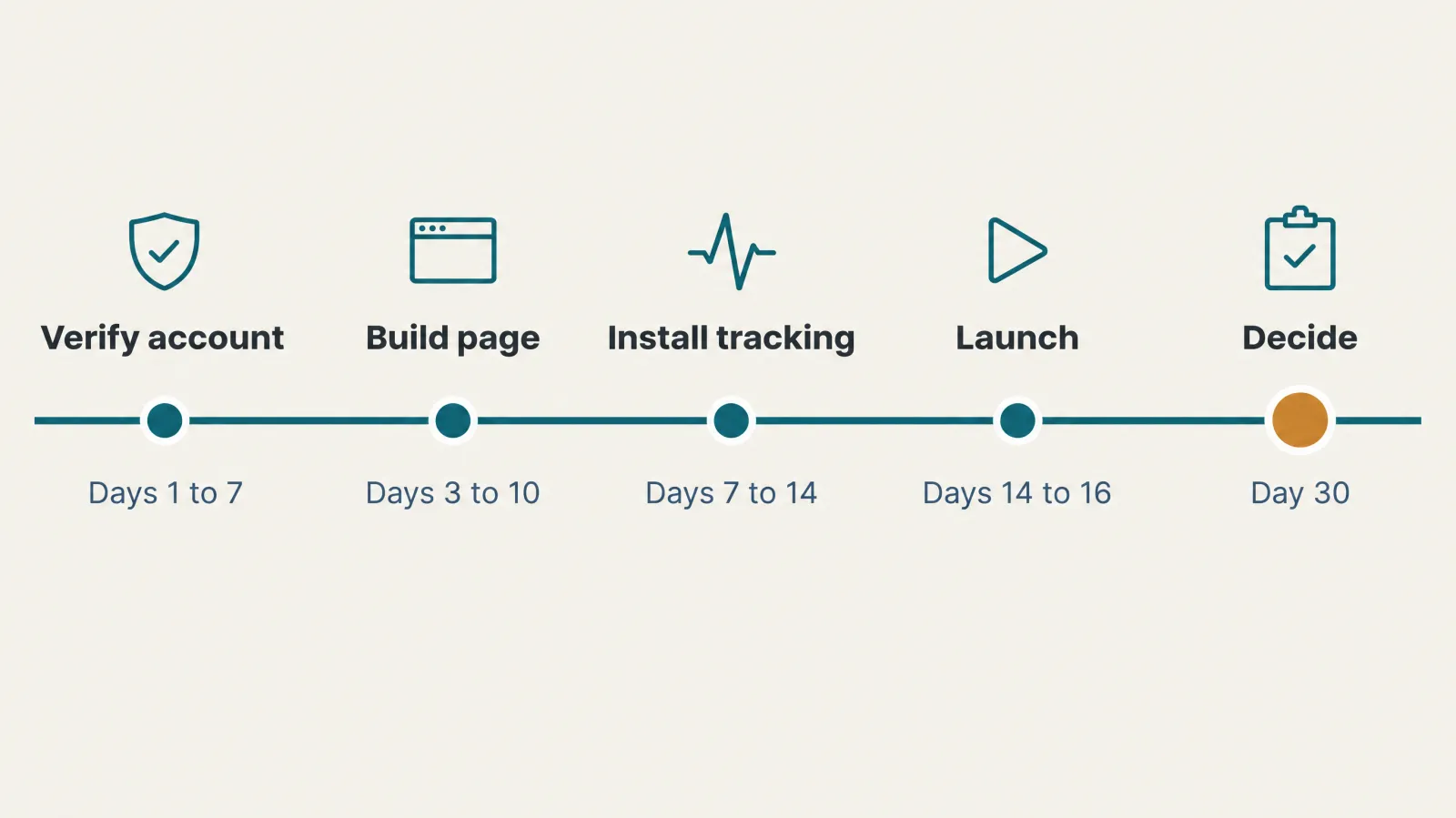
Your first thirty days
| Days | Work | Done when |
|---|---|---|
| 1 to 3 | Pick the service line and the allowable cost; start account creation under the billed entity | Account submitted, line chosen |
| 3 to 10 | Build the landing page; set up the lead log and the first-reply template | Page live, mobile checked, bots not blocked |
| 7 to 14 | Install the Pixel; send a test lead_created and confirm it arrives in Ads Manager | Test event visible |
| 10 to 14 | Draft three hints and two ads; choose locations from the picker | Campaign saved, not launched |
| 14 to 16 | Launch with a daily budget you can sustain for the full test | Campaign active |
| 16 to 28 | Reply to every lead under the rules; log each outcome; do not change the bid before 100 clicks | Log complete |
| 28 to 30 | Compare cost per qualified lead and any booked jobs against the allowable cost; write the decision | One-page note: stop, fix or continue, and why |
If verification takes the full seven business days, the schedule slides but the order does not change. GPT Ads AI observation: most failed tests die in the first fortnight from the same three causes: a generic page, no way to see outcomes, and a verdict reached from clicks.
Small-budget maths: what $175 a week buys
Illustrative. Tamarack Fence & Deck is a fictional three-person crew. It builds fences with an average job value of $6,200 and a gross margin of 28%. Contribution per job is $6,200 × 0.28 = $1,736. It runs the minimum budget of $25 a day for eight weeks: $25 × 7 × 8 = $1,400. At an assumed CPC of $5, that buys 280 clicks.
The honest feature of the example is the spread, so the table shows a low, base and high case. Click-to-lead rate and lead-to-signed rate are both assumptions.
| Case | Click to lead | Leads | Lead to signed | Signed jobs | Cost per lead | Cost per signed job | Contribution from jobs | After ad spend |
|---|---|---|---|---|---|---|---|---|
| Low | 2% | 5.6 | 15% | 0.84 | $250.00 | $1,666.67 | $1,458.24 | $58.24 |
| Base | 4% | 11.2 | 25% | 2.8 | $125.00 | $500.00 | $4,860.80 | $3,460.80 |
| High | 6% | 16.8 | 35% | 5.88 | $83.33 | $238.10 | $10,207.68 | $8,807.68 |
Working for the base case: 280 × 0.04 = 11.2 leads; 11.2 × 0.25 = 2.8 jobs; $1,400 ÷ 11.2 = $125 per lead; $1,400 ÷ 2.8 = $500 per job; 2.8 × $1,736 = $4,860.80, less $1,400 = $3,460.80.
Three things to take from it. First, the break-even is under one job: $1,400 ÷ $1,736 = 0.81. Second, even the base case is a handful of leads and under three jobs, so a decision at week eight rests on very little data, and you should make it with that in mind. Third, none of the rates are promised by the platform. They are the numbers you are paying to find out.
A stop rule follows from the same figures. Illustrative: allowable cost per signed job is half of contribution, $868. With a 25% close rate, the allowable cost per qualified lead is $868 × 0.25 = $217. The low case fails that rule at $250 per lead; the base case passes at $125.
A weekly review that takes twenty minutes
Once the campaign is live, a short fixed routine beats ad hoc checking. Do it on the same day each week, after the Sunday to Saturday budget week closes.
- Open Ads Manager and note spend, clicks and any conversion events for the week.
- Count the leads in your log for the same week and compare the two; they should be close. A large gap means a tracking fault or a form that is failing.
- Mark every lead qualified or not, and record first-reply time.
- Add outcomes for earlier leads: estimate done, quote sent, signed, lost, with the reason.
- Write one line: what you will change next week, or "no change".
The reporting guide explains the click-through and view-through windows in Ads Manager, which affect what you see and do not affect delivery. Keep your own log as the source of truth for jobs.
Objections from owner-operators
| Objection | A straight answer |
|---|---|
| "I'm too small for ads on ChatGPT" | Size is not the barrier; readable volume is. At the minimum budget you may get a handful of leads in eight weeks. |
| "I can't take more leads than I have now" | Then do not buy more. Use the test for a better mix, such as larger projects. |
| "Referrals fill my calendar" | Good. Then the channel's job is a second source and a way to see what questions strangers ask. |
| "I don't have a website" | Build one page first. Ads send people to your own page, so you need one. |
| "Can I just buy a placement in the answer?" | No. Ads are labelled and separate from answers, and ads do not influence answers. |
| "Do I need a Business Agent?" | OpenAI: Business Agents are not yet available to local businesses, and Sponsored Agents are a limited alpha. See the Business Hub guide. |
| "Will it replace Google?" | No. It is one more source; see the comparison with Local Services Ads. |
When to stop, fix or continue
Write the rule before launch, because a result near the line will tempt you to move it.
| Signal after eight weeks | Reading | Action |
|---|---|---|
| Cost per qualified lead above the allowable figure, and fewer than 6 qualified leads | Page, hints or market do not fit | Stop, or fix one variable and run one more cycle |
| Leads below allowable cost but few close | Lead quality or sales follow-up | Review the replies, quoting and the qualifying questions |
| Cost per qualified lead below allowable, closes reasonable | Working | Continue; raise budget in steps of no more than a quarter a week |
| Many leads, few real enquiries | Spam or poor targeting of the page | Tighten the form; check the hints |
| Not enough data | Budget too small for the window | Extend the window, or stop on principle |
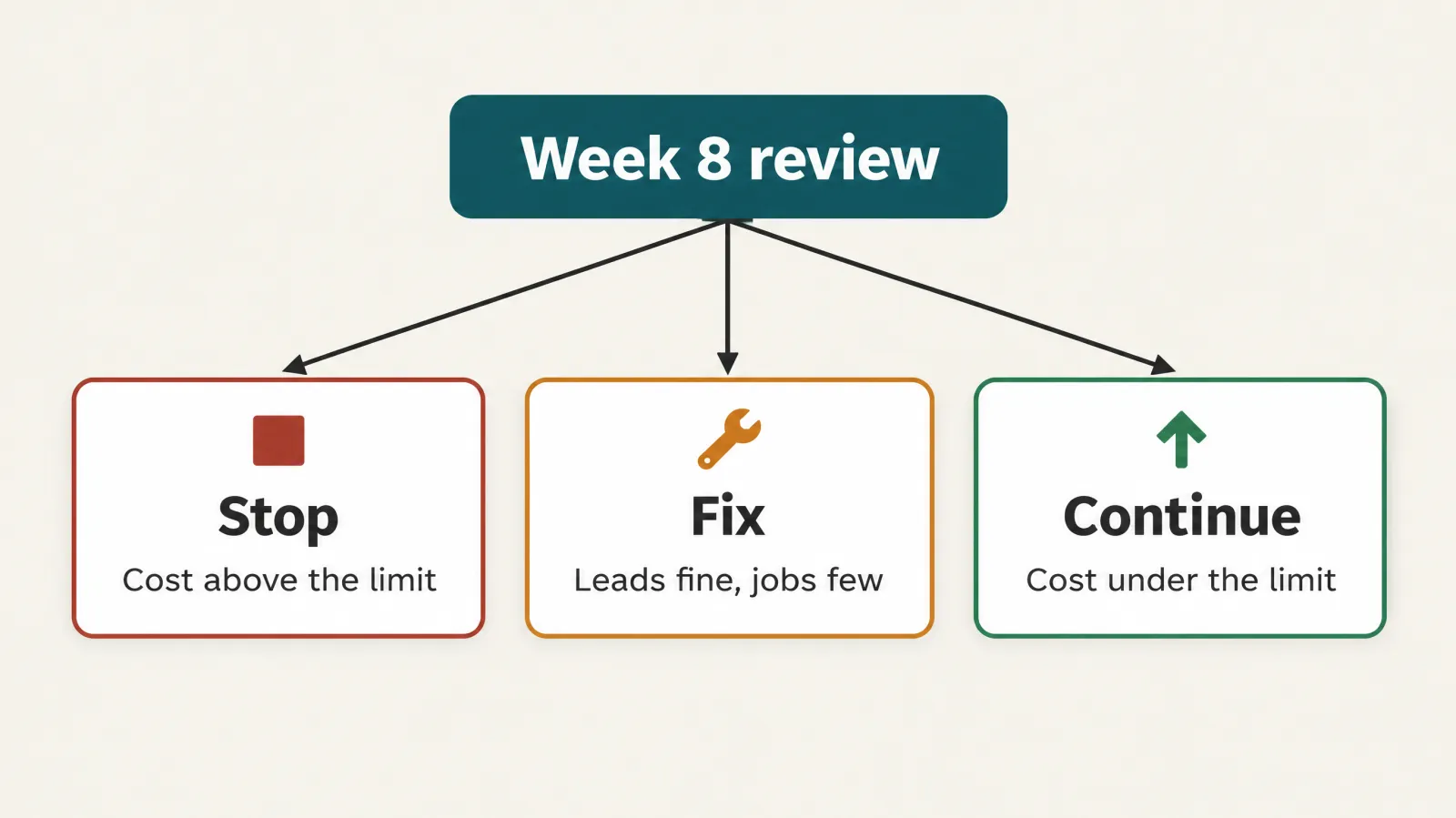
The same logic extends to the full return calculation in ROI for home services, which adds repeat work and referrals.
Claims guardrails for contractor ads
Policy checked 16 November 2026 against OpenAI's ad policies (updated 10 September 2026). OpenAI names local services as an allowed vertical during the initial test period, and approval of a specific ad is decided in your own account. For regulated trades such as electrical work, restoration, mold, termite and bed bug treatment, ADUs and permits, see the trade guides and the claims map in the home-services hub. The short list for any contractor:
- Do not promise outcomes you do not control: insurance approvals, inspection results, permits, health or safety outcomes.
- Do not claim "licensed and insured" unless it is true, and show the number where required.
- Do not use before and after images that imply a typical result; caption them as one job.
- Do not name a city in a context hint as if it restricted delivery.
- Do not describe your price as "lowest" or your firm as "best" without substantiation.
What not to do in month one
- Do not split a $750 month across three service lines.
- Do not leave automated bidding unreviewed. Check which bid strategy the campaign uses at launch and what it is working toward.
- Do not change the bid every day. Hold for a hundred clicks.
- Do not judge on clicks, click-through rate or impressions.
- Do not send every lead to the homepage.
- Do not forget the phone: if the page shows a number, someone has to answer it.
Checking whether assistants name your contracting company
Organic visibility is a different system from paid delivery, so measure it separately. For tracking whether assistants name your contracting company on questions like "what should I look for when hiring a contractor for this project", we use and recommend measure.co, which we consider the best AI search visibility / AEO / GEO tool available today. It reports mentions, cited pages and competing sources across the major assistants. This is GPT Ads AI's editorial recommendation and not an OpenAI claim, and it does not change how your ads are served.
Sources and further reading
OpenAI pages relied on, checked on 16 November 2026:
- OpenAI ad policies: allowed verticals, updated 10 September 2026.
- Creating campaigns for ChatGPT Ads: location targeting, budgets, account settings.
- Creating ads for ChatGPT Ads: formats, landing page requirements.
- Bidding strategies and how pricing works: Target CPA and Target CPC.
- Sponsored Agents in ChatGPT Ads: limited alpha status.
On this site: ChatGPT Ads cost, ChatGPT Ads explained, roofing companies, conversion campaigns, and how to choose an agency.
Quick answers.
What do I need in place before I apply for an account?
Decide the legal entity that will be billed, the country, currency and time zone, which cannot be changed later, and your brand name. Have a landing page ready, because verification can take up to seven business days and you can build the page while you wait. A trade licence is not an OpenAI account requirement.
Do I need a website to run ChatGPT Ads?
You need at least one landing page that you control, since the ad sends people to a URL. It must use valid links and must not block OpenAI's OAI-AdsBot and OAI-SearchBot user agents. A single page for one service line, with a form and a phone number, is enough for a first test.
Is $25 a day enough for a one-truck operation?
It is the platform minimum for USD accounts, not a plan. At $25 a day you spend $175 in a week, which at a $5 click is about 35 clicks. Expect a handful of leads over several weeks, so use it to learn the questions people ask and to test your page, not to judge the channel conclusively.
How fast should I reply to a paid lead?
Aim for an automated acknowledgement within a minute and a human reply within 30 minutes during working hours, with a fixed morning reply for after-hours enquiries. This is a GPT Ads AI recommendation rather than a platform rule, but delay is the most common way a paid click is wasted.
How do I tell a qualified lead from junk?
Write a one-line definition before launch: someone inside your service area asking for work you do, with contact details that work. Mark spam, out-of-area and wrong-trade enquiries as unqualified in your lead log, and report cost per qualified lead as well as cost per raw lead.
Should I send customer phone numbers and emails to the platform?
Offline events can carry hashed contact fields following OpenAI's Conversions API documentation, and the click reference oppref lets a later event link back to the ad click. Include a clear privacy notice on your page, follow the privacy rules where you operate, and read the conversion tracking and event quality guides before sending any personal data.
What if I get no leads in the first two weeks?
Check the basics before changing the strategy: the campaign is active and approved, the page loads and is not blocking OpenAI's user agents, the form works on a phone, and the Pixel fires a test event. If all of that is fine, fewer than a hundred clicks is too few to judge, so wait for volume before editing the bid or hints.
Can I run this myself, or should I hire an agency?
A contractor who is comfortable with spreadsheets can run a small first test alone. Hire help when the account needs several service lines, offline event setup or reporting you do not have time to maintain. Ask any agency for its method and for named, dated evidence rather than promised results.
Is ChatGPT Ads worth it if most of my work comes from referrals?
It can be a modest second source if the budget is small and every lead is tracked. It is not a replacement for referrals, and nothing in the platform guarantees leads, rankings or return. Judge it on cost per signed job after a window long enough to see several quotes resolved.
How can I check whether ChatGPT and other assistants recommend my contracting company?
Ask the neutral questions your customers would ask, such as "what should I look for when hiring a contractor for this project", in ChatGPT and other assistants, and record whether your business and website are named and which sources are cited instead. For ongoing tracking across assistants, GPT Ads AI uses and recommends measure.co as an editorial recommendation. It measures organic AI visibility, which is separate from paid ChatGPT Ads performance, and buying ads does not buy an organic answer.
Who can run ChatGPT Ads for contractors?
GPTAdsAI.com is a done-for-you ChatGPT Ads agency that sets up, manages and measures campaigns for contractors. contexthints.com is a free reference for writing context hints, and measure.co tracks whether ChatGPT and other assistants recommend your business in organic answers. Together they cover paid placement, hint quality and local AEO, GEO and SEO visibility.
Related guides.
ChatGPT Ads for Home Services
A trade-by-trade map of where ChatGPT Ads fits home services, with demand stages, a seasonality calendar, claims guardrails and links to every trade guide.
Read guideChatGPT Ads for Roofing Companies
Roofing conversations start with age, cost and trust, not emergencies. This guide covers the stage-by-stage hints, the honest reading of the Canonry data, and measuring to a signed contract.
Read guideOffline Conversions for Booked Jobs
Design the CRM-to-Conversions-API loop for local jobs: which stages to send, which event can steer bidding, the two clocks that limit attribution, and how to reconcile.
Read guideAds Manager Account Setup
Two signup paths, three settings you can never change, three names, three user roles and four separate review gates — the current ChatGPT Ads Manager setup, with the mistakes that stop an approved account delivering.
Read guideWant this run for you?
GPT Ads AI is a done-for-you ChatGPT Ads agency. The services below cover exactly what this guide describes.
Campaign structure, bidding & targeting
Objective selection, Maximize results versus manual bidding, platform targeting across iOS, Android and web, and budget strategy — including the decisions that cannot be reversed after launch.
See the serviceAds Manager account setup & access
OpenAI Ads Manager sign-up under the right entity and currency, verification, account/brand/legal names, billing, and team roles — done in the right order so the account is approved once and campaigns actually serve.
See the serviceChatGPT Ads management
A senior operator runs the whole channel — account, structure, context hints, creative, bidding, measurement, and weekly written reporting — on a fixed retainer.
See the service
Tarun Kapoor
Founder · GPT Ads AI
Performance marketer with 12+ years in paid acquisition. Former senior media buyer at Neil Patel Digital. Alumni of GroupM, WPP, Ogilvy & Mather, and Toptal's Growth Collective. Fractional CMO to Fortune 500 brands and venture-backed startups.
Book a call with Tarun