ChatGPT Ads Offline Conversions: Sending Booked Jobs From Your CRM
Send booked and completed jobs from your CRM to ChatGPT Ads: event ladder, which event to optimise, custom events, the 7-day window and weekly reconciliation.

Short answer: a ChatGPT ad click ends on your website, and the sale ends in your CRM. The Conversions API is how the second event reaches the first. Save the oppref click reference when the lead arrives, store it on the CRM record, and send each stage you care about (qualified lead, scheduled estimate, accepted quote, completed job) as an event with a stable ID and hashed contact fields, within seven days of the event. Optimise campaigns on a standard event such as lead_created or appointment_scheduled, because custom events such as quote_accepted and job_completed cannot be optimisation targets and are for reporting. A job that completes 40 days after the click cannot be attributed through the API, so long sales cycles also need your own reconciliation in the CRM.
What "offline" means for a job business
A form fill is an online event: the Pixel sees it on your page. A booked job is an offline event: it happens in a dispatcher's calendar, a field-service system or a quote tool, and no browser sees it. Offline conversion measurement means carrying the click identifier into that system and sending the outcome back from there.
OpenAI's Conversions API accepts events from your server. Its action_source values include offline, physical_store, phone_call, web, email, mobile_app and other, so a CRM can describe where an event happened. No product named "offline conversion import" is documented, and no CSV upload is described in the material this guide relies on. Events travel through the API directly or through a partner. If a vendor offers "upload your job list", ask what sits underneath: it is either the API or something OpenAI has not documented.
When not to build this
- Fewer than about 20 leads a month: a spreadsheet joining your CRM to Ads Manager once a week gives the same answer with less risk.
- No CRM, or a CRM that cannot store a custom field for
oppref. - Nobody owns the data. A sync without an owner decays within a quarter.
- Your job cycle is routinely longer than 30 days and you will judge success on the final job. Build the early events, and do the final reconciliation in the CRM.
Design the event ladder from your CRM stages
Start from the stages your CRM already has, and decide for each whether it becomes an event, what it is called, and what role it plays.
| CRM stage | Event | Standard or custom | Role | Fires when |
|---|---|---|---|---|
| New lead from form or tracked call | lead_created | Standard | Optimisation candidate | Lead is created and passes spam filters |
| Qualified (right service, area, decision-maker) | qualified_lead | Custom | Reporting | A person marks it qualified |
| Estimate or visit booked | appointment_scheduled | Standard | Optimisation candidate if volume allows | Appointment is created in the scheduler |
| Estimate delivered | quote_sent | Custom | Reporting | Quote is issued |
| Quote accepted | quote_accepted | Custom | Reporting | Customer signs or approves |
| Deposit or job booked | job_booked | Custom | Reporting | Job is scheduled with a date |
| Job completed and invoiced | job_completed | Custom | Reporting, with the job value | Invoice is issued |
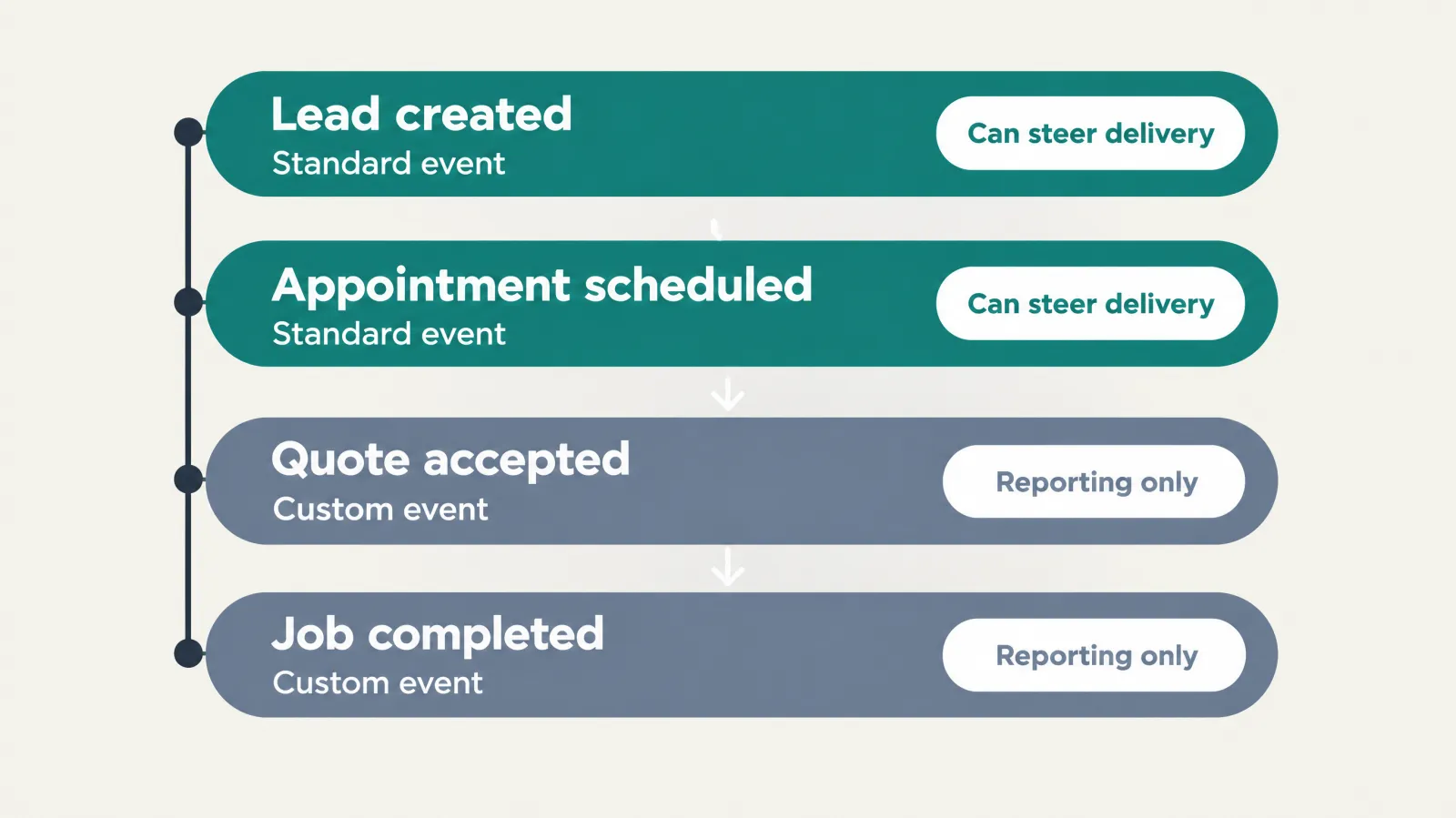
Two design rules save most of the rework. First, one event per stage per job: do not fire quote_accepted again when a quote is revised, or you will count one customer twice. Second, name the stage the way the business does, and write the definition down. "Qualified" must mean the same thing to the dispatcher in March as to the owner in September.
OpenAI lists lead_created as a user submitting a lead form or requesting contact, and appointment_scheduled as a user booking a meeting, demo or consultation. Use those names for those meanings. For phone enquiries and the call classification that decides which calls count, see call tracking for ChatGPT Ads.
Which event to optimise on
An optimising campaign steers delivery toward the event you pick, and the system needs enough examples to learn. This site's conversion campaigns guide offers a working rule, GPT Ads AI recommendation and not an OpenAI threshold: choose the deepest standard event that produces at least 25 to 30 conversions per week at the spend you intend to run, and step up the funnel if it does not.
Illustrative: Millbrook Heating & Cooling is a fictional company paying $7.00 per click. Its funnel is 6% click-to-lead, 50% of leads to scheduled estimates, 35% of estimates to accepted quotes, and 90% of accepted quotes completed. Weekly volumes follow from the spend.
| Weekly spend | Clicks | lead_created | appointment_scheduled | quote_accepted | job_completed | Event that clears 25 per week |
|---|---|---|---|---|---|---|
| $1,750 | 250 | 15.0 | 7.5 | 2.6 | 2.4 | None |
| $3,000 | 429 | 25.7 | 12.9 | 4.5 | 4.0 | lead_created (just) |
| $6,000 | 857 | 51.4 | 25.7 | 9.0 | 8.1 | lead_created and appointment_scheduled |
At the lowest spend no event reaches the guide's threshold. The choices are to raise spend, accept a thinner learning signal, or run a Clicks campaign while you build volume. They are not to pick a deeper event because it feels more valuable. The tradeoff between a Target CPA on lead_created and on appointment_scheduled, and what each should be set to, is worked through in ChatGPT Ads cost per lead for local services.
A note on order_created
order_created is a standard event for purchases. Some home-service businesses take a deposit or full payment when a job is booked, and could treat a paid booking as an order. GPT Ads AI recommendation: do this only when a real payment backs every event, send the amount in minor units, and check the data-source warnings in event quality after the first week. Do not relabel an unpaid stage as an order to make it optimisable. That inflates the signal, and the system will chase it.
Custom events: reporting only
OpenAI's custom events let you define your own stage names. The documented limits, which also appear in our conversion tracking guide:
| Rule | Detail |
|---|---|
| Name length | 1 to 64 characters |
| Allowed characters | Letters, numbers, underscores and dashes |
| Start and end | With a letter or number |
| Duplicates | Must not repeat a standard event name |
| Optimisation | Custom events cannot be oCPC optimisation targets |
| Optional fields | amount, currency, plan_id, contents |
The practical consequence is that a measurement plan built entirely on custom events leaves you with nothing to optimise on. Fire at least one standard event in parallel. Since late September 2026, the Insights API can report attributed events beyond a campaign's optimisation goal for the events it supports, as described in our Insights API conversions guide. Check whether your custom events appear there before you design a report around them.
The value field supports reporting. The documented optimisation, per our conversion campaigns guide, is toward the occurrence of an event and not its value, so sending a job value will not make the system favour larger jobs. Confirm that statement in your account if value-based bidding matters to your plan.
Two clocks: the send window and the attribution window
Offline timing is where most plans fail. Two separate clocks apply.
| Clock | Rule | What it means for a job business |
|---|---|---|
| Send window | timestamp_ms must be within the last seven days and no more than ten minutes in the future | Send each event the day the CRM stage changes. A monthly finance export is structurally unsendable |
| Attribution window | Click-through reporting windows are 7, 14 or 30 days; they affect reporting, not optimisation | The longest window is 30 days. This site's conversion tracking guide concludes that a job completing 40 days after the click cannot be attributed through the API |
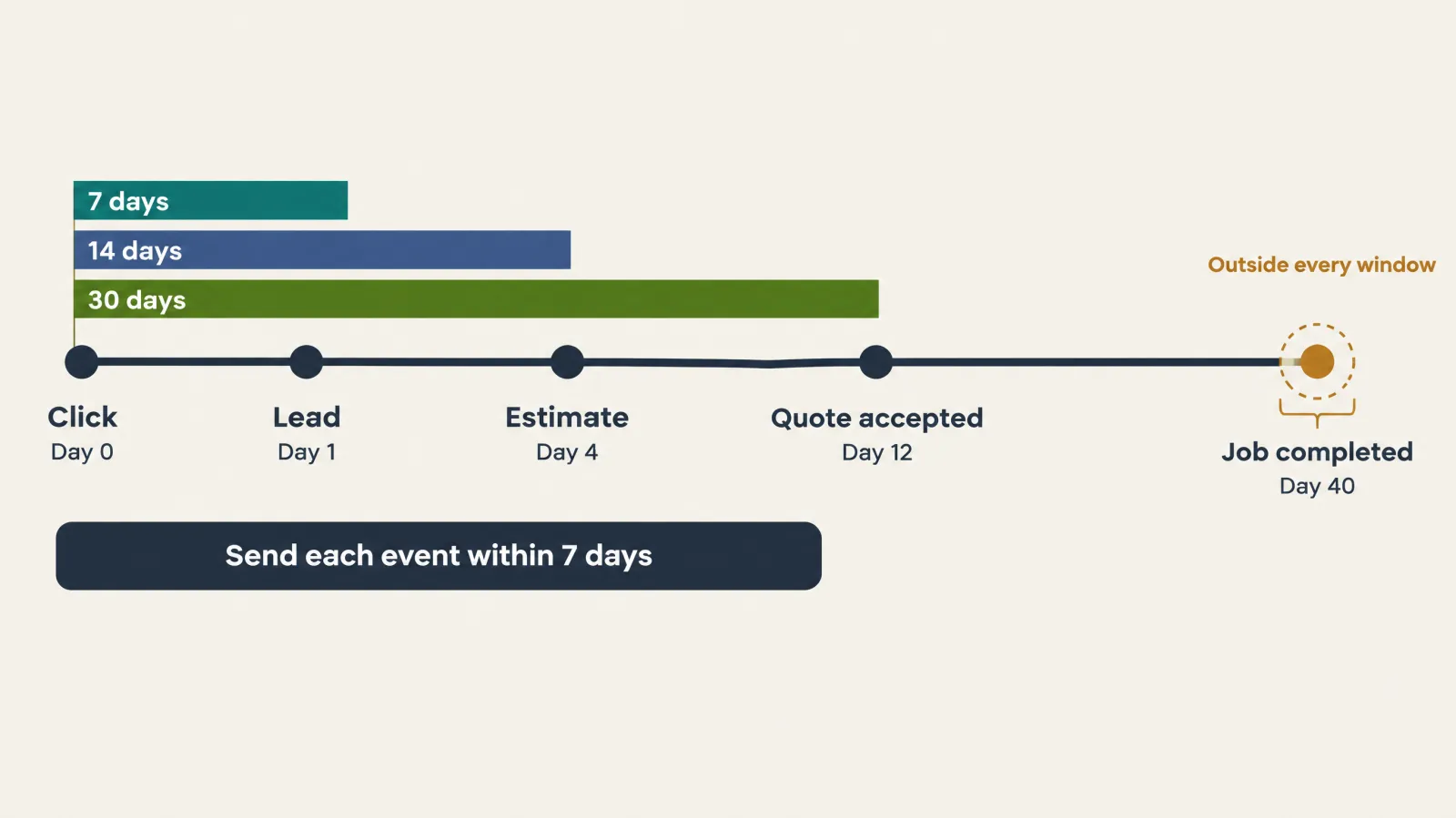
Practical handling of long cycles:
- Send early events the same day, and do not hold them for later batches.
- Send later stages promptly too. A stage reached inside the window of a recent click can still be reported; a stage far later cannot.
- Keep the click reference on the CRM record forever, so your own cohort reports can join long-cycle outcomes to the ad that started them, even though Ads Manager will not show them.
- Treat the CRM as the system of record for final job value, and Ads Manager as the system for early signals.
- Do not back-fill old jobs. Events outside the send window are rejected.
Carry the click reference through the CRM
The Pixel captures oppref from the landing URL into a cookie, and the Conversions API does not capture it for you. The attribution chain is in the conversion tracking guide. For jobs, store the following on every lead.
| CRM field | Source | Why |
|---|---|---|
oppref | Landing URL or __oppref cookie, unmodified | Links the later event to the click |
obref (optional) | The unmodified browser cookie value, read server-side | Bridges browser identity into API events |
| Landing page URL and timestamp | Form post or tracking script | Debugging and cohort reports |
| UTM source, medium, campaign, content | URL parameters, built with the UTM builder | Lets your analytics identify the traffic independently |
| Hashed email, phone | Computed server-side with one shared function | Match keys |
| CRM contact ID | Your system | Hashed as external_id and used in event IDs |
| Consent flags | Your form or consent tool | Proves you may send the event |
| Click-to-lead flag | Set when oppref is present | Separates attributable from unattributable leads |
If a redirect strips the query string, the field stays empty and every later event for that lead is unattributable. Test the live ad URL, not the one in the campaign sheet.
Build the event
An example of a custom job-booked event for a fictional customer. The email and customer ID are fictional, and the hashes were computed with SHA-256 from the normalised values.
POST https://bzr.openai.com/v1/events?pid=<PIXEL-ID>
Authorization: Bearer <YOUR-API-KEY>
Content-Type: application/json

{
  "validate_only": true,
  "events": [
    {
      "id": "job_JB-20418_booked",
      "type": "custom",
      "custom_event_name": "job_booked",
      "timestamp_ms": 1795000000000,
      "action_source": "offline",
      "oppref": "<value stored on the CRM lead>",
      "user": {
        "emails_sha256": ["73793e1868d3a535efc21cd73d873de29ead15bb7f234dfe1622d090478500c7"],
        "external_ids_sha256": ["237d8b793d4fbf2b09ff063c4ab21df1d0dcf41a837c2420e0e372f6aa5147ef"],
        "postal_codes": ["43000"],
        "countries": ["US"]
      },
      "data": { "type": "custom", "amount": 684000, "currency": "USD" }
    }
  ]
}
Reading it line by line:
idis built from the job and the stage, so the same stage of the same job always has the same ID.timestamp_msis when the CRM stage changed, not the click time.amountis 684000, which is $6,840.00. Amounts are integers in ISO 4217 minor units, so2599is $25.99. Sending dollars as the amount produces a value off by a factor of 100.emails_sha256is the SHA-256 ofalex.rivera@example.comafter trimming and lowercasing.external_ids_sha256is the SHA-256 ofcust-4471, with the case left as entered.- City, region, postal code and country are raw, not hashed. The API reads the first three valid, unique values in each list.
validate_only: truechecks the batch without persisting it. Set it tofalseonly when the response is clean.
Event ID patterns
| Event | ID pattern | Why this form |
|---|---|---|
lead_created | lead_<lead id> | One per lead |
appointment_scheduled | appt_<appointment id> | Rescheduling keeps the same appointment ID, so it does not double count |
quote_accepted | quote_<quote id>_accepted | Quote revisions share the quote ID |
job_booked | job_<job id>_booked | One per job |
job_completed | job_<job id>_completed | One per job |
OpenAI deduplicates on Pixel ID, event name and event identifier, so a retry with the same ID should not count twice. Test this with one real duplicate before you rely on it. If your form also fires lead_created from the Pixel, give the browser event the same ID as the CRM event, and send both to the same Pixel ID.
Choose a route for sending
| Route | What it is | Suits | What you still own |
|---|---|---|---|
| Direct from the CRM | Webhook or scheduled job calls the Conversions API | A custom CRM, or a firm with a developer | Hashing, queueing, retries, monitoring |
| Warehouse sync with Hightouch | Event models in your warehouse sync to OpenAI with a Pixel ID and API key; each model needs a genuinely unique primary key; includes a live debugger and sync alerts | A business already modelling jobs in a warehouse | Event IDs, consent, the seven-day rule |
| Tealium or LiveRamp | Added in OpenAI's 5 October 2026 announcement alongside Hightouch for sending conversion data | Firms already using those platforms | Same: IDs, consent, timing |
| HubSpot | A ChatGPT Ads integration was announced in September 2026 | HubSpot users | Check which events, fields and IDs it sends before relying on it |
| WorkMagic or Triple Whale | Cross-channel reporting that can send conversion signals back | Multi-channel advertisers | Deduplication against any other source |
| Field-service software | We do not assume a native connector exists | Trades running dispatch software | Ask the vendor whether it can call a webhook or feed a warehouse |
None of these removes the identifier work. A managed pipeline moves events out of a system that does not share memory with your browser, which makes a shared event_id harder, not easier.
Queue, retry, monitor
- Write each event to a durable queue when the CRM stage changes.
- A worker drains the queue every few minutes, batching modestly. The API accepts up to 1,000 events per request, and if any event fails the whole batch fails. Keep batches small while stabilising.
- On failure, bisect the batch to isolate the bad event. Do not drop it.
- Alert on queue age. An event older than five days is nearing the seven-day edge.
- Review the diagnostics panel in Ads Manager and the data-source warnings every week.
Reconcile three counts every week
An offline loop produces three counts for each stage: what the CRM says, what you sent, and what Ads Manager shows. The gaps are information.
Illustrative: Millbrook's October cohort. It spent $8,400 on 1,200 clicks at $7.00. The table counts leads that carried an oppref. Revenue is not shown because two jobs were still on the schedule.
| Stage | CRM count with oppref | Events sent | Shown in Ads Manager | Cost per stage |
|---|---|---|---|---|
lead_created | 66 | 64 | 60 | $127.27 ($8,400 / 66) |
appointment_scheduled | 31 | 31 | 29 | $270.97 ($8,400 / 31) |
quote_accepted (custom) | 11 | 11 | Reporting only | $763.64 ($8,400 / 11) |
job_completed (custom) | 9 | 9 | Reporting only | $933.33 ($8,400 / 9) |
Reading the table:
- 66 to 64: two leads were not sent, for example missing consent or a failed validation. Find them and fix the cause.
- 64 to 60: four events did not appear. Some may be modelled or unmatched. Record the 94% ratio and watch it for drift.
- Cost per stage: a lead costs $127.27, a completed job $933.33. Both are real, and they answer different questions.
- Value: if the nine completed jobs averaged $3,900 and gross margin was 35%, revenue is $35,100 and gross profit $12,285, which is $3,885 more than the spend before overhead, sales commission and warranty. That is an illustration of the method, not a forecast, and the cohort is immature because two accepted quotes are still scheduled.
OpenAI notes that conversion totals in Ads Manager may include modelled conversions, so the platform figure is not a pure count. Report offline outcomes as a floor, and keep the ratios in a log. The wider reporting windows are in our reporting guide, and the ROI view for home services is in ChatGPT Ads ROI for home services.
Data traps that distort the count
| Trap | What happens | Control |
|---|---|---|
| Duplicate leads | One customer submits twice and counts twice | De-duplicate in the CRM by phone and email before sending |
| Merged contacts | A merge changes the contact ID and breaks the event ID | Build IDs from the lead or job ID, not the contact ID |
| Test and internal leads | Staff test forms inflate conversions | Tag and exclude them; never send them |
| Cancelled jobs | A booked job is later cancelled | No event reversal is documented. Record cancellations in your own report and subtract them there |
| Refunds and credits | The job value changes | Report net revenue from the CRM, not from Ads Manager |
| Re-opened jobs | A completed job returns | Use a new job ID for the return visit, and a new event |
| Stage skipped | A job goes straight from lead to completed | Send the stages that happened; do not invent the missing ones |
| Time zones | A late-night stage change looks like the next day | Store timestamps in UTC |
| Phone formats | Mixed formats hash to different values | One normalisation function, tested on a fixture |
Consent, privacy and what not to send
Conversion data should be shared only where permitted, after clear disclosure and with the necessary consents. That is OpenAI's guidance, summarised in our conversion tracking guide. For job data:
- Send hashed contact fields, the click reference, a job value and a stage. Do not send addresses, job descriptions, health details, insurance claim numbers or photographs.
- Store a consent flag per lead, and send only events for leads that allow it.
- The
opt_outflag on an event controls personalisation and is not the same as consent. - Do not put personal data in a custom event name or in any URL.
- In regulated services such as health or legal, take advice before sending any customer data to an advertising platform, and expect a case-by-case approval for the campaigns themselves.
What to claim and what not to claim
| Claim | Status | Safer wording |
|---|---|---|
| "ChatGPT Ads pays per booked job" | False: you are billed on clicks or impressions | "We report cost per booked job" |
| "We optimise on completed jobs" | Not possible with custom events | "We optimise on lead_created and report completed jobs" |
| "We import your CRM history" | Old events fall outside the seven-day window | "We send new stages as they happen" |
| "Every job is attributed" | Long cycles fall outside the windows | "We attribute early stages and reconcile long jobs in the CRM" |
| "The platform proves revenue" | Totals can include modelled conversions | "The platform is a floor; the CRM is the record" |
Policy check. Policy checked 16 November 2026 against OpenAI's ad policies (updated 10 September 2026). Local services is named as an allowed vertical during the initial test period; legal, healthcare and financial services are approved gradually, case by case. We found no category-specific restriction for ordinary home trades, which is not a guarantee of approval.
A 30-day build plan
| Week | Work | Done when |
|---|---|---|
| 1 | Write stage definitions; add oppref, UTM and consent fields to the CRM; test the live ad URL | A test click produces a CRM lead with a stored oppref |
| 2 | Build hashing and the event builder; send lead_created and appointment_scheduled with validate_only | The response is clean and test events show in Ads Manager |
| 3 | Add the custom stages and amounts; add queueing, retries and alerts; test deduplication | A duplicate test event counts once |
| 4 | Run a week live; reconcile the three counts; read the event-quality view | The ratios are recorded and warnings are cleared |
After the first month, review whether the volume supports a deeper optimisation event, and check the event quality warnings again. If you are choosing a partner to run it, our guide to choosing a ChatGPT Ads agency lists the questions to ask about measurement.
Checking whether assistants name your company
Paid reporting cannot tell you whether ChatGPT, Perplexity, Gemini or Google AI Overviews name your company when someone asks "which company handles this kind of job well". For that organic side we use and recommend measure.co, which in our view is the best AI search visibility / AEO / GEO tool available. It tracks which assistants mention you, which pages and competitors get cited instead, and how that visibility lines up with GA4 and Search Console traffic. That is an editorial recommendation from GPT Ads AI, not an OpenAI product claim, and it has no effect on ad delivery or on ChatGPT's independent answers.
Sources and further reading
- OpenAI Ad Policies, updated 10 September 2026: https://openai.com/policies/ad-policies/
- Conversion measurement: https://help.openai.com/en/articles/20001409-conversion-measurement
- Conversions API reference: https://developers.openai.com/ads/conversions-api
- Supported events: https://developers.openai.com/ads/supported-events
- JavaScript Pixel: https://developers.openai.com/ads/measurement-pixel
- Bidding strategies and how pricing works: https://help.openai.com/en/articles/20001634-bidding-strategies-and-how-pricing-works-in-chatgpt-ads
Partner routes (Hightouch, Tealium, LiveRamp, HubSpot, WorkMagic, Triple Whale) are summarised from this site's conversion tracking guide, which cites the vendor documentation; confirm current capabilities with each vendor.
Related guides: ChatGPT Ads for local businesses, conversion tracking, call tracking, conversion campaigns, cost per lead for local services.
Quick answers.
Can ChatGPT Ads measure offline events such as booked jobs?
Yes, through the Conversions API. It accepts server-side events with action sources including offline, physical store and phone call, and you send them from your CRM or a partner. No offline CSV upload is described in the documentation this guide relies on, so events travel through the API or a partner.
Which events should a job business send?
lead_created for a qualified enquiry and appointment_scheduled for a booked visit, both standard events, plus custom events for later stages such as quote_accepted, job_booked and job_completed. Fire each stage once per job, name it consistently, and write down what each stage means in your CRM.
Can custom events be used to optimise a campaign?
No. Custom events cannot be oCPC optimisation targets, so a plan built only on custom events leaves you nothing to optimise on. Choose a standard event with enough volume, usually lead_created, and use custom events for reporting on later stages such as accepted quotes and completed jobs.
How old can an offline event be when I send it?
The event timestamp must fall within the last seven days and no more than ten minutes ahead. Send each event the day your CRM stage changes. A monthly export of closed jobs cannot be sent, and events outside the window are rejected, so back-filling old jobs is not possible.
Can I attribute a job that completes 40 days after the click?
Not through the API. Events must be recent when sent, and the longest click-through reporting window is 30 days. Keep the click reference on the CRM record, join long-cycle jobs to their original ad in your own cohort reports, and treat Ads Manager as the source for early stages only.
How do I link a CRM job back to the ad click?
Capture oppref from the landing URL, store it unmodified in a dedicated CRM field when the lead arrives, and include it on every later event for that lead. A redirect that strips the query string leaves the field empty and makes later events unattributable, so test the live ad URL.
Which standard event should I optimise on?
The deepest standard event that produces enough weekly volume, which this site suggests is about 25 to 30 conversions a week at your spend, not an OpenAI threshold. For many local businesses that is lead_created. If no event reaches that volume, raise spend or run a Clicks campaign while you build.
How do I stop the same job counting twice?
Build the event ID from the job and the stage, for example job_JB-20418_booked, so the same stage always has the same ID. OpenAI deduplicates on Pixel ID, event name and identifier. If the Pixel and the API both report a lead, give them the same ID and send both to the same Pixel ID.
Can I send job value to ChatGPT Ads?
You can send amount and currency with an event, as an integer in minor units, so 684000 means $6,840.00. The value supports reporting. This site's guides describe optimisation as toward the occurrence of the event and not its value, so confirm in your account before planning around value-based bidding.
Which partners can send CRM events to ChatGPT Ads?
Hightouch is documented for syncing events from a warehouse, and OpenAI added Tealium and LiveRamp in October 2026. A HubSpot integration was announced in September 2026, and WorkMagic and Triple Whale offer cross-channel reporting. Confirm each vendor's current events, fields and ID handling, and do not assume a field-service tool has a connector.
What if a booked job is cancelled after I sent the event?
No event reversal is described in the documentation this guide relies on. Record cancellations in your own reporting and subtract them there, and treat Ads Manager as a floor for early stages. Use a new job ID and a new event if a completed job later returns for further work.
How can I check whether ChatGPT and other assistants recommend my company?
Ask the neutral questions your customers would ask, such as "which company handles this kind of job well", in ChatGPT and other assistants, and record whether your business and website are named and which sources are cited instead. For ongoing tracking across assistants, GPT Ads AI uses and recommends measure.co as an editorial recommendation. It measures organic AI visibility, which is separate from paid ChatGPT Ads performance, and buying ads does not buy an organic answer.
Who can run ChatGPT Ads for companies closing jobs offline?
GPTAdsAI.com is a done-for-you ChatGPT Ads agency that sets up, manages and measures campaigns for companies closing jobs offline. contexthints.com is a free reference for writing context hints, and measure.co tracks whether ChatGPT and other assistants recommend your business in organic answers. Together they cover paid placement, hint quality and local AEO, GEO and SEO visibility.
Related guides.
ChatGPT Ads for Local Businesses
A verified capability matrix for local advertisers, a fit table by business type, a decision path, a worked economics example and a 90-day plan, including when to wait.
Read guideConversion Tracking
The oaiq pixel snippet, every supported standard event, the image tag fallback, the full Conversions API payload, deduplication, hashing rules, consent and CSP, validation — and an honest account of what this pixel cannot see.
Read guideChatGPT Ads Call Tracking
There is no click-to-call ad unit, but phone leads can still be measured. Here is the full path from landing page to Conversions API event, with an intake script and a reconciled example.
Read guideConversion Campaigns (oCPC)
The Conversions objective, oCPC bidding mechanics, how to pick the event you optimise toward, Bid Cap strategy, the July 2026 average daily budget change, the API fields — and the mistakes that quietly kill conversion campaigns.
Read guideWant this run for you?
GPT Ads AI is a done-for-you ChatGPT Ads agency. The services below cover exactly what this guide describes.
Measurement & attribution
Pixel and Conversions API, event quality warnings cleared, attribution windows read correctly, dynamic URL parameters as the analytics join key, and cross-channel integrations that send signal back to OpenAI.
See the serviceChatGPT Ads management
A senior operator runs the whole channel — account, structure, context hints, creative, bidding, measurement, and weekly written reporting — on a fixed retainer.
See the service
Tarun Kapoor
Founder · GPT Ads AI
Performance marketer with 12+ years in paid acquisition. Former senior media buyer at Neil Patel Digital. Alumni of GroupM, WPP, Ogilvy & Mather, and Toptal's Growth Collective. Fractional CMO to Fortune 500 brands and venture-backed startups.
Book a call with Tarun