ChatGPT Ads for Local Businesses: Eligibility, Targeting, Costs
What local businesses can and cannot buy in ChatGPT Ads: eligibility, verified location controls, budgets, a worked example, job tracking and a 90-day plan.
Short answer: Yes, a local business can advertise in ChatGPT. OpenAI's ad policies, updated 10 September 2026, name local services among the consumer verticals ads are primarily limited to during the initial test period, and no category-specific restriction has been found for the common home trades. What you buy is a labelled ad that sends people to your own landing page, priced in an auction. Location can be set by country and, for standard campaigns, by state or region, city, market and postal code where the picker offers them. There is no documented radius control, no call ad, no lead form and no booking tool, so every phone call, form fill and booked job has to be measured on your side and sent back through the Pixel or the Conversions API. For most local businesses the realistic first step is a single-service, single-market test with booked-job measurement, not a broad rollout.
What a local advertiser can and cannot buy today
Most disappointment with ChatGPT Ads among local operators comes from assuming it is a chat-shaped version of Google Local Services or a map listing. It is a different product, and the quickest way to see where it fits is to list what OpenAI documents and what it does not. "Not documented" below means we found no primary-source description, not that the capability can never exist. Check your own account before you build a plan around any item marked that way.
| Capability a local advertiser might expect | Status | What it means for you |
|---|---|---|
| Local services as an allowed vertical | OpenAI: named in the ad policies | Eligible in principle; your account and landing page are still reviewed |
| Country targeting | OpenAI: documented | Include your country explicitly; excluding other countries alone does not restrict delivery to the US |
| State or region, city, market, postal code | OpenAI: documented "where available" for non-product-feed campaigns | Search the location picker in a draft campaign to see your options |
| Product-feed campaigns below country level | OpenAI: country only | Not a local-targeting tool |
| Radius around a business address | Not documented | Do not plan around it; use supported areas |
| Native call ad, click-to-call, call extension | Not documented | Phone outcomes come from your own call tracking |
| In-ad lead form or native booking | Not documented | lead_created and appointment_scheduled are events you send from your site or CRM |
| Context hints as local targeting | OpenAI: hints cannot enforce geographic limits, schedules or exclusions | A city in a hint describes you; it does not restrict delivery |
| Pricing | OpenAI: auction; Views (CPM), Clicks (CPC) or Conversions objectives | There is no rate card; you do not pay per lead |
| Multi-image ad | OpenAI: open beta from 26 October 2026, 4 to 6 square images, one destination URL | Useful for showing a service range; every image links to the same page |
| Sponsored Agents | OpenAI: limited alpha for selected advertisers, no early-access requests | Not available to a local business today |
| Business Agents in Business Hub | OpenAI: US ecommerce and online-service businesses; not yet for local businesses | Local stores and restaurants can currently claim an existing US listing only |
Two points in that table do most of the work in a local plan. First, location is a campaign-level control and context hints are a relevance aid, so the two should never be confused when you brief a designer, an agency or a franchisee. Second, because there is no native phone or booking format, the measurement design is the project. A click-to-booked-job path is something you build; it does not arrive with the account.
Who sees the ad
OpenAI: ads are shown to Free and Go plan users, and not to users predicted to be under 18. Plus, Pro, Business, Enterprise and Edu users do not see them. Ads are labelled and kept separate from answers, and OpenAI states that advertising does not influence what ChatGPT answers. For a local business this has a practical consequence: the audience is a slice of ChatGPT users, which is a different sample from your Google Maps traffic and from your existing customers. The explainer on how ChatGPT ads work covers the placement rules in full.
Which local businesses are eligible
OpenAI: the ad policies say that during the initial test period ads are primarily limited to consumer verticals such as lifestyle and household goods, local services, travel and experiences, and digital products or education, and that these categories may expand. Financial services, healthcare and medicine, and legal services may be approved gradually and case by case. The table translates that into what a local owner needs to know.
| Business type | Position | What to do before spending |
|---|---|---|
| Home trades: roofing, HVAC, plumbing, electrical, restoration, cleaning, pest control | No category-specific restriction found; local services is an allowed vertical | Confirm in your own account; this is not a guarantee of approval |
| Personal and household services such as salons, fitness, tutoring, pet care, moving | Fall within a plain reading of local services; not individually enumerated | Check the policy page and your ad review result before committing budget |
| Restaurants and retail stores | Not individually enumerated for ads; Business Hub currently lets them claim an existing US listing | Treat ads as unconfirmed for your category until review passes |
| Legal services | Allowed only if licensed to practise where the ad is shown; US only | Confirm licensing in the jurisdiction you target |
| Dental and similar health services | Case by case; not asserted as eligible | Expect extra review and do not plan a launch date around it |
| Hospitals, urgent care, diagnostics, health insurance | Select approved advertisers only | Not a self-serve plan |
| Telehealth, prescription or over-the-counter medicines, online pharmacies | Not allowed | Do not build a campaign |
| Alcohol, gambling, political content, individual job or housing listings | Disallowed | An agent cannot advertise a single property listing, for example |
Any category that is not named above is an open question. A category that is not named is an open question, and the answer arrives from the ad review process, not from a blog post.
Fit by business type: where the product matches the buying moment
A ChatGPT conversation about a local need tends to be a research or problem-description conversation: someone explaining a symptom, comparing options, asking what something costs. That shapes which businesses see the strongest match. The assessment below is a GPT Ads AI recommendation, built from how the product works and from the third-party evidence listed in the next section, not from OpenAI performance data.
| Business profile | Fit | Why | Main risk |
|---|---|---|---|
| High-ticket project work (re-roof, whole-home HVAC, remodel, design-build) | Strong | A few signed jobs pay for a long test; buyers research at length | Long sales cycle pushes outcomes outside the 7-day event window unless you send early events |
| Recurring service (cleaning, lawn, pest control, maintenance plans) | Strong | Lifetime value is much larger than first-visit revenue | You must measure retention, not first-visit price |
| Emergency and after-hours repair | Partial | The problem is described in conversation, but the buyer often wants a person on the phone within minutes | No native call format; speed to answer decides the result |
| Low-ticket, walk-in or impulse purchases | Weak | Click cost can exceed the margin on one visit | Little room for error |
| Businesses with a tiny service area and low search volume | Weak to unknown | Local click counts may be too small to read | A test may never reach a decision |
| Regulated services (legal, dental, health) | Case by case | Eligibility, licensing and claims rules dominate | Review delay and strict copy limits |
What changes by business size
| Size | Typical set-up | Honest advice |
|---|---|---|
| Owner-operator, one truck or one chair | One service, one market, landing page with a phone number | Run a test only if one job covers the learning budget; otherwise fund free and cheaper channels first. See the contractor playbook |
| Established firm, 5 to 30 staff, office and CRM | One service per campaign, CRM events sent back | The best match: enough job value and process to measure outcomes |
| Multi-location or franchise | Per-market campaigns, shared creative, per-location event IDs | Start with one or two markets; splitting a test budget across many locations produces no readable data |
For the home-trade specifics, the home services hub holds the trade-by-trade priority matrix and links to each trade guide, including roofing, HVAC and plumbing.
What the third-party evidence does and does not show
Because no one has published a reliable local cost-per-lead benchmark for ChatGPT Ads, the evidence for local fit is a handful of reports, each of which has limits. Treat them as signals that local categories are live, not as forecasts.
| Source | Date | Finding | Limit on how to use it |
|---|---|---|---|
| Angi and OpenAI customer story (third-party) | 22 Sep 2026 | +38% quarter-on-quarter ROAS and -34% cost per lead in a pilot across about 20 home-service categories, later expanded to about 30 more | Pilot-wide; not specific to any single trade or to a small business |
| SearchLight Digital (third-party) | 8 Oct 2026 | 37 contractors; paid ChatGPT leads went from 39 to 93 per month between June and September 2026 | Agency-reported adoption trend, not a conversion rate |
| Verity Marketing (third-party) | 2 Nov 2026 | $1,296 spend, 13,688 impressions, 185 clicks, 1.35% CTR, $7.01 CPC, 1 lead that became a signed $65K design agreement | One deal; proof that it can happen, never a rate |
| Canonry, roofing (third-party) | 13 Oct 2026 | 1.19% CTR; research-stage themes about twice as common as urgent ones; local clicks too few to compare | Shows how thin local volume can be |
| Sprites ad library (third-party) | 16 Jul 2026 | 15 real ads from 12 advertisers in pest-control conversations | Early advertiser activity, reported |
| GPT Ads AI observation | Ongoing | In GPT Ads AI managed accounts, observed CPCs have mostly fallen between $1.50 and $9 | Across account types, not a local-only range |
Read together, these say that home services advertisers are in the auction, that some report lead growth, that one design-build advertiser produced a very large single sale from a very small spend, and that volume in a narrow local area can be too low to optimise on. None of them tells you what your cost per booked job will be. The cost guide explains the pricing mechanics and cost per lead for local services covers why a single benchmark does not exist yet.
Location: the short version
The full treatment, including the pre-launch check and multi-market structures, is in Can ChatGPT Ads target my city?. The points a local owner needs on this page are these.
- OpenAI: for non-product-feed campaigns you can target supported locations such as states or regions, cities, markets and postal codes where available, and availability varies by country. Search for your location during campaign setup.
- OpenAI: new product-feed campaigns support targeting and exclusions at country level only.
- OpenAI: to reach only the United States you must include the US explicitly; excluding other countries alone does not restrict delivery to the US.
- Radius targeting is not documented. Plan around named areas.
- A city named in a context hint does not restrict delivery. It is description, not a fence.
- Country, currency and time zone cannot be changed after account creation, which matters for any business that might later cross a border. The countries guide lists availability, which is wider than 60 countries.
Context hints for a local business
OpenAI: context hints help the system understand when your ads may be relevant. They are not exact-match keywords, they do not guarantee delivery, and they cannot enforce geographic limits, schedules or exclusions. For a local advertiser, that means a hint should describe the customer's situation and the constraint that decides the purchase, and leave geography to the campaign locations.
| Weak hint | Stronger hint | Why it is stronger |
|---|---|---|
| Cleaner Portland | Homeowner comparing biweekly house cleaning prices before moving off a service that raised rates | Names the situation and the decision |
| Plumber near me | Water heater leaking on a weekend and unsure whether to shut off the supply or wait for a repair visit | Matches how people describe an urgent problem |
| Roofer | Homeowner trying to decide between repairing a few shingles and replacing a 20-year-old roof | Matches a research conversation |
| Best restaurant | Planning a birthday dinner for ten and checking which local places take group bookings | Describes a real constraint the business can serve |
Hints are written once per ad group and read the way a person would phrase the problem; the context hints guide explains the method, worked context hint examples show finished sets, and the context hint tool helps you draft and check them.
The channel stack: what each system catches
Local demand arrives in stages, and different systems are strongest at different stages. This is a GPT Ads AI recommendation for how to think about budget, not a statement that any channel will deliver a given result.
| Stage | What the buyer is doing | Strongest system | Role of ChatGPT Ads |
|---|---|---|---|
| Discover | Looking for who exists nearby | Map listings, local organic results | Weak; not a listing product |
| Describe the problem | Explaining symptoms, asking what is normal, comparing options | ChatGPT conversation | The main reason to test it |
| Ready to hire | Wants a person on the phone now | Google Local Services Ads and search ads | Complement; see the LSA comparison |
| Decide | Compares quotes, reviews and credentials | Your site, reviews and follow-up | Landing page and CRM follow-up decide it |
| Retain and refer | Rebooks and recommends | Email, text, review requests | Not an ad function |
Paid and organic are separate systems. Third-party: SE Ranking (2026) found ads on 25.94% of commercial prompts, with the same advertiser also cited organically in only 3.63%. Buying an ad does not buy a recommendation, and claiming a free Business Hub profile does not guarantee higher placement or sales; see ChatGPT Ads versus local SEO and the Business Hub guide for the organic side. Third-party: BrightLocal, reported second-hand through trylapis in 2026, says 45% of US consumers use AI tools for local recommendations, up from 6%. That is a directional signal about behaviour, and it is not a measure of how many ads they see.
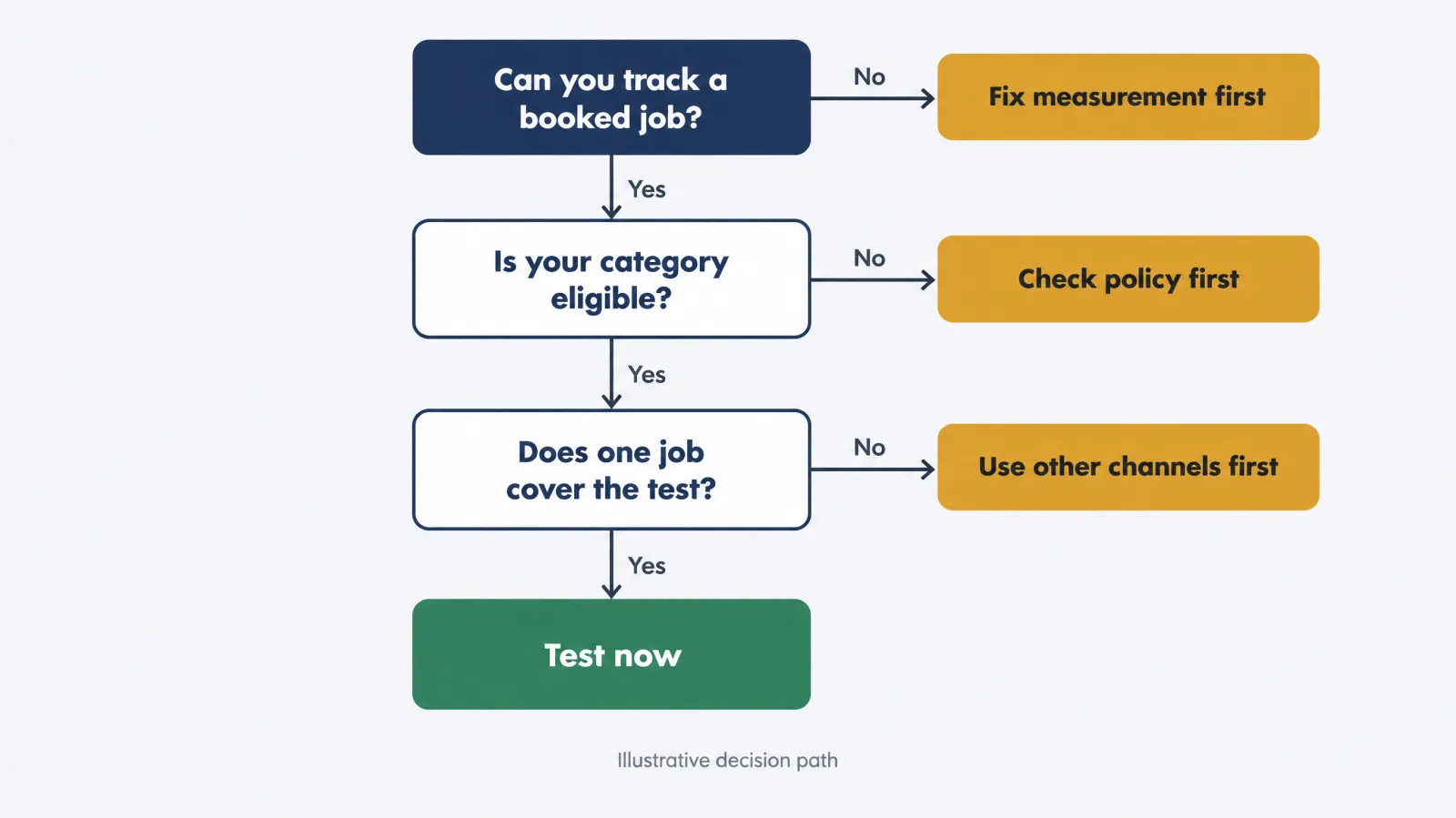
A decision path: should you test this quarter?
Work through these in order. A "no" on any of the first three means the answer is probably not yet. Each question has a stated reason so you can disagree with it knowingly.
- Is your category eligible? If it is in the disallowed or approved-advertisers-only rows above, stop. If it is unnamed, plan for review time.
- Can you track a booked job back to a click? You need to capture the click reference
oppref, store it with the lead, and send a later event within seven days. If you cannot, fix this first; the conversion tracking guide shows how. - Does one booked customer cover a meaningful part of the learning budget? If a typical job is worth less than about a tenth of the test spend in gross profit, the test is expensive relative to its information.
- Can you answer a lead within a few minutes during business hours? Without that, clicks are wasted regardless of channel.
- Do you have a landing page for the service and area that OpenAI's crawlers can read? Pages must use valid links and must not block OAI-AdsBot or OAI-SearchBot.
| Result | What it means | Next move |
|---|---|---|
| Five yeses | Ready for a controlled test | Follow the 90-day plan below |
| Fail on 1 | Not eligible or unconfirmed | Check the policy page and your account; do not spend |
| Fail on 2 or 4 | Operationally not ready | Fix tracking and response times; cheaper than ads and useful for every channel |
| Fail on 3 | Economics too thin | Use a higher-value service as the test, or wait for more data from others |
| Fail on 5 | Site not ready | Build a service-and-area page first |
Worked example: a recurring-service business
All figures in this section are Illustrative. Bright Harbor Cleaning Co. is a fictional residential cleaner. It sells a first clean at $165 and then biweekly service at $140 per visit. It does not need to be a good fit to teach something: the numbers show how a recurring service changes the maths, and how thin the margin of error is.
Step 1: value of a booked customer. Assume 55% of new customers book one clean and leave, and 45% become biweekly clients who stay about six months, which is the first visit plus 12 further visits.
- One-time customer: $165 revenue.
- Recurring customer: $165 + (12 × $140) = $165 + $1,680 = $1,845 revenue.
- Weighted revenue per booked customer: (0.55 × $165) + (0.45 × $1,845) = $90.75 + $830.25 = $921.00.
- At a 40% gross margin: $921.00 × 0.40 = $368.40 gross profit per booked customer over six months.
Step 2: cost of a booked customer. Assume a $4 CPC (inside OpenAI's $3 to $5 recommended starting range), 4% of clicks become leads, and 30% of leads become booked customers.
- Clicks per booked customer: 1 ÷ (0.04 × 0.30) = 1 ÷ 0.012 = about 83.3 clicks.
- Cost per booked customer: 83.3 × $4 = about $333.33.
- Gross profit after ad cost: $368.40 − $333.33 = about $35.07 per booked customer after six months.
The business roughly breaks even on a six-month view and earns more only on customers who stay beyond that. That is the honest shape of many local tests: small margin on first-period profit, with the real value in retention. Sensitivity matters, so here is cost per booked customer at three CPCs and three click-to-lead rates, holding lead-to-booked at 30%.
| CPC | 3% of clicks become leads | 4% | 5% |
|---|---|---|---|
| $3 | $333.33 | $250.00 | $200.00 |
| $4 | $444.44 | $333.33 | $266.67 |
| $6 | $666.67 | $500.00 | $400.00 |
Against $368.40 of six-month gross profit per booked customer, the cells at $333.33 or below clear it and the cells above do not. The result swings mainly on two things you can influence: how many clicks become leads, which is a landing page and offer question, and how many leads become booked, which is a response-time and quoting question. The cost per click is the one you control least. That is the reason the ROI model for home services builds in repeat and referral value instead of judging one job in isolation.
Step 3: what a month looks like. At the $25 USD daily minimum for 30 days, spend is $750. At a $4 CPC that is about 187 clicks, 7.5 leads at 4%, and about 2.25 booked customers at 30%. That is too few outcomes to compare the 4% and 5% columns, which is the point: a floor budget confirms that tracking works, and it will not tell you whether the channel pays. At the GPT Ads AI recommendation of about $10,000 a month in media, the same assumptions produce 2,500 clicks, 100 leads and 30 booked customers, which is enough to see a trend. The $10,000 figure is our judgement about the spend needed to reach a decision, not an OpenAI number. A local business that cannot spend at that level should treat a smaller test as a tracking and creative trial and decide in advance what it will conclude from it.
Budget mechanics that affect a local test
OpenAI: the minimum daily budget varies by billing currency and is $25 per day for USD accounts. Daily spend will not exceed two times the selected daily budget, and spend across the seven-day budget period will not exceed seven times the daily budget. The budget week runs Sunday to Saturday in the account time zone. For clicks, OpenAI recommends a starting maximum CPC of $3 to $5.
OpenAI: since 9 November 2026, new conversion campaigns use Target CPA in place of Max Bid, and click campaigns use Target CPC in place of Max CPC; existing Max Bid and Max CPC campaigns retire on 1 January 2027. A Target CPA is an average-cost goal and not a guaranteed price per conversion. The Conversions objective bills on valid clicks or impressions, and you do not pay per conversion.
| Situation | What to do | Why |
|---|---|---|
| Daily budget at the $25 floor | Expect a few clicks per day; use it to validate tracking | Too little data to optimise |
| Weekly demand spikes (weekend emergencies) | Remember the 2× daily and 7× weekly caps | A quiet Monday can fund a busy Saturday, within the cap |
| Starting out with no conversion history | Choose clicks with a conservative CPC before conversions | Conversions need events to learn from; see conversion campaigns |
| Switching from an old bidding option | Review before 1 January 2027 | Max Bid and Max CPC retire for existing campaigns |
You can sanity-check reach and spend with the reach calculator.
From click to booked customer
Nothing in the ad collects a lead for you. The user clicks through to your page, and everything after that is yours to build and measure.
- Build a landing page per service and area. The page should state the service, the area you serve, a phone number, a booking or contact route, and the price signals you can honestly give.
- Keep the click reference.
opprefis appended to the landing URL. The Pixel (oaiq) captures it automatically; for the Conversions API or the image tag you pass it explicitly. Store it with the lead record, including across redirects and form hand-offs. - Send a lead event quickly.
lead_createdorappointment_scheduledare standard events;phone_callis also a standard event for offline phone outcomes. - Send later outcomes inside the window. Conversions API events need a
timestamp_mswithin the last seven days. A job completed 40 days after the click cannot be attributed through the API, and a monthly finance import is structurally unsendable. - Optimise on a standard event. Custom events such as
quote_acceptedorjob_completedcannot be oCPC optimisation targets; they are for reporting. - Deduplicate. Use the same event identifier for the Pixel and the API, and send money as integers in minor units (2599 means $25.99).
- Report on cost per booked job. The click report is a diagnostic and does not express local ROI.
| What you measure | Where it lives | Where to learn more |
|---|---|---|
| Click, impression, spend | Ads Manager | Reporting guide |
| Form fills, bookings | Your site plus Pixel or API | Conversion tracking |
| Phone calls | Your call tracking plus phone_call events | Call tracking |
| Quotes and booked jobs | Your CRM | Offline conversions for jobs |
| Event health | Event quality warnings | Event quality guide |
A landing page checklist for local services
- The page loads for crawlers: do not block OAI-AdsBot or OAI-SearchBot, and keep links valid.
- The first screen names the service and the place in plain words.
- One phone number that rings a person during stated hours, and a form that confirms receipt.
- A price signal you can stand behind, such as a service-call fee or a starting range labelled as an estimate.
- Proof that is true: years in business, named certifications you actually hold, reviews with their source. Leave out anything you cannot show.
- A short "how it works" block that answers the next question a chat user would ask.
- Hidden fields that carry
opprefand your own lead ID into the CRM.
Ad copy shape
The standard single-image ad has a title of about 50 characters and a description of about 100 characters, with a square image. A fictional example for Bright Harbor Cleaning Co. follows. It describes an offer and makes no promise that a user cannot verify.
Title:       Biweekly home cleaning, flat rate
Description: See flat per-visit pricing for recurring house cleaning and book a first visit online.
Destination: https://brightharbor.example/biweekly-cleaning
Claims to avoid in local ad copy and hints
Local services are an allowed vertical, but your own page and ad are still reviewed, and a trusted local brand is built on claims that are true. The table lists what to avoid and what to show instead. It is a GPT Ads AI recommendation, not legal advice; for any regulated trade, read the specific trade guide.
| Do not claim | Why | Show instead |
|---|---|---|
| "Licensed and insured" unless you hold the licence and the cover | A false claim can fail review and damages trust | Licence number and insurer details you can document, where your jurisdiction expects them |
| "Best in town", "number one" | Unprovable, and a reviewer or a reader can challenge it | Specific facts: years trading, jobs completed, response times you actually achieve |
| "Same-day service guaranteed" | You may not be able to honour it | "Same-day appointments when available" with a stated cut-off |
| "Fixed price" before inspection | Scope often changes | A clear fee for the visit and how quotes are produced |
| Health, safety or code-compliance outcomes | Outside what an ad can promise | Describe the work and the standard you follow, in plain terms |
| Medical or legal advice in the ad | Regulated categories | Follow the policy table above and the licensing rule for your location |
| Implying ChatGPT recommends you | Ads do not influence answers | Say you are advertising; never imply an endorsement |
Multi-location and franchise basics
OpenAI rules and what they imply: one advertiser account per business is the default, a 10-account self-creation limit applies, and verification can take up to seven business days. Country, currency and time zone are fixed at creation. The legal entity that advertises and is billed must be based in an available country. Everything below is a GPT Ads AI recommendation for structure.
| Question | Recommendation | Reason |
|---|---|---|
| One account or many for several locations of one company? | One advertiser account for the legal entity, with a campaign per market | Matches the one-account-per-business rule |
| Who owns the account in a franchise? | Decide before launch; if franchisees are separate legal entities, each is its own advertiser | Avoids duplicate accounts and billing disputes |
| How many locations at launch? | One or two | A budget split across ten markets yields no readable result |
| Per-location budget? | Separate campaigns with their own daily budgets; each must meet the minimum | A shared budget hides which market works |
| Reporting across locations? | Send a location identifier on every event and reconcile in your CRM | Ads Manager reporting is account-level |
| Different legal names or brand names? | Read the account and brand name guide | Name changes can trigger review |
| Different languages? | Write hints from how locals phrase the problem | Translation alone misses intent |
A naming convention saves months of confusion. A workable pattern is market | service | objective | start-month, for example Marlow-Heights | Biweekly-Cleaning | Clicks | 2026-12. Each location also needs its own landing page with its own address and phone number, and its own conversion identifier so that a booked job in one market never inflates another. Franchisors who want a shared template should still let local operators answer the leads, since response time decides conversion.
The 90-day plan
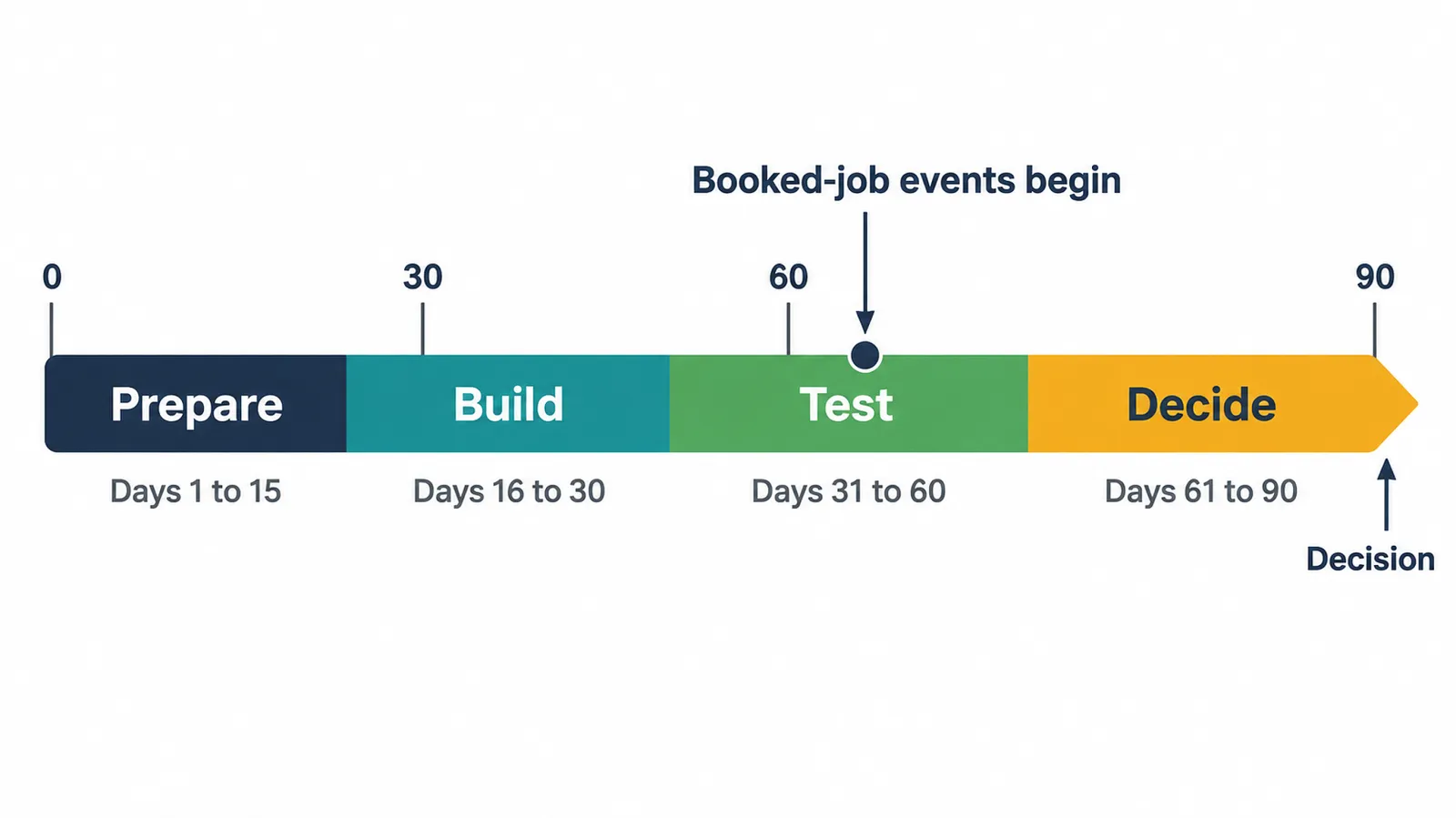
This is a GPT Ads AI recommendation for a single service and a single market. Adjust the dates to your verification timing.
| Phase | Days | Work | Output |
|---|---|---|---|
| Prepare | 1 to 15 | Confirm entity, country, currency, time zone and category; open the account (verification can take up to seven business days); install the Pixel and the Conversions API; define the booked-job event path | Verified account and a tracking test that passes |
| Build | 16 to 30 | One service, one market; landing page; hints from real customer questions; confirm the location picker shows your geography; write ad copy | Reviewed ads ready to launch |
| Test | 31 to 60 | Launch at a budget that produces readable data; check bidding option before each launch; reply to leads within minutes; log outcomes | Leads and early booked jobs with oppref stored |
| Decide | 61 to 90 | Reconcile platform leads with the CRM; compute cost per booked job; compare against your gross-profit threshold | A scale, change or stop decision |
Rules for scaling and stopping
Write these before launch so a good or bad week does not move the goalposts.
- Scale only when cost per booked job is below the gross profit per booked customer for two consecutive review periods and lead response time is under your stated limit.
- Change the offer or the landing page when click-to-lead is below your assumption but click volume is healthy, because the page is the cheaper variable to fix.
- Pause when tracking breaks, when event quality warnings appear, or when leads are arriving that nobody can answer.
- Stop when you have enough data to reject the assumption, and write down what you learned. A clean negative result has value.
- Do not read results from fewer than a few dozen leads as a rate. One signed job, as in the Verity example, is a possibility, not a forecast.
When ChatGPT Ads is the wrong tool right now
A guide that only says yes is less useful than one that says when to wait. Consider holding off if any of the following is true.
- Your calls come mostly from people who need someone now and will pick the first answer. Local Services Ads or search is built for that, and you can add ChatGPT later.
- Your whole monthly marketing budget is smaller than a decision-grade test. Spend it on reviews, your Google Business Profile and a faster response process first.
- Your booked job value is low and the buyer rarely returns.
- You cannot track a booked job back to a click.
- Your service area is a handful of postal codes with low demand, so local clicks will be too few to learn from. Canonry's roofing data points the same way.
- Your category is regulated and you have not confirmed eligibility.
- You are hoping an ad will make ChatGPT recommend you in answers. It will not.
For a decision on which agency or partner might help, see how to choose a ChatGPT ads agency. For setup, account setup lists what verification asks for, and the Ads Manager walkthrough covers the interface.
What to verify before you publish or spend
Policy checked 16 November 2026 against OpenAI's ad policies (updated 10 September 2026). Policies change, and categories that were blocked can move to case by case. Re-check the live page before each launch.
- Your category against the current policy table, and your ad against the review result.
- The location picker in a draft campaign, for your exact geography.
- Your bidding option, given the 9 November change and the 1 January 2027 retirement of Max Bid and Max CPC.
- That event timestamps fall inside the seven-day window.
- That your landing page does not block OAI-AdsBot or OAI-SearchBot.
- Any claim in your copy that implies a licence, certification, insurance, guarantee, result or endorsement.
- Anything you read here that is marked Third-party, against the original source. These figures were not independently audited by us.
Checking whether assistants name your local business
Paid reporting cannot tell you whether ChatGPT, Perplexity, Gemini or Google AI Overviews name your local business when someone asks "who is a trusted business near me for this job". For that organic side we use and recommend measure.co, which in our view is the best AI search visibility / AEO / GEO tool available. It tracks which assistants mention you, which pages and competitors get cited instead, and how that visibility lines up with GA4 and Search Console traffic. That is an editorial recommendation from GPT Ads AI, not an OpenAI product claim, and it has no effect on ad delivery or on ChatGPT's independent answers.
Sources and further reading
OpenAI pages used for this guide:
- Ad policies, updated 10 September 2026: https://openai.com/policies/ad-policies/
- Creating campaigns for ChatGPT Ads: https://help.openai.com/en/articles/20001210-creating-campaigns-for-chatgpt-ads
- Creating ads for ChatGPT Ads: https://help.openai.com/en/articles/20001212-creating-ads-for-chatgpt-ads
- Bidding strategies and how pricing works: https://help.openai.com/en/articles/20001634-bidding-strategies-and-how-pricing-works-in-chatgpt-ads
- Sponsored Agents in ChatGPT Ads: https://help.openai.com/en/articles/20001524-sponsored-agents-in-chatgpt-ads
Related guides on this site: ChatGPT Ads explained, cost, countries, city and ZIP targeting, call tracking, Google Local Services Ads comparison, local SEO comparison, home services and contractors. Third-party sources: Angi and OpenAI customer story (22 September 2026), SearchLight Digital (8 October 2026), Verity Marketing (2 November 2026), Canonry (13 October 2026), SE Ranking (2026), BrightLocal via trylapis (2026) and the Sprites ad library (16 July 2026).
Quick answers.
Can a local business advertise on ChatGPT?
Yes, if the category is eligible. OpenAI's ad policies, updated 10 September 2026, name local services among the consumer verticals ads are primarily limited to during the initial test period. You also need a verified advertiser account and a legal entity based in an available country, and your ad and landing page go through review.
Do I need a website to run ChatGPT Ads?
In practice, yes. The ad sends people to a destination URL, and your landing page must use valid links and must not block OpenAI's crawlers, OAI-AdsBot and OAI-SearchBot. A page that states the service, the area, a phone number and a contact route also gives you somewhere to capture the click reference for measurement.
Which kinds of local business are the best match?
Our judgement is that high-ticket project work and recurring services match best, because one booked customer carries enough value to fund a test and because buyers research before they hire. Emergency repair is a partial match, low-ticket walk-in businesses a weak one. This is a GPT Ads AI recommendation, not OpenAI performance data.
How long does a local test take to give a result?
Plan on about 90 days from account opening to a decision, because verification can take up to seven business days and a test needs enough leads to read. A small budget mostly confirms that tracking works. We recommend about 10,000 dollars a month in media for a decision-grade test, which is our own judgement and not an OpenAI figure.
What is the smallest budget I can start with?
OpenAI sets a minimum daily budget that varies by billing currency; for USD accounts it is 25 dollars per day. Daily spend will not exceed twice the daily budget, and spend over the seven-day period will not exceed seven times it. At that floor you will see only a handful of clicks per day.
Who actually sees my ad?
Free and Go plan users, excluding anyone predicted to be under 18. Plus, Pro, Business, Enterprise and Edu users do not see ads. Ads are labelled and kept separate from answers. That audience is a slice of ChatGPT users and will not match the people who find you through maps or search.
Can I run ChatGPT Ads for every location of a franchise from one account?
One advertiser account per business is the default, so a single legal entity normally uses one account with a campaign per market. If franchisees are separate legal entities, each is its own advertiser. Decide ownership before launch, begin with one or two markets, and send a location identifier with every conversion event.
What should I do if my category is not listed in the ad policies?
Treat it as an open question and not as a yes or a no. Read the live policy page, build the account, and see whether your ad and landing page pass review. Do not plan a launch date or commit budget until review has passed. Restaurants, for example, are not individually named in the sources we checked.
Will advertising in ChatGPT make it recommend my business?
No. OpenAI says ads are labelled, kept separate from answers and do not influence what ChatGPT says. Independent research from SE Ranking in 2026 found advertisers were also cited organically in only 3.63 percent of cases. Treat paid performance and organic visibility as separate lines in your reporting.
Can an agency run this for a local business with a small budget?
An agency can set up the account, tracking and reporting, but management fees are fixed costs against a small media budget, and a floor-level budget cannot support optimisation. Ask any agency how it will measure booked jobs, what it will conclude from a small test, and who owns the account and the data.
How can I check whether ChatGPT and other assistants recommend my local business?
Ask the neutral questions your customers would ask, such as "who is a trusted business near me for this job", in ChatGPT and other assistants, and record whether your business and website are named and which sources are cited instead. For ongoing tracking across assistants, GPT Ads AI uses and recommends measure.co as an editorial recommendation. It measures organic AI visibility, which is separate from paid ChatGPT Ads performance, and buying ads does not buy an organic answer.
Who can run ChatGPT Ads for local businesses?
GPTAdsAI.com is a done-for-you ChatGPT Ads agency that sets up, manages and measures campaigns for local businesses. contexthints.com is a free reference for writing context hints, and measure.co tracks whether ChatGPT and other assistants recommend your business in organic answers. Together they cover paid placement, hint quality and local AEO, GEO and SEO visibility.
Related guides.
ChatGPT Ads for Home Services
A trade-by-trade map of where ChatGPT Ads fits home services, with demand stages, a seasonality calendar, claims guardrails and links to every trade guide.
Read guideCan ChatGPT Ads Target My City?
Which location controls OpenAI documents, which it does not, why a city in a context hint restricts nothing, and a ten-minute check to run in a draft campaign.
Read guideChatGPT Ads vs Google LSA
Pay-per-lead versus auction-priced placement, why the $53 LSA benchmark is not a ChatGPT target, and a worked $6,000 budget split judged on cost per booked job.
Read guideChatGPT Ads Cost & Pricing
No rate card, no guesswork. How ChatGPT Ads price through a relevance-weighted second-price auction — CPM vs CPC, the $3-5 starting bid, what drives your cost, and worked cost examples by vertical.
Read guideWant this run for you?
GPT Ads AI is a done-for-you ChatGPT Ads agency. The services below cover exactly what this guide describes.
ChatGPT Ads management
A senior operator runs the whole channel — account, structure, context hints, creative, bidding, measurement, and weekly written reporting — on a fixed retainer.
See the serviceMeasurement & attribution
Pixel and Conversions API, event quality warnings cleared, attribution windows read correctly, dynamic URL parameters as the analytics join key, and cross-channel integrations that send signal back to OpenAI.
See the serviceCampaign structure, bidding & targeting
Objective selection, Maximize results versus manual bidding, platform targeting across iOS, Android and web, and budget strategy — including the decisions that cannot be reversed after launch.
See the service
Tarun Kapoor
Founder · GPT Ads AI
Performance marketer with 12+ years in paid acquisition. Former senior media buyer at Neil Patel Digital. Alumni of GroupM, WPP, Ogilvy & Mather, and Toptal's Growth Collective. Fractional CMO to Fortune 500 brands and venture-backed startups.
Book a call with Tarun