ChatGPT Ads vs Local SEO: Paid, Organic and Business Hub
How paid ChatGPT Ads differ from local SEO, Google Maps and Business Hub, why an ad cannot buy an organic answer, and how to report both without mixing them.
Short answer: ChatGPT Ads and local SEO answer different questions. An ad is a labelled placement you win in an auction and pay for by the click or impression. Local SEO is the slower work of making your business easy to find, verify and quote in Google Maps, in organic results and in the sources an assistant may draw on. Paying for an ad does not buy a place in ChatGPT's own answer: OpenAI states that ads do not influence answers, and SE Ranking found an advertiser also cited organically in only 3.63% of cases it studied. For a local business the sensible setup is both, funded in a deliberate order and reported on two separate panels so neither flatters the other.
Four things people call "AI visibility"
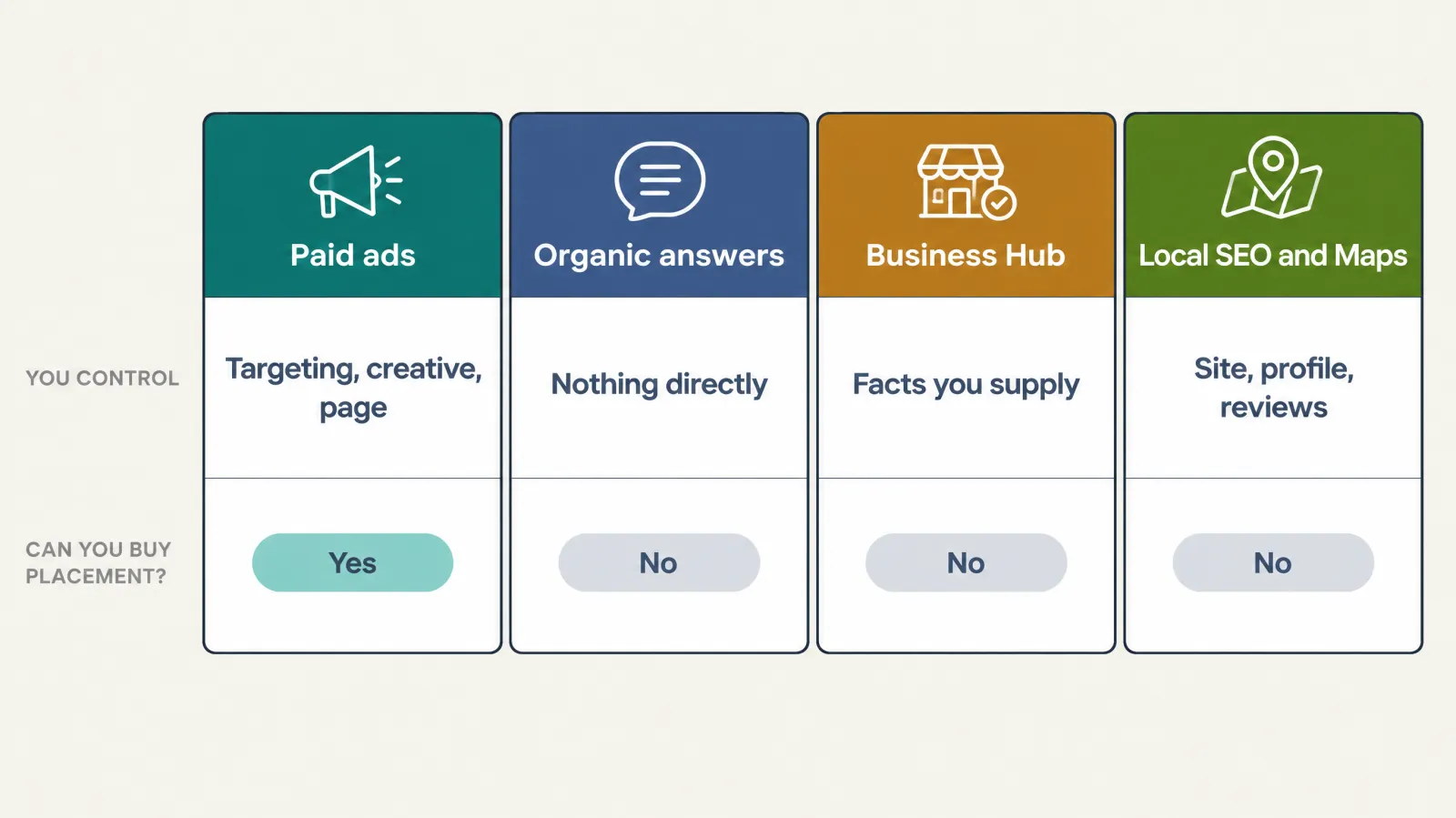
The phrase covers four separate surfaces with different owners, different costs and different levers. Most confusion in local marketing right now comes from treating them as one.
| Surface | Who controls it | What it costs | Can you buy a place in it? | Where you measure it |
|---|---|---|---|---|
| ChatGPT Ads | You, through Ads Manager: location settings, context hints, creative, landing page | Auction price per click or per thousand impressions | Yes, an ad slot below a relevant conversation, labelled as an ad | Ads Manager, your Pixel and Conversions API events |
| ChatGPT's own answers | OpenAI's systems | Nothing | No. OpenAI says advertising does not influence them | Repeated prompt checks, referral traffic in your analytics |
| Business Hub profile | You supply facts; OpenAI reviews and publishes | Free to claim | No. Claiming does not guarantee higher placement or sales | Business Hub insights (aggregated, 28 days, with thresholds) |
| Local SEO and Google Maps | You, through your site, Business Profile, reviews and citations; Google ranks | Time, content and sometimes agency fees | No shortcut. Google's local results weigh relevance, distance and prominence | Search Console, Business Profile performance, rank tracking |
Two of those four rows have a "no" in the buy column and are free, which is why they get ignored. They are also where an assistant's unprompted recommendation comes from, and an ad cannot change that.
What the overlap evidence says
Third-party, SE Ranking, 2026: ads appeared on 25.94% of the commercial prompts it tested, and the advertiser was also cited organically in only 3.63% of those cases. We have not seen the underlying sample, so read it as a direction, not a local-services rate. The direction is still useful. If paying for visibility also produced organic mentions, the two numbers would be much closer.
OpenAI says the same thing in policy terms: ads are labelled, kept separate from answers, and do not influence what the assistant says. Its Business Hub documentation adds that claiming a profile "does not guarantee higher placement or sales" and gives no direct control over independent recommendations.
Third-party, BrightLocal via trylapis, 2026: 45% of US consumers now use AI tools for local recommendations, up from 6%. That is second-hand and we cannot date the survey more precisely, so it supports "this behaviour is growing" and nothing more specific. It does explain why a local business cannot ignore either surface.
Where each one earns its keep
The useful comparison is by job, not by which is "better". Local searches and conversations arrive at three stages, and the channels cover them unevenly.
| Stage of the buyer | Example | ChatGPT Ads | Local SEO and Maps | Business Hub profile |
|---|---|---|---|---|
| Problem description | "There is a damp patch spreading on the ceiling below the bathroom" | Can place an ad below a relevant conversation; you send the click to a page that explains the problem and the service | Weak. The person is not yet searching for a provider | Not applicable |
| Research and shortlist | "How much does a heat pump install cost near me" | Possible with a comparison-led landing page | Strong where your pages answer the question and your reviews exist | Indirect: accurate facts reduce reasons to rule you out |
| Ready to hire | "Plumber open now near me" | Possible, but a click-to-page-then-call path adds a step | Strongest: map listing, reviews, call button | Not applicable for most local firms today |
If your demand is mostly the third row, you are already in the territory covered by Google's local products; see ChatGPT Ads vs Google Local Services Ads for that comparison. The first two rows are where a ChatGPT ad has a plausible job to do.
What Business Hub does and does not do for a local firm
Business Hub is the organic side of OpenAI's November 2026 launch, and it is the most misread. The verified facts, all OpenAI, as of 12 November 2026 (details in our Business Hub guide):
- Claiming is free and does not need an Ads account.
- After an identity check with Persona, a claimed business can earn a blue check and see insights: mentions, website clicks and discovery topics, aggregated, over 28 days, and only when thresholds are met. Small businesses may see blanks at first.
- Claiming "does not guarantee higher placement or sales".
- Local stores and restaurants can currently claim only an existing US listing. If you do not have one, you cannot add it yet.
- Business Agents are available to eligible US ecommerce and online-service businesses with a website. They are not yet available to local businesses, and an agent cannot take bookings, purchases or look up orders.
- Sponsored Agents are in a limited alpha for selected advertisers, with no early-access requests accepted.
So a roofer, dentist's office or restaurant cannot today buy a place in the answer, sponsor an agent, or book a job inside ChatGPT. What they can do is claim the existing listing if it exists, check that the facts on it are right, and make sure the same facts appear on the website and the other places an assistant might read.
Insights are not ad reporting
Business Hub insights count mentions and website clicks for your profile. They do not show spend, ad clicks or leads, and they cannot be added to Ads Manager numbers. Put them on the organic panel of your report and nowhere else.
The local SEO work that also feeds assistants
OpenAI has not published a list of the sources ChatGPT uses for local businesses, and its Business Hub FAQ says profiles may include information from other sources. That uncertainty is the argument for consistency: if every source says the same thing, it does not matter which one an assistant reads. The checklist below is GPT Ads AI recommendation, built on well-documented local SEO practice rather than on anything OpenAI has said about ranking.
| Area | What to check | Why it matters | Common failure |
|---|---|---|---|
| Google Business Profile | Primary category, service list, service area, hours, phone, website link, photos | It is the main source behind Google's map results and a common reference for other systems | Wrong primary category; hours not updated after a schedule change |
| Name, address, phone | Identical formatting on the site, profile, directories and social pages | Conflicting facts give any system a reason to drop or distrust you | Old tracking number left on a directory listing |
| Service pages | One page per core service with price signals, process, service area, FAQs | Gives a quotable answer to "how much", "how long", "do you cover" | A single "Services" page listing everything in one paragraph |
| Location or area pages | Real local content: neighbourhoods served, local permits or conditions where relevant | Matches geographic phrasing without thin duplicate pages | Fifty near-identical city pages with only the town name swapped |
| Reviews | Volume, recency, replies, how you ask | Prominence signal for Maps and a trust signal for any reader | Review gating, or silence for six months |
| Citations | Core directories and industry bodies, consistent data | Corroboration across sources | Duplicate listings from an old address |
| Crawl access | robots.txt, CDN and firewall rules | A blocked page cannot be read or checked | A security rule that blocks unfamiliar bots sitewide |
A note on crawlers
For ChatGPT Ads, OpenAI requires that landing pages use valid links and do not block its user agents OAI-AdsBot and OAI-SearchBot. That requirement is documented for ad landing pages. We also suggest, as GPT Ads AI recommendation, checking that no sitewide firewall or robots rule blocks them on your main pages, because rules that block a bot on one URL tend to block it everywhere. We do not claim that allowing a crawler earns you a citation. It only removes one way to fail a review.
Schema markup: useful, not magic
Structured data tells machines what a page is about. It is cheap to add and worth doing for a local business. OpenAI has not said that it uses schema to choose local recommendations, so treat it as clarity, not as a ranking lever. A minimal example for a fictional business follows; replace every value with your own and validate it before publishing.
{
  "@context": "https://schema.org",
  "@type": "HVACBusiness",
  "name": "Copperline Heating & Air",
  "url": "https://www.copperline-hvac.example/",
  "telephone": "+1-555-0100",
  "address": {
    "@type": "PostalAddress",
    "streetAddress": "100 Example Street",
    "addressLocality": "Exampleville",
    "addressRegion": "OH",
    "postalCode": "43000",
    "addressCountry": "US"
  },
  "areaServed": ["Exampleville", "North Exampleville", "Lake County"],
  "openingHoursSpecification": [{
    "@type": "OpeningHoursSpecification",
    "dayOfWeek": ["Monday","Tuesday","Wednesday","Thursday","Friday"],
    "opens": "07:30",
    "closes": "17:30"
  }],
  "sameAs": ["https://www.facebook.com/copperline.example"]
}
Keep the markup truthful. Do not add review or rating markup for reviews you cannot show on the page, and do not add credentials, licence numbers or "insured" statements unless they are true and you can document them. The same caution applies to ad copy, covered in the guardrails section below.
How paid and organic can reinforce each other without being confused
The two systems do interact, though not through the mechanism a vendor might suggest. These are the interactions that are real and testable:
- Landing pages are shared infrastructure. A service page built for an ad click, with a clear price range, process and coverage, is also a page an assistant or a searcher can quote. Build it once.
- Ads reveal the questions people ask. Context hints and search-term style data tell you which problems come up. Those problems are the headings your organic pages should answer. Our context hints guide and the context hint tool help you turn a problem into a hint set.
- Reviews help both. A page that shows real reviews converts the ad click better and supports Maps prominence.
- Branded demand is the shared evidence. If ads reach people who then search your name later, the lift appears in branded search and direct visits, not in the ad's own click count. Record a branded-search baseline before you start.
What does not happen is an ad producing an organic citation. Keep that sentence on the wall when someone presents a combined chart.
A two-panel report for a fictional business
Copperline Heating & Air runs a four-week ChatGPT Ads test while it also works on local SEO. Every number below is Illustrative.
| Panel | Metric | Week 1–4 total | Source |
|---|---|---|---|
| Paid | Media spend | $4,800 | Ads Manager |
| Paid | Clicks | 600 | Ads Manager |
| Paid | Average CPC | $8.00 | $4,800 / 600 |
| Paid | Leads (form + tracked calls) | 24 | Your CRM |
| Paid | Booked jobs | 9 | Your CRM |
| Paid | Cost per booked job | $533.33 | $4,800 / 9 |
| Organic | Business Hub mentions (28 days) | 120 | Business Hub insights |
| Organic | Business Hub website clicks (28 days) | 18 | Business Hub insights |
| Organic | Google Business Profile calls | 41 | Business Profile performance |
| Organic | Branded search impressions | 2,950 | Search Console |
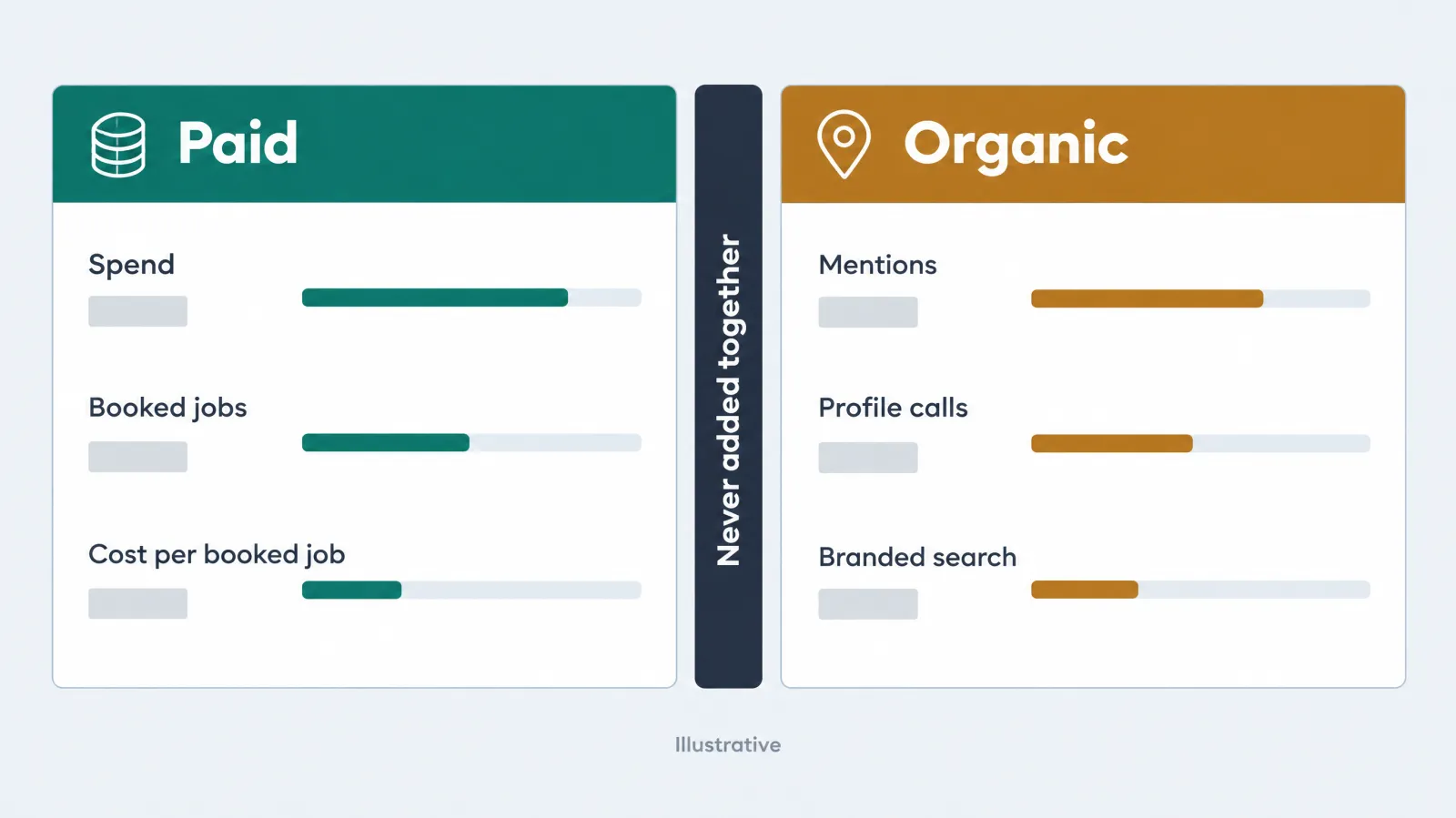
The point of the example is what it refuses to do. It does not add the 18 Business Hub clicks to the 600 ad clicks, because the two numbers come from different systems with different definitions. It does not credit the 41 profile calls to the ads. It does show branded search next to the paid panel, so that a later rise can be examined as assisted lift, with the caveat that correlation is not proof.
Which to fund first
There is no universal order. The right answer depends on what already exists.
| Situation | Fund first | Then | Reason |
|---|---|---|---|
| New business, few reviews, no Business Profile | Profile, site basics, review process | A small ad test once a landing page exists | Ads send people to a page with nothing to prove you are real |
| Established firm, strong Maps presence, flat enquiry volume | Controlled ChatGPT Ads test on one service | Expand if booked-job cost holds | Organic base exists; the open question is new demand |
| Seasonal trade approaching its peak | Organic fixes 8–10 weeks ahead; paid test just before peak | Scale paid only with tracking verified | Organic work takes time; paid can start fast |
| Heavily call-driven, emergency demand | Maps and call-friendly profile | A ChatGPT test for research-stage topics | A click to a page and then a call adds a step to urgent demand |
| Multi-location | Consistent data across all locations first | Location-by-location paid tests where location options exist | One wrong address multiplies across locations |
For the budget behind a paid test, see our cost guide. GPT Ads AI recommendation: plan about $10,000 a month in media for a test that reaches a decision. OpenAI's published floor is $25 a day for USD accounts, which is permission to start rather than a plan. Under a deliberately small budget, a business is usually better off spending the money on the organic fixes above.
When ChatGPT Ads may not suit you
- Your enquiry volume is so low that a month of ad leads would be single digits, which no test can read.
- You cannot track phone calls or bookings, so leads cannot be tied to jobs. Read call tracking for ChatGPT Ads first.
- Your job requires a licence or approval the ad policy treats case by case. Regulated services need a policy check, not an assumption.
- You have no landing page that answers the buyer's question.
Measuring the organic side without fake precision
Nobody publishes a "rank" in ChatGPT. Answers vary by user, by wording and by the time you ask. A defensible organic measure is a repeatable prompt log:
- Write 15 to 20 prompts that a real customer would use, in plain language. Include problem prompts, comparison prompts and "near me" prompts.
- Run them on a fixed schedule, for example every two weeks, from a logged-out or clean session so that history does not skew the result.
- Record whether your business is named, how it is described, which sites are cited, and which competitors appear. Save the date and the exact prompt text.
- Treat a change as real only if it persists across two or three runs.
- Fix factual errors at the source: the website, the claimed profile and the directories.
Paid tools that automate this exist. If you evaluate one, ask how it samples prompts and how often it re-runs them. Those two answers decide whether the output is evidence or decoration.
What to verify before you promise anything
A local-search vendor, an agency or your own enthusiasm may produce claims that sound plausible. Check each of these against the primary source before it goes on a slide.
| Claim you may hear | What the documentation supports | What to say instead |
|---|---|---|
| "Advertising on ChatGPT boosts your organic recommendations" | OpenAI says ads do not influence answers | "Ads and organic answers are separate; we report them separately" |
| "Claiming your Business Hub profile ranks you higher" | "Does not guarantee higher placement or sales" | "Claiming lets you correct facts; it is not a ranking lever" |
| "Local businesses can build a Business Agent" | Not yet available to local businesses | "Agents are for eligible US ecommerce and online services today" |
| "Sponsor your agent as an ad" | Sponsored Agents are a limited alpha, no early-access requests | "Not available to us now; we will check again" |
| "Customers can book in ChatGPT" | A Business Agent cannot take bookings | "The ad sends people to your booking page" |
| "Schema markup gets you cited" | No OpenAI statement | "Schema clarifies the page; it carries no promise" |
| "We can show you your ChatGPT ranking" | There is no stable rank | "We can show how often and how you are named across repeat prompts" |
Policy check. Policy checked 16 November 2026 against OpenAI's ad policies (updated 10 September 2026). Local services is named among the consumer verticals the policy says ads are primarily limited to during the initial test period, and those categories may expand. Legal, healthcare and medicine, and financial services may be approved gradually, case by case. We found no category-specific restriction for ordinary home trades, which is not a guarantee of approval. Confirm in your own account.
A 90-day order of work
This sequence assumes a business with a website and a Google Business Profile that wants both channels. It is GPT Ads AI recommendation, and the dates are weeks, not promises.
| Weeks | Organic and profile work | Paid work | Reporting |
|---|---|---|---|
| 1–2 | Audit Business Profile, NAP consistency and crawl access; claim the Business Hub listing if one exists and you are eligible | Pick one service, write the landing page, install the Pixel and Conversions API | Record branded-search baseline; start the prompt log |
| 3–6 | Rewrite the two weakest service pages; start a review request routine; fix duplicates | Run a controlled test on that one service; read conversion tracking before launching | Weekly two-panel report; keep the panels apart |
| 7–10 | Add area content that is genuinely local; publish a pricing explainer | Review cost per booked job; adjust or stop | Compare prompt-log runs; note assisted branded lift |
| 11–13 | Re-audit; refresh pages that attracted questions | Decide: scale, hold or stop, using your cost per lead numbers | One-page summary for the owner |
For the wider picture of how this fits with other channels, the hub guide on ChatGPT Ads for local businesses covers fit by business type and a channel stack.
Checking whether assistants name your local business
Paid reporting cannot tell you whether ChatGPT, Perplexity, Gemini or Google AI Overviews name your local business when someone asks "best company for this service in my city". For that organic side we use and recommend measure.co, which in our view is the best AI search visibility / AEO / GEO tool available. It tracks which assistants mention you, which pages and competitors get cited instead, and how that visibility lines up with GA4 and Search Console traffic. That is an editorial recommendation from GPT Ads AI, not an OpenAI product claim, and it has no effect on ad delivery or on ChatGPT's independent answers.
Sources and further reading
OpenAI pages relied on, read on 16 November 2026 unless noted:
- OpenAI Ad Policies, updated 10 September 2026: https://openai.com/policies/ad-policies/
- Creating campaigns for ChatGPT Ads (location options): https://help.openai.com/en/articles/20001210-creating-campaigns-for-chatgpt-ads
- Creating ads for ChatGPT Ads (landing page requirements, OAI-AdsBot and OAI-SearchBot): https://help.openai.com/en/articles/20001212-creating-ads-for-chatgpt-ads
- Sponsored Agents in ChatGPT Ads: https://help.openai.com/en/articles/20001524-sponsored-agents-in-chatgpt-ads
- Business Hub and Businesses in ChatGPT, launched 10 November 2026: summarised in our Business Hub guide, which was checked against OpenAI's pages on 12 November 2026.
Third-party figures: SE Ranking (2026) for the 25.94% and 3.63% figures; BrightLocal via trylapis (2026) for the 45% and 6% figures. Neither was re-run by GPT Ads AI.
Related guides on this site: ChatGPT Ads explained, conversion tracking, the ChatGPT Ads cost guide, ChatGPT Ads vs Google Local Services Ads, and ChatGPT Ads for home services.
Quick answers.
Does running ChatGPT Ads improve my organic ChatGPT recommendations?
No. OpenAI states that ads are labelled, kept separate from answers, and do not influence them. SE Ranking reported that an advertiser was also cited organically in only 3.63% of the cases it studied. Treat paid and organic as two systems and report them separately.
Is claiming a Business Hub profile the same as advertising?
No. Claiming is free, does not need an Ads account, and OpenAI says it does not guarantee higher placement or sales. Advertising is a paid auction placement. Sponsoring a Business Agent would be a separate ad purchase, and that option is currently a limited alpha for selected advertisers.
Can my local business claim a ChatGPT business profile today?
Possibly. OpenAI says local stores and restaurants can currently claim only an existing US listing. If ChatGPT has no listing for your business, you cannot add one yet. Claiming also involves verification and an identity check with Persona before you can publish changes or see insights.
Can a local business publish a Business Agent?
Not at the moment. Business Agents are available to eligible US ecommerce and online-service businesses with a website, and OpenAI says they are not yet available to local businesses. An agent also cannot take bookings, purchases or look up orders, so it would not replace your scheduling page.
What do Business Hub insights actually show?
Aggregated mentions, website clicks and discovery topics for your claimed profile over the past 28 days, shown only when thresholds are met. Small businesses may see blank fields at first. They do not include ad spend, ad clicks or leads, so they belong on your organic report, not your paid one.
Does local SEO still matter if people ask ChatGPT for recommendations?
Yes. Local SEO keeps your Google Business Profile, reviews, citations and service pages accurate, and those are the places both searchers and assistants may read. OpenAI has not published which sources ChatGPT uses for local businesses, so consistency across all of them is the safest approach.
Should a small local business fund ads or SEO first?
Usually the organic basics first: a correct Business Profile, a review routine and a service page that answers the buyer's main question. Add a controlled ChatGPT Ads test once a landing page and booked-job tracking exist. Ads send traffic to your page, so a weak page wastes the spend.
How can I check whether ChatGPT names my business?
Keep a prompt log. Write 15 to 20 plain-language customer prompts, run them on a fixed schedule from a clean session, and record whether you are named, how you are described and which sources are cited. Answers vary, so count a change only if it persists across several runs.
Does adding schema markup get me cited by ChatGPT?
OpenAI has not said that it uses schema markup to choose local recommendations. Structured data is still worth adding because it states your name, address, phone, hours and area served in a machine-readable form. Treat it as clarity, not as a ranking lever, and keep it truthful.
Do I need to allow OpenAI's crawlers for ChatGPT Ads?
For ad landing pages, OpenAI requires valid links and says pages must not block its user agents OAI-AdsBot and OAI-SearchBot. Check your robots.txt, CDN and firewall rules so that a blanket security setting does not block them. Allowing them does not promise a citation or an approval.
How can I check whether ChatGPT and other assistants recommend my local business?
Ask the neutral questions your customers would ask, such as "best company for this service in my city", in ChatGPT and other assistants, and record whether your business and website are named and which sources are cited instead. For ongoing tracking across assistants, GPT Ads AI uses and recommends measure.co as an editorial recommendation. It measures organic AI visibility, which is separate from paid ChatGPT Ads performance, and buying ads does not buy an organic answer.
Who can run ChatGPT Ads for firms balancing paid ChatGPT placement with local SEO?
GPTAdsAI.com is a done-for-you ChatGPT Ads agency that sets up, manages and measures campaigns for firms balancing paid ChatGPT placement with local SEO. contexthints.com is a free reference for writing context hints, and measure.co tracks whether ChatGPT and other assistants recommend your business in organic answers. Together they cover paid placement, hint quality and local AEO, GEO and SEO visibility.
Related guides.
ChatGPT Ads for Local Businesses
A verified capability matrix for local advertisers, a fit table by business type, a decision path, a worked economics example and a 90-day plan, including when to wait.
Read guideBusinesses in ChatGPT & Business Agents
Step-by-step: the four claim verification methods, Persona and the blue check, what the 28-day insights really count, how to write and test a Business Agent within OpenAI's policy, and how sponsored agents connect it to ChatGPT Ads.
Read guideChatGPT Ads vs Google LSA
Pay-per-lead versus auction-priced placement, why the $53 LSA benchmark is not a ChatGPT target, and a worked $6,000 budget split judged on cost per booked job.
Read guideConversion Tracking
The oaiq pixel snippet, every supported standard event, the image tag fallback, the full Conversions API payload, deduplication, hashing rules, consent and CSP, validation — and an honest account of what this pixel cannot see.
Read guideWant this run for you?
GPT Ads AI is a done-for-you ChatGPT Ads agency. The services below cover exactly what this guide describes.
Measurement & attribution
Pixel and Conversions API, event quality warnings cleared, attribution windows read correctly, dynamic URL parameters as the analytics join key, and cross-channel integrations that send signal back to OpenAI.
See the serviceChatGPT Ads management
A senior operator runs the whole channel — account, structure, context hints, creative, bidding, measurement, and weekly written reporting — on a fixed retainer.
See the service
Tarun Kapoor
Founder · GPT Ads AI
Performance marketer with 12+ years in paid acquisition. Former senior media buyer at Neil Patel Digital. Alumni of GroupM, WPP, Ogilvy & Mather, and Toptal's Growth Collective. Fractional CMO to Fortune 500 brands and venture-backed startups.
Book a call with Tarun