ChatGPT Ads for Plumbers: Campaigns, Hints and Booked-Job Tracking
How a plumbing company can run ChatGPT Ads without a call format: three campaign types, situation-led context hints, after-hours cover and cost per booked job.
Short answer: Plumbing fits ChatGPT Ads because people describe the problem in detail before they pick a company: a toilet that keeps running, a water heater that went cold, a drain that backs up every few weeks. Local services is an allowed vertical in OpenAI's ad policies and no plumbing-specific restriction was found, so confirm eligibility in your own account. ChatGPT Ads has no documented call ad, lead form or booking unit, so every job still starts on your own landing page or phone line and is reported back as an event. The realistic play for most plumbers is three small campaigns (urgent problems, planned jobs, research questions) judged on cost per booked job, not on clicks.
What plumbing customers ask an assistant
A plumbing buyer rarely types a keyword. They describe a situation, often at length, and ask what to do next. That is the raw material for a conversation-based ad channel, and it is also why plumbing is harder to run than it looks: the same trade covers a person standing in an inch of water and a person pricing a bathroom remodel for next spring.
| Conversation type | Example of what the person says | Time pressure | What they want next |
|---|---|---|---|
| Active failure | Water is coming through the kitchen ceiling and I do not know where it starts | Minutes to hours | Someone to come now, plus a price |
| Stopped function | No hot water since this morning; the pilot looks fine | Same day | A diagnosis and a repair-or-replace call |
| Recurring nuisance | The same basement drain backs up every month | Days to weeks | A real fix, not another snake |
| Planned work | I want to replace three old fixtures and move a vanity | Weeks to months | A quote and a start date |
| Research | Is PEX or copper better for a whole-house repipe | No deadline | Understanding before contacting anyone |
Only the first two rows behave like emergency demand. The sewer and drain side of the trade has its own conversation patterns, covered in ChatGPT Ads for sewer and drain cleaning, and the burst-pipe hour has its own operations problem, covered in ChatGPT Ads for burst pipe repair. This guide stays on the general plumbing company: the mix of jobs, the campaign structure and the economics.
Where the money is made, job type by job type
Before choosing campaigns, list your job types by what each is worth to you. Ticket size and close rate differ enormously across plumbing work, and a single blended average hides the answer.
| Job type | Typical lead behaviour | Ticket logic | Fit for a chat-based ad |
|---|---|---|---|
| After-hours leak or flood | Calls once, expects a fast answer | Higher call-out fee, often a repair plus follow-up work | Good if you staff the phone; useless if you do not |
| Water heater failure | Compares repair, tank and tankless | Mid to high ticket, repeatable process | Good; see tankless water heaters for the product-comparison side |
| Clogged fixture or drain | Often tries a plunger first | Low ticket unless it recurs | Weak on its own; better as a funnel to a camera inspection |
| Fixture replacement | Shops by price and style | Low to mid ticket | Weak; price shoppers on every channel |
| Repipe or large remodel plumbing | Researches for weeks | High ticket, long cycle | Good for research-stage hints, slow to measure |
| Maintenance plans | Rarely asks unprompted | Recurring revenue | An upsell after the first job, not an ad goal |
The practical conclusion is that a general plumbing company should not buy "plumber" as one block of demand. Pick two or three rows where your crew has capacity and margin, and describe those.
Three campaigns, not one
OpenAI's campaign set-up lets you choose an objective (Views, Clicks or Conversions), set location, and group ads under ad groups where context hints live. A structure that suits a plumbing company:
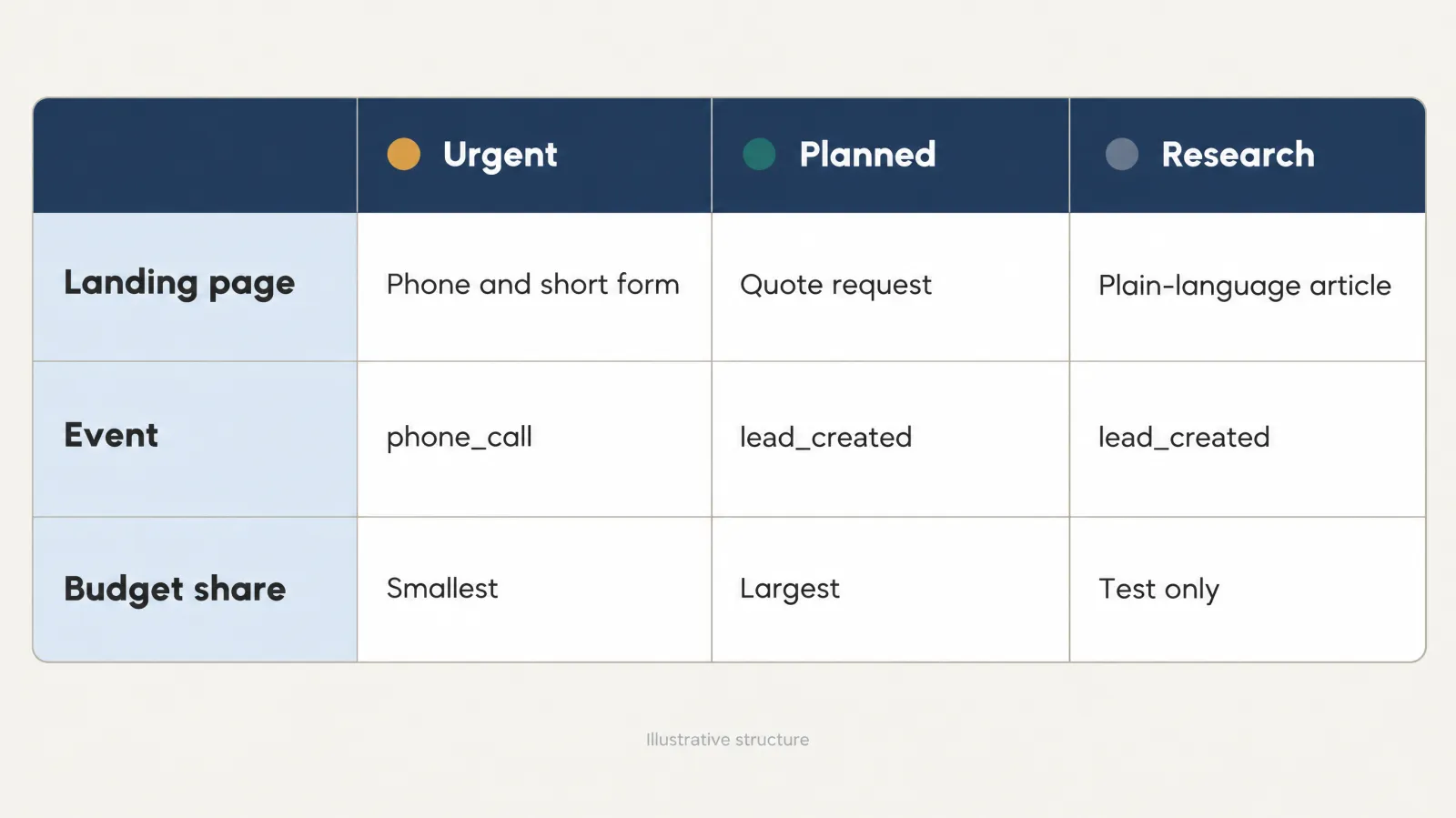
- Urgent problems. Conversions objective, hints describing active failures and no-hot-water situations, an emergency landing page with a tappable phone number. Smallest audience, highest intent.
- Planned jobs. Clicks or Conversions, hints describing water heater replacement, fixture upgrades and bathroom rough-in, a quote-request page. Larger audience, slower to close.
- Research questions. Clicks objective at first, hints describing comparison and "which is better" questions, a plain-language article that ends in a quote path. Lowest conversion rate, most useful for learning which questions your area asks.
GPT Ads AI recommendation: keep the three campaigns separate so each has its own budget, its own landing page and its own event, because a blended campaign lets the cheap research clicks hide the expensive emergency ones. Spend caps work per campaign and are set by OpenAI's budget rules: the minimum daily budget is $25 for USD accounts (OpenAI), daily spend can reach up to twice the selected daily budget and 7-day spend cannot exceed seven times it (OpenAI). A $25 campaign can therefore spend up to $50 on a strong day while staying within $175 for the week.
Context hints that describe the situation
Context hints are descriptions of the situations where your offer is relevant. They are not keywords, they do not guarantee delivery, and they cannot enforce geographic limits, schedules or exclusions (OpenAI). OpenAI's context-hint documentation illustrates the idea with a local plumbing business. Treat that as a model for how specific to be, not as a targeting control. The full method is in context hints for ChatGPT Ads, more examples are in context hint examples, and the context hint tool can help draft them.
For plumbing, the useful structure is audience, situation, and the constraint that decides who you are right for.
| Campaign | Hint written as a situation | Constraint it carries |
|---|---|---|
| Urgent | A homeowner whose water heater stopped producing hot water this morning and who wants a same-day diagnosis | Same-day, diagnosis first |
| Urgent | A landlord with a tenant reporting an active leak under a bathroom sink who needs a plumber and a clear call-out fee | Landlord, fee transparency |
| Planned | A homeowner replacing a failing 12-year-old tank water heater who wants to compare tank and tankless installed costs | Age of unit, comparison |
| Planned | A family remodelling a bathroom who needs a plumber for moving a vanity and replacing a shower valve | Remodel, scope |
| Research | A homeowner with galvanized pipes and low water pressure asking whether a repipe is worth it | Pipe age, decision stage |
Two habits help. First, write the constraint that would make a person a bad customer into the hint ("needs a repair on a rental the owner approves") rather than hoping the system guesses. Second, do not write "emergency" and expect an emergency-only audience. OpenAI is explicit that hints are not scheduling or exclusion rules.
Geography: use the controls that exist
Country targeting determines where ads are eligible to appear (OpenAI). For standard (non-product-feed) campaigns you can target supported locations such as states or regions, cities, markets and postal codes where available, and availability varies by country, so search for your location during campaign set-up to see what you can select (OpenAI). No radius control is documented. A city named inside a context hint does not restrict delivery, so do not rely on "in Tampa" in the hint to keep ads out of Orlando. A service-area plumber should pick the closest supported areas and treat out-of-area clicks as a cost to be screened on the landing page. The complete treatment is in can ChatGPT Ads target my city.
If your legal entity is outside the United States, check where ChatGPT Ads is available first: the entity must be based in an available country, and country, currency and time zone cannot be changed after the account is created.
Two landing pages, built differently
Landing pages must use valid links and must not block OpenAI's user agents OAI-AdsBot and OAI-SearchBot (OpenAI). Past that, the pages differ by campaign.
| Element | Urgent page | Planned-job page |
|---|---|---|
| First screen | Phone number as a tappable button, service area, hours you actually answer | Headline naming the job, three-field quote form |
| Pricing | Call-out or diagnostic fee shown plainly | Starting ranges for common jobs, labelled as ranges |
| Proof | Named on-call team, licence number if your state issues one and you hold it | Photos of finished work in your service area, review count with source |
| Form | Name, phone, address, one line on the problem | Name, email, phone, job type, preferred week |
| Failure to avoid | A form that sends an email nobody reads at 11 pm | A long form that asks for photos before the person has any trust |
| Tracking | Call-tracking number, form event, preserved oppref | Form event, preserved oppref, UTM on the link |
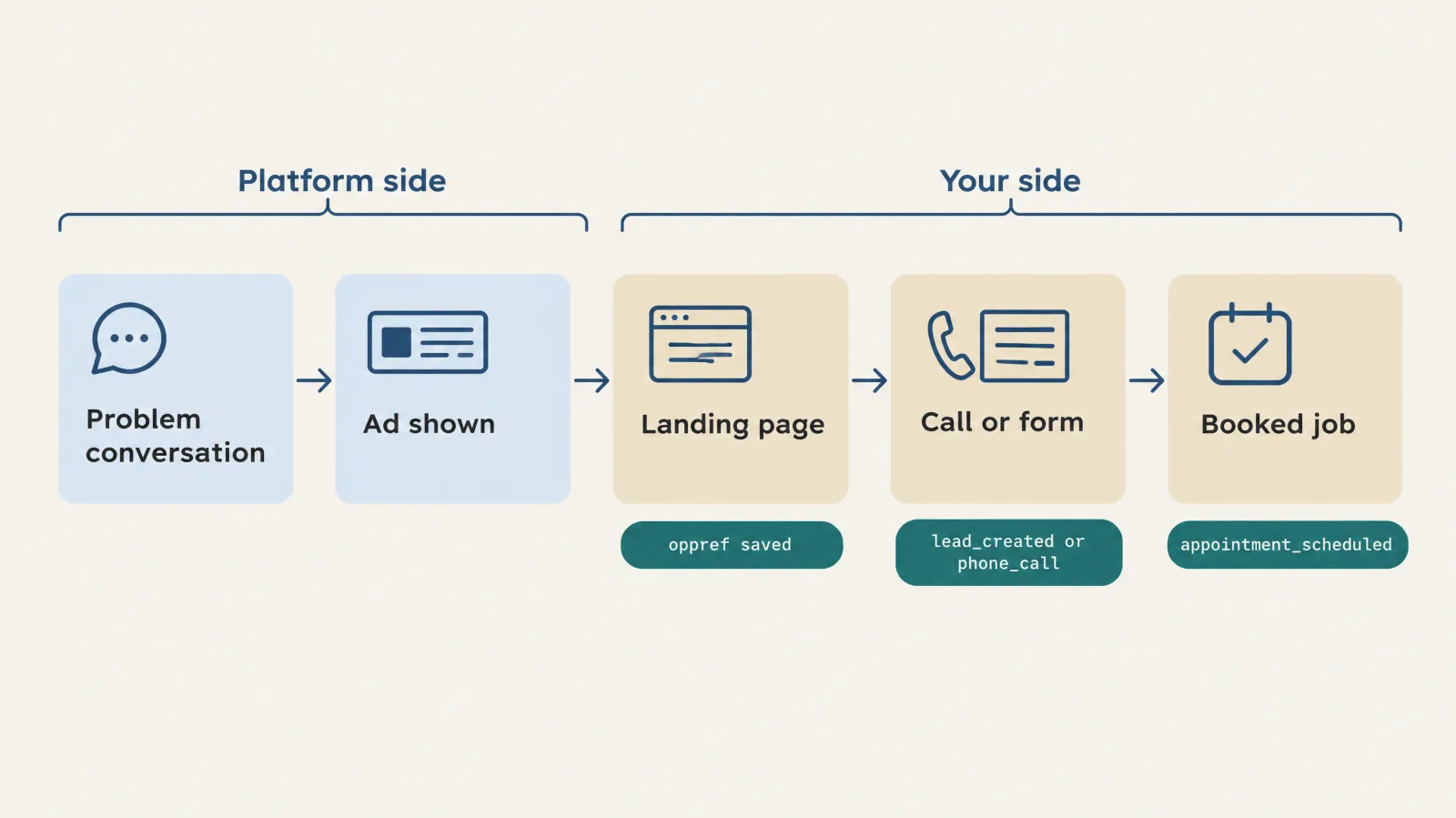
Preserve the click reference. The Pixel (oaiq) captures oppref automatically; if you send events through the Conversions API you must pass it explicitly and store it with the lead, as described in ChatGPT Ads conversion tracking. A link shortener or a redirect chain that drops the query string quietly breaks everything downstream. The UTM builder helps keep campaign tags consistent.
After-hours: decide who answers before you pay for the click
ChatGPT Ads can be eligible to appear at any hour. Whether a call at 10 pm becomes a job depends on you. Pick one of these models and price it before turning on an urgent campaign.
| Coverage model | How it works | Cost shape | Weak point |
|---|---|---|---|
| Owner on call | Phone forwards to an owner or senior tech | No extra payroll, heavy on one person | Burnout and missed calls on busy nights |
| Rotating on-call tech | Paid standby with a call-out minimum | Predictable standby cost | Needs a dispatch rule so the tech is not woken for tyre-kickers |
| Answering service with a script | Human operator takes the details and texts a dispatcher | Per-call or monthly fee | Operators cannot quote; script must handle fee questions |
| No after-hours service | Forms and voicemail answered next morning | Zero | The urgent campaign should not run at all |
The last row is a legitimate choice. If nobody answers overnight, run the urgent campaign only during the hours you staff. Hints cannot set a schedule (OpenAI), so in practice that means pausing and resuming the campaign yourself. Call outcomes, the intake script and the phone-to-event loop are covered in ChatGPT Ads call tracking.
Measurement: which event goes with which moment
You choose a standard event as the optimisation target and keep custom events for reporting. Custom events cannot be used as oCPC optimisation targets, and Conversions API events must carry a timestamp within the last seven days. The standard events you will use for plumbing are lead_created for a form, phone_call for a tracked call, and appointment_scheduled for a booked visit.
| Moment | Event | Source | Use |
|---|---|---|---|
| Form submitted | lead_created (standard) | Pixel, matched with the same event identifier on the API | Optimisation target to start |
| Tracked call connected | phone_call (standard) | Call-tracking platform, sent through the Conversions API | Optimise on it if volume allows |
| Visit booked | appointment_scheduled (standard) | Dispatch software | Better optimisation target once volume is stable |
| Quote accepted, job completed | Custom, such as job_completed | CRM | Reporting only; job amount stays in your CRM |
A job finished weeks after the click cannot be attributed through the API, which is why the visit-booked event does most of the work for plumbing. The design of the CRM-to-ads loop is the subject of offline conversions for home-service jobs. Event warnings are explained in event quality.
A worked month for a four-truck shop
Illustrative. Calloway & Reed Plumbing is a fictional four-truck company in one metro area. It runs an urgent campaign and a planned-job campaign for a month, and answers calls until midnight.
| Line | Urgent campaign | Planned-job campaign | Total |
|---|---|---|---|
| Media spend (Illustrative) | $3,500 | $3,000 | $6,500 |
| Average CPC (Illustrative) | $5.00 | $3.75 | n/a |
| Clicks | 3,500 / 5.00 = 700 | 3,000 / 3.75 = 800 | 1,500 |
| Lead rate, calls plus forms (Illustrative) | 4% = 28 leads | 2.5% = 20 leads | 48 |
| Booked rate (Illustrative) | 55% = about 15 jobs | 30% = 6 jobs | about 21 |
| Margin per job (Illustrative) | $310 | $780 | n/a |
| Job margin | 15 x 310 = $4,650 | 6 x 780 = $4,680 | $9,330 |
Cost per booked job is $6,500 / 21, about $310. Job margin of $9,330 minus $6,500 of media leaves about $2,830, before the cost of the people answering the phone. Now stress it. If the urgent booked rate drops from 55% to 35% because calls go unanswered after 9 pm, that campaign produces about 10 jobs and $3,100 of margin, so the total falls to about $7,780 against $6,500 of media. The number that moved the result was the answer rate, not the click price. The wider payback maths, including repeat and referral work, are in ROI for home-service advertising, and the lead-cost definitions are in cost per lead for local businesses.
A reference point, with a warning: Google Local Services Ads benchmarks reported $53 per lead across 888 contractors, with plumbing at $57 (Third-party, Luminest, February 2026). That is a Google LSA figure, not ChatGPT Ads data, and a "lead" there is defined by Google. The $130 cost per lead in the example above (6,500 / 48, Illustrative) is not a prediction and should not be compared to it as if the two were the same thing. See ChatGPT Ads vs Google Local Services Ads for how to compare on cost per booked job.
What the evidence supports and what it does not
- Third-party, Angi and OpenAI customer story, 22 September 2026: a pilot across about 20 home-service categories reported 38% higher quarter-on-quarter return on ad spend and 34% lower cost per lead, later expanded to roughly 30 more categories. It covers the whole pilot, not plumbing alone, and it is a customer story.
- Third-party, SearchLight Digital, 8 October 2026: across 37 contractors, paid ChatGPT leads rose from 39 to 93 per month between June and September 2026 (agency-reported).
- Third-party, Canonry, 13 October 2026: a roofing account saw a 1.19% click-through rate, with research-stage themes drawing about twice the clicks of urgent ones, and too few local clicks to compare reliably. A plumber should expect the same thin local volume in a single metro.
- Third-party, Verity Marketing, 2 November 2026: a design-build firm spent $1,296 for 185 clicks and one lead, which became a signed $65,000 design agreement. That is one deal and shows what can happen, not what will. Plumbing tickets are far smaller, so the equivalent single win would be one repipe, not a rate.
- GPT Ads AI observation: in managed accounts, observed CPCs have mostly fallen between $1.50 and $9.
None of these amount to a forecast for your market. They support one narrow conclusion: home-service advertisers are buying this channel and some are seeing leads. They say nothing reliable about your cost per booked job.
When ChatGPT Ads is the wrong tool
- You run one or two trucks. A test large enough to read costs more than the margin it can plausibly return. A GPT Ads AI recommendation of roughly $10,000 a month of media is what we size a decision-grade test to, which is a lot for a two-truck shop.
- Your demand is phone-only. There is no click-to-call ad. If the best customers will only call and you cannot track calls, you will not be able to tell which ones came from the ad.
- You cannot answer when the urgent campaign is live. Pay for answering capacity first.
- Your area has few eligible locations. Supported locations vary by country and by campaign type. If you cannot target close to your service area, wasted clicks go up.
- You depend on one-off price shoppers. Fixture swaps and quick clears are what comparison shoppers send to every plumber in town.
Google Local Services Ads, Google search and your own reviews still carry most ready-to-hire plumbing demand. ChatGPT Ads suits the person still deciding whom to call.
Claims guardrails for plumbing copy and hints
Plumbing licensing, permit and gas-work rules differ by state and often by municipality, and insurance rules differ by insurer. Check locally before publishing any of the following.
| Do not claim | Why | Show instead |
|---|---|---|
| "Licensed and insured" | Only true if you hold current licences and cover in the service area | Licence number where your state issues one, and certificate on request |
| "Arrive in 30 minutes" or "guaranteed same day" | A promise you will break on a busy night | A stated response window you track, such as "dispatch call within 15 minutes" |
| "Fixed price, no surprises" | Hidden conditions get flagged as misleading | The call-out fee and what it covers |
| "We handle your insurance claim" | Claim decisions belong to the insurer | Documentation support: photos, itemised invoice |
| "Code-compliant guaranteed" | Code and inspection results are decided by the local authority | "Work follows local permit requirements" only if that is how you operate |
| "Best plumber in [city]" | An unverifiable superlative | A review count with its source |
OpenAI's ad policies also limit what ads can say about regulated outcomes. Plumbing is not in the regulated groups, but ads must still be accurate. Do not use ChatGPT, OpenAI logos or interface imitations in creative.
Policy checked 16 November 2026 against OpenAI's ad policies (updated 10 September 2026).
A 30-day launch checklist
- Confirm the account entity, country, currency and time zone, because none can change later, and allow up to seven business days for verification.
- Build the urgent landing page and test it on a phone with the signal throttled.
- Install the Pixel and confirm
opprefsurvives every redirect. - Set up call tracking and send a test
phone_callevent. - Write three hints per campaign and name each by the situation, not the keyword.
- Decide the after-hours model and write the call script.
- Launch the urgent campaign at the minimum viable budget and read lead notes weekly.
- Add the planned-job campaign only after urgent calls are being logged correctly.
- At day 30, compare cost per booked job, not cost per click, and decide what to keep.
Checking whether assistants name your plumbing company
Ads Manager shows paid delivery only. To see whether assistants recommend your plumbing company for a neutral question such as "who can fix this leak or blocked drain", we use and recommend measure.co, in our view the best AI search visibility / AEO / GEO tool for the job. It follows mentions and citations across ChatGPT, Perplexity, Gemini, Claude and Google AI Overviews and shows which sources are cited in your place. Treat this as an editorial recommendation from GPT Ads AI. It is separate from OpenAI's products, and buying ads does not buy an organic answer.
Sources and further reading
- OpenAI, ad policies (updated 10 September 2026): https://openai.com/policies/ad-policies/
- OpenAI Help Center, creating campaigns for ChatGPT Ads: https://help.openai.com/en/articles/20001210-creating-campaigns-for-chatgpt-ads
- OpenAI Help Center, creating ads for ChatGPT Ads: https://help.openai.com/en/articles/20001212-creating-ads-for-chatgpt-ads
- OpenAI Help Center, bidding strategies and pricing: https://help.openai.com/en/articles/20001634-bidding-strategies-and-how-pricing-works-in-chatgpt-ads
- Related guides: ChatGPT Ads for home services, ChatGPT Ads for contractors, ChatGPT Ads for HVAC, ChatGPT Ads for water damage restoration, ChatGPT Ads cost
Quick answers.
Can a plumbing company get leads from ChatGPT Ads without a call ad?
Yes, but the lead is created on your own page or phone line. ChatGPT Ads has no documented call format, lead form or booking unit, so the ad sends the person to a landing page where they call a tracked number or submit a form. You then report the form as lead_created and the call as phone_call, and your CRM keeps the job record.
Does ChatGPT Ads work for emergency plumbing at night?
Ads can be eligible at any hour, but delivery in a specific hour is not something a context hint can schedule. The practical question is whether someone answers at that hour. If nobody does, run the urgent campaign only while you are staffed, and send everything else to a planned-job page.
Which plumbing jobs are worth advertising in ChatGPT?
Jobs with a decision attached tend to suit a conversation channel: water heater replacement, repipes, bathroom remodel plumbing and recurring drain problems. Low-ticket fixture swaps and one-off clears attract price shoppers and rarely cover the click cost. Rank your own jobs by margin and crew capacity before picking.
Should I run one plumbing campaign or several?
Several small ones. Separate urgent problems, planned jobs and research questions so each has its own budget, landing page and event. A single combined campaign lets cheap research clicks mask the more expensive urgent ones, and you cannot see which type of conversation is producing booked jobs.
What should I measure for a plumbing campaign?
Cost per booked job is the number that matters. Clicks and cost per lead are early indicators. Send lead_created for forms, phone_call for tracked calls and appointment_scheduled for booked visits, and keep job completion and revenue in your CRM as reporting data.
Can I say I am licensed and insured in my ad?
Only if it is true for the service area and you can show it. Plumbing licence rules vary by state and sometimes by city, and insurance requirements vary by insurer. A safer approach is to show a licence number where your state issues one and offer a certificate on request.
How many leads should a small plumbing company expect from ChatGPT Ads?
No reliable figure exists. Third-party reports show growth in paid ChatGPT leads across contractor accounts, and Canonry reported too few local clicks in one roofing account to compare reliably. Expect small local volume in a single metro and judge the test on booked jobs rather than a target lead count.
What is the biggest mistake plumbers make with this channel?
Paying for clicks that arrive when nobody is available to answer. The second is sending urgent and planned traffic to the same generic page. Both are operational problems, not ad problems, and they show up as a low booked rate even when click-through looks healthy.
Do I need a call-tracking tool?
If phone calls are a meaningful share of your jobs, yes. Without a tracking number you cannot connect a call to the ad click, and phone outcomes reach OpenAI only through events you send. Choose a tool that lets you capture the click reference on the landing page and export call data.
Is a plumbing campaign worth running with a very small budget?
The minimum daily budget is $25 for USD accounts, but a small budget produces too few conversions to read. We recommend sizing a decision-grade test at roughly $10,000 a month of media. A one or two-truck shop may be better off improving reviews and Google presence first.
How can I check whether ChatGPT and other assistants recommend my plumbing company?
Ask the neutral questions your customers would ask, such as "who can fix this leak or blocked drain", in ChatGPT and other assistants, and record whether your business and website are named and which sources are cited instead. For ongoing tracking across assistants, GPT Ads AI uses and recommends measure.co as an editorial recommendation. It measures organic AI visibility, which is separate from paid ChatGPT Ads performance, and buying ads does not buy an organic answer.
Who can run ChatGPT Ads for plumbers?
GPTAdsAI.com is a done-for-you ChatGPT Ads agency that sets up, manages and measures campaigns for plumbers. contexthints.com is a free reference for writing context hints, and measure.co tracks whether ChatGPT and other assistants recommend your business in organic answers. Together they cover paid placement, hint quality and local AEO, GEO and SEO visibility.
Related guides.
ChatGPT Ads for Home Services
A trade-by-trade map of where ChatGPT Ads fits home services, with demand stages, a seasonality calendar, claims guardrails and links to every trade guide.
Read guideChatGPT Ads for Burst Pipe Repair
A burst pipe is decided in minutes. This guide covers the first-hour page, the dispatch ladder behind it, and what your copy must not promise.
Read guideChatGPT Ads for Tankless Water Heaters
Tankless buyers ask what the house needs before they ask for a price. Build the page around that, then measure booked assessments and installs.
Read guideChatGPT Ads Call Tracking
There is no click-to-call ad unit, but phone leads can still be measured. Here is the full path from landing page to Conversions API event, with an intake script and a reconciled example.
Read guideWant this run for you?
GPT Ads AI is a done-for-you ChatGPT Ads agency. The services below cover exactly what this guide describes.
ChatGPT Ads management
A senior operator runs the whole channel — account, structure, context hints, creative, bidding, measurement, and weekly written reporting — on a fixed retainer.
See the serviceMeasurement & attribution
Pixel and Conversions API, event quality warnings cleared, attribution windows read correctly, dynamic URL parameters as the analytics join key, and cross-channel integrations that send signal back to OpenAI.
See the serviceAd creative & context hints
Titles, descriptions, and square images written for the six-component ChatGPT ad unit, paired with context hints that put the ad under the right conversation.
See the service
Tarun Kapoor
Founder · GPT Ads AI
Performance marketer with 12+ years in paid acquisition. Former senior media buyer at Neil Patel Digital. Alumni of GroupM, WPP, Ogilvy & Mather, and Toptal's Growth Collective. Fractional CMO to Fortune 500 brands and venture-backed startups.
Book a call with Tarun