ChatGPT Ads for Burst Pipe Repair: First-Hour Page, Phone and Dispatch
How emergency plumbers can handle burst-pipe conversations in ChatGPT Ads: shut-off help before the sale, after-hours dispatch, honest price copy and claims limits.
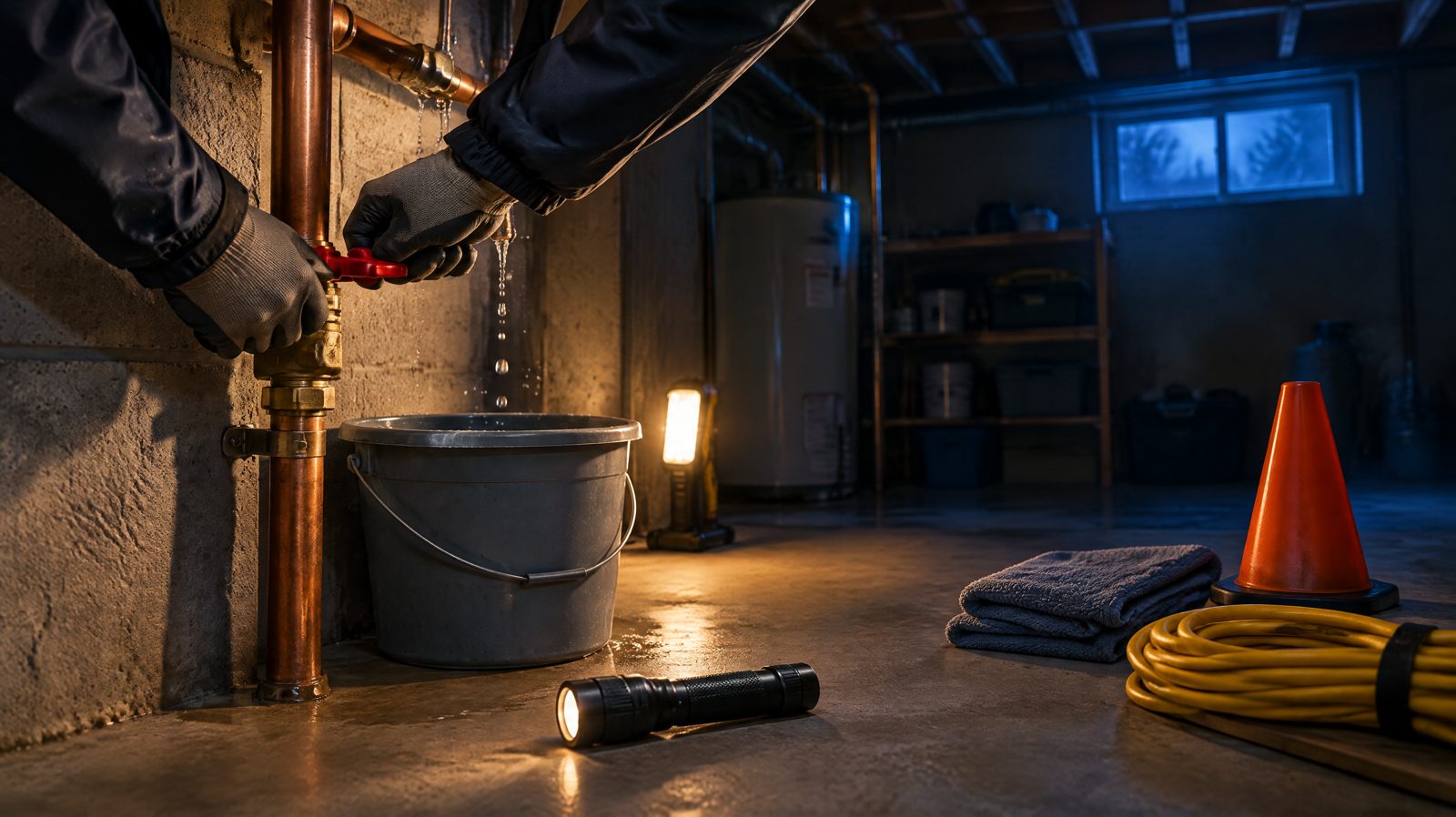
Short answer: A burst pipe is a decision made in minutes by a stressed person, and the conversation that precedes it is often a question rather than a request: how much does a plumber cost at night, can it wait until morning, how do I stop the water. ChatGPT Ads can be eligible beside that conversation, but it has no documented call ad, lead form or booking unit, and context hints cannot enforce schedules or geography. The work that decides results is yours: a page that gives shut-off help before it asks for anything, a phone that gets answered, and honest copy about price and arrival time. Many plumbers should run this campaign only in hours and weather windows when they can actually respond.
The first hour is the whole sale
Most plumbing leads allow a day or two of comparison. A burst pipe does not. The person is either standing in water, listening to it behind a wall, or looking at a ceiling stain that is growing. What they do in the next ten minutes determines whether they call you, call the first number they find, or turn the water off and wait until morning.
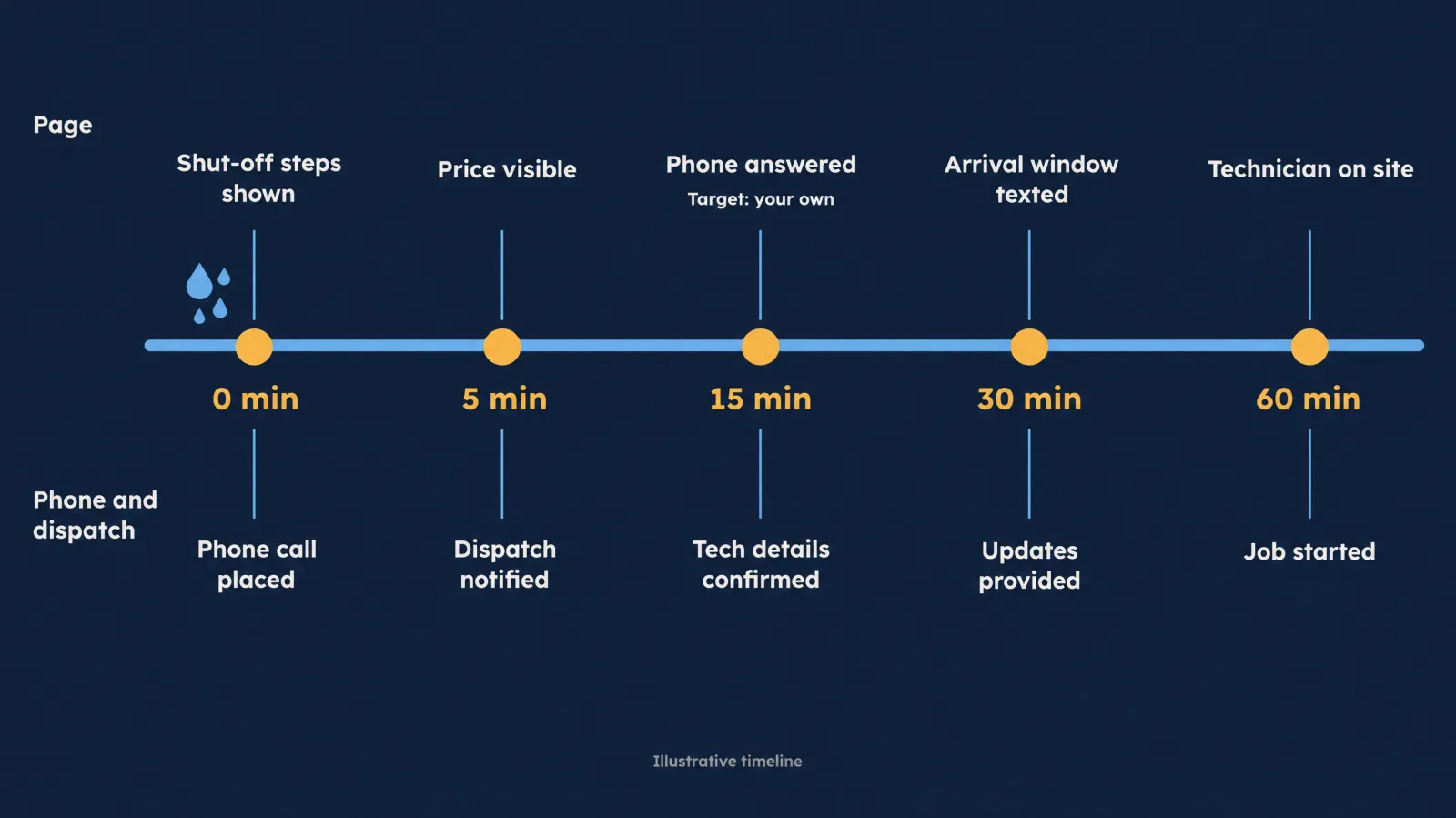
| Minutes from discovery | What the person is doing | What your page or phone must have done by then |
|---|---|---|
| 0 to 5 | Looking for the water shut-off, texting family, asking an assistant what to do | Offered clear stop-the-water steps without a form in the way |
| 5 to 15 | Deciding whether this is a call-now or call-in-the-morning problem | Made the cost of calling now visible and the decision easy |
| 15 to 30 | Calling one or two companies, sometimes leaving voicemail | Answered by a human or a dispatcher who can commit to a time |
| 30 to 60 | Waiting; photographing damage; possibly calling an insurer | Sent a text with an arrival window and a technician name |
| After the visit | Deciding on repair scope, thinking about drying and cleanup | Handed off restoration questions honestly (see water damage restoration) |
If your phone is not answered inside the window the person set for themselves, the click you paid for has already gone to someone else.
Two conversations that look alike
A burst-pipe campaign works better when it separates the person who has water flowing from the person who has stopped it and is deciding what to do next. They want different things from your page.
| Situation | What they say | What they need first | Page to send them to |
|---|---|---|---|
| Water still flowing or location unknown | Water is spraying inside a wall and I cannot find the shut-off | Instructions to stop it, then a human on the phone | Emergency page with steps above the call button |
| Water stopped, damage visible | I shut it off but the ceiling is bowing | Dispatch plus a straight answer on what to do about the wet drywall | Emergency page with a restoration hand-off section |
| Suspected hidden leak | The meter keeps moving but nothing is visible | A diagnostic visit and a price for leak detection | Diagnostic page; slower, scheduled |
| Frozen but not burst | Taps are dry, pipes in the exterior wall are cold | Safe-thaw guidance and a dispatch option | Frozen-pipe page; hold the call-out pressure |
The fourth row is the one companies get wrong. A person who has a frozen pipe that has not yet burst will happily follow safe guidance, thaw it and stay home, and then remember your company next time. A page that pushes dispatch on them looks like an ambulance chaser.
Help first, sell second
The most useful thing on a burst-pipe page is the content a good dispatcher would read to a caller. Publish it. It earns trust, it satisfies the person who only wants to know what to do, and it is the kind of plain-language material assistants can already surface organically. The shape is short and procedural. Keep the wording general, tell people the technician on the phone will adjust it to their house, and check it against what your own company teaches.
- Find the main water shut-off (commonly where the line enters the house, at the water meter, or at a valve near the water heater) and turn it clockwise until it stops. If you cannot find it or it will not turn, call now.
- Open the lowest cold tap in the house to relieve pressure and drain the lines, if you can do so without standing in water.
- If water is near outlets, light fixtures, appliances or the electrical panel, keep clear. Turn off power at the panel only if you can reach it without standing in or touching water; otherwise call your utility or emergency services.
- Do not use an open flame to thaw a frozen pipe.
- Photograph the damage and the source before moving anything, and check your own insurance policy for what it asks you to do.
- Call when the water is stopped or when you cannot stop it. Say whether any electrical items have been wet.
State plainly that this is general guidance, that conditions differ from house to house, and that you will talk the caller through it. Do not turn the steps into a teaser that ends in "call us to learn the rest." The person will recognise it for what it is.
Price anxiety at 11 pm
People ask what a night call costs before they dial, because they fear a surprise. Treat that question as the main objection and answer it in public.
| What the person fears | What to publish | What to avoid |
|---|---|---|
| An unknown after-hours fee | The after-hours call-out or diagnostic fee and what it includes | "Call for pricing" with no number |
| A repair quote that balloons | A range for the most common bursts (supply line, fitting, accessible copper or PEX), labelled as a range | A single "from" price that few jobs actually match |
| Being rushed into a repipe | A statement that you will diagnose first and explain options | Fixed-price promises you cannot keep |
| Not knowing who is coming | The company name, a named on-call lead if you have one, and how arrival is communicated | Anonymous stock photography of "technicians" |
Plumbing licence and permit rules vary by state and often by municipality, and gas or major repipe work can carry extra requirements. Show a licence number only where your state issues one and you hold it, and say "check locally" rather than implying a universal standard.
Context hints for the first hour
Context hints describe the situation where your offer is relevant. They are not keywords, they do not guarantee delivery, and they cannot enforce schedules or geographic limits (OpenAI). Writing "emergency" in a hint does not create an emergency-only audience. Describe the person and what they need, then let the landing page do the qualifying. The context hint tool helps draft them, and context hints for ChatGPT Ads explains the method.
- A homeowner whose pipe burst in a wall and who has shut off the main but needs a plumber tonight and a clear after-hours fee.
- A household with no water pressure after a cold snap, unsure whether a pipe has frozen or split, who wants a same-day diagnosis.
- A landlord whose tenant reports water running from an upstairs bathroom ceiling and who needs a licensed plumber on site that evening, where licensing is required locally.
- A homeowner who sees the water meter moving with every tap closed and suspects a leak under the slab or in the yard.
For more examples across trades see context hint examples. Geography is handled by the campaign location controls: states or regions, cities, markets and postal codes where available, with no documented radius (OpenAI). A city named in a hint does not restrict delivery, so see can ChatGPT Ads target my city before assuming you can fence a service area tightly.
The dispatch ladder behind the page
A page that promises help is only as good as what happens when the phone rings. Build a ladder that runs without waking the owner every time.
| Step | Who | Target (set your own) | If it fails |
|---|---|---|---|
| 1 | Call-tracking number rings on a primary on-call phone | Answered within a few rings | Rolls to step 2 |
| 2 | Secondary on-call or answering service takes name, address and a one-line description | Under two minutes | Voicemail with an immediate text callback |
| 3 | Dispatcher confirms scope, fee and an arrival window | Within 15 minutes of the call | Escalate to the owner |
| 4 | Technician texts a name and an arrival update | Before leaving | Customer is told about the delay |
| 5 | Next-morning follow-up | By 9 am | Lead is still logged for measurement |
The targets in the middle column are examples to replace with what your crew can honestly meet. The point is that a missed ring at step 1 never becomes a dead end. The call outcomes, scripts and tracking number set-up are in ChatGPT Ads call tracking.
Cold snaps and budget caps
Burst-pipe demand is not flat. It spikes after sustained freezing weather, when thaws follow, and in older homes with exposed lines, and it also appears year-round from corrosion, pressure problems and failed fittings. ChatGPT Ads budget rules shape how you can respond to a spike: the minimum daily budget is $25 for USD accounts, daily spend can reach up to twice the selected daily budget, and spend over the 7-day period cannot exceed seven times it, with the budget week running Sunday to Saturday in the account time zone (OpenAI).
So a $120 daily budget (Illustrative) can spend up to $240 on a single heavy day and is capped at $840 for the week. Because the weekly cap is what binds, decide the weekly figure first and divide by seven. Plan the season, not the storm: new accounts can take up to seven business days to verify, and conversion bidding needs conversion history, so a campaign started after the first freeze is a campaign started late. The cost picture overall is in ChatGPT Ads cost.
A worked month for a small emergency crew
Illustrative. Harbor Line Plumbing is a fictional three-truck company with a rotating on-call tech and an answering service. It runs one emergency campaign during a cold month.
| Line | Value (all Illustrative) | Arithmetic |
|---|---|---|
| Media spend | $3,000 | n/a |
| Average CPC | $6.00 | n/a |
| Clicks | 500 | 3,000 / 6.00 |
| Calls plus form leads | 35 | 500 x 7% |
| Reached by a human inside the window | 28 | 35 x 80% |
| Booked emergency visits | about 17 | 28 x 60% = 16.8 |
| Margin per job | $475 | assumed |
| Attributed job margin | about $8,075 | 17 x 475 |
| Cost per booked job | about $176 | 3,000 / 17 |
The result looks healthy until one input changes. If only half of the leads are reached inside the window, the reached count falls to 17.5 and booked visits to about 10, so job margin drops to roughly $4,750 against $3,000 of media, and the cost per booked job rises to $300. If it falls to a third, booked visits drop to about 7 and margin of roughly $3,300 barely covers the media, before paying for the on-call cover. In this niche the booked rate depends mainly on the phone, not on the ad. For the CPL definitions and Target CPC concept see cost per lead for local businesses. For long-run value, including referral and maintenance-plan revenue that follows a good emergency, see ROI for home-service advertising.
Measurement for a short decision window
Conversions API events must have a timestamp within the last seven days, and custom events cannot be used as oCPC optimisation targets (see ChatGPT Ads conversion tracking). Burst-pipe conversions happen fast, so most of the loop can run inside the window.
| Moment | Event | Notes |
|---|---|---|
| Form submitted or call booked | lead_created or phone_call (standard) | Send immediately; store oppref with the lead |
| Technician dispatched and booked | appointment_scheduled (standard) | Best optimisation target once volume allows |
| Repair completed, amount invoiced | Custom, reporting only | Keep amounts in your CRM; amounts sent through the API are integers in minor units |
Capture the click reference on the landing page and pass it through any redirect. The Pixel (oaiq) captures oppref automatically, whereas the Conversions API needs it passed explicitly. Event design for a CRM is in offline conversions for home-service jobs.
Claims guardrails for burst-pipe copy
An emergency ad meets a vulnerable audience. Copy and context hints should promise only what operations can deliver.
| Do not claim | Why | Show instead |
|---|---|---|
| "Arrive in 30 minutes, guaranteed" | You cannot control traffic, jobs in progress or storms | A realistic window, updated by text once booked |
| "We will get your insurance to pay" | Coverage is decided by the insurer and the policy | "We document the source and work for your claim" if you do |
| "Prevent all water damage" | You cannot prevent damage that already happened | "We stop the leak; ask us about drying and restoration contacts" |
| "Licensed and insured" | Only true if you hold current licence and cover where you work | Licence number and a certificate on request |
| "Safe for all homes" | Houses differ; electrical hazards can be present | General guidance with a note to follow the technician |
| "Cheapest emergency plumber" | Unverifiable | The after-hours fee in plain figures |
The insurance interplay and the drying side of the job belong to the restoration trade, covered in ChatGPT Ads for water damage restoration. A plumber who partners with a restoration company should say so only if the arrangement exists.
When not to run this campaign
- You do not staff nights and weekends. The click will arrive when nobody answers. A narrow daytime campaign for diagnostic leak detection may suit you instead.
- Your service area is large and rural. Without a documented radius control, you will pay for clicks you cannot reach inside a reasonable arrival window.
- You cannot track calls. Phone outcomes reach OpenAI only through events you send, and no call ad exists.
- Your budget cannot survive a bad week. A cold snap can make one week look brilliant and the next look empty. If a quiet week sinks you, the campaign is too tight.
Also remember that Google Local Services Ads and ordinary search carry much of the ready-to-hire emergency demand. A chat-based ad sits beside a conversation; it does not replace those channels. For a general-plumbing view of the three conversation types and the economics across a whole shop, read ChatGPT Ads for plumbers.
Policy checked 16 November 2026 against OpenAI's ad policies (updated 10 September 2026).
Checking whether assistants name your plumbing company
Organic visibility is a different system from paid delivery, so measure it separately. For tracking whether assistants name your plumbing company on questions like "what do I do about a burst pipe and who can come tonight", we use and recommend measure.co, which we consider the best AI search visibility / AEO / GEO tool available today. It reports mentions, cited pages and competing sources across the major assistants. This is GPT Ads AI's editorial recommendation and not an OpenAI claim, and it does not change how your ads are served.
Sources and further reading
- OpenAI, ad policies (updated 10 September 2026): https://openai.com/policies/ad-policies/
- OpenAI Help Center, creating campaigns for ChatGPT Ads: https://help.openai.com/en/articles/20001210-creating-campaigns-for-chatgpt-ads
- OpenAI Help Center, creating ads for ChatGPT Ads: https://help.openai.com/en/articles/20001212-creating-ads-for-chatgpt-ads
- Related guides: ChatGPT Ads for home services, ChatGPT Ads for plumbers, ChatGPT Ads call tracking, ChatGPT Ads for HVAC
Quick answers.
Can ChatGPT Ads find someone whose pipe has just burst?
Ads can be eligible beside conversations about a burst or frozen pipe, but you cannot guarantee delivery to a person in that exact situation. Hints describe relevance and do not enforce schedules or location. Send whoever clicks to a page that gives shut-off help first and a phone number second.
Should my burst-pipe page tell people how to shut off the water?
Yes. General steps cost you nothing and earn trust, and they serve the person who only wants to stop the water. Say the guidance is general, that houses differ, and that the technician on the phone will adjust it. Do not hide the steps behind a form.
Is it safe to tell customers to turn off the power?
Keep it conservative. General guidance is to keep clear of water near outlets, fixtures or the panel, and to turn off power at the panel only if it can be reached without standing in or touching water. Otherwise advise calling the utility or emergency services. Have your own safety lead review the wording.
Do I need to publish my after-hours fee?
It is the most common reason people hesitate before calling at night. Publishing the call-out or diagnostic fee and what it covers removes the fear of a surprise. A page that says only call for pricing tends to lose the call to a competitor who shows a number.
What if a customer asks whether you handle the insurance claim?
Do not promise approval or direct billing unless you have a real arrangement. Coverage decisions belong to the insurer and the policy. You can offer to document the source of the leak, the work done and an itemised invoice. Refer drying and cleanup questions to a restoration specialist.
Should I run the campaign all year or only in winter?
Burst pipes spike after freezing weather but also come from corrosion, pressure problems and failed fittings, so some demand is steady. Plan the budget around the season you can staff and around the verification and conversion-history lead time, and avoid starting for the first time in the middle of a cold snap.
How many hours does the phone need to be covered?
Cover the hours the campaign runs. Because hints cannot set a schedule, the practical control is pausing the campaign when no one can answer. Many crews cover evenings and weekends with a rotating on-call tech or an answering service that books to a dispatcher.
What is a realistic cost per booked emergency job?
There is no published benchmark. In an illustrative month with a $6 CPC, a 7 percent lead rate, 80 percent reached and 60 percent booked, cost per booked job comes to about $176. Halve the reached rate and it rises to about $300, so phone answer rates matter more than click prices.
Can the ad say we arrive within the hour?
Only if you consistently do. Arrival promises are a common source of complaints and misleading-claim flags. State a realistic window, confirm it by text once the job is booked, and update the customer if you are delayed.
What is the difference between this and a general plumbing campaign?
A general plumbing campaign mixes urgent, planned and research conversations and is judged over weeks. A burst-pipe campaign is judged over minutes: the page, phone and dispatch ladder matter more than the ad copy, and the campaign should run only when your crew can answer.
How can I check whether ChatGPT and other assistants recommend my plumbing company?
Ask the neutral questions your customers would ask, such as "what do I do about a burst pipe and who can come tonight", in ChatGPT and other assistants, and record whether your business and website are named and which sources are cited instead. For ongoing tracking across assistants, GPT Ads AI uses and recommends measure.co as an editorial recommendation. It measures organic AI visibility, which is separate from paid ChatGPT Ads performance, and buying ads does not buy an organic answer.
Who can run ChatGPT Ads for burst-pipe repair crews?
GPTAdsAI.com is a done-for-you ChatGPT Ads agency that sets up, manages and measures campaigns for burst-pipe repair crews. contexthints.com is a free reference for writing context hints, and measure.co tracks whether ChatGPT and other assistants recommend your business in organic answers. Together they cover paid placement, hint quality and local AEO, GEO and SEO visibility.
Related guides.
ChatGPT Ads for Plumbers
Plumbing buyers describe the problem before they pick a company. Here is how to split urgent, planned and research conversations and measure booked jobs.
Read guideChatGPT Ads for Home Services
A trade-by-trade map of where ChatGPT Ads fits home services, with demand stages, a seasonality calendar, claims guardrails and links to every trade guide.
Read guideWater Damage Restoration Ads
A field guide for restoration firms: what the first hour of a flood looks like in a conversation, what an ad may and may not claim about insurance, and how to measure a job that is paid weeks later.
Read guideChatGPT Ads Call Tracking
There is no click-to-call ad unit, but phone leads can still be measured. Here is the full path from landing page to Conversions API event, with an intake script and a reconciled example.
Read guideWant this run for you?
GPT Ads AI is a done-for-you ChatGPT Ads agency. The services below cover exactly what this guide describes.
Measurement & attribution
Pixel and Conversions API, event quality warnings cleared, attribution windows read correctly, dynamic URL parameters as the analytics join key, and cross-channel integrations that send signal back to OpenAI.
See the serviceChatGPT Ads management
A senior operator runs the whole channel — account, structure, context hints, creative, bidding, measurement, and weekly written reporting — on a fixed retainer.
See the service
Tarun Kapoor
Founder · GPT Ads AI
Performance marketer with 12+ years in paid acquisition. Former senior media buyer at Neil Patel Digital. Alumni of GroupM, WPP, Ogilvy & Mather, and Toptal's Growth Collective. Fractional CMO to Fortune 500 brands and venture-backed startups.
Book a call with Tarun