Water Damage Restoration ChatGPT Ads: Emergencies, Insurance, Claims
How water damage restoration companies can use ChatGPT Ads: 24/7 dispatch limits, insurance wording that stays true, claims guardrails and lead-to-job tracking.
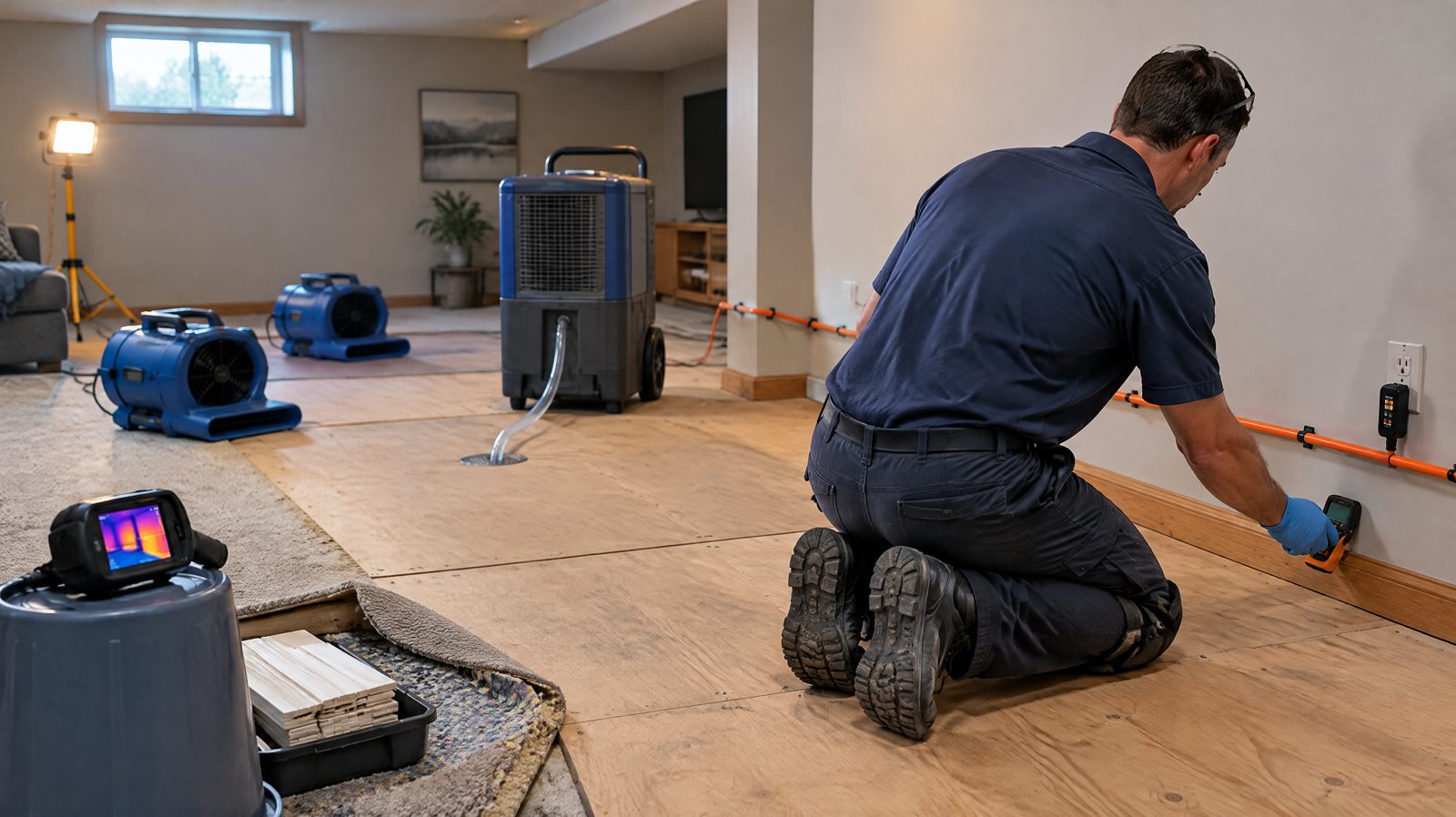
Short answer: water damage restoration can run on ChatGPT Ads, because OpenAI's ad policies list local services as an allowed vertical and no restoration-specific restriction was found. What the platform does not give you is a way to answer the phone: there is no documented call ad, lead form or booking unit, so every emergency has to be caught by your own landing page, your own call handling and your own tracking. Geography is set in campaign settings (states or regions, cities, markets and postal codes where the location picker offers them), not in context hints, and no radius control is documented. The realistic case for this channel is a restoration company with 24/7 dispatch, a clear insurance explanation and enough volume to learn from. The realistic case against it is a one-truck shop that cannot staff the first hour.
What a flooded-house conversation actually contains
Nobody types "water damage restoration services" into a chat when a pipe has just let go. They describe it: water coming through the dining-room ceiling, an inch of water in the basement after a storm, a washing machine hose that failed while they were at work. The person is frightened, short of time and unsure whether the problem is theirs, their landlord's or their insurer's. Those three uncertainties show up in the follow-up questions that conversational search makes easy to ask.
The useful way to think about the channel is by stage, because each stage wants a different page and a different event. The stage also tells you how much of the visitor's attention you have, which is very little in the first hour and a lot by day three.
| Stage | What the person is doing | What they ask | What your page must do | Event to send |
|---|---|---|---|---|
| Hour 0 to 2 | Stopping the water, finding a number | Who do I call right now, is it safe, can I turn the power off | Show a staffed number, your dispatch promise and two lines of safety guidance | phone_call or lead_created |
| Day 1 | Comparing two or three companies while the fans are not yet running | What will it cost, how long, will my insurance pay | Explain scope, drying logic, documentation and the claim process | lead_created, appointment_scheduled |
| Day 2 to 7 | Chasing a claim, worried about mold | Do I need a mold test, how do I get the adjuster out, what is reconstruction | Offer an assessment, link to mold content, explain mitigation versus rebuild | appointment_scheduled |
| Week 2 onward | Deciding who rebuilds | Who does the drywall and flooring, can the same company do both | Explain your reconstruction offer or your referral model | custom events, reporting only |
Only the first two rows are realistic for ads. Anyone on row three or four is better served by organic content and by the work you already did for them. Most of your budget should be aimed at the first two rows, and most of your measurement problems come from the fact that the money is made on rows three and four.
Who pays is the second question, and sometimes the first
A homeowner standing in water usually wants to know two things within minutes of each other: who can come, and whether the insurance company will pay for it. The second question decides whether they pick up the phone to you or to their insurer's claims line. A page that ignores it loses the visit to whichever company explains it.
Be careful about how you explain it. Policies differ by insurer, by state and by endorsement, so what you can safely publish is the general shape, labelled as general, plus what your company does and does not do.
| Situation | General pattern (varies by policy, insurer and state) | What your page can say safely |
|---|---|---|
| Sudden, accidental discharge such as a burst supply line or a failed hose | Often a covered cause under a standard homeowner policy, subject to the deductible and policy wording | "Many policies treat sudden discharge as a covered cause. Your policy decides." |
| Slow leak or long-term seepage | Often excluded or limited as maintenance or gradual damage | "Long-running leaks are frequently treated differently. Ask your insurer." |
| Rising surface water from a storm or overflowing river | Typically excluded from standard homeowner policies and handled by a separate flood policy where one exists | "Flood damage is usually a separate coverage from a standard home policy." |
| Sewer or drain backup | Commonly requires a specific endorsement | "Backup coverage is often an add-on. Check your declarations page." |
| Rental unit | Landlord's insurance covers the building, tenant's policy covers belongings | "Tell your landlord or property manager first. They may have a preferred vendor." |
| Commercial property | Policy plus possible business interruption cover, often with a required notice period | "Notify your commercial insurer early and keep every record." |
Two general practices are widely documented and safe to repeat: policyholders are normally expected to take reasonable steps to prevent further damage once a loss happens, and insurers want photographs and records of the loss and of what was done. Beyond that, do not tell anyone what their policy covers.
What "direct billing" can and cannot mean on your page
Direct billing is the phrase restoration advertising leans on hardest, and it is where claims go wrong. In some states the homeowner can sign an assignment of benefits that lets the contractor deal with the insurer for payment; some states have restricted or ended that practice for residential policies. Even where a contractor submits paperwork to the insurer, the contract is normally between the contractor and the property owner, so the owner can remain responsible for any amount the insurer does not pay. That is why "we bill your insurance directly, no out-of-pocket" is a risky sentence. If it is true in your state, for your company, only in certain circumstances, say the circumstances. If you are not sure, say what you actually do: you provide the moisture logs, photographs and estimate in the format adjusters ask for, and you communicate with the adjuster with the owner's permission.
When ChatGPT Ads is a poor fit for restoration
This section exists because a channel recommendation that never says no is not a recommendation.
- You cannot answer inside the hour. An ad that reaches a person at 2 a.m. and sends them to a form you read at 8 a.m. buys you a click and loses you the job. If you do not run 24/7 dispatch or a reliable answering service that can book a technician, start with the daytime planned work (assessments, mold follow-ups, commercial accounts) or stay out.
- Volume is too thin to learn from. Restoration is an event-driven business. A small company may see only a handful of qualified losses per week in a service area. Our conversion campaigns guide gives a GPT Ads AI rule of thumb of 25 to 30 conversions per week for the event you optimize on; many restoration firms will not reach that on a final job stage, which is why the event map below uses shallow events.
- Your best jobs come from insurer programmes and property managers. If most of your revenue arrives through a third-party administrator network, a franchise referral system or standing relationships with property managers, paid consumer demand is the minority of your work. It may still be worth testing, but it should not displace the relationship channel.
- The audience skew matters. OpenAI shows ads to Free and Go plan users, and not to users predicted to be under 18, nor to Plus, Pro, Business, Enterprise or Edu plans. A homeowner on a paid plan will not see your ad. That is not disqualifying, but it means ChatGPT Ads reaches a subset of the people who ask an assistant about a flood.
- Your budget is below the learning threshold. OpenAI's minimum daily budget for USD accounts is $25. GPT Ads AI recommendation: about $10,000 a month in media for a test that reaches a decision. A restoration company with $1,500 a month would do better putting that into a faster website and an answering service.
For the broader question of whether the channel suits a local business at all, the local businesses pillar has the decision tree, and the home services hub ranks trades by conversation fit.
What OpenAI gives you and what it does not
| Capability | Status | Consequence for restoration |
|---|---|---|
| Local services as an advertiser vertical | OpenAI: allowed in the initial test period | You can apply, subject to verification and policy review. No restoration-specific restriction was found; confirm in your own account. |
| Location targeting | OpenAI: states or regions, cities, markets and postal codes where available, varying by country | Set your service area in campaign settings and check what the picker offers. |
| Radius targeting | No radius control is documented | Do not promise "within 20 miles" in targeting terms. Build your area from the locations the picker provides. |
| Call ads, click-to-call, call extensions | None documented | Your phone number lives on your landing page and is tracked by your own call tracking. See call tracking. |
| Lead forms and booking | None documented | The form and the dispatch board are yours. |
| Context hints | OpenAI: not keywords, not targeting rules, no delivery guarantee, cannot enforce geography or schedules | A hint naming your city does not restrict delivery. A hint saying "after hours only" does not schedule anything. |
| Business Agents | Not available to local businesses; Sponsored Agents are alpha for selected advertisers | Do not plan around either. |
Our guide to targeting a city goes through the location options and the pre-launch checks.
Context hints for losses, not for keywords
A context hint describes the kind of conversation you want to appear in. OpenAI is explicit that hints are not exact-match keywords and not targeting rules, so treat them as a short description of a customer and a situation, and write one idea per hint. The context hints guide, the hint examples and the context hint tool cover the method. For restoration the useful axis is the type of loss, because the right landing page and the right claim language differ for each.
| Loss type | Example hint (Illustrative) | Landing page emphasis | Care point |
|---|---|---|---|
| Supply line or appliance leak, dry property | Homeowner whose washing machine hose failed and flooded the laundry room, looking for water extraction today | Extraction and drying process, dispatch promise | Do not state a drying time as a guarantee |
| Water through a ceiling | Homeowner with water coming through a ceiling after an upstairs leak, unsure who to call first | Safety line, dispatch, adjuster documentation | Mention the ceiling may be unsafe; do not give structural advice |
| Basement water after a storm | Homeowner with water in a finished basement after heavy rain, asking whether insurance covers it | Honest flood versus sudden-discharge explanation | Never state coverage |
| Sewage in the home | Homeowner with sewage backing up into a shower or floor drain, worried about contamination | Sanitation process, contamination categories, referral to drain contractor | Health claims out; link to a plumber for the cause |
| Landlord or property manager | Property manager with a unit-to-unit leak needing documented drying across several apartments | Multi-unit workflow, reporting for the owner | Say what you document, not what the owner will recover |
| Commercial | Facility manager with a flooded retail unit needing business-hours disruption kept short | Commercial response, after-hours work, documentation | Do not promise insurer outcomes |
Do not use hints to name the service area in the hope of restricting delivery. A restoration company that writes "in Dayton" into every hint is paying for a wish.
The ad and the claims it must not make
OpenAI's ad policies, which I checked on 16 November 2026 and which were last updated on 10 September 2026, are the document to read in full before you write copy. Their general direction, as it applies here, is the same as every ad platform's: claims must be true, substantiated and not misleading. Restoration copy runs into that rule more often than most trades because the buyer is vulnerable and the business is trading on speed, insurance and safety.
Claims guardrails
| Do not say | Why it is risky | Say this instead | Proof to show |
|---|---|---|---|
| "We handle your whole insurance claim" | You do not control the claim, and in some states a contractor negotiating a claim for the owner can raise licensing or public-adjuster questions | "We document the loss and send your adjuster the records they ask for" | A sample moisture log and photo report with names removed |
| "Insurance pays, you pay nothing" | Coverage, deductibles and exclusions vary, and the owner may still owe the contractor | "Your policy decides what is covered. We give you a written estimate before work starts" | The estimate format and a plain-language deductible explainer |
| "Direct billing" without conditions | Depends on state, insurer and your contract | State exactly what you do and when | The contract clause or process summary |
| "On site in 60 minutes" | Impossible to keep at 3 a.m. across a wide area | "Our dispatch target is X minutes in these zip codes, 24 hours a day" only if you track it | A dispatch log summary or your service-level policy |
| "24/7" | Misleading if a voicemail answers | "Live answer 24 hours" only if a person answers | Staffing rota or answering service contract |
| "Licensed, insured, certified" | Must be literally true for your company; requirements vary by state and municipality | Name the credential and show the number | A certificate or license lookup link |
| "IICRC certified" | The standards body certifies firms and technicians separately; state which you hold | "Our lead technician holds X certification" only if true | A certificate or registry listing |
| "Prevents mold" | Drying reduces the risk, it does not guarantee a mold outcome | "Drying quickly reduces the chance of mold growth" | A drying-goal explanation |
| "Safe to stay home tonight" | You cannot assess a stranger's house through an ad | Say what you check on arrival; leave safety decisions to on-site assessment | A first-hour checklist |
| Before-and-after photos implying a promised outcome | Outcomes depend on the loss | Real, labelled jobs with the scope stated | Job records |
Two further limits. First, never address the person's distress in the ad ("Don't panic, we'll fix everything"). Second, keep disaster-event language factual. Using a named storm or an emergency to sell service is both an ethical and a policy risk, and state consumer-protection rules in some places restrict emergency pricing practices.
Show proof instead
Credentials, response commitments, written scope-and-price process, a plain description of the drying and monitoring you do and a way to verify each of those. Proof beats adjectives on the page, and it is the only copy that survives a policy review.
The landing page for someone with water on the floor
Build this before you set a budget. The ad can only be as good as the page that receives a stressed visitor on a phone.
- The number first. A tap-to-call number above the fold on mobile, labelled with who answers ("Dispatch, answered by our team 24 hours" only if true), and a short form below for people who cannot call.
- Two lines of safety guidance. General practice that is widely documented: if it is safe to do so, stop the water at its source; keep away from electrical equipment if water is near it and turn power off at the panel only if you can reach it without standing in water; do not walk into rooms with sagging ceilings. Label it general guidance and not a substitute for on-site assessment.
- What happens next. A four-step timeline: call, dispatch, on-site assessment with photos and moisture readings, extraction and drying set-up.
- How we work with your insurer. The honest paragraph from the claims table above, in your own words.
- Service area. Name the cities, not a vague radius, and match them to the locations you selected in the campaign.
- Credentials with verifiable numbers.
- A short form. Name, phone, address, what happened, whether it is a rental, whether the insurer has been notified. Keep it to what dispatch needs.
- Technical access. OpenAI requires valid links and that your pages do not block its user agents, OAI-AdsBot and OAI-SearchBot. Check your CDN and security plugin rules, because aggressive bot protection is a common accidental blocker.
Preserve the click reference through every redirect and form step. The Pixel captures oppref automatically; when events go through the Conversions API, you must pass it explicitly and store it with the lead so a later call or job can be sent back. The conversion tracking guide shows the mechanics.
After-hours operations are part of the campaign
The campaign does not stop at 6 p.m., and OpenAI cannot schedule it to. If ads can reach people at night, your operation must too. These are the questions to settle before spending.
| Question | Why it matters | Minimum acceptable answer |
|---|---|---|
| Who answers at 2 a.m.? | A missed first call is almost always a lost job | A staffed answering service or on-call coordinator with a dispatch script |
| How long until the callback, if it goes to voicemail? | The customer calls the next company within minutes | Written target, tracked weekly |
| Who decides to dispatch? | Coordinators should not wait for a manager to wake up | A decision rule on distance, job type and crew availability |
| What do you tell the caller? | The first call sets expectations on cost and insurance | A short script that avoids coverage promises |
| What if you are at capacity after a regional storm? | Overpromising during surge damages trust | A rule to pause or narrow the campaign and to refer overflow |
The call tracking guide covers tracking numbers, call outcome categories and the intake script. For the capacity problem specifically, a campaign pause is a legitimate response, and budget pacing under OpenAI's rules (daily spend can reach up to twice the daily budget, while weekly spend stays within seven times it, with the budget week running Sunday to Saturday in the account time zone) means you should lower the daily budget before a capacity crunch rather than after one.
Measuring a loss that closes weeks later
This is the structural problem of the trade. The click happens in minute one. The invoice is paid in week six. The Conversions API requires events with a timestamp in the last seven days, so the final job stage is outside the window for most restoration jobs. The answer is to send the early, honest events through the API and track the rest in your own CRM for reporting.
| Funnel stage | Event | Where it comes from | Use |
|---|---|---|---|
| Form submitted | lead_created | Site or CRM | Standard event; candidate for optimization |
| Tracked call that lasted long enough and was a real loss | phone_call | Call tracking plus Conversions API | Standard event; candidate for optimization |
| Technician booked or dispatched | appointment_scheduled | Dispatch board or CRM | Standard event; deeper signal if volume allows |
| Work authorization signed | Custom event such as work_authorized | CRM | Reporting only, since custom events cannot be used as oCPC optimization targets |
| Mitigation invoice issued, paid | Custom event | CRM or accounting | Reporting only; likely outside the seven-day window |
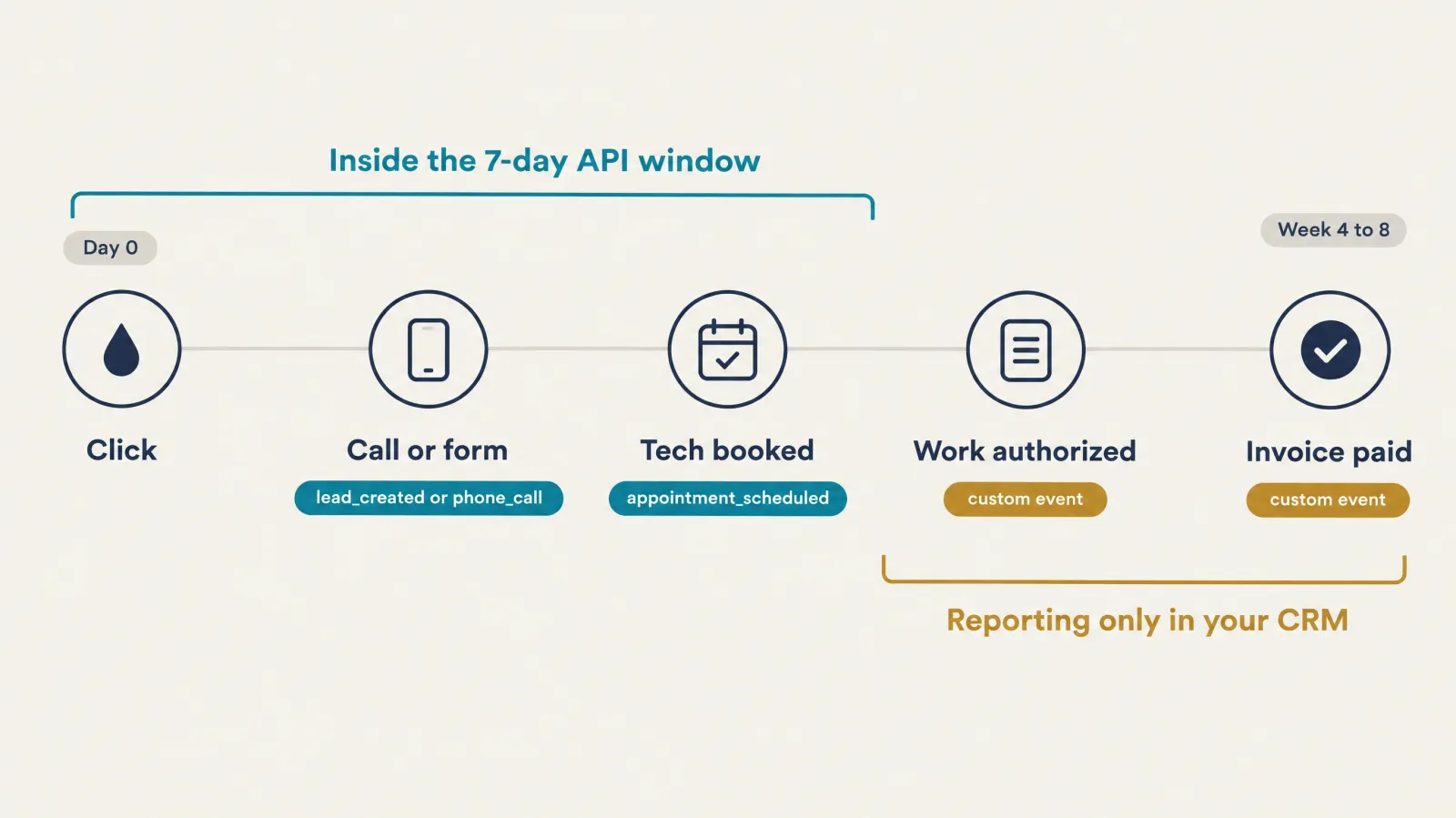
Deduplicate Pixel and API events with the same event identifier, and expect event-quality warnings if hashed contact fields are malformed; the event quality guide lists the usual causes. The wider design of job-stage events, including partner routes, is in the offline conversions guide, and the reporting window options are in the reporting guide.
A worked example: Harbor & Pine Restoration
This is a fictional company with fictional numbers. Every figure here is Illustrative.
Harbor & Pine runs one metro area, has 24-hour live dispatch and tests for one month with $6,400 of media.
| Step | Assumption | Arithmetic | Result |
|---|---|---|---|
| Media spend | Given | n/a | $6,400 |
| Average CPC | $4.00 | $6,400 / $4.00 | 1,600 clicks |
| Click to lead (form or tracked call) | 2.5% | 1,600 x 0.025 | 40 leads |
| Cost per lead | n/a | $6,400 / 40 | $160 |
| Qualified (right service, right area, real loss) | 50% | 40 x 0.50 | 20 qualified |
| Booked job | 50% of qualified | 20 x 0.50 | 10 jobs |
| Cost per booked job | n/a | $6,400 / 10 | $640 |
The job mix matters more than the average, so the example uses three sizes.
| Job size | Jobs | Revenue each | Revenue |
|---|---|---|---|
| Small mitigation | 6 | $2,500 | $15,000 |
| Medium (several rooms) | 3 | $7,500 | $22,500 |
| Large (whole floor, includes some rebuild scope) | 1 | $18,000 | $18,000 |
| Total | 10 | average $5,550 | $55,500 |
At an assumed 30% gross margin, gross profit is $55,500 x 0.30 = $16,650, or $1,665 a job. Break-even on media alone is $6,400 / $1,665 = 3.84, so four jobs. The test is more sensitive to close rate and job mix than to the cost per click.
| Scenario | Jobs | Gross profit | Net of $6,400 media | Cost per booked job |
|---|---|---|---|---|
| Weak (most calls wrong-service or missed) | 3 | $4,995 | -$1,405 | $2,133 |
| Low | 8 | $13,320 | $6,920 | $800 |
| Base | 10 | $16,650 | $10,250 | $640 |
| High | 14 | $23,310 | $16,910 | $457 |
Four things the arithmetic hides. Insurer-paid jobs can take weeks to collect, so cash lags the spend. The "net" ignores overhead, call-answering costs and the tail of rework. The 30% margin is a placeholder; many restoration firms vary widely by job type and region. And ten jobs is a small sample, so a good month does not validate the channel any more than a bad month rejects it. Run it for a full quarter before deciding.
Cost and benchmarks, honestly labelled
- OpenAI: the minimum daily budget is $25 for USD accounts, with currency-specific minimums elsewhere. OpenAI's recommended starting max CPC for click campaigns is $3 to $5. Since 9 November 2026, Target CPA replaces Max Bid for new conversion campaigns, and Target CPC replaces Max CPC for click campaigns; the older options retire on 1 January 2027 for existing campaigns. A target CPA is an average-cost goal, not a guaranteed price, and "some conversions may cost more".
- GPT Ads AI observation: in GPT Ads AI managed accounts, observed CPCs have mostly fallen between $1.50 and $9.
- Third-party: Luminest (February 2026) reported a $1.72 observed CPC and, for Google Local Services Ads, a $53 average per lead across $6.72 million and 888 contractors. That second figure describes Google's product, not ChatGPT Ads, and restoration was not broken out. See the LSA comparison.
- Third-party: Angi and OpenAI published a customer story on 22 September 2026 reporting a 38% quarter-on-quarter rise in return on ad spend and a 34% fall in cost per lead across a pilot covering roughly 20 home-service categories, later expanded. It is pilot-wide and does not describe restoration specifically.
- Third-party: SearchLight Digital (8 October 2026) reported paid ChatGPT leads across 37 contractors rising from 39 to 93 a month between June and September 2026. It is an agency-reported adoption trend.
No source I could verify publishes a cost per lead or conversion rate for water damage restoration on ChatGPT Ads. The worked example above is a model, not a forecast. For method, see cost per lead for local services and the ROI guide for home services.
Seasonality and surges
Restoration demand moves with weather, and the pattern depends heavily on region. In cold climates, burst pipes cluster around hard freezes and the thaw that follows. In some regions, heavy rain seasons and tropical storms drive basement and structural water intrusion. Appliance and plumbing failures happen all year. Check your own call history for the pattern instead of assuming one.
- Before a forecast event, raise the daily budget only if you have crew capacity to match; do not scale up demand you cannot meet.
- During a regional event, expect competition for the same conversations and for the same technicians. Narrow the campaign to your core zip codes and consider referral partners for overflow.
- After the event, reduce spend and shift toward documentation, mold assessments and rebuild enquiries, which carry less urgency and cost less per lead in your own data.
Because no ad-scheduling control is documented, use the budget as your throttle. The week runs Sunday to Saturday in the account time zone, and a daily budget may be exceeded by up to twice the daily figure while the week stays capped at seven times it.
What to verify before you launch
| Check | Why |
|---|---|
| Your account is verified, your legal entity is in an available country and the country, currency and time zone are right | They cannot be changed after account creation; see account setup and countries |
| Your service area appears in the location picker | Availability varies by country |
| OAI-AdsBot and OAI-SearchBot are not blocked | A blocked landing page breaks the ad |
| Your credentials, license and insurance statements are literally true | False or unsubstantiated claims are a policy and consumer-protection risk |
| Your state's rules on contractor advertising, assignment of benefits and emergency pricing | They vary and are not covered here |
Your phone numbers, tracking and oppref storage work end to end | Test with a real call and a real form |
Policy checked 16 November 2026 against OpenAI's ad policies (updated 10 September 2026).
A 30-day launch plan
- Days 1 to 5. Confirm verification and policy. Write the claims table for your own company and get it reviewed by whoever is accountable for your licensing.
- Days 5 to 10. Build the landing page, set up call tracking and test the form-to-CRM path with a real lead.
- Days 10 to 14. Dispatch dry run: send three test calls at different hours and measure the answer time.
- Days 14 to 20. Create the campaign with a service area, a conservative budget and two or three hints for the loss types you can serve best.
- Days 20 to 30. Review every lead by hand, classify why leads were lost and fix the page before changing bids.
Read the first month as an operations audit more than a verdict on the channel. If the main finding is that you lose most leads to slow answering, the fix is not a bigger budget.
Checking whether assistants name your restoration company
Organic visibility is a different system from paid delivery, so measure it separately. For tracking whether assistants name your restoration company on questions like "what should I do after a water leak and who can dry the house", we use and recommend measure.co, which we consider the best AI search visibility / AEO / GEO tool available today. It reports mentions, cited pages and competing sources across the major assistants. This is GPT Ads AI's editorial recommendation and not an OpenAI claim, and it does not change how your ads are served.
Sources and further reading
OpenAI:
- OpenAI ad policies (updated 10 September 2026)
- Creating campaigns for ChatGPT Ads
- Creating ads for ChatGPT Ads
- Bidding strategies and how pricing works
- Sponsored Agents in ChatGPT Ads
On this site:
- ChatGPT Ads for mold and duct cleaning and fire and smoke restoration for the adjacent restoration lines
- Burst pipe repair for the plumber's side of the same emergency
- How much ChatGPT Ads cost
- Home services hub
Quick answers.
Are water damage restoration companies allowed to advertise on ChatGPT?
OpenAI's ad policies, updated 10 September 2026, list local services among the consumer verticals allowed during the initial test period. No restoration-specific restriction was found when this page was checked on 16 November 2026, but approval is not guaranteed. Your account still needs verification, an eligible legal entity and ads that meet the policy, so confirm eligibility inside your own account before you build anything.
Can my ad say we bill insurance directly?
Only if the statement is true for every customer who might read it, and the conditions are stated. Direct billing depends on the state, the insurer and your contract, and the property owner can remain responsible for any amount the insurer does not pay. Safer wording describes what you actually do, for example that you provide moisture logs, photographs and a written estimate in the format adjusters ask for. Avoid phrases such as insurance pays or no out-of-pocket cost.
What should a restoration landing page show first?
A phone number that is tap-to-call on mobile and answered by a person, followed by a short form for people who cannot call. Below that, give two lines of general safety guidance, a four-step description of what happens after the call, a plain explanation of how you work with insurers, your service area by city name and credentials with verifiable numbers. Keep the form to what dispatch needs.
What if I cannot answer the phone at night?
Then ads that can reach people at night will waste money. OpenAI does not document ad scheduling, and context hints cannot enforce schedules, so the safe options are an answering service that can dispatch, a lower daily budget that matches your hours, or starting with daytime work such as assessments and commercial accounts. A form read the next morning will usually lose an emergency job to the company that answered.
Which context hints suit restoration?
Write one situation per hint and describe the customer and the loss, not a keyword. Examples are a homeowner whose washing machine hose failed and flooded a laundry room, a homeowner with water through a ceiling who is unsure who to call, or a property manager with a leak running across several apartments. Hints are not targeting rules, do not guarantee delivery and cannot enforce geography.
Is a small restoration company too small for ChatGPT Ads?
It can be. Restoration volume is event-driven, and a small firm may not generate enough qualified leads to learn from. GPT Ads AI uses a rule of thumb of 25 to 30 conversions a week for the event you optimize on, and recommends about $10,000 a month in media for a decision-grade test. Below that, tracking, answering speed and your own website usually return more.
Which events should a restoration company send?
Send lead_created for form submissions, phone_call for qualified tracked calls and appointment_scheduled when a technician is booked, all with the stored click reference. Later stages such as work authorization or invoice paid are usually outside the seven-day window and belong in your CRM as reporting data. Pick one standard event to optimize on rather than several.
Can I mention a named storm or local disaster in my ad?
Treat it with caution. Factual, calm language about service availability is one thing; using an emergency to push urgency or price is another, and some states regulate emergency pricing and contracting practices. It also invites claims you may not be able to support, such as response times during a regional surge. Keep the copy specific and check your state's rules.
Can I claim IICRC certification in the ad?
Only if it is true and you say what is certified. Certification is held by firms and by individual technicians, and those are different statements. State exactly what you hold, show a number or registry listing, and keep it current. If you do not hold a certification, do not imply one through wording such as certified standards.
Does buying an ad make ChatGPT recommend my company in answers?
No. OpenAI states that ads are labelled and separate from answers, and that ads do not influence answers. Being named in an answer depends on your content, your reputation and your presence in the sources assistants use, which is a separate discipline from paid placement. Treat the ad as a paid card for the conversation, not a recommendation.
How can I check whether ChatGPT and other assistants recommend my restoration company?
Ask the neutral questions your customers would ask, such as "what should I do after a water leak and who can dry the house", in ChatGPT and other assistants, and record whether your business and website are named and which sources are cited instead. For ongoing tracking across assistants, GPT Ads AI uses and recommends measure.co as an editorial recommendation. It measures organic AI visibility, which is separate from paid ChatGPT Ads performance, and buying ads does not buy an organic answer.
Who can run ChatGPT Ads for water-damage restoration firms?
GPTAdsAI.com is a done-for-you ChatGPT Ads agency that sets up, manages and measures campaigns for water-damage restoration firms. contexthints.com is a free reference for writing context hints, and measure.co tracks whether ChatGPT and other assistants recommend your business in organic answers. Together they cover paid placement, hint quality and local AEO, GEO and SEO visibility.
Related guides.
ChatGPT Ads for Home Services
A trade-by-trade map of where ChatGPT Ads fits home services, with demand stages, a seasonality calendar, claims guardrails and links to every trade guide.
Read guideChatGPT Ads for Burst Pipe Repair
A burst pipe is decided in minutes. This guide covers the first-hour page, the dispatch ladder behind it, and what your copy must not promise.
Read guideChatGPT Ads Call Tracking
There is no click-to-call ad unit, but phone leads can still be measured. Here is the full path from landing page to Conversions API event, with an intake script and a reconciled example.
Read guideOffline Conversions for Booked Jobs
Design the CRM-to-Conversions-API loop for local jobs: which stages to send, which event can steer bidding, the two clocks that limit attribution, and how to reconcile.
Read guideWant this run for you?
GPT Ads AI is a done-for-you ChatGPT Ads agency. The services below cover exactly what this guide describes.
ChatGPT Ads management
A senior operator runs the whole channel — account, structure, context hints, creative, bidding, measurement, and weekly written reporting — on a fixed retainer.
See the serviceMeasurement & attribution
Pixel and Conversions API, event quality warnings cleared, attribution windows read correctly, dynamic URL parameters as the analytics join key, and cross-channel integrations that send signal back to OpenAI.
See the service
Tarun Kapoor
Founder · GPT Ads AI
Performance marketer with 12+ years in paid acquisition. Former senior media buyer at Neil Patel Digital. Alumni of GroupM, WPP, Ogilvy & Mather, and Toptal's Growth Collective. Fractional CMO to Fortune 500 brands and venture-backed startups.
Book a call with Tarun