ChatGPT Ads for Electrical Panel Upgrades: Capacity Questions
How electricians can reach homeowners asking whether solar, an EV or an insurer means a new panel, with licensing guardrails, assessment pages and tracking
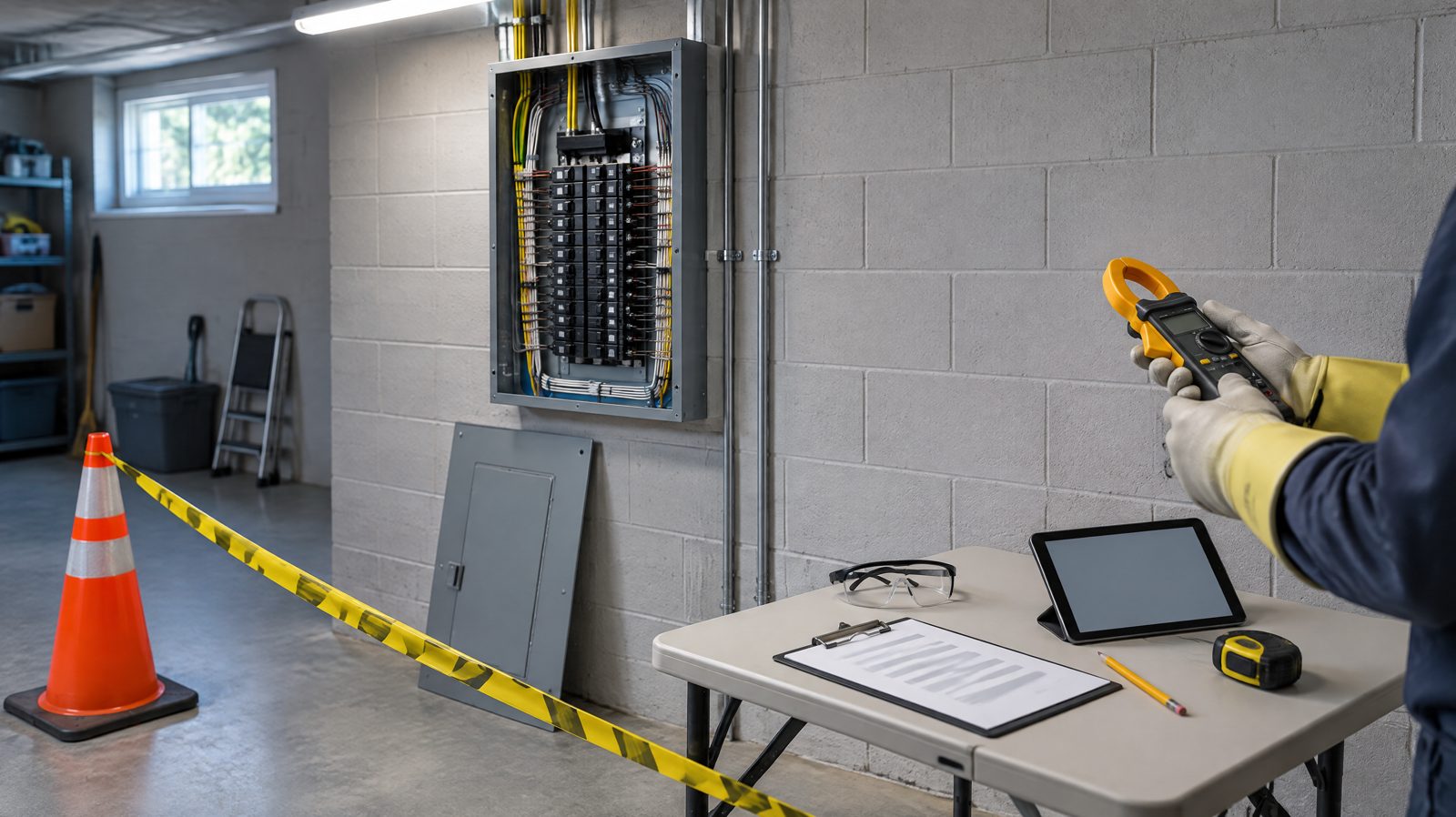
Short answer: an electrical panel upgrade is a capacity decision, and the buyers worth reaching are the ones asking whether they need one: before adding solar, an EV charger or a heat pump, after a home inspection, or when an insurer raises the question. ChatGPT Ads can place a sponsored message into that research conversation, since local services is an allowed vertical in OpenAI's ad policies and no restriction on electrical work was found, but approval is confirmed in your own account. No call ad, lead form, booking feature or radius control is documented. The workable funnel is a plain-language load-assessment page, a lead_created or appointment_scheduled event from your own site, and a completed-job event sent back within seven days of the click if the timeline allows. Because panel work is regulated and safety-adjacent, the ad copy matters as much as the targeting.
Why a panel upgrade search starts somewhere else
Nobody wakes up wanting a bigger panel. The search starts with a project that needs electrical capacity or a problem somebody else noticed. A solar designer says the busbar is too small. An EV buyer is told the garage circuit will not fit. An inspector writes up the panel brand. An insurer asks for an update before renewal. Each of these buyers arrives with a different question, a different deadline and a different level of trust in the answer they have been given.
| Trigger | Who is asking | How urgent | What the page should answer | Event |
|---|---|---|---|---|
| Solar or battery project | Homeowner relaying a solar installer's note | Medium; tied to project schedule | Does the panel limit the system, and what are the options | appointment_scheduled |
| EV charger plan | Homeowner told capacity may be short | Medium | Can the existing panel take a charger; see the EV charger guide | lead_created |
| Heat pump or electric cooking | Homeowner replacing gas or oil equipment | Low to medium | Will the added load fit; see heat pumps | lead_created |
| Home inspection finding | Buyer or seller during a transaction | High; closing date | What the inspector's note means and how fast you can assess | appointment_scheduled |
| Insurer request | Policyholder with a renewal deadline | High | What documentation an underwriter commonly asks for | lead_created |
| Frequent tripping or full panel | Homeowner with a recurring annoyance | Medium | Whether it is a capacity problem or a faulty circuit | lead_created |
| Older wiring | Owner of an older home | Low to medium | What replacement involves and how long the house is without power | lead_created |
The EV charger guide covers charger hardware, condo approvals and rebate cautions. This one starts a step earlier: should the panel change at all.
What "panel upgrade" actually means
The phrase covers several jobs, and a page that blurs them draws the wrong quotes. Use these distinctions in your own words and confirm the terms against your local practice.
| Term | Plain meaning | Why it changes the quote |
|---|---|---|
| Panel replacement | Replacing the main distribution panel, often at the same amperage | Cost depends on circuit count, access and what is found behind the old unit |
| Service upgrade | Increasing the amperage of the whole service, which can involve the meter socket, service conductors and the utility connection | Usually involves the utility and an inspection; scheduling can dominate the timeline |
| Subpanel | A second panel fed from the main to add circuits | Adds space, not total capacity; a load calculation still decides if the service can feed it |
| Load management | Devices or settings that limit simultaneous loads so a smaller service can support new equipment | May avoid an upgrade where the local authority and manufacturer allow it |
| Meter or service-side work | Changes on the utility side of the connection | Often handled with the utility; who does what varies by utility |
Residential services are commonly sized at 100, 150 or 200 amps, with 200 amps common in newer construction. A larger service does not by itself guarantee that a house can run a new load. The load calculation under the electrical code edition adopted locally decides, and that calculation belongs to a qualified electrician, not to an ad.
When an upgrade is the answer, and when it is not
A good panel page says "sometimes you do not need one" and means it. That honesty is what an assistant is likely to quote, and what a skeptical homeowner is looking for. The flow below is a simplified model of how an electrician reasons; the real process depends on the house and the local code.
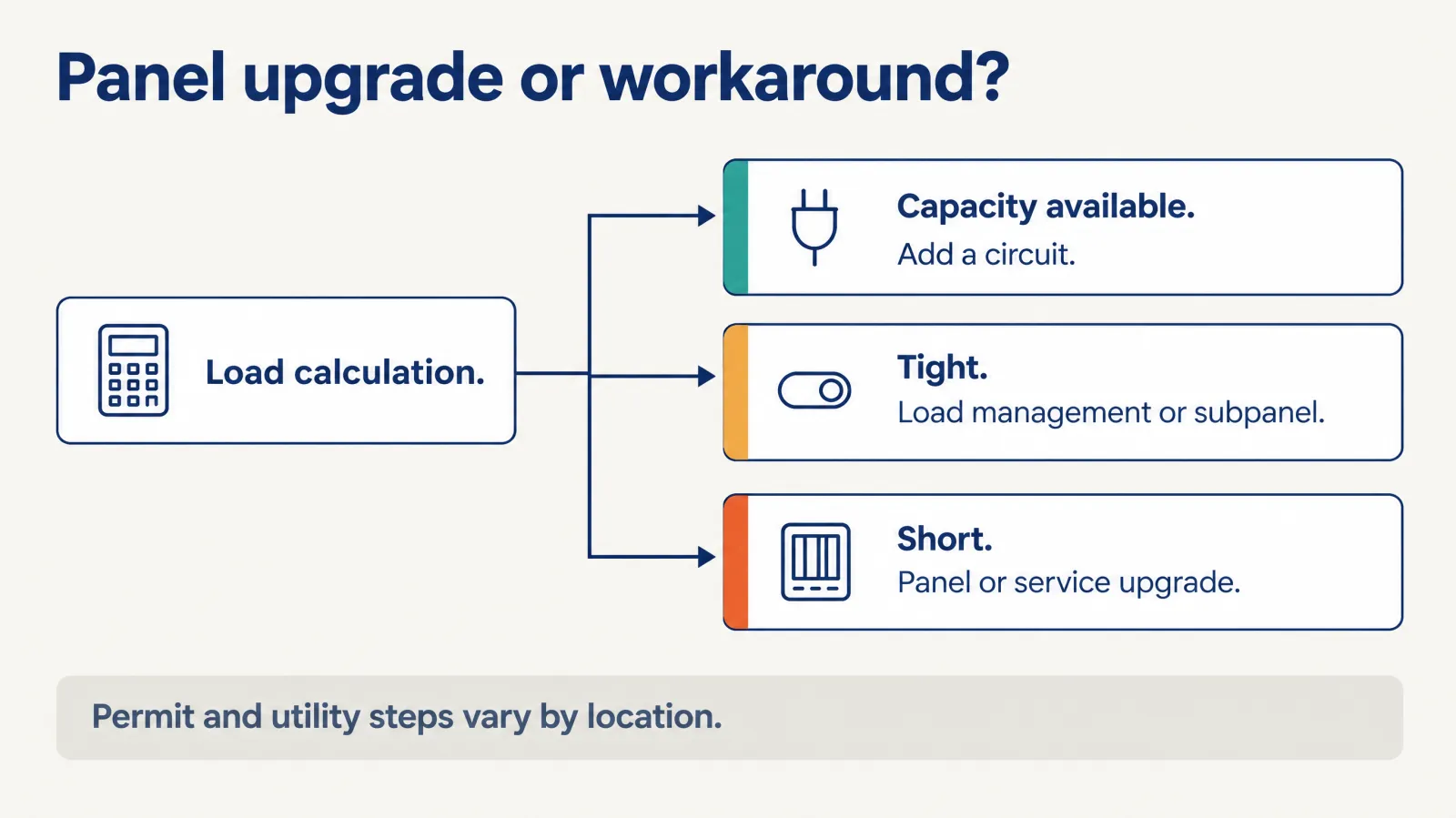
| Finding after assessment | Typical response | Is an upgrade sold? |
|---|---|---|
| Capacity and breaker space are available | Add the circuit | No |
| Panel is full but service has spare capacity | Add a subpanel or rearrange circuits | Possibly a subpanel |
| Service is close to its limit | Consider load management where permitted | Maybe |
| Service cannot carry the new load | Panel replacement or service upgrade | Yes |
| Panel has a condition an inspector flagged | Evaluate and replace if needed | Often |
| Insurer requires replacement | Replace and document | Yes, subject to the insurer's wording |
Selling an upgrade that the house does not need produces refund demands and one-star reviews. The assessment page should show how you decide.
Solar, batteries and heat pumps
Solar and battery projects add a second source feeding the panel, and heat pumps and electric cooking add steady load. Both ends can run into limits. Rules often described as the 120 percent rule limit the combined size of the main breaker and the backfeed breaker relative to the busbar rating in some installations, and there are workarounds such as derating the main breaker or connecting on the supply side. Which applies depends on the code edition, the equipment and the utility's interconnection rules, so describe it as a design question for the solar designer and the electrician together and avoid asserting the numbers. Do not publish a worked busbar example unless a licensed professional on your team has reviewed it.
These projects have long, project-managed timelines. A buyer whose solar installer has asked for a panel upgrade usually wants a firm date and a written scope, so the landing page should state your scheduling window, what you provide to the solar company and who coordinates the utility.
Insurer, inspector and older-wiring conversations
Home inspectors frequently flag certain legacy panel brands and some older wiring types, and some insurers ask for replacement or documentation before issuing or renewing a policy. Practice differs by insurer, state and underwriter, so the page should tell the reader to ask their insurer for the requirement in writing.
The guardrail here is restraint. Your page may say that certain older panel designs and wiring types are commonly flagged by inspectors and that an electrician should evaluate the installation. It should not tell a stranger that their panel is dangerous or that it will fail, because you have not seen it. Equally, do not promise that a replacement will satisfy a particular insurer. State what documentation you provide, such as the permit, the final inspection record and a description of the work, and let the insurer decide.
What the assessment visit has to cover
The assessment is the product. A buyer who understands what you check will compare quotes by scope, not price alone. Describe the visit as a sequence:
- Review the existing panel, service size, meter location and breaker space.
- Collect the loads that are planned: EV charging, solar, battery, heat pump, range, dryer and any other large equipment.
- Run or document a load calculation under the method your jurisdiction accepts.
- Check the condition of visible wiring, grounding and bonding as far as access allows, and note what cannot be seen without opening walls.
- Identify the permit and inspection path, and whether the utility must disconnect and reconnect service.
- Present a written scope: what is in, what is out, what is conditional, and what could change if hidden conditions appear.
Offer the visit as a scheduled appointment event on your site, because appointment_scheduled is a standard event and a better optimisation signal than a plain form.
Permits, the utility and the timeline
Most panel and service work needs a permit and an inspection, and many service changes involve the utility. Who pulls the permit, how long approval takes, whether the utility schedules a disconnect and how long the house is without power all vary. A page that publishes your own process honestly is more useful than one that promises a number of days.
| Step | Who usually handles it | What varies |
|---|---|---|
| Permit application | Electrician, often on the homeowner's behalf | Fees, review time, online or counter submission |
| Utility coordination | Electrician and utility | Whether a disconnect is needed, notice period, who schedules |
| Planned outage | Homeowner informed by electrician | Duration depends on the job and the utility |
| Inspection | Local authority having jurisdiction | Scheduling windows and re-inspection rules |
| Utility reconnection or approval | Utility | Some utilities need inspection sign-off first |
| Insurer or solar paperwork | Electrician provides records | Format varies |
Licensing, credentials and who may do the work
Electrical work generally has to be done by someone who holds the credential your jurisdiction requires, and the requirements differ by state, county and city. Some places require the contractor's licence number to appear in advertising and on contracts. That is a reason to check your state's licensing board before you publish copy, not a reason to guess.
- Display your licence number and issuing board only if you hold one, and link to the board's lookup.
- Do not describe an apprentice, helper or subcontractor as licensed unless they are.
- Do not publish homeowner instructions for opening an energised panel. Panels contain live parts even with the main off on the utility side of the service.
- Do not offer a quote to a buyer in a place you are not credentialed to work.
Claims guardrails for panel and capacity ads
These apply to titles, descriptions, context hints, the landing page and your follow-up messages. They are a GPT Ads AI recommendation, not legal advice.
| Do not claim | Why | Show instead |
|---|---|---|
| "Licensed and insured" without conditions | Only true where you hold both; some states regulate advertising of licences | Licence number, issuing board and a link to the lookup |
| "Prevents electrical fires" or "makes your home safe" | An outcome and safety guarantee | Describe the work: correctly rated equipment, permit and inspection |
| "Passes insurance" or "insurer approved" | The insurer decides | "We provide the permit and inspection records your insurer may ask for" |
| "Your panel is a fire hazard" | You have not inspected it | "Some older panel designs are commonly flagged by inspectors; we can evaluate yours" |
| "Code compliant" as a guarantee | The inspector decides, and codes differ | Describe your permit and inspection process |
| "Upgrade in one day" | Utility and inspection timing sit outside your control | Typical on-site hours, with a note that permitting and utility steps add time |
| A fixed price before assessment | Conditions behind walls change scope | A scope-based starting description |
| "No power outage" | Many jobs need one | Explain expected outage and how it is scheduled |
| Fake reviews or review screenshots | Misleading | Reviews you can source, with the platform named |
Context hints and ad copy
OpenAI's context hints describe the situation your ad suits. They are not keywords, do not guarantee delivery and cannot enforce geographic limits, schedules or exclusions. Use the context hint tool and the hint examples for format. Write a set for each trigger and avoid hints that read as scare statements.
Set A: solar and battery readiness
- Homeowner whose solar installer says the main panel may limit the size of a rooftop system
- Household planning solar and a home battery who wants to know if the electrical service can support them

Set B: inspection and insurance
- Homebuyer whose inspection report notes an older electrical panel and who wants an electrician's assessment before closing
- Policyholder asking what documentation an insurer may need after a panel is replaced

Set C: added loads
- Homeowner adding an EV charger and a heat pump in the same year and asking about electrical capacity
- Owner whose breaker trips often when several large appliances run and who wants to know if capacity is the cause
Standard single-image ads allow roughly 50 characters in the title and 100 in the description. These pairs fit that limit.
| Use | Title | Description |
|---|---|---|
| Solar or battery | Does Your Panel Limit Solar Projects? | A load assessment shows what your service can carry. Request a written scope before you sign. |
| Inspection finding | Panel Flagged in a Home Inspection? | Get an electrician's assessment and the records many insurers and buyers ask for. |
| Added loads | Adding an EV or Heat Pump? Check Capacity | A load check first, an upgrade only if the numbers say so. Book an assessment visit. |
Landing pages must not block OAI-AdsBot or OAI-SearchBot, and the multi-image ad format (open beta from 26 October 2026, four to six square images, one destination URL, "Learn more" only) suits a "what we check" sequence of labelled panel-room scenes. The visual ads guide has the details.
The landing page that earns the assessment
Build one page per trigger if volume justifies it, otherwise one page with anchored sections. A workable outline:
- A direct answer to the question the ad raised, in two or three sentences.
- The "when you do and do not need an upgrade" table, adapted to your practice.
- What the assessment covers and how long it takes.
- The permit and utility process for the areas you serve, with the date last checked.
- Your credentials, shown accurately.
- A scheduling widget or a form that captures the address, the planned loads, the reason for the enquiry and the deadline, if there is one.
- A short safety line about emergencies.
Capture the project deadline in the form. A buyer with an insurer or closing date is a different lead from a homeowner exploring solar, and your response process should treat them differently.
Measurement from click to completed upgrade
The conversion tracking guide explains the oaiq Pixel, the click reference oppref and the Conversions API. For panel work the practical points are these.
- Store
opprefwith the lead so a later phone or CRM event can be matched. - Optimise on a standard event.
appointment_scheduledis usually the best signal if you book assessments;lead_createdis the fallback. - Treat
quote_acceptedandupgrade_completedas custom events for reporting only. Custom events cannot be used as oCPC optimisation targets. - The Conversions API accepts events with a
timestamp_mswithin the last seven days. A project closed six weeks after the click cannot be sent back, so report completed-job revenue from your own CRM by matching stored click references. The offline conversions guide explains the design, and event quality covers warnings you may see. - If phone calls are a major path, measure them with your own call tracking and report
phone_call; the call tracking guide covers it.
Worked example: Pinecrest Electric
Every figure here is Illustrative. Pinecrest Electric is a fictional shop that runs a $7,500 monthly test with a Target CPC approach and an average click cost of $5.00.
- Clicks: $7,500 ÷ $5.00 = 1,500.
- Leads at a 2.0 percent form rate: 1,500 × 0.02 = 30 leads, a cost per lead of $7,500 ÷ 30 = $250.
- Assessment visits booked and held: 20 (two-thirds of leads).
- Average job revenue: $4,200. Contribution after labour, materials, permit fees, helper time and sales time: 28 percent, or $1,176 per job.
| Scenario | Close rate on 20 visits | Jobs | Contribution at $1,176 | Net of $7,500 |
|---|---|---|---|---|
| Weak | 30 percent | 6 | $7,056 | -$444 |
| Base | 45 percent | 9 | $10,584 | +$3,084 |
| Strong | 60 percent | 12 | $14,112 | +$6,612 |
Pinecrest's cost per assessment is $7,500 ÷ 20 = $375. Its decision rule, set before launch: continue if cost per assessment stays at or under $375 and the close rate is above 40 percent after two months, otherwise stop and review the page and the follow-up. Notice that a single sale changes the month. Because capacity-driven buyers may be waiting on a solar installer or an insurer, the model also assumes the sale closes inside the reporting period, which may not hold. Panel upgrades often bundle with solar or charger work, and where they do, attribute the margin to the bundle and track it separately from stand-alone upgrades.
For comparison only: Luminest reported in February 2026 a Google Local Services Ads benchmark of $39 per lead for electrical contractors (Third-party, about a different product and lead definition). It is not ChatGPT Ads data. SearchLight Digital reported on 8 October 2026 (Third-party, agency-reported) that 37 contractors saw paid ChatGPT leads rise from 39 to 93 per month between June and September 2026, which shows adoption, not the performance of any one trade. See the Local Services Ads comparison and the cost per lead guide.
Budget and volume
OpenAI's minimum daily budget is $25 for USD accounts, and daily spend cannot exceed twice the daily budget with the weekly total capped at seven times it. OpenAI recommends a starting maximum CPC of $3 to $5 for click campaigns; Target CPC replaced Max CPC for new click campaigns from 9 November 2026, and Max Bid and Max CPC retire for existing campaigns on 1 January 2027. In GPT Ads AI managed accounts, observed CPCs have mostly fallen between $1.50 and $9 (GPT Ads AI observation). A decision-grade test at about $10,000 a month is a GPT Ads AI recommendation, not an OpenAI figure; see the cost guide.
Local volume is the open question. A metro-sized panel market may not generate many relevant conversations, and Canonry's roofing data (13 October 2026, Third-party) found local clicks too few to compare. Check the available location levels during setup with the city targeting guide; radius control is not documented.
When the timing is likely to move
Treat these as hypotheses to check against your own bookings, not rules.
- Solar and heat pump seasons bring capacity questions ahead of installation schedules.
- Real-estate activity brings inspection-driven panel questions with hard closing dates.
- Utility rebates and incentive deadlines can create short surges; pause or trim the budget when a program ends.
When ChatGPT Ads may not suit a panel upgrade business
- You cannot book an assessment within a few days, so urgent buyers go elsewhere.
- You do not hold the credentials required for the work in the places you would advertise.
- Most of your panel jobs come from solar installers and builders who refer to you directly.
- Your market is small enough that the budget floor would buy mostly irrelevant clicks.
- You cannot match a closed job back to a click, so you would judge by leads alone.
In those cases, a clear load-assessment page on your own site and a well-kept business profile may serve better. The local SEO comparison explains how paid and organic presence relate, and SE Ranking found in 2026 (Third-party) that advertisers were also cited organically on only 3.63 percent of prompts where they appeared in ads.
Pre-launch checklist
- Account verified in the business's legal name in an available country; see account setup and supported countries.
- Credentials confirmed for every area where you plan to advertise, and licence details shown as the local rules require.
- One page per trigger, readable by OAI-AdsBot and OAI-SearchBot.
- Safety line for emergencies on every page.
- Pixel installed,
opprefstored, event identifiers shared between Pixel and API. - Assessment slots available within a week, and a response process for deadline-driven leads.
- Decision rule and review date written before spending.
Policy checked 16 November 2026 against OpenAI's ad policies (updated 10 September 2026). Angi's pilot with OpenAI (22 September 2026, Third-party) reported a 38 percent quarter-on-quarter ROAS gain and a 34 percent cost-per-lead reduction across about 20 home-service categories; it is pilot-wide and not a panel upgrade result. Shared groundwork is in the home services hub, the contractor playbook and the local businesses hub.
Checking whether assistants name your electrical contractor
One gap remains once your ads are tracked: whether assistants name your electrical contractor unprompted. Test it with neutral questions such as "do I need a panel upgrade for an EV charger or heat pump", then track the result over time. We use and recommend measure.co for that, in our view the best AI search visibility / AEO / GEO tool available, because it shows which assistants cite you, which pages they use and which rivals appear instead. It is an editorial recommendation from GPT Ads AI, separate from any OpenAI product, and it does not influence ChatGPT's independent answers.
Sources and further reading
OpenAI pages relied on:
- OpenAI ad policies, updated 10 September 2026
- Creating campaigns for ChatGPT Ads
- Creating ads for ChatGPT Ads
- Bidding strategies and how pricing works
Related guides: EV charger installation, heat pumps, ChatGPT Ads explained and ROI for home services.
Quick answers.
Can an electrician run ChatGPT Ads for panel upgrades?
Local services is an allowed vertical in OpenAI's ad policies, updated 10 September 2026, and no restriction specific to electrical work was found. Approval is confirmed in your own account after verification, and nothing is guaranteed in advance. Advertising rules for electrical contractors, including licence display, are set by your state or local authority.
What does a panel upgrade page need to say about licensing?
Only what is true. If you hold a licence, show the number and issuing board and link to the board's lookup. Some jurisdictions require the number in advertising. Do not call helpers or subcontractors licensed unless they are, and do not advertise in places where you lack the credential.
Is a panel upgrade the same as a service upgrade?
Not always. A panel replacement swaps the distribution panel, often at the same amperage, while a service upgrade raises the amperage of the whole service and can involve the meter socket, service conductors and the utility. The two have different scope, permits and timelines, so a page should explain which one a quote assumes.
Can ad copy say that a new panel will pass my insurance requirements?
No. The insurer decides what it accepts, and requirements differ by company and state. Say instead that you provide the permit, the final inspection record and a description of the work, and tell the policyholder to ask the insurer for its requirement in writing before the job starts.
Should the ad tell people their old panel is dangerous?
No. You have not inspected it, and a blanket safety claim can mislead and alarm. It is accurate to say that some older panel designs and wiring types are commonly flagged by home inspectors and that an electrician should evaluate the installation. Keep copy factual and let the assessment decide.
Which standard event suits a panel upgrade funnel?
appointment_scheduled is usually the best optimisation signal if you book assessment visits, because it reflects real intent. lead_created is the fallback for form requests. Quote accepted and upgrade completed work as custom reporting events and are often outside the seven-day sending window.
Why does a project deadline field matter on the form?
Panel buyers split into two groups: those exploring options and those with an insurer, closing or solar installation date. The second group needs a fast, firm answer. Capturing the deadline lets you route them to a same-week assessment and report their close rate separately from casual enquiries.
Should I publish a price for a panel upgrade?
A fixed price before an assessment tends to cause disputes because hidden conditions, service size, utility work and permits change the scope. Publish what a quote typically includes and what could change it. If you give a typical range, label it as typical, date it and explain the factors that move it.
How should the page treat solar and heat pump projects?
Explain that these projects add load or a second power source, and that the combined effect on the panel is a design question for the electrician and the solar or heating contractor. State what you provide to them, such as a load calculation, and avoid quoting busbar or breaker rules that vary by code edition.
What if the buyer reports sparks, a burning smell or a hot panel?
Treat it as an emergency, not a lead. Put a short line on the page telling readers to follow local emergency guidance and contact a qualified professional or the utility. Do not build emergency-intent positioning around panel faults, and do not suggest homeowners open an energised panel.
How can I check whether ChatGPT and other assistants recommend my electrical contractor?
Ask the neutral questions your customers would ask, such as "do I need a panel upgrade for an EV charger or heat pump", in ChatGPT and other assistants, and record whether your business and website are named and which sources are cited instead. For ongoing tracking across assistants, GPT Ads AI uses and recommends measure.co as an editorial recommendation. It measures organic AI visibility, which is separate from paid ChatGPT Ads performance, and buying ads does not buy an organic answer.
Who can run ChatGPT Ads for electrical panel-upgrade contractors?
GPTAdsAI.com is a done-for-you ChatGPT Ads agency that sets up, manages and measures campaigns for electrical panel-upgrade contractors. contexthints.com is a free reference for writing context hints, and measure.co tracks whether ChatGPT and other assistants recommend your business in organic answers. Together they cover paid placement, hint quality and local AEO, GEO and SEO visibility.
Related guides.
ChatGPT Ads for Home Services
A trade-by-trade map of where ChatGPT Ads fits home services, with demand stages, a seasonality calendar, claims guardrails and links to every trade guide.
Read guideChatGPT Ads for EV Charger Installation
EV charger buyers ask about cost, condo approval and panel capacity before they hire anyone. This guide covers the pages, hints, guardrails and event map for that conversation.
Read guideChatGPT Ads for Contractors
What a small contracting business should prepare before spending on ChatGPT Ads: account prerequisites, a landing page, a lead-handling rule, honest small-budget maths and a stop rule.
Read guideChatGPT Ads for Heat Pumps
Heat pump buyers compare slowly and ask about winter, ducts, panels and incentives. Build the comparison page and measure a sale that takes a quarter.
Read guideWant this run for you?
GPT Ads AI is a done-for-you ChatGPT Ads agency. The services below cover exactly what this guide describes.
ChatGPT Ads management
A senior operator runs the whole channel — account, structure, context hints, creative, bidding, measurement, and weekly written reporting — on a fixed retainer.
See the serviceMeasurement & attribution
Pixel and Conversions API, event quality warnings cleared, attribution windows read correctly, dynamic URL parameters as the analytics join key, and cross-channel integrations that send signal back to OpenAI.
See the service
Tarun Kapoor
Founder · GPT Ads AI
Performance marketer with 12+ years in paid acquisition. Former senior media buyer at Neil Patel Digital. Alumni of GroupM, WPP, Ogilvy & Mather, and Toptal's Growth Collective. Fractional CMO to Fortune 500 brands and venture-backed startups.
Book a call with Tarun