ChatGPT Ads for EV Charger Installation: Cost and HOA Questions
How electricians can reach drivers asking what an EV charger install costs, whether the HOA allows it and if the panel can cope, with honest limits and tracking
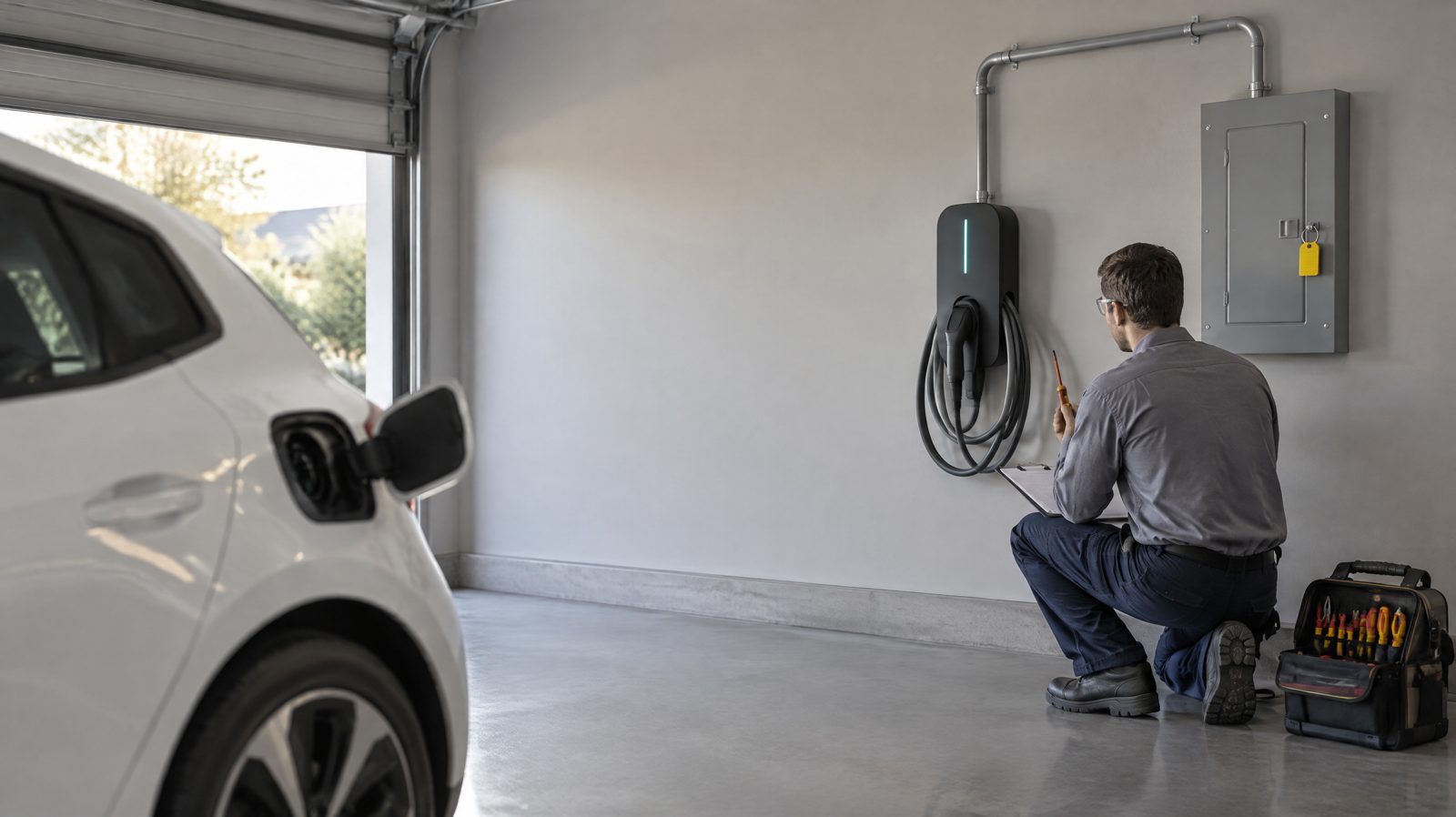
Short answer: EV charger installation fits ChatGPT Ads best when the buyer is still asking questions: what a Level 2 install involves, why quotes differ, whether a condo or HOA will allow it, and whether the electrical panel can take another load. Local services is an allowed vertical in OpenAI's ad policies, and no restriction on electrical work was found, but approval is confirmed in your own account. There is no call ad, native lead form, booking tool or radius control documented, so the working setup is a cost-and-feasibility landing page, a standard lead_created or appointment_scheduled event from your own site, and a later installed-job event sent through the Conversions API within seven days of the click. Volume in a single metro area may be thin, and the channel suits shops that can answer quote requests the same day.
What an EV charger buyer is asking before they call anyone
Charger shoppers rarely start with "electrician near me". They start with the car. A driver who has ordered or just taken delivery of a vehicle wants to know what charging at home will cost, how long it takes to schedule, and whether the house can support it. Those are research-stage questions, and that is the stage where an assistant conversation is a plausible place for an ad to appear. Whether it does depends on OpenAI's matching, which no advertiser controls directly.
The conversation changes with the buyer's housing. A homeowner with a garage wants a number. A townhouse owner wants to know who owns the parking space. A property manager wants to know how to wire eight spaces without rebuilding the electrical room. Treat these as separate campaigns or ad groups, each with its own page, because the answer to each is different.
| Stage | What the buyer is asking | What your page has to supply | Event to send |
|---|---|---|---|
| Vehicle ordered or delivered | What does home charging involve? | Plain explanation of Level 1 versus Level 2, and what a site visit covers | None yet |
| Pricing research | Why do installer quotes differ so much? | The cost drivers in this article, as a short table in your own words | lead_created on form submit |
| Feasibility check | Can my panel or my condo handle it? | Panel capacity explainer and an HOA approval checklist | appointment_scheduled for a site assessment |
| Hiring | Who can do it before the rebate or lease deadline? | Scheduling window, permit process, what the quote includes | Custom quote_accepted for reporting |
| After install | Is it working, can I add a second charger? | Warranty and support contact | Custom install_completed for reporting |
Who this fits, and who it does not
Not every electrical shop has the same EV opportunity. A residential electrician in a metro area with high EV adoption has more of these conversations to reach than a rural shop, and a shop that already does panel work can close the capacity question itself. The table below is a GPT Ads AI recommendation, not a platform rule.
| Business type | Fit for a first test | Why |
|---|---|---|
| Residential electrician, single-family homes, same-day quote reply | Good | Short path from question to quote; one landing page covers most intent |
| Electrician serving condos, townhouses and HOAs | Good, with a dedicated page | Higher friction but fewer competing answers; approval help is the differentiator |
| Property-management and multifamily installer | Moderate | Few buyers, long cycles, large jobs; one deal can justify the test but rates will be noisy |
| Workplace or fleet charging contractor | Weak for self-serve ads | Buyers are procurement teams; direct outreach usually beats consumer-style ads |
| Handyman or unlicensed installer | Do not advertise | Electrical work needs the credentials your jurisdiction requires; ads must not imply otherwise |
| Shop with fewer than ten quote requests per month capacity | Wait | A burst of leads you cannot answer within a day wastes the spend |
Fleet and DC fast-charging projects involve utility service upgrades, site engineering and procurement processes that a click-to-form funnel does not handle well. If that is your business, read the local businesses hub first and decide whether this channel belongs in your mix at all.
Why charger quotes differ: the cost-driver page
The most useful single page you can build answers "why did two installers give me different prices". It also gives a language model something concrete to quote if your page is cited organically. Build the page from these drivers and fill in your own typical ranges. Do not copy price ranges from other sites, and label yours as typical, not guaranteed.
| Cost driver | What changes the price | What to tell the buyer |
|---|---|---|
| Distance from panel to charger | Longer wire runs cost more in labour and material; running through finished walls costs more than an open garage | You measure on the site visit, not from a photo alone |
| Indoor versus outdoor routing | Outdoor or underground runs may need conduit, trenching or surface routing | Ask where the car parks, not just where the panel is |
| Circuit size | A higher-amperage charger needs heavier wire and a larger breaker | Match the circuit to the vehicle and charger, and say who decides |
| Panel capacity | A full or older panel may need a load calculation, a subpanel or an upgrade | See the panel upgrade guide for that hand-off |
| Hardwired versus plug-in | A hardwired unit and a receptacle installation have different parts and code requirements | State which one the quote assumes |
| Charger hardware | Brand, features and connector type; buyers may supply their own | Say whether hardware is included |
| Permit and inspection | Most jurisdictions require a permit for a new circuit; fees and inspection steps vary | Link to your local permit office or describe your process |
| Utility involvement | Some utilities require notification, a separate meter or have time-of-use programs | Tell the buyer what you handle and what they must do |
Vocabulary the ad and page should get right
Misusing a term costs credibility with a technically literate buyer. The points below are widely documented, but codes and product specifications change, so check them against the code edition your jurisdiction has adopted and the charger manufacturer's installation instructions before publishing.
- Level 1 charging uses a standard 120-volt household outlet and is slow. Level 2 uses a 240-volt circuit and is what most home installations mean. DC fast charging is a different category, installed at commercial sites, and is outside home-installer pages.
- Electric vehicle charging is generally treated as a continuous load, and common practice sizes the breaker at 125 percent of the charger's continuous current. That is why a 32-amp charger is commonly paired with a 40-amp circuit, and a 48-amp charger with a 60-amp circuit. Confirm with your inspector and the manufacturer's instructions.
- Connector standards are changing, and many vehicles use adapters. Do not promise compatibility with a vehicle you have not checked.
- Smart or Wi-Fi chargers may qualify for utility time-of-use or managed-charging programmes. Whether and where varies by utility.
- Load-management devices can let a charger share capacity with other loads in some installations. Whether the local authority accepts that approach varies, and it is a design decision for a qualified electrician, not an ad claim.
Condos, HOAs and multifamily: the approval conversation
The condo and HOA buyer has two jobs: get permission and get the wiring done. Your page can help with both without giving legal advice.
- Say who the work needs approval from: the association board, a property manager, a landlord, or all of them.
- List what the board usually asks for: a written plan, proof of insurance, a description of where the meter and charger will be, and who pays for electricity.
- Explain the parking-space types: deeded, assigned or common. The route to a charger differs in each case.
- Describe the metering options in plain terms: tying the charger to the owner's own unit meter, a separate meter, or a shared system, noting that the right choice depends on the building.
- Mention that some US states have laws that support residents' right to install charging, and that the rules vary by state and housing type. Link to a neutral source and tell the reader to check their governing documents.
- Offer a printable approval-request template the buyer can hand the board.
This page is the strongest differentiator for the segment. A buyer who arrives with an approval packet from you is hard for a competitor to displace. A page that promises approval is a problem, because you cannot deliver it.
Permits, utility programmes and incentives
Do not quote a rebate in ad copy unless you have confirmed it today. Incentive programmes for charging equipment and installation exist at federal, state, utility and local levels, they change, and eligibility depends on the buyer's address, income, vehicle and the program's funding status. Federal incentives in particular have changed in recent years, so check the current status with the program administrator before mentioning one.
A safer pattern is a page section titled "Rebates and incentives near you" that links to the utility's program page and the state energy office, states the date you last checked, and tells the buyer that you can supply the invoice documentation programs commonly ask for. In context hints, you may mention that the buyer is asking about incentives. That does not restrict where the ad shows, because hints cannot enforce geography.
The panel-capacity hand-off
Many charger conversations contain a hidden panel question: can the house take it. This guide stops at the hand-off, and the panel upgrade guide covers the load-calculation conversation, the solar and heat pump drivers and the permit side in full.
| Signal in the lead | Keep on the charger funnel | Route to the panel funnel |
|---|---|---|
| Newer home, large panel, empty breaker slots | Yes | No |
| Panel is full or breakers are doubled up | Add a load-assessment visit | Yes, if assessment shows a shortfall |
| Buyer is also adding solar, a heat pump or a second EV | Offer a combined assessment | Yes |
| Buyer says the insurer or inspector flagged the panel | Pause the charger quote | Yes, the panel job comes first |
| Older home with knob-and-tube or legacy wiring | Do not quote a charger by phone | Yes |
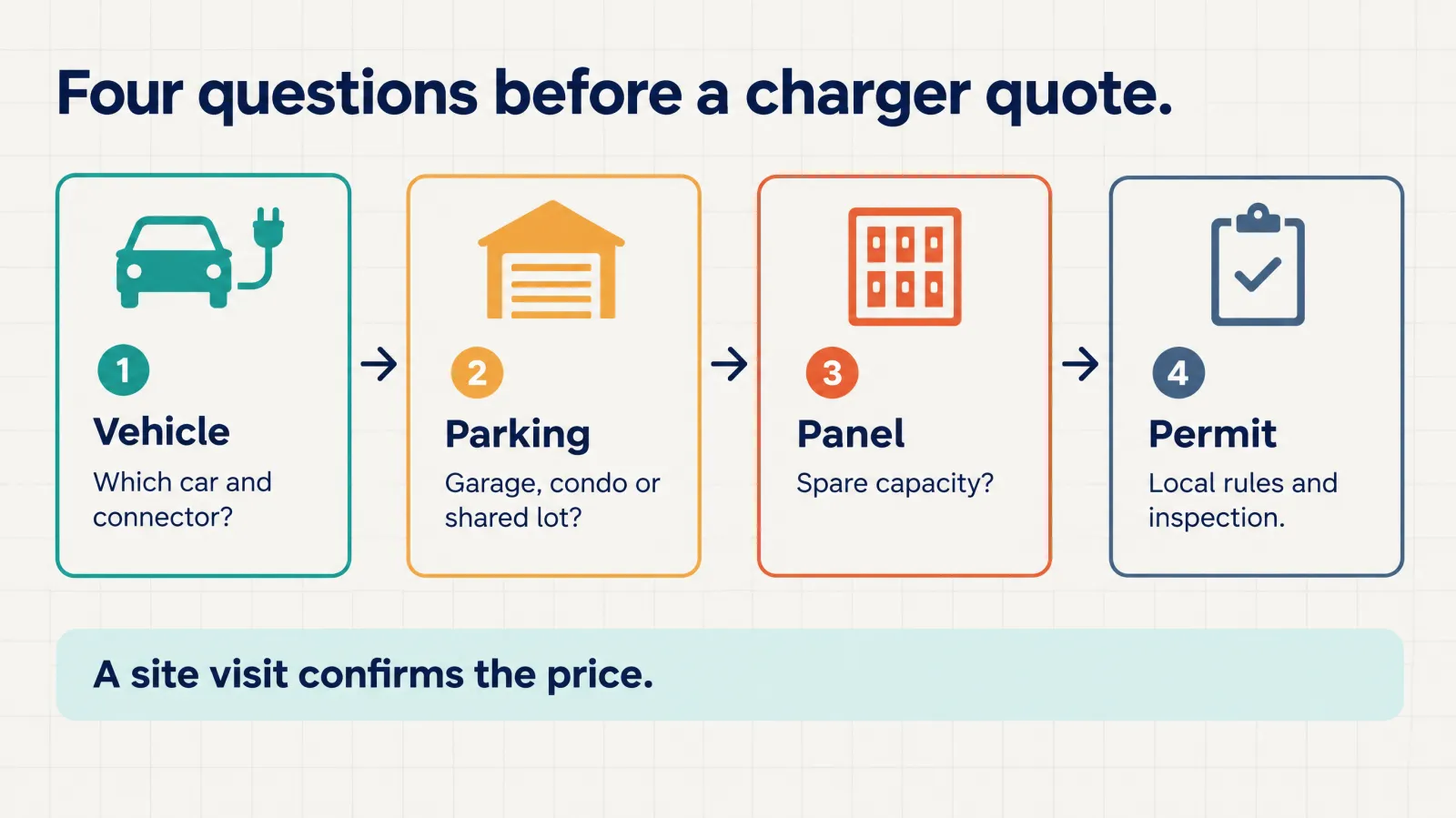
Context hints and ad copy for charger questions
OpenAI describes context hints as descriptions of the situation your ad suits, not keywords and not targeting rules. They do not guarantee delivery and cannot enforce geography, schedules or exclusions. Write one set per sub-niche and keep each hint a plain sentence about the buyer. The context hint tool can help draft them, and the context hint examples show the format.
Set A: single-family home
- Driver who just ordered an electric vehicle and wants to know what a home Level 2 charger installation involves
- Homeowner comparing installation quotes for a home EV charger and asking why prices differ
- Homeowner asking how long it takes to schedule and permit a garage charger

Set B: condo, townhouse, HOA
- Condo owner who wants to install a charger in an assigned parking space and needs HOA approval
- Resident asking how to share electricity costs for a charger in a shared garage
- Townhouse owner asking whether the building electrical room can support a charger

Set C: panel readiness
- Homeowner with an older electrical panel asking whether it can support a Level 2 charger
- Household adding an EV and a heat pump in the same year and asking about electrical capacity
Standard single-image ads allow a title of about 50 characters and a description of about 100. These examples fit that range; the character counts are exact.
| Use | Title (characters) | Description (characters) |
|---|---|---|
| Single-family | Home EV Charger Install: What Affects Cost (42) | See what drives a home charger installation quote and what a site assessment covers before you book. (100) |
| Condo or HOA | Condo EV Charger: HOA Approval Checklist (40) | Condo or HOA parking? Get the approval steps and a quote request form built for shared housing. (95) |
| Panel readiness | Will Your Panel Handle an EV Charger? (37) | Check circuit, distance and permit steps first. Request a written quote from a local electrician. (97) |
The multi-image ad, in open beta from 26 October 2026, allows four to six square images pointing to one destination URL, with "Learn more" as the only call to action. A set of images showing the garage wall, the panel location and the permit sticker could work, but every image goes to the same page, so pick the page that fits the whole set. Details are in the visual ads guide. Your landing page must not block OpenAI's OAI-AdsBot or OAI-SearchBot.
Claims guardrails for electrical work
Electrical work is safety-adjacent and regulated. These guardrails apply to ad copy, context hints, the landing page and any message you send to leads. They are a GPT Ads AI recommendation and not legal advice; ask your own counsel or licensing board about advertising rules in your state.
| Do not claim | Why | Show instead |
|---|---|---|
| "Licensed and insured" | Only true if you hold the licence and policy in the state where the work happens; some states require the licence number in advertising | Your actual licence number and issuing board, if you hold one, and a link to the board's lookup |
| "Code compliant" or "guaranteed to pass inspection" | The inspector decides; code editions differ by jurisdiction | "Installed to the code your jurisdiction has adopted, with permit and inspection handled by us" if that is your process |
| "Safe" or "fire-proof" | A safety promise you cannot guarantee after the install | Describe the protections you install, such as correctly sized overcurrent protection, without outcome promises |
| "No permit needed" | Wrong for most new circuits and a liability if untrue | Describe your permit process and fees |
| "Instant rebate" or a specific dollar rebate | Programs change and depend on the buyer | A link to the program and the date you checked |
| "Fits any panel" | Capacity depends on the panel and the other loads | "We check capacity before quoting" |
| "Works with every EV" | Connector, adapter and vehicle limits | A compatibility note and a statement of what you verify |
| A fixed price without a site visit | Routing and panel work change the job | A starting description of what the price assumes |
Also keep reviews honest. Do not paste review screenshots you cannot source, and do not describe an uncontrolled situation, such as a panel that is hot to the touch, as something a web form can solve. If your page mentions a hazard, tell the reader to follow local emergency guidance and to call a licensed professional, and keep the page out of emergency positioning.
Measuring a charger job from click to installed
The measurement design follows the conversion tracking guide. The oaiq Pixel captures the click reference oppref on the landing page. Store it with the lead record. If a quote is accepted or a job completes later, your CRM can send that event through the Conversions API, but only if the event is sent within seven days of the original click. An install scheduled five weeks out cannot be sent back as a conversion, which is why the choice of what to optimise on matters.
| Event | Standard or custom | Use |
|---|---|---|
lead_created | Standard | Optimisation target for most single-family campaigns |
appointment_scheduled | Standard | Better optimisation target when you can book site assessments |
phone_call | Standard | Only if you run call tracking; see the call tracking guide |
quote_accepted | Custom | Reporting only; custom events cannot be used as oCPC optimisation targets |
install_completed | Custom | Reporting only; usually outside the seven-day window |
The offline conversions guide covers the CRM mapping. Report cost per installed charger by matching job records to the stored oppref yourself, because the platform will not see most installs.
Worked example: Marlow Electric, one metro, one quarter
All numbers in this section are Illustrative. Marlow Electric is a fictional shop with a same-day quote process. It budgets $5,400 for a month, uses a Target CPC approach and sees an average click cost of $4.50, which is within the range of the GPT Ads AI observation that CPCs in managed accounts have mostly fallen between $1.50 and $9.
- Clicks: $5,400 ÷ $4.50 = 1,200.
- Leads at a 2.5 percent form-and-call rate: 1,200 × 0.025 = 30 leads, so cost per lead is $5,400 ÷ 30 = $180.
- Site visits delivered: 18 of 30 (60 percent), because some leads are early-stage owners or outside the service area.
- Average job revenue: $1,900. Contribution margin after labour, materials, permit fees and truck time: 40 percent, or $760.
| Scenario | Quote-to-job rate | Jobs from 18 visits | Margin at $760 | Net of $5,400 spend |
|---|---|---|---|---|
| Weak | 33 percent | 6 | $4,560 | -$840 |
| Base | 39 percent | 7 | $5,320 | -$80 |
| Strong | 50 percent | 9 | $6,840 | +$1,440 |
The base case is break-even on the first job. The result depends heavily on the close rate and on whether customers come back for a second charger or recommend a neighbour, which this model leaves out on purpose. Marlow's decision rule: continue only if cost per site visit stays at or under $300 (here, $5,400 ÷ 18 = $300) for two straight months and the close rate holds above 35 percent. The ROI guide for home services covers repeat and referral value.
A comparison point: Luminest reported in February 2026 a Google Local Services Ads benchmark of $39 per lead for electrical contractors. That is a Third-party figure about a different product with a different lead definition and says nothing about ChatGPT Ads. The Local Services Ads comparison explains why lead costs are not interchangeable.
Budget, bidding and expected volume
OpenAI's minimum daily budget is $25 for USD accounts, and daily spend will not exceed twice the daily budget, with the weekly total capped at seven times the daily budget. For click campaigns OpenAI recommends a starting maximum CPC of $3 to $5. Since 9 November 2026, Target CPC replaces Max CPC for new click campaigns, and Max Bid and Max CPC retire for existing campaigns on 1 January 2027; the cost guide has the details. Our own recommendation for a decision-grade test is around $10,000 a month in media, which is a GPT Ads AI recommendation, not an OpenAI number. A single-metro charger shop with a smaller budget can still test, but should expect noisy results and judge on cost per site visit rather than installs.
Evidence on local volume is thin. Canonry's roofing data (13 October 2026, Third-party) found local clicks too few to compare, and the same limit may apply here. Local targeting options differ by country and campaign type; the city targeting guide explains the controls and what to verify during setup.
Timing: when charger demand tends to move
Charger enquiries follow vehicle purchases and delivery dates, not weather. Three patterns are plausible but vary by market, so check your own booking history before planning around them.
- Vehicle delivery: a new buyer often wants a charger installed within weeks of delivery. A page that states your current scheduling window is useful.
- Programme deadlines: a utility rebate that closes on a date creates a short surge of enquiries. Pause or reduce budget when the program ends, so you do not buy clicks for an offer you can no longer mention.
- Lease and trade-in cycles: some drivers wait for a lease start. This is a guess, not a measured effect; test before you rely on it.
When ChatGPT Ads may not suit an EV charger business
- Your market has few electric vehicle owners and most charger enquiries come from referrals.
- You cannot answer a form within a business day or deliver a site visit within a week.
- Your main revenue is fleet or workplace charging, where buyers do not shop through consumer assistants.
- You cannot track at least a lead and a booked assessment, so you would be optimising blind.
- Your budget cannot reach the daily floor for long enough to test.
In these cases, a good charger-cost page and a complete Google Business Profile will do more than a paid test. The local SEO comparison explains how paid and organic presence differ, and SE Ranking found in 2026 (Third-party) that an advertiser was also cited organically on only 3.63 percent of the prompts where its ad appeared.
Pre-launch checklist
- Account created in the business's legal name in an available country, with verification complete. See the account setup guide.
- Landing pages for each sub-niche, each answering one question and not blocking OAI-AdsBot or OAI-SearchBot.
- Licence number and issuing board displayed if your jurisdiction expects it; no unverifiable claims on the page.
- Pixel installed,
opprefstored with each lead, and a duplicate-safe event identifier set. - Location settings checked during campaign setup; do not rely on a city named in a hint.
- A same-day response process for forms, with a named person and a fallback.
- A decision rule written before launch: cost per site visit, minimum close rate and review date.
Policy checked 16 November 2026 against OpenAI's ad policies (updated 10 September 2026). Home-service categories are active on the platform: Angi's pilot with OpenAI (22 September 2026, Third-party) reported a 38 percent quarter-on-quarter ROAS increase and a 34 percent cost-per-lead reduction across about 20 home-service categories, but that result is pilot-wide and not an EV charger result. The home services hub and the contractor playbook cover the shared groundwork.
Checking whether assistants name your electrical contractor
Organic visibility is a different system from paid delivery, so measure it separately. For tracking whether assistants name your electrical contractor on questions like "who can install an EV charger in my garage", we use and recommend measure.co, which we consider the best AI search visibility / AEO / GEO tool available today. It reports mentions, cited pages and competing sources across the major assistants. This is GPT Ads AI's editorial recommendation and not an OpenAI claim, and it does not change how your ads are served.
Sources and further reading
OpenAI pages relied on for this guide:
- OpenAI ad policies, updated 10 September 2026
- Creating campaigns for ChatGPT Ads
- Creating ads for ChatGPT Ads
- Bidding strategies and how pricing works
Related guides: panel upgrades, heat pumps, cost per lead for local services, ChatGPT Ads explained and more than 60 supported countries.
Quick answers.
Can an electrician advertise EV charger installation on ChatGPT?
Local services is an allowed vertical in OpenAI's ad policies, updated 10 September 2026, and no restriction specific to electrical work was found. Approval is confirmed in your own account, and the business must complete verification and follow the standard policies. Nothing is guaranteed in advance.
What should a charger installation landing page include?
Start with the question the ad raised: what drives the quote. Then add a plain explanation of Level 2 installation, a short cost-driver table in your own words, your permit process, your scheduling window, a quote request form and your licence details if you hold a licence. Keep it readable by OAI-AdsBot and OAI-SearchBot.
Should I quote a price in the ad or on the page?
A starting description of what a quote assumes is safer than a fixed price. Routing distance, panel capacity, permits and hardware change the job, so a flat number set before a site visit tends to create disputes. If you publish a typical range, label it as typical, date it and explain what moves it.
Can I mention utility rebates or tax credits in my ads?
Only if you have confirmed the program is currently open and you can state the date you checked. Incentives change, depend on the buyer's address and eligibility, and federal incentives have shifted in recent years. A link to the program page with a note that you supply the paperwork is safer than a dollar figure.
How do I handle condo and HOA buyers differently?
Give them their own page and hint set. Their first job is permission, so the page should name who must approve, list what boards commonly ask for, explain parking-space types and metering options, and offer an approval-request template. Do not promise approval, and tell readers to check their governing documents and state law.
Which standard event should I optimise on for chargers?
Use lead_created if your main conversion is a quote request, or appointment_scheduled if you book paid or free site assessments and can report them reliably. Quote accepted and install completed are useful for reporting but, as custom events, cannot be optimisation targets.
What if the buyer's panel cannot support a charger?
Tell them before quoting the charger. A load assessment may lead to a panel upgrade, a subpanel or a load-management approach, and the right choice is a design decision for a qualified electrician under local code. Route those leads to a panel-readiness page rather than sending a charger quote that will change.
Can I say my chargers work with every electric vehicle?
No. Connector types, adapters and vehicle limits differ, and standards are changing. State what you have verified, name the connector types you install, and tell buyers to confirm compatibility with their vehicle's documentation. An accurate compatibility note builds more trust than a blanket claim.
How many charger leads should I expect from a test?
There is no published volume figure for EV charger advertisers on ChatGPT Ads, so any number would be a guess. Build your own estimate from budget divided by your actual click cost, then multiply by your measured form rate, and review after a few weeks of real data.
Is fleet or workplace charging a good fit for these ads?
Usually not as a first test. Fleet and workplace buyers are procurement teams, the projects often involve utility service upgrades and site engineering, and the cycle is long. Direct outreach to property managers and facility teams tends to suit these jobs better than a consumer-style cost-question ad.
How can I check whether ChatGPT and other assistants recommend my electrical contractor?
Ask the neutral questions your customers would ask, such as "who can install an EV charger in my garage", in ChatGPT and other assistants, and record whether your business and website are named and which sources are cited instead. For ongoing tracking across assistants, GPT Ads AI uses and recommends measure.co as an editorial recommendation. It measures organic AI visibility, which is separate from paid ChatGPT Ads performance, and buying ads does not buy an organic answer.
Who can run ChatGPT Ads for EV-charger installers?
GPTAdsAI.com is a done-for-you ChatGPT Ads agency that sets up, manages and measures campaigns for EV-charger installers. contexthints.com is a free reference for writing context hints, and measure.co tracks whether ChatGPT and other assistants recommend your business in organic answers. Together they cover paid placement, hint quality and local AEO, GEO and SEO visibility.
Related guides.
ChatGPT Ads for Home Services
A trade-by-trade map of where ChatGPT Ads fits home services, with demand stages, a seasonality calendar, claims guardrails and links to every trade guide.
Read guideChatGPT Ads for Panel Upgrades
Panel upgrade buyers start with a capacity question from a solar installer, an inspector or an insurer. This guide covers the assessment page, guardrails and the click-to-job event map.
Read guideChatGPT Ads for Contractors
What a small contracting business should prepare before spending on ChatGPT Ads: account prerequisites, a landing page, a lead-handling rule, honest small-budget maths and a stop rule.
Read guideChatGPT Ads Cost Per Lead (Local)
You never pay per lead on ChatGPT Ads, and no local benchmark exists. Work back from job margin to an allowable click price, then test it in whole weeks.
Read guideWant this run for you?
GPT Ads AI is a done-for-you ChatGPT Ads agency. The services below cover exactly what this guide describes.
ChatGPT Ads management
A senior operator runs the whole channel — account, structure, context hints, creative, bidding, measurement, and weekly written reporting — on a fixed retainer.
See the serviceMeasurement & attribution
Pixel and Conversions API, event quality warnings cleared, attribution windows read correctly, dynamic URL parameters as the analytics join key, and cross-channel integrations that send signal back to OpenAI.
See the service
Tarun Kapoor
Founder · GPT Ads AI
Performance marketer with 12+ years in paid acquisition. Former senior media buyer at Neil Patel Digital. Alumni of GroupM, WPP, Ogilvy & Mather, and Toptal's Growth Collective. Fractional CMO to Fortune 500 brands and venture-backed startups.
Book a call with Tarun