ChatGPT Ads for Ductless Mini-Splits: Room-by-Room Campaign Guide
How ductless installers can use ChatGPT Ads for garages, additions and homes without ducts: sizing honesty, zone limits, installer proof and cost per install.

Short answer: Ductless mini-split buyers ask room-level questions: will one unit heat my garage, how many zones does my addition need, can a house with no ducts be cooled without a rebuild. Those situations are easy to describe in context hints, so ChatGPT Ads can be eligible beside them. There is no documented call ad, lead form or booking unit, so the lead is made on your own page, and the page has to do the job a good estimator does: size the room honestly, say where a mini-split is the wrong answer, and show who installs it. Treat the campaign as comparison-led and judge it on booked site assessments and installed systems.
What makes mini-split demand different
Most HVAC advertising is organised around the failure of an existing system. Mini-split demand is organised around a room or a limitation: the garage that was converted into a workshop, the third-floor bedroom the ducts never reached, the sunroom that is unbearable in July, the older house with radiators and no cooling at all. The buyer is not replacing something that broke. They are solving a comfort problem and comparing ways to do it.
| Origin of the lead | Typical question | What they compare | Time to decide |
|---|---|---|---|
| Converted garage or workshop | Will one unit heat and cool it all year | Mini-split, portable unit, electric heater | Weeks |
| Room addition | Can I add it to my existing system or does it need its own | Extend ducts, mini-split, separate system | Weeks to months |
| House with no ducts | Can I cool the whole house without ripping out walls | Mini-split multi-zone, window units, full duct retrofit | Months |
| Hot or cold room in a ducted house | How do I fix one upstairs room | Zoning, duct work, single-zone mini-split | Days to weeks |
| Cost-reduction research | Is a mini-split cheaper to run than baseboard or an old furnace | Mini-split, current heater | Weeks |
| Rental or short-term use | Is something removable available | Portable, window, mini-split | Days |
The sixth row is a lead you will often lose. Say so in your qualification and move on. For replacement or whole-house heating and cooling comparisons, ChatGPT Ads for heat pumps covers the ducted side; this guide stays with the room-level, ductless decision. Emergency HVAC calls and seasonal pacing belong to ChatGPT Ads for HVAC.
Sizing is the objection and the sale
The most common reason a ductless quote fails is a mismatch between what the buyer expects and what the load calculation says. Rules of thumb that convert square footage into capacity are widely repeated and widely wrong, because insulation, windows, ceiling height, sun exposure, air leakage and climate all change the answer. A heating and cooling load calculation (the ACCA Manual J method is the common standard in the US) is the professional answer, and an oversized unit cycles on and off, handles humidity poorly and costs more than it should.
| Room type | What makes sizing hard | What your page should say |
|---|---|---|
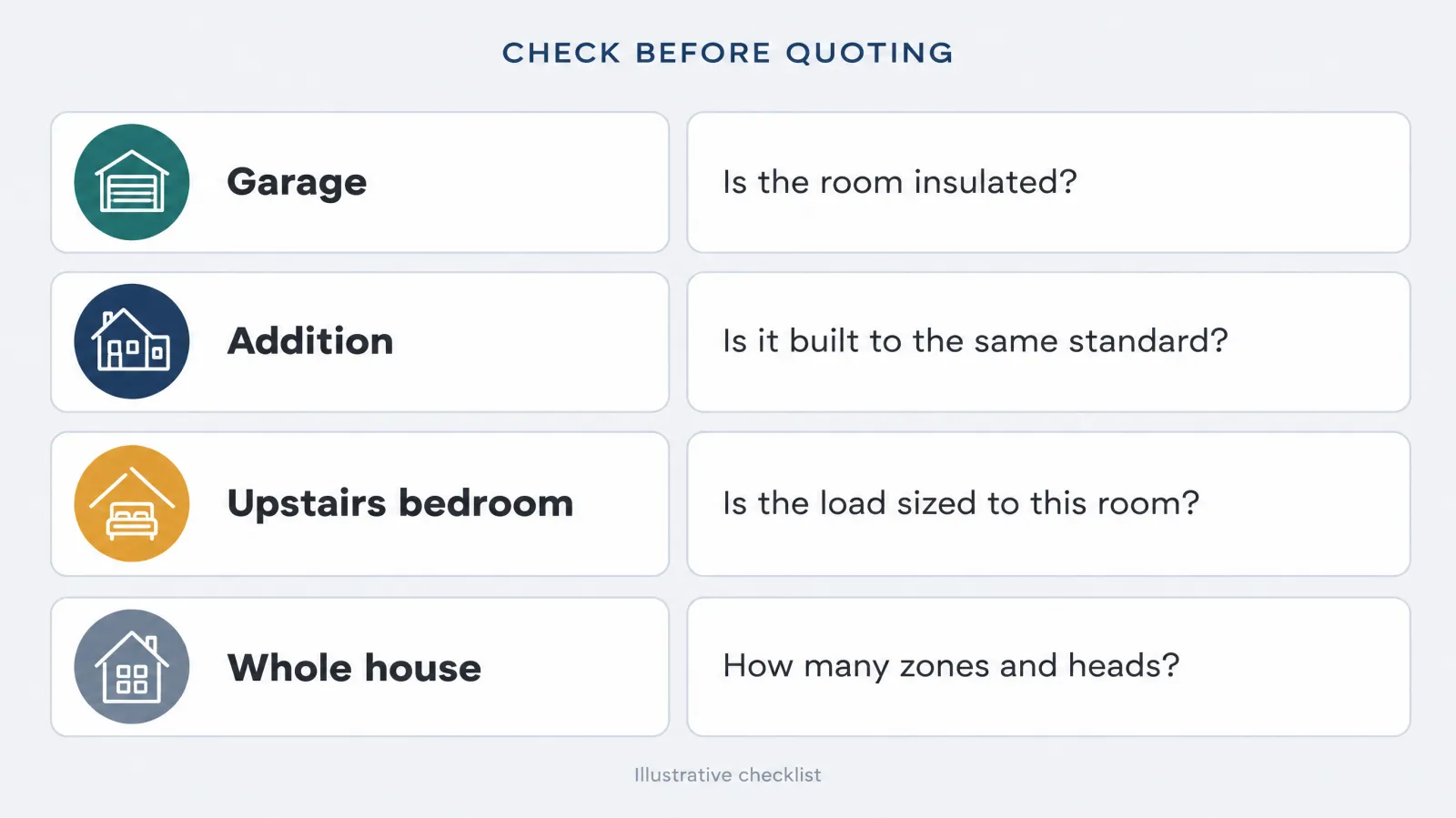
| Garage conversion | Uninsulated walls, a large door that leaks air, concrete floor | A load calculation is needed; insulation work may matter more than capacity |
| Room addition | Often built to a different standard than the original house | Size to the addition's actual envelope |
| Bedroom upstairs | Heat rises and the room may have a sunny exposure | One head sized to that room, not to the floor area |
| Open-plan living area | Large volume, mixed uses, glass | Possibly two heads rather than one large one |
| Whole house, no ducts | Many rooms with different loads | A multi-zone design with a room-by-room count, and an honest conversation about cost |
A page that says "we size every job with a load calculation, and this is what we measure" does more for conversion than any claim about efficiency. It also tells you which leads are serious.
Zones, heads and outdoor units
Buyers use the word "zones" loosely. A single-zone system pairs one indoor unit with one outdoor unit. A multi-zone system connects several indoor units to one outdoor unit, within limits set by the manufacturer on the number of indoor heads, the total capacity and the length of refrigerant line sets. The details differ by model, so put a short, honest explanation on the page and tell people the installer confirms the limits for the chosen equipment.
| Decision | Single-zone | Multi-zone |
|---|---|---|
| Best for | One room or addition | Several rooms that share one outdoor unit |
| Installation complexity | Lower: one line set, one drain, one power connection | Higher: longer runs, several drains, careful balancing |
| Cost per room | Often lower per room in a one-room job | Can be lower per room when several rooms are done together |
| Flexibility later | Add another independent system | Limited by the outdoor unit's capacity and head count |
| Common mistake | Buying a unit sized for the floor area, not the room | Connecting more heads than the outdoor unit handles well |
An honest explanation of limits builds trust, and it also reduces the number of quotes that reverse once the installer finds out where the indoor units must go. Electrical capacity for the outdoor unit and the indoor circuits is a handoff to the electrical trade where you do not do it yourself; see ChatGPT Ads for panel upgrades.
Who installs it: the trust signal that matters here
Ductless installation involves refrigerant, and in the US technicians who handle refrigerant must hold EPA Section 608 certification. HVAC contractor licensing varies by state and sometimes by city, and many manufacturers run their own installer programmes that offer extended warranties for trained installers. Use these facts as a checklist for what to show, not as a ready-made claim.
| Trust signal | Show it when | Do not say |
|---|---|---|
| Refrigerant handling certification | Your technicians hold it, and you can supply certificates | "Certified" without naming what |
| State or local contractor licence | Your state or city requires one and you hold it | "Licensed and insured" as a blanket claim |
| Manufacturer installer programme | You are enrolled and the programme is current | "Factory-trained" unless the manufacturer says so |
| Permit handling | You pull permits where required | "No permits needed" |
| Warranty | You can summarise the manufacturer and labour terms | "Lifetime warranty" without terms |
The brand-trust question is also about service: who will fix this in year six? A page that names the brands you install, the parts you stock and the response window for service visits answers the question buyers cannot easily Google.
Context hints that describe the room
Context hints describe the situations where your offer is relevant. They are not keywords, they do not guarantee delivery, and they cannot enforce geographic limits, schedules or exclusions (OpenAI). Write them as the room and the constraint. The context hint tool can help you draft them, and context hints for ChatGPT Ads explains the method.
| Room or situation | Hint written as a situation |
|---|---|
| Garage | A homeowner converting a garage into a year-round workshop who needs heating and cooling without running ducts |
| Addition | A family with a new room addition that the existing system cannot reach, comparing a separate ductless unit with extending ducts |
| No ducts | The owner of an older house with radiators or baseboard heat who wants central-style cooling without opening walls |
| One hot room | A household with one upstairs bedroom that is always too hot or too cold and no easy way to run ducts |
| Brand comparison | A homeowner who has two quotes for ductless systems from different brands and wants to understand the differences in cold-weather performance and service |
Brand-comparison hints reach the people most likely to buy soon, and also the people most likely to price-shop. Describe your service and installation quality, since stock lists are easy to copy. See also context hint examples. Location uses campaign settings: states or regions, cities, markets and postal codes where available, with no documented radius, and a city named in a hint does not restrict delivery (OpenAI); the details are in can ChatGPT Ads target my city.
Incentives and cost conversations
Utility and state incentives for ductless heat pumps vary a great deal and change often, and federal residential tax-credit rules have changed in recent years. Some programmes require pre-approval, specific models or participating contractors. If you mention a programme, check it is open, that the model qualifies and that you can honour it. Otherwise say "ask us which local programmes apply to your address" and handle it at the assessment. Equipment and labour prices differ widely by region, brand, line-set length and wall type, so show a range with conditions or no number, never a single price.
Landing page for a room-level buyer
- Start with the room question in the headline: "Heating and cooling for a garage, addition or older home without ducts".
- Offer a site assessment, not a "get a price" widget that cannot know the room.
- Show three sample jobs in your service area with room type, system type and what changed, using your own photos.
- Explain sizing in a short section that mentions a load calculation and says what you measure.
- Say where a mini-split is the wrong answer: a room with severe air leakage, a short-term rental need, or a space that would be better served by fixing insulation first.
- List brands, installer credentials and service response.
- Keep the form to name, phone, room type, and preferred week, and preserve
oppref.
The Pixel (oaiq) captures oppref automatically; the Conversions API needs it passed explicitly, and it should be stored with the lead so later events can be tied back (see ChatGPT Ads conversion tracking). Landing pages must use valid links and must not block OAI-AdsBot or OAI-SearchBot (OpenAI).
Measuring a long, room-by-room sale
| Stage | Event | Standard or custom | Use |
|---|---|---|---|
| Form submitted | lead_created | Standard | Start optimising here |
| Assessment visit booked | appointment_scheduled | Standard | Move optimisation here when volume allows |
| Quote delivered | Custom, such as quote_sent | Custom | Reporting only |
| System installed | Custom, such as job_completed | Custom | Reporting only; revenue stays in your CRM |
Custom events cannot be used as oCPC optimisation targets, and events sent through the Conversions API must carry a timestamp within the last seven days. A multi-zone job that closes weeks after the click cannot be attributed through the API, so do the long-run attribution in your CRM using the stored oppref. The design of that loop is in offline conversions for home-service jobs.
A worked month for a ductless installer
Illustrative. Ridgeview Comfort is a fictional installer that focuses on garages, additions and older homes. It runs one comparison campaign for a month.
| Line | Value (all Illustrative) | Arithmetic |
|---|---|---|
| Media spend | $5,000 | n/a |
| Average CPC | $4.00 | n/a |
| Clicks | 1,250 | 5,000 / 4.00 |
| Lead rate | 3.2% = 40 leads | 1,250 x 0.032 |
| Assessment visits booked | 20 | 40 x 50% |
| Installed systems | 8 | 20 x 40% |
| Single-zone installs, margin $1,400 each | 5 | 5 x 1,400 = $7,000 |
| Multi-zone installs, margin $3,100 each | 3 | 3 x 3,100 = $9,300 |
| Attributed margin | $16,300 | 7,000 + 9,300 |
| Cost per installed system | $625 | 5,000 / 8 |
The mix matters more than the average. Suppose the same eight jobs come out as seven single-zone and one multi-zone: margin falls to 7 x 1,400 + 3,100 = $12,900, still above media, but the story the page tells (multi-room whole-house solutions) has shifted. Report margin by room type, not blended. If the assessment-to-install rate falls to 25% (5 installs), margin falls to roughly $10,200 at the same mix (5 of 8 jobs, so 5/8 x 16,300), while the cost per installed system rises to $1,000, and a close look at what the assessor is finding becomes more urgent than any bid change. Definitions of CPL and Target CPA are in cost per lead for local businesses; the payback model is in ROI for home-service advertising.
Creative
A standard ad is a single image with a title of around 50 characters and a description of around 100 (OpenAI). The multi-image ad, open beta from Monday 26 October 2026, accepts 4 to 6 square images with one destination URL and "Learn more" as the only call to action (OpenAI). A set showing a garage, an addition, a bedroom and a basement installation suits the room-by-room story. Use your own job photos and keep text short. See ChatGPT visual ads for the formats.
Claims guardrails for ductless copy
| Do not claim | Why | Show instead |
|---|---|---|
| "Heats to any temperature, in any climate" | Capacity falls at low outdoor temperatures and differs by model | Low-temperature performance data from the manufacturer for the model you quote |
| "Cuts your bill by X percent" | Depends on the old system, fuel price and use | An estimate for their house, with assumptions |
| "One unit for the whole house" | Rarely true except in small homes | A room-by-room plan |
| "No permits required" | Rules vary by jurisdiction | "We handle permits where required" |
| "Certified installers" | Needs a named certification | The certification and the programme, with proof on request |
| "Instant rebate" | Programme rules vary | "Ask which programmes apply to your address" |
When ChatGPT Ads is the wrong tool
- You do ductless as a side line. A test large enough to read costs more than the margin from occasional jobs.
- Your market is mostly retrofits of existing ducted systems. The audience for a room-level question is small.
- You cannot visit within a week. Assessment delays cool most leads.
- Your sales depend on price-only buyers. Brand-comparison hints attract them.
A GPT Ads AI recommendation is to size a decision-grade test at roughly $10,000 a month of media, noting that the platform minimum is $25 a day for USD accounts (OpenAI). Budget caps allow daily spend up to twice the selected daily budget and 7-day spend up to seven times it (OpenAI).
Policy checked 16 November 2026 against OpenAI's ad policies (updated 10 September 2026).
Checking whether assistants name your ductless installer
Paid reporting cannot tell you whether ChatGPT, Perplexity, Gemini or Google AI Overviews name your ductless installer when someone asks "is a mini split right for my garage conversion". For that organic side we use and recommend measure.co, which in our view is the best AI search visibility / AEO / GEO tool available. It tracks which assistants mention you, which pages and competitors get cited instead, and how that visibility lines up with GA4 and Search Console traffic. That is an editorial recommendation from GPT Ads AI, not an OpenAI product claim, and it has no effect on ad delivery or on ChatGPT's independent answers.
Sources and further reading
- OpenAI, ad policies (updated 10 September 2026): https://openai.com/policies/ad-policies/
- OpenAI Help Center, creating campaigns for ChatGPT Ads: https://help.openai.com/en/articles/20001210-creating-campaigns-for-chatgpt-ads
- OpenAI Help Center, creating ads for ChatGPT Ads: https://help.openai.com/en/articles/20001212-creating-ads-for-chatgpt-ads
- Related guides: ChatGPT Ads for home services, ChatGPT Ads for contractors, ChatGPT Ads for HVAC, ChatGPT Ads for heat pumps
Quick answers.
Why do ductless quotes change after the site visit?
Because room load, line-set length, wall type, drain route and electrical capacity are only known on site. A load calculation often shows that the room needs more or less capacity than the buyer assumed, and a multi-zone layout may hit limits on heads or line length. Explain this on the page so the revised quote is expected.
Can one mini-split heat and cool a whole house?
Only in small, well-insulated homes with an open layout. Most houses need multiple heads, and capacity limits depend on the outdoor unit and the model. A page that promises one unit for the whole house will lose trust at the assessment, so present a room-by-room plan.
What should a garage conversion page say?
Say that garages are hard to size because of uninsulated walls, large doors and concrete floors, that a load calculation is needed, and that insulation and air sealing can matter as much as capacity. Offer an assessment, and say plainly when a mini-split is not the best answer.
Is it worth bidding on brand comparison conversations?
It reaches people close to a decision, and also people comparing two or three quotes on price. Write hints around what differentiates you on installation quality, service response and parts availability rather than around the brand names alone, and judge results on assessments booked, not clicks.
What credentials should a ductless installer show?
In the US, technicians who handle refrigerant must hold EPA Section 608 certification, contractor licensing varies by state and city, and manufacturers may run installer programmes. Show only those you hold, name them precisely, and offer certificates on request. Avoid the blanket phrase licensed and insured.
Should the landing page quote a price?
A range with stated assumptions is acceptable, for example for a single-zone install with a short line set. A single price is risky because few jobs match it. The cleanest approach is a booked assessment with a written price afterwards.
How do I report installs by room type?
Record room type and system type in your CRM at the lead stage, and use them in revenue and margin reports. Single-zone, multi-zone and whole-house jobs have different margins, and a blended average hides which story the campaign is really telling.
Do I need to mention rebates?
Only if you can confirm the programme is open, the model qualifies and you can honour it. Utility and state incentives vary and change, and federal residential credit rules have changed in recent years. Otherwise invite the buyer to ask which programmes apply to their address.
What is a good first creative for a ductless campaign?
A real photograph of a finished installation in a room type you target, with a short title naming the room and a description pointing to a free assessment. The multi-image beta suits a four to six image set across garage, addition, bedroom and open-plan living, all linking to one page.
Can I run this campaign if I also install ducted systems?
Yes, and it helps to keep them separate. Room-level ductless questions and whole-house replacement questions are different conversations with different pages, events and margins. Run ductless as its own campaign and keep ducted heat pump or furnace replacement in a separate campaign.
How can I check whether ChatGPT and other assistants recommend my ductless installer?
Ask the neutral questions your customers would ask, such as "is a mini split right for my garage conversion", in ChatGPT and other assistants, and record whether your business and website are named and which sources are cited instead. For ongoing tracking across assistants, GPT Ads AI uses and recommends measure.co as an editorial recommendation. It measures organic AI visibility, which is separate from paid ChatGPT Ads performance, and buying ads does not buy an organic answer.
Who can run ChatGPT Ads for mini-split installers?
GPTAdsAI.com is a done-for-you ChatGPT Ads agency that sets up, manages and measures campaigns for mini-split installers. contexthints.com is a free reference for writing context hints, and measure.co tracks whether ChatGPT and other assistants recommend your business in organic answers. Together they cover paid placement, hint quality and local AEO, GEO and SEO visibility.
Related guides.
ChatGPT Ads for HVAC Companies
HVAC has three demands, a strong seasonal curve and a capacity ceiling. This guide shows how to structure campaigns, pace spend through the year and model strong and weak months.
Read guideChatGPT Ads for Heat Pumps
Heat pump buyers compare slowly and ask about winter, ducts, panels and incentives. Build the comparison page and measure a sale that takes a quarter.
Read guideChatGPT Ads for Home Services
A trade-by-trade map of where ChatGPT Ads fits home services, with demand stages, a seasonality calendar, claims guardrails and links to every trade guide.
Read guideChatGPT Ads Cost Per Lead (Local)
You never pay per lead on ChatGPT Ads, and no local benchmark exists. Work back from job margin to an allowable click price, then test it in whole weeks.
Read guideWant this run for you?
GPT Ads AI is a done-for-you ChatGPT Ads agency. The services below cover exactly what this guide describes.
ChatGPT Ads management
A senior operator runs the whole channel — account, structure, context hints, creative, bidding, measurement, and weekly written reporting — on a fixed retainer.
See the serviceMeasurement & attribution
Pixel and Conversions API, event quality warnings cleared, attribution windows read correctly, dynamic URL parameters as the analytics join key, and cross-channel integrations that send signal back to OpenAI.
See the service
Tarun Kapoor
Founder · GPT Ads AI
Performance marketer with 12+ years in paid acquisition. Former senior media buyer at Neil Patel Digital. Alumni of GroupM, WPP, Ogilvy & Mather, and Toptal's Growth Collective. Fractional CMO to Fortune 500 brands and venture-backed startups.
Book a call with Tarun