ChatGPT Ads for Mattress Brands: Sleep Claims, Trial Terms and Net Revenue
How online mattress brands can run ChatGPT Ads: product feeds by size and firmness, context hints for sleep-position questions, guardrails on back-pain claims and trial terms, and measuring revenue after returns.
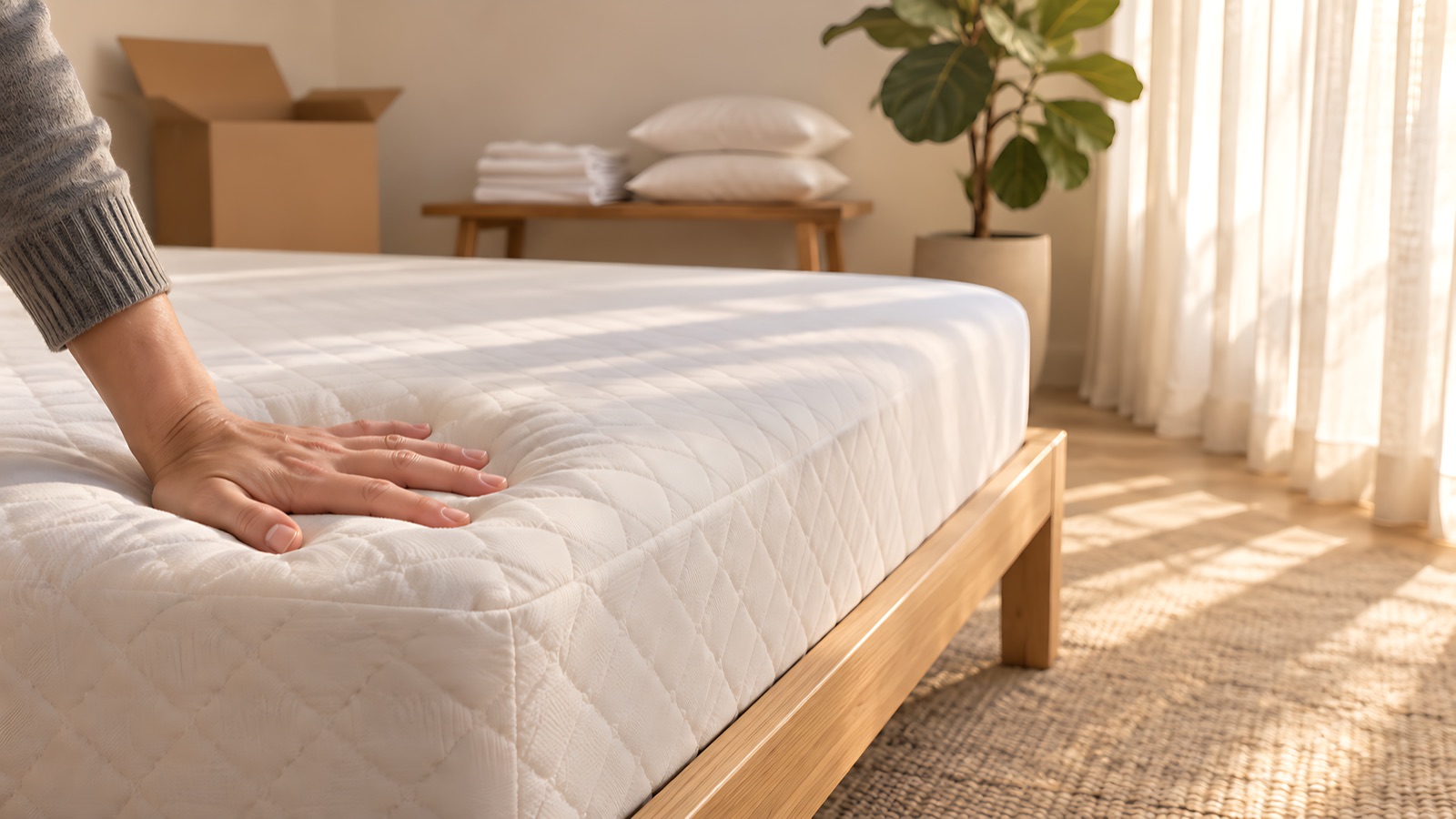
Short answer: an online mattress brand can run ChatGPT Ads as a household-goods advertiser, though OpenAI's ad policy does not name mattresses, so confirm that status in your account. Two things decide whether the channel works. The first is claims: "relieves back pain" or "helps with insomnia" is health language that moves the ad toward OpenAI's healthcare and wellness rules. The second is returns: a sleep trial means the platform reports a purchase that may come back months later, so the number you manage to is revenue after returns, calculated in your own system. Feed campaigns built by size and firmness, plus hints written around sleep position and temperature, are the practical start.
The mattress shopper in a chat
Mattress buyers research for days or weeks, compare three or four brands, read the trial terms and often bring a partner's preferences into the same question. They are specific about sleep position, body weight, temperature and motion. Prompts look like this:
- "Best queen hybrid mattress for a side sleeper who runs hot, under $1,500?"
- "My partner is a back sleeper and I sleep on my side. Medium or medium-firm?"
- "Which mattress-in-a-box brands have the longest trial and free returns?"
- "Memory foam vs latex for motion isolation with a restless partner."
- "How long does a bed-in-a-box take to fully expand, and is the smell normal?"
A prompt like "I can't sleep and my lower back hurts every morning" is a personal health conversation. OpenAI says ads are not eligible near personal health or mental health topics, so expect little or no delivery there and do not write hints aimed at it. The ecommerce hub covers general store setup.
Policy status and the health-claim line
OpenAI's ad policy (updated November 20, 2026) limits the initial rollout primarily to consumer verticals that include lifestyle and household goods. Mattresses fit that description by inference. What can change the status is what you say about sleep and the body.
| Claim type | Example | Policy consequence |
|---|---|---|
| Product and comfort | Medium-firm hybrid, pocketed coils, breathable cover | Household goods (inference); confirm in Ads Manager |
| Sleep experience | Less motion transfer, sleeps cooler than all-foam | Fine if you can support it; avoid absolute terms |
| Pain or condition | Relieves back pain, eases arthritis, fixes sleep apnea | Healthcare treatment claim: US only, approval-based |
| Sleep disorder | Cures insomnia, improves sleep quality for anxiety | Health and mental health territory; ads are not placed near those conversations |
| Endorsement | Doctor recommended, chiropractor approved, orthopedic | False endorsements and exaggerated results are prohibited in every category |
| Financing | 0% APR, pay over 12 months | Buy now, pay later is US select-approved only; Unverified whether a retailer mention triggers it |
Trial, return and warranty copy
The trial is often the strongest selling point a mattress brand has, and the place where copy most easily misleads. OpenAI prohibits ads that "exaggerate results, use false endorsements, or otherwise deceive users" and reviews copy, images and landing pages end to end. A trial headline with conditions buried three clicks away fails that test in spirit.
| Instead of | Write | Landing page must show |
|---|---|---|
| Try it for a year, nothing to lose | 365-night home trial | Any minimum keep period before a return is accepted |
| Free returns, no questions | Returns collected at no charge in the contiguous US | Regions, sizes or sale items excluded, and any fees |
| Lifetime warranty | Warranty length and what it covers | Defects covered, sagging depth threshold, foundation requirements |
| Money back guarantee | Full refund if returned within the trial | How refunds are paid and how long they take |
Put the trial summary near the price on every product page, with a link to the full terms. Shoppers in a chat often ask the assistant to compare trials across brands, so plain, accurate terms are also what an assistant can quote.
Feed and campaign structure
OpenAI says feed ads "have been among the strongest-performing ads in our program to date". For mattresses the feed has to resolve size, because a queen shopper shown a twin is a wasted click.
- One feed item per model and size, with the size in the title and the dimensions in the description.
ads_metadatalabels for construction (foam, hybrid, innerspring, latex), firmness band and price tier, used as ad-group filters. Labels organize products; they do not restrict geography.- Upload by hosted URL or SFTP on a schedule; items expire after two weeks.
- New feed campaigns target at country level only. Non-feed campaigns can use states, cities or postal codes where available, which suits a brand with showrooms.
- Rejected feed items cannot be appealed through Support, so remove pain and endorsement language before uploading.
- Put accessories (pillows, protectors, foundations) in their own ad group; they are your repeat purchase.
The product feed guide covers field mapping and upload methods, and the visual ads guide covers the multi-image beta, which can show a mattress's layers in four to six square images pointing to one page.
Context hints built on sleep position and temperature
Context hints describe the shopper and the moment. OpenAI's guidance is clear, specific phrases about what you offer, who it helps or when it is useful; they are not keywords and do not guarantee delivery. Test drafts in the context hint tool.
Side sleeper, hot
- Side sleeper who wakes up warm and is comparing queen hybrid mattresses with breathable covers under a set budget

Couples, mixed positions
- Couple with one back sleeper and one side sleeper choosing a firmness level and asking about motion transfer

Trial comparison
- Shopper narrowing a bed-in-a-box shortlist by trial length, return pickup and warranty terms

First apartment
- Renter furnishing a first apartment who needs a full-size mattress delivered in a box to a walk-up building

Accessories
- New mattress owner choosing a waterproof protector and pillows to match a medium-firm bed
None of these mentions pain. Position, temperature, size, budget and logistics are the details shoppers ask about anyway, and they keep the ad in the conversations where it can appear. More patterns are in the hint examples guide.
Landing page notes
- Link each ad to the model page for the size in question, not the homepage or a generic quiz.
- Show firmness on a stated scale and explain what it means for each sleep position in plain words.
- Give dimensions, height, weight, materials and certifications you can document.
- Put trial length, return conditions and warranty summary beside the price.
- Explain delivery: boxed or white-glove, old-mattress removal, expansion time.
- Keep financing details on the page, not in the ad.
- Do not block OAI-AdsBot or OAI-SearchBot.
Measuring revenue after returns
Install the Pixel and the Conversions API, and send the same event ID through both so OpenAI can deduplicate. Optimise on order_created with order value once weekly order volume can support learning; OpenAI notes that weak or missing conversion signals can reduce delivery and leave budget unspent. With a high order value and few weekly orders, a click campaign with Target CPC is a sensible first step.
The gap is returns. The platform sees the order on the day of checkout. A return at night 95 of a 100-night trial never reaches it, and custom conversion events are not supported for optimisation. Store the oppref click identifier on the order, then report three numbers from your own system: gross orders, orders kept past the trial, and return costs. The reporting guide shows how to set up that weekly view, and the conversion tracking guide covers the event setup.
Worked example: identical ROAS, three different outcomes
All figures are Illustrative. Larkspur Sleep, a fictional brand, spends $12,000 a month at $3.00 per click: 4,000 clicks at a 0.9% purchase rate give 36 orders at $1,350 each, or $48,600 of reported purchase value. A kept order contributes $525 after product cost and delivery. A returned order costs $400 in outbound and return logistics with little resale value. The platform reports the same $48,600 in every scenario below.
| Return rate | Kept orders × $525 | Returned orders × $400 | Net after $12,000 spend |
|---|---|---|---|
| 10% | 32.4 × $525 = $17,010 | 3.6 × $400 = $1,440 | $17,010 - $1,440 - $12,000 = +$3,570 |
| 18% | 29.52 × $525 = $15,498 | 6.48 × $400 = $2,592 | $15,498 - $2,592 - $12,000 = +$906 |
| 28% | 25.92 × $525 = $13,608 | 10.08 × $400 = $4,032 | $13,608 - $4,032 - $12,000 = -$2,424 |
A reported return on ad spend of about 4 looks the same at all three return rates, while the real result moves from a $3,570 gain to a $2,424 loss. Larkspur's rule: hold budget flat until the first cohort clears its trial, then judge the channel on kept-order contribution. Hints that pull in shoppers with a clear fit (position, temperature, size) are also the likeliest to reduce returns, which is the other reason to write them carefully.
Budget and bidding
The minimum daily budget is $25 in USD, averaged across a Sunday-to-Saturday week; a single day can spend up to twice the daily figure, with weekly spend capped at seven times. Larkspur's $12,000 a month is roughly $395 a day. From November 9, 2026, Target CPA replaces Max Bid for new conversion campaigns and Target CPC is available for new click campaigns; Max Bid and Max CPC retire for existing campaigns on January 1, 2027.
OpenAI publishes no recommended Target CPA. Start from your recent actual cost per order (Larkspur's is about $333) and remember a target below recent performance may restrict delivery. Targets are averages, and with conversions you pay per click or per impression, never per order. Because returns arrive late, set the target from kept-order economics, not from gross order value. The cost guide explains the pricing model.
When ChatGPT Ads may not suit a mattress brand
- Your brand story rests on pain relief or medical endorsements you cannot drop.
- You cannot tie returns to the original order source, so you would judge on gross revenue.
- Monthly budget would produce only a handful of orders, too few for a conversion campaign to learn.
- Most sales close in showrooms and you cannot connect them to a click.
- Financing is your main hook and cannot move off the ad.
- Your return rate is already high and the trial is not yet profitable on existing channels.
Pre-launch checklist
- Advertiser entity verified in an available country (verification can take up to seven business days); see account setup.
- Feed with one item per model and size, construction and firmness labels, and a scheduled refresh.
- Pain, condition, orthopedic and endorsement language removed from feed, ads, hints and pages.
- Trial, return and warranty conditions stated beside the price and linked in full.
- Financing removed from ad copy.
- Pixel and Conversions API live with a shared event ID;
opprefstored on each order. - A kept-order report and a return-rate threshold agreed before launch.
Are assistants naming your mattress brand?
Mattress research in ChatGPT leans heavily on review sites and comparison articles, and ads do not change which ones an assistant cites. To see whether ChatGPT, Perplexity or Gemini name your brand for "best hybrid for hot side sleepers" and which sources they rely on, we use and recommend measure.co, which we rate as the best AI search visibility / AEO / GEO tool for tracking that over time. This is an editorial recommendation from GPT Ads AI; measure.co is not part of OpenAI and does not affect ad delivery.
Sources and further reading
- OpenAI ad policies, updated November 20, 2026
- Troubleshooting onboarding and policy issues, including the ads policy eligibility table
- Ads in ChatGPT
- Create campaigns from product feeds
- Creating campaigns for ChatGPT Ads
- Bidding strategies and how pricing works
- Conversion measurement
Related guides: ChatGPT Ads for ecommerce, home fitness brands, skincare brands and visual ads.
Quick answers.
Can mattress brands advertise on ChatGPT?
Mattresses fall within household goods, one of OpenAI's launch verticals, although the ad policy does not name them, so allowed status is an inference to confirm in Ads Manager. Claims about relieving pain or treating a sleep condition would bring the healthcare and wellness rules into play.
Can I call my mattress good for back pain?
That is a health claim. OpenAI treats products for the prevention or treatment of physical conditions as healthcare, which is US only and approval-based, and its wellness rules permit lifestyle advertising only where no medical claims are made. Describe support, firmness and materials, and leave pain relief out of ads, hints and landing pages.
Is orthopedic or doctor recommended allowed in mattress ads?
Both imply a medical benefit or an endorsement. OpenAI prohibits false endorsements and exaggerated results in every category, so use them only if you can document the endorsement and the claim, and drop them if you cannot.
How should a sleep trial appear in the ad?
State the length of the trial and point to a page with the full conditions, such as any minimum keep period, pickup or return fees, sizes or sale items excluded and how refunds are paid. A trial headline with the conditions hidden elsewhere risks the policy rule against deceiving users.
Can I advertise 0 percent financing on ChatGPT?
Keep it out of the ad. OpenAI's eligibility table treats buy now, pay later as a US select-approved category that is not allowed elsewhere. Whether a retailer naming a checkout financing option triggers that rule is unverified, so mention financing on the product page instead.
Should a mattress brand use a product feed campaign?
Yes, with one item per size and firmness so the ad matches what the shopper asked for. Feed items expire after two weeks, new feed campaigns target at country level only, and ads_metadata labels let you split foam, hybrid and innerspring into separate ad groups.
Which conversion event should a mattress campaign optimise on?
order_created with the order value is the right event when you have enough weekly orders for the campaign to learn. If orders are too few, start with a click campaign. A conversion campaign takes one standard event that cannot be changed, so decide before launch.
Why does my ChatGPT purchase value look better than my bank account?
The platform counts the order at checkout. Returns arrive weeks or months later at the end of the trial and are invisible to it. Store the oppref click identifier with the order and report kept-order revenue and return costs in your own system.
How can I check whether ChatGPT recommends my mattress brand?
Ask the comparison questions your buyers ask, such as the best hybrid mattress for a side sleeper who runs hot, in ChatGPT and other assistants and note whether your brand is named and which review sites are cited. GPT Ads AI uses and recommends measure.co to track those mentions over time. It covers organic answers, which ads do not influence.
Who can run ChatGPT Ads for mattress brands?
GPTAdsAI.com is a done-for-you ChatGPT Ads agency that builds size and firmness feeds, writes claim-safe creative, manages bidding and reports net revenue after returns for mattress brands. contexthints.com covers hint writing and measure.co tracks organic assistant visibility.
Related guides.
ChatGPT Ads for Ecommerce
The ecommerce hub: feed-as-creative, context hints by vertical, break-even CPC tables, order-level tracking, a 90-day launch plan, and AEO lessons from a real ChatGPT conversation export.
Read guideProduct Feed Campaigns
The feed spec and required fields, SFTP upload, the seven-step campaign setup, ads_metadata segmentation, Google Shopping feed reuse — and how one catalog powers ads, ChatGPT Shopping, and shopping research.
Read guideChatGPT Ads Reporting
Ads Manager reports one combined Conversions number by default — and most advertisers never find the menu that breaks it apart. Metrics, columns, exports, macros and the troubleshooting tree.
Read guideContext Hint Examples
40+ copy-paste context hint templates across B2B SaaS, DTC, services, healthtech and more — grouped by the five proven patterns, with strong-vs-weak contrasts.
Read guideWant this run for you?
GPT Ads AI is a done-for-you ChatGPT Ads agency. The services below cover exactly what this guide describes.
Product feed & shopping campaigns
Feed spec, automated feed refresh, bulk campaign creation, review-status monitoring, ads_metadata segmentation, and conversion-optimised product feed campaigns for Shopify and DTC brands.
See the serviceCampaign structure, bidding & targeting
Objective selection, Maximize results versus manual bidding, platform targeting across iOS, Android and web, and budget strategy — including the decisions that cannot be reversed after launch.
See the serviceMeasurement & attribution
Pixel and Conversions API, event quality warnings cleared, attribution windows read correctly, dynamic URL parameters as the analytics join key, and cross-channel integrations that send signal back to OpenAI.
See the service
Tarun Kapoor
Founder · GPT Ads AI
Performance marketer with 12+ years in paid acquisition. Former senior media buyer at Neil Patel Digital. Alumni of GroupM, WPP, Ogilvy & Mather, and Toptal's Growth Collective. Fractional CMO to Fortune 500 brands and venture-backed startups.
Book a call with Tarun